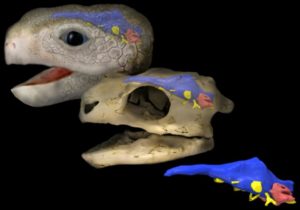
The image shows a reconstruction of Proganochelys (the oldest turtle with a complete shell) as it would have appeared in life. This reconstruction is based on a digital model of the fossil skull, which was scanned using computed tomography and is shown in the middle. Shown in the front is the digitally reconstructed brain of Proganochelys analyzed in the current study. Credit: Stephan Lautenschlager, University of Birmingham
A new study led by the University of Birmingham shows that the brain of turtles has evolved slowly, but constantly over the last 210 million years, eventually reaching a variety in form and complexity, which rivals that of other animal groups.
The study also discovered that the first turtles with a fully formed shell were very likely to be living on land and not in water or in an environment where they burrowed underground.
Turtles are one of the oldest vertebrate groups still alive today. Their origins date back nearly 250 million years, yet they have changed very little since then. Almost all fossil turtles looked very similar to modern turtles today and this probably enabled turtles to survive several mass extinctions.
An international team of scientists from the UK, Brazil and Germany used modern computer analysis to look at what happened to the turtle brain over this long period of evolution.
The team’s research, published today (1 February 2018) in the journal Frontiers in Ecology and Evolution, focussed on the fossils of the oldest turtle with a fully formed shell: Proganochelys quenstedti, found in the Triassic sediments (ca. 210 million years) of Germany. Using computed tomography scanning of two fossil skulls, the researchers generated digital models of the brain of Proganochelys and compared them to brain models of modern turtles.
Dr Stephan Lautenschlager, lead author from the University of Birmingham’s School of Geography, Earth and Environmental Sciences, said: ‘Our results demonstrate that Proganochelys, the oldest turtle with a real shell, had a very simple brain structure. Vision and hearing were probably not very good, while the sense of smell was moderately developed.’
Results of this study further showed that the turtle brain increased in size and complexity over the course of evolution to modern turtles. Modern turtles show a wide variety of brain shapes and sizes, which reflects their sensory capabilities and their life styles.
Co-author Dr Ingmar Werneburg from the Senckenberg and University Tübingen, Germany, added: ‘Over a period of 200 million years the brain of turtles became more complex, allowing them to adapt to different habits and living conditions. This is very important as we see similar diversifications in other animal groups such as mammals and birds.’
The team’s results further helped to clarify some mysteries of turtle origins. Different competing hypotheses exist as to whether turtles originated in an aquatic, terrestrial or even fossorial (digging underground) environment.
Gabriel Ferreira from the University of São Paulo, Brazil, who also co-authored the study, explained: ‘By comparing the digital brain reconstruction of Proganochelys with those of modern turtles we can show that the first turtles with a fully formed shell were very likely living on land and not in the water or in an fossorial environment. It was only later that they explored those different habitats.’
Reference:
Stephan Lautenschlager, Gabriel S. Ferreira and Ingmar Werneburg. Sensory evolution and ecology of early turtles revealed by digital endocranial reconstructions. Frontiers in Ecology and Evolution, 2018 DOI: 10.3389/fevo.2018.00007
New research shows that some 12,800 years ago, an astonishing 10 percent of the Earth’s land surface, or about 10 million square kilometers, was consumed by fires. Dryas Fires Credit: Pexels com
On a ho-hum day some 12,800 years ago, the Earth had emerged from another ice age. Things were warming up, and the glaciers had retreated.
Out of nowhere, the sky was lit with fireballs. This was followed by shock waves.
Fires rushed across the landscape, and dust clogged the sky, cutting off the sunlight. As the climate rapidly cooled, plants died, food sources were snuffed out, and the glaciers advanced again. Ocean currents shifted, setting the climate into a colder, almost “ice age” state that lasted an additional thousand years.
Finally, the climate began to warm again, and people again emerged into a world with fewer large animals and a human culture in North America that left behind completely different kinds of spear points.
This is the story supported by a massive study of geochemical and isotopic markers just published in the Journal of Geology.
The results are so massive that the study had to be split into two papers.
“Extraordinary Biomass-Burning Episode and Impact Winter Triggered by the Younger Dryas Cosmic Cosmic Impact ~12,800 Years Ago” is divided into “Part I: Ice Cores and Glaciers” and “Part 2: Lake, Marine, and Terrestrial Sediments.”
The paper’s 24 authors include KU Emeritus Professor of Physics & Astronomy Adrian Melott and Professor Brian Thomas, a 2005 doctoral graduate from KU, now at Washburn University.
“The work includes measurements made at more than 170 different sites across the world,” Melott said.
The KU researcher and his colleagues believe the data suggests the disaster was touched off when Earth collided with fragments of a disintegrating comet that was roughly 62 miles in diameter — the remnants of which persist within our solar system to this day.
“The hypothesis is that a large comet fragmented and the chunks impacted the Earth, causing this disaster,” said Melott. “A number of different chemical signatures — carbon dioxide, nitrate, ammonia and others — all seem to indicate that an astonishing 10 percent of the Earth’s land surface, or about 10 million square kilometers, was consumed by fires.”
According to Melott, analysis of pollen suggests pine forests were probably burned off to be replaced by poplar, which is a species that colonizes cleared areas.
Indeed, the authors posit the cosmic impact could have touched off the Younger Dryas cool episode, biomass burning, late Pleistocene extinctions of larger species and “human cultural shifts and population declines.”
“Computations suggest that the impact would have depleted the ozone layer, causing increases in skin cancer and other negative health effects,” Melott said. “The impact hypothesis is still a hypothesis, but this study provides a massive amount of evidence, which we argue can only be all explained by a major cosmic impact.”
References:
Wendy S. Wolbach, Joanne P. Ballard, Paul A. Mayewski, Victor Adedeji, Ted E. Bunch, Richard B. Firestone, Timothy A. French, George A. Howard, Isabel Israde-Alcántara, John R. Johnson, David Kimbel, Charles R. Kinzie, Andrei Kurbatov, Gunther Kletetschka, Malcolm A. LeCompte, William C. Mahaney, Adrian L. Melott, Abigail Maiorana-Boutilier, Siddhartha Mitra, Christopher R. Moore, William M. Napier, Jennifer Parlier, Kenneth B. Tankersley, Brian C. Thomas, James H. Wittke, Allen West, James P. Kennett. Extraordinary Biomass-Burning Episode and Impact Winter Triggered by the Younger Dryas Cosmic Impact ∼12,800 Years Ago. 1. Ice Cores and Glaciers. The Journal of Geology, 2018; 000 DOI: 10.1086/695703
Wendy S. Wolbach, Joanne P. Ballard, Paul A. Mayewski, Andrew C. Parnell, Niamh Cahill, Victor Adedeji, Ted E. Bunch, Gabriela Domínguez-Vázquez, Jon M. Erlandson, Richard B. Firestone, Timothy A. French, George Howard, Isabel Israde-Alcántara, John R. Johnson, David Kimbel, Charles R. Kinzie, Andrei Kurbatov, Gunther Kletetschka, Malcolm A. LeCompte, William C. Mahaney, Adrian L. Melott, Siddhartha Mitra, Abigail Maiorana-Boutilier, Christopher R. Moore, William M. Napier, Jennifer Parlier, Kenneth B. Tankersley, Brian C. Thomas, James H. Wittke, Allen West, James P. Kennett. Extraordinary Biomass-Burning Episode and Impact Winter Triggered by the Younger Dryas Cosmic Impact ∼12,800 Years Ago. 2. Lake, Marine, and Terrestrial Sediments. The Journal of Geology, 2018; 000 DOI: 10.1086/695704
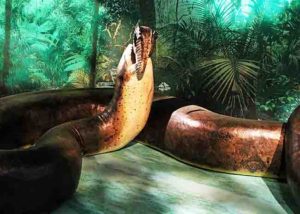
Life-sized model of Titanoboa devouring a dyrosaurid crocodyliform, from the Smithsonian exhibit. Credit: Ryan Quick, CC BY 2.0
Snakes are beautiful and bizarre animals. Limbless vertebrates, they have been around for more than 150 million years, and occupy almost every ecological role possible, including living under the sea!
Over geological time, they have come in all sorts of shapes and sizes (typically still sausage-ish shaped), and have a unique evolutionary history.
One particular group of snakes, Madtsoiidae, used to be widely distributed around the world back in the Cretaceous when the dinosaurs ruled. They are now extinct, with a range of around 100 million years, making them one of the longest lived lineages ever.
The first named madtsoiid was back in 1901, and called Gigantophis garstini. It was discovered from 40 million year old rocks in very, very ancient Egypt. From the name, you can probably tell that this was one hefty snake, bigger than an anaconda and making most modern species look like something you’d find in a pick n mix.
However, Gigantophis isn’t that well understood by scientists, and only 20 vertebra are known in total for the species. Previous research from the early 20th century only briefly figured and described the specimens, which have otherwise remained unstudied in the Egyptian Geological Museum in Cairo for more than a century.
Jonathan Rio and Phil Mannion (my old Ph.D. supervisor!) recently undertook the mammoth task of redescribing and analysing these vertebrae. They compared them to similar fossils from across North Africa and Pakistan, to see what they could learn about the mystery giant snake.
What they discovered is that other material that had been referred to this species from Pakistan was markedly different, and most likely a new species altogether. Instead, Gigantophis appears to have been confined to the late Eocene of North Africa.
By comparing the vertebrae to those of living snakes, they were able to estimate that Gigantophis was around 7 metres in length. When discovered, researchers thought that Gigantophis was the biggest of all snakes ever known, and an analysis in 2004 estimated that it could grow to around 10 meters in length!
However, in 2009, Titanoboa was discovered from the Paleocene of Colombia, which has since gained notorious fame for its immense slithery size, coming in at around 12-13 metres in length. Down the ladder Gigantophis went.
A new analysis of Gigantophis’ evolutionary relationships found that its closest relative was an Indian species called Madtsoia. Its scaly cousin was much older, living in the latest Cretaceous, before the great dinosaur extinction. This distinction in time and space suggests that during the Cretaceous, these strange snakes were much more widespread across the southern continents, although it is remains difficult to know exactly what happened. This is because the fossil record is notoriously bad at this time, and therefore we’re probably just not finding the fossils needed to help fill the gaps in the puzzle.
So, you know what to do. Next time you’re out exploring in SE Asia, South America, or Africa, keep an eye out for giant snake fossils!
Reference:
Jonathan P. Rio et al. The osteology of the giant snake Gigantophis garstini from the upper Eocene of North Africa and its bearing on the phylogenetic relationships and biogeography of Madtsoiidae, Journal of Vertebrate Paleontology (2017). DOI: 10.1080/02724634.2017.1347179
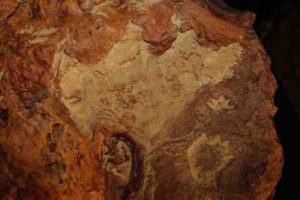
Detail view of a cast from the sandstone slab imprinted with more than 70 dinosaur and mammal tracks discovered at NASA’s Goddard Space Flight Center in Greenbelt, Maryland. Credit: NASA’s Goddard Space Flight Center/Rebecca Roth
A slab of sandstone discovered at NASA’s Goddard Space Flight Center contains at least 70 mammal and dinosaur tracks from more than 100 million years ago, according to a new paper published Jan. 31 in the journal Scientific Reports. The find provides a rare glimpse of mammals and dinosaurs interacting.
The tracks were discovered by Ray Stanford — a local dinosaur track expert whose wife, Sheila, works at Goddard. After dropping off Sheila at work one day in 2012, Stanford spotted an intriguing rock outcropping behind Shelia’s building on a hillside. Stanford parked his car, investigated, and found a 12-inch-wide dinosaur track on the exposed rock. Excavation revealed that the slab was the size of a dining room table and examination in the ensuing years found that it was covered in preserved tracks.
The remarkable Goddard specimen, about 8 feet by 3 feet in size, is imprinted with nearly 70 tracks from eight species, including squirrel-sized mammals and tank-sized dinosaurs. Analysis suggests that all of the tracks were likely made within a few days of each other at a location that might have been the edge of a wetland, and could even capture the footprints of predator and prey.
“The concentration of mammal tracks on this site is orders of magnitude higher than any other site in the world,” said Martin Lockley, paleontologist with the University of Colorado, Denver, a co-author on the new paper. Lockley began studying footprints in the 1980s, and was one of the first to do so. “I don’t think I’ve ever seen a slab this size, which is a couple of square meters, where you have over 70 footprints of so many different types. This is the mother lode of Cretaceous mammal tracks.”
After Stanford’s initial find, Stephen J. Godfrey, curator of paleontology at the Calvert Marine Museum, coordinated the excavation of the slab and produced the mold and cast that formed the basis of the scientific work.
The first track Stanford found was of a nodosaur — “think of them as a four-footed tank,” Stanford said. Subsequent examination revealed a baby nodosaur print beside and within the adult print, likely indicating that they were traveling together. The other dinosaur tracks include: a sauropod, or long-necked plant-eater; small theropods, crow-sized carnivorous dinosaurs closely related to the Velociraptor and Tyrannosaurus rex; and pterosaurs, a group of flying reptiles that included pterodactyls.
“It’s a time machine,” Stanford said. “We can look across a few days of activity of these animals and we can picture it. We see the interaction of how they pass in relation to each other. This enables us to look deeply into ancient times on Earth. It’s just tremendously exciting.”
The dinosaur tracks are impressive, but it is the collection of mammal tracks that make the slab significant. At least 26 mammal tracks have been identified on the slab since the 2012 discovery — making it one of two known sites in the world with such a concentration of prints. Furthermore, the slab also contains the largest mammal track ever discovered from the Cretaceous. It is about four inches square, or the size of a raccoon’s prints.
Lockley and Stanford said most of these ancient footprints belong to what we would consider small mammals — animals the size of squirrels or prairie dogs. Most Cretaceous mammals discovered to date have been the size of rodents, their size usually determined only from their teeth. “When you have only teeth, you have no idea what the animals looked like or how they behaved,” Lockley said.
Lockley and Stanford believe the wide diversity and number of tracks show many of the animals were in the area actively feeding at the same time. Perhaps the mammals were feeding on worms and grubs, the small carnivorous dinosaurs were after the mammals, and the pterosaurs could have been hunting both the mammals and the small dinosaurs.
The parallel trackway patterns made by four crow-sized carnivorous dinosaurs suggests they were hunting or foraging as a group. “It looks as if they were making a sweep across the area,” Lockley said.
Several of the mammal tracks occur in pairs, representing hind feet. “It looks as if these squirrel-sized animals paused to sit on their haunches,” Lockley said. The team gave the new formal scientific name of Sederipes goddardensis, meaning sitting traces from Goddard Space Flight Center, to this unusual configuration of tracks.
“We do not see overlapping tracks — overlapping tracks would occur if multiple tracks were made over a longer period while the sand was wet,” said Compton Tucker, a Goddard Earth scientist who helped with the excavation, coordinated bringing in multiple scientists to study the tracks, and has worked to create a display of the cast in Goddard’s Earth science building. “People ask me, ‘Why were all these tracks in Maryland?’ I reply that Maryland has always been a desirable place to live.”
What is now Maryland would have been a much hotter, swampier place in the Cretaceous, when sea levels would have been hundreds of feet higher than today. As scientists continue to study the slab and compare the tracks to others found in the area and around the world, they will continue to discover more about prehistoric life that existed here.
“This could be the key to understanding some of the smaller finds from the area, so it brings everything together,” Lockley said. “This is the Cretaceous equivalent of the Rosetta stone.”
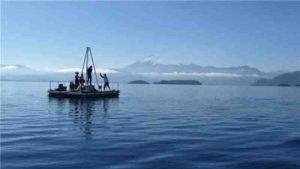
Researchers taking sediment cores on Chilean lake Calafquén (with Villarrica Volcano in the background). Credit: Maarten Van Daele
By analyzing sediment cores from Chilean lakes, an international team of scientists discovered that giant earthquakes reoccur with relatively regular intervals. When also taking into account smaller earthquakes, the repeat interval becomes increasingly more irregular to a level where earthquakes happen randomly in time.
“In 1960, South-Central Chile was hit by the largest known quake on earth with a magnitude of 9.5. Its tsunami was so massive that -in addition to inundating the Chilean coastline- it travelled across the Pacific Ocean and even killed about 200 persons in Japan,” says Jasper Moernaut, an assistant professor at the University of Innsbruck, Austria, and lead author of the study. “Understanding when and where such devastating giant earthquakes may occur in the future is a crucial task for the geoscientific community.”
It is generally believed that giant earthquakes release so much energy that several centuries of stress accumulation are needed to produce a new big one. Therefore, seismological data or historical documents simply do not go back far enough in time to reveal the patterns of their recurrence. “It is an ongoing topic of very vivid debate whether we should model large earthquake recurrence as a quasi-regular or random process in time. Of course, the model choice has very large repercussions on how we evaluate the actual seismic hazard in Chile for the coming decades to centuries.”
In their recent paper in Earth and Planetary Science Letters, Moernaut`s team of Belgian, Chilean and Swiss researchers presented a new approach to tackle the problem of large earthquake recurrence. By analyzing sediments on the bottom of two Chilean lakes, they recognized that each strong earthquake produces underwater landslides which get preserved in the sedimentary layers accumulating on the lake floor. By sampling these layers in up to 8 m long sediment cores, they retrieved the complete earthquake history over the last 5000 years, including up to 35 great earthquakes of a magnitude larger than 7.7.
“What is truly exceptional is the fact that in one lake the underwater landslides only happen during the strongest shaking events (like a M9 earthquake), whereas the other lake also reacted to “smaller” M8 earthquakes,” says Maarten Van Daele from Ghent University, Belgium. “In this way we were able to compare the patterns in which earthquakes of different magnitudes take place. We did not have to guess which model is the best, we could just derive it from our data.”
With this approach, the team found that giant earthquakes (like the one in 1960) reoccur every 292 ±93 years and thus the probability for such giant events remains very low in the next 50-100 years. However, the “smaller” (~M8) earthquakes took place every 139 ±69 years and there is a 29.5% chance that such an event may occur in the next 50 years. Since 1960, the area has been seismically very quiet, but a recent M7.6 earthquake (on 25 DEC 2016) near Chiloé Island suggests a reawakening of great earthquakes in South-Central Chile.
“These Chilean lakes form a fantastic opportunity to study earthquake recurrence,” says Moernaut. “Glacial erosion during the last Ice Age resulted in a chain of large and deep lakes above the subduction zone, where the most powerful earthquakes are getting generated. We hope to extend our approach along South America, which may allow us to discover whether e.g. earthquakes always rupture in the same segments, or whether other areas in the country are capable of producing giant M9+ earthquakes.”
“In the meanwhile, we already initiated similar studies on Alaskan, Sumatran and Japanese lakes,” says Marc De Batist from Ghent University. “We are looking forward to some exciting comparisons between the data from these settings, and see if the Chilean patterns hold for other areas that have experienced giant M9+ earthquakes in the past.”
Reference:
J. Moernaut, M. Van Daele, K. Fontijn, K. Heirman, P. Kempf, M. Pino, G. Valdebenito, R. Urrutia, M. Strasser, M. De Batist. Larger earthquakes recur more periodically: New insights in the megathrust earthquake cycle from lacustrine turbidite records in south-central Chile. Earth and Planetary Science Letters, 2018; 481: 9 DOI: 10.1016/j.epsl.2017.10.016
New research backing claims that the Earth experienced a ‘geological lull’ in its development around 2.3 to 2.2 billion years ago has just been released by Curtin University.
Published today in Nature Geoscience, the research is likely to re-ignite debate over the Earth’s development, with scientists divided over what geologic processes occurred during the Palaeoproterozoic geologic era.
Lead researcher Dr. Christopher Spencer from the School of Earth and Planetary Sciences at Curtin University said the research findings point to a near complete shutdown of continental magmatism during this period, and has profoundly shaped the geologic record as we know it today.
“Our research shows a bona fide gap in the Palaeoproterozoioc geologic record, with not only a slowing down of the number of volcanoes erupting during this time, but also a slow-down in sedimentation and a noticeable lull in tectonic plate movement,” Dr. Spencer said.
“The early Paleoproterozoic was a significant time in Earth history. It was at this time when the atmosphere got its first whiff of oxygen and also the first global glaciation event. But this was also a period where other geologic processes effectively shut down. It’s almost as if the Earth experienced a mid-life crisis.”
The research involved compiling massive amounts of existing geological data as well as examination of rocks collected in Western Australia’s Stirling Ranges, China, Northern Canada and Southern Africa.
“The more rocks and data we collected the clearer it is that there is very little preserved record for this period,” Dr. Spencer said.
“Earth’s mantle used to be much hotter than it is today and over time volcanoes allowed the mantle to cool and geologic processes are thought to have slowed down. We believe this continual slowdown led to dramatic geological changes such as those seen in the early Paleoproterozoic.
“This ‘dormant’ period lasted around 100 million years and signalled what we believe was a shift from ‘ancient-style’ tectonics to ‘modern-style’ tectonics more akin to those operating in the present day. Following this dormant period Earth’s geology started to ‘wake-up’ again around 2.2 to 2.0 billion years ago with a ‘flare-up’ of volcanic activity and a shift in the composition of the continental crust.”
Dr. Spencer believes these findings could provide greater insight into our understanding of the world’s natural resources and where they exist, and has suggested more research is now needed into this time period to better determine how the earth’s geological processes were impacted.
The full research paper has been published in Nature Geoscience.
Reference:
Christopher J. Spencer et al. A Palaeoproterozoic tectono-magmatic lull as a potential trigger for the supercontinent cycle, Nature Geoscience (2018). DOI: 10.1038/s41561-017-0051-y
Professor Tamsin Mather, a volcanologist in Oxford’s Department of Earth Sciences reflects on her many fieldwork experiences at Massaya volcano in Nicaragua, and what she has learned about how they effect the lives of the people who live around them.
Over the years, fieldwork at Masaya volcano in Nicaragua, has revealed many secrets about how volcanic plumes work and impact the environment, both in the here and now and deep into the geological past of our planet.
Working in this environment has also generated many memories and stories for me personally. From watching colleagues descend into the crater, to meeting bandits at dawn, or driving soldiers and their rifles across the country, or losing a remotely controlled miniature airship in Nicaraguan airspace and becoming acquainted with Ron and Victoria (the local beverages), to name but a few.
I first went to Masaya volcano in Nicaragua in 2001. In fact, it was the first volcano that I worked on for my Ph.D. It is not a spectacular volcano. It does not have the iconic conical shape or indeed size of some of its neighbours in Nicaragua. Mighty Momotombo, just 35 km away, seems to define (well, to me) the capital Managua’s skyline. By comparison, Masaya is a relative footnote on the landscape, reaching just over 600 m in elevation. Nonetheless it is to Masaya that myself and other volcanologists flock to work, as it offers a rare natural laboratory to study volcanic processes. Everyday of the year Masaya pumps great quantities of volcanic gases (a noxious cocktail including acidic gases like sulphur dioxide and hydrogen chloride) from its magma interior into the Nicaraguan atmosphere. Furthermore, with the right permissions and safety equipment, you can drive a car directly into this gas plume easily bringing heavy equipment to make measurements. I have heard it described by colleagues as a ‘drive-through’ volcano and while this is not a term I like, as someone who once lugged heavy equipment up 5500 m high Lascar in Chile, I can certainly vouch for its appeal.
Returning for my fifth visit in December 2017 (six years since my last) was like meeting up with an old friend again. There were many familiar sights and sounds: the view of Mombacho volcano from Masaya’s crater rim, the sound of the parakeets returning to the crater at dusk, the pungent smell of the plume that clings to your clothes for days, my favourite view of Momotombo from the main Managua-Masaya road, Mi Viejo Ranchito restaurant – I could go on.
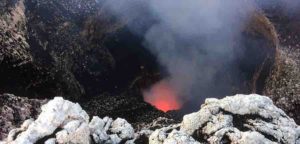
But, as with old friends, there were many changes too. Although in the past I could often hear the magma roaring as it moved under the surface, down the vents, since late 2015 a combination of rock falls and rising lava levels have created a small lava lake visibly churning inside the volcanic crater. This is spectacular in the daytime, but at night the menacing crater glow is mesmerising and the national park is now open to a stream of tourists visiting after dark. Previously, I would scour the ground around the crater for a few glassy fibres and beads of the fresh lava, forced out as bubbles burst from the lava lake (known as Pele’s hairs and tears after the Hawaiian goddess of the volcano – not the footballer) to bring back to analyse. Now the crater edge downwind of the active vent is carpeted with them, and you leave footprints as if it were snow. New instruments and a viewing platform with a webcam have been put in, in place of the crumbling concrete posts where I used to duct-tape up my equipment.
This time my mission at Masaya was also rather different. Before I had been accompanied solely by scientists but this time I was part of an interdisciplinary team including medics, anthropologists, historians, hazard experts and visual artists. All aligned in the shared aim of studying the impacts of the volcanic gases on the lives and livelihoods of the downwind communities and working with the local agencies to communicate these hazards. Masaya’s high and persistent gas flux, low altitude and ridges of higher ground, downwind of it, mean that these impacts are felt particularly acutely at this volcano. For example, at El Panama, just 3 km from the volcano, which is often noticeably fumigated by the plume, they cannot use nails to fix the roofs of their houses, as they rust too quickly in the volcanic gases.
The team was drawn from Nicaragua, the UK and also Iceland, sharing knowledge between volcano-affected nations. Other members of the team had been there over the previous 12 months, installing air quality monitoring networks, sampling rain and drinking water, interviewing the local people, making a short film telling the people’s stories and scouring the archives for records of the effects of previous volcanic degassing crises at Masaya. Although my expertise was deployed for several days installing new monitoring equipment (the El Crucero Canal 6 transmitter station became our rather unlikely office for part of the week), the main mission of this week was to discuss our results and future plans with the local officials and the communities affected by the plume.
Having worked at Masaya numerous times, mainly for more esoteric scientific reasons, spending time presenting the very human implications of our findings to the local agencies, charged with monitoring the Nicaraguan environment and hazards, as well managing disasters was a privilege. With their help we ran an information evening in El Panama. This involved squeezing 150 people into the tiny school class room in flickering electric light, rigging up the largest TV I have ever seen from the back of a pick-up and transporting 150 chicken dinners from the nearest fried chicken place! But it also meant watching the community see the film about their lives for the first time, meeting the local ‘stars’ of this film and presenting our work where we took their accounts of how the plume behaves and affects their lives and used our measurements to bring them the science behind their own knowledge.
Watching the film it was also striking to us that for so many of this community it was the first time they had seen the lava lake whose effects they feel daily. Outside the school house there were Pele’s hair on the ground in the playground and whiffs of volcanic gas as the sun set – the volcano was certainly present. However, particularly watching the film back now sitting at home in the UK, I feel that with this trip, unlike my others before, it is the people of El Panama that get the last word rather than the volcano.
Senckenberg scientist Hervé Bocherens has studied the extinction of mega-herbivores — plant-eating animals that weighed more than one ton — that occurred approx. 12,000 years ago. The scientist from Tübingen reached the conclusion that, on the one hand, modern man was the cause of these giant terrestrial animals’ extinction, and on the other hand, humans took over part of the animals’ ecosystem functions. In his study, recently published in the scientific journal “Frontiers in Ecology and Evolution,” he concludes that the reintroduction of large animals in certain parts of the world could have a positive effect in regard to species diversity.
Today, there are only few animals that weigh in at a ton or more. Elephants, hippopotamuses and rhinoceroses are among these “mega-herbivores,” and despite their large size, their populations are endangered. “Under geological aspects, the small number of so few large animal species presents an anomaly,” explains Professor Dr. Hervé Bocherens of the Senckenberg Center for Human Evolution and Palaeoenvironment at the University of Tübingen, and he continues, “The most prominent example of prehistoric giants is, of course, the dinosaurs.”
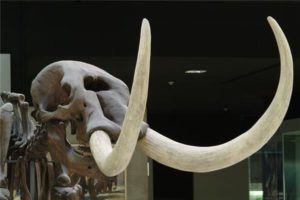
But the more recent geological history also included colossal animals such as the giant sloths, woolly rhinoceroses, and mammoths. The biogeologist from Tübingen now examined the reasons for these animals’ extinction around 12,000 years ago and its consequences for the environment.
“Like modern-day elephants, these mega-herbivores acted as ‘ecosystem engineers.’ They reduced the tree cover and kept open the landscape and the watering holes that are of vital importance for many animals. Plant seeds were transported over many kilometers in the animals’ digestive tract, thus aiding in their distribution,” explains Bocherens.
In his recent study, he shows that these tasks were taken over in part by modern humans in the period between 45,000 and 12,000 years ago. “During this epoch, modern man spread across northern Eurasia, North and South America and Australia, and the giant herbivores gradually became extinct,” adds Bocherens.
With the “Neolithic revolution,” the rise of agriculture and animal husbandry, the keeping of stores and a sessile lifestyle, the functions of the extinct “ecosystem engineers” were partially replaced. But in certain areas, such as the agriculturally ill-suited Subarctic — once home to the mammoth steppe — there remained a gap in this respect that continues until today. The lifestyle of these giant animals impacted the entire vegetation — trees were kept small and other plants had sufficient room and nutrients for their growth. The diversity of the flora, in turn, had a positive effect on the faunal diversity.
Following the extinction of the giant herbivores, the steppes turned into boreal coniferous forests. This led to a reduction of the so-called “albedo effect”: Instead of a white layer of snow in the winter or a yellow landscape with dry grasses in the summer, the forests’ dark green color reflects less solar radiation, leading to a warming of the climate. Moreover, the soils of the mammoth steppe were drier and emitted less of the greenhouse gas methane. Bocherens comments, “The presence of giant herbivores thus not only contributed to a higher species diversity, it also had an effect on the global climate.”
According to the study, a better understanding of the differences as well as the similarities between the effects of the extinct mega-herbivores and the human landscape on the ecosystems may aid in better predicting the future of terrestrial ecosystems. “In some areas of the world, it may even make sense to reintroduce such mega-herbivores in order to increase biodiversity, thereby avoiding global warming,” adds Bocherens in summary.
Reference:
Hervé Bocherens. The Rise of the Anthroposphere since 50,000 Years: An Ecological Replacement of Megaherbivores by Humans in Terrestrial Ecosystems? Frontiers in Ecology and Evolution, 2018; 6 DOI: 10.3389/fevo.2018.00003
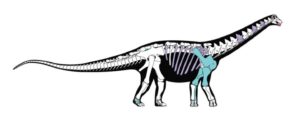
Skeletal reconstruction of the new titanosaurian dinosaur Mansourasaurus shahinae from the Late Cretaceous of the Dakhla Oasis, Egypt. Bones shown in color are those that are preserved in the original fossil; other bones are based on those of closely related dinosaurs. Credit: Andrew McAfee, Carnegie Museum of Natural History
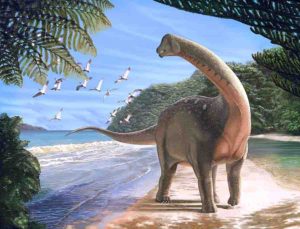
When it comes to the final days of the dinosaurs, Africa is something of a blank page. Fossils found in Africa from the Late Cretaceous, the time period from 100 to 66 million years ago, are few and far between. That means that the course of dinosaur evolution in Africa has largely remained a mystery. But in the Sahara Desert of Egypt, scientists have discovered a new species of dinosaur that helps fill in those gaps: Mansourasaurus shahinae, a school-bus-length, long-necked plant-eater with bony plates embedded in its skin.
The fossilized remains of Mansourasaurus were unearthed by an expedition undertaken by the Mansoura University Vertebrate Paleontology (MUVP) initiative, an effort led by Dr. Hesham Sallam of the Department of Geology at Mansoura University in Mansoura, Egypt. Sallam is the lead author of the paper published today in the journal Nature Ecology and Evolution that names the new species. The field team included several of his students, many of whom — Ms. Iman El-Dawoudi, Ms. Sanaa El-Sayed, and Mrs. Sara Saber — also participated in the study of the new dinosaur. The creature’s name honors both Mansoura University and Ms. Mona Shahin for her integral role in developing the MUVP. According to Sallam, “The discovery and extraction of Mansourasaurus was such an amazing experience for the MUVP team. It was thrilling for my students to uncover bone after bone, as each new element we recovered helped to reveal who this giant dinosaur was.”
“Mansourasaurus shahinae is a key new dinosaur species, and a critical discovery for Egyptian and African paleontology,” says Dr. Eric Gorscak, a postdoctoral research scientist at The Field Museum and a contributing author on the study. Gorscak, who began work on the project as a doctoral student at Ohio University, where his research focused on African dinosaurs, adds, “Africa remains a giant question mark in terms of land-dwelling animals at the end of the Age of Dinosaurs. Mansourasaurus helps us address longstanding questions about Africa’s fossil record and paleobiology — what animals were living there, and to what other species were these animals most closely related?”
Late Cretaceous dinosaur fossils in Africa are hard to come by — much of the land where their fossils might be found is covered in lush vegetation, rather than the exposed rock of dinosaur treasure troves such as those in the Rocky Mountain region, the Gobi Desert, or Patagonia. The lack of a Late Cretaceous fossil record in Africa is frustrating for paleontologists since, at that time, the continents were undergoing massive geological and geographic changes.
During the earlier years of the dinosaurs, throughout much of the Triassic and Jurassic periods, all the continents were joined together as the supercontinent of Pangaea. During the Cretaceous Period, however, the continents began splitting apart and shifting towards the configuration we see today. Historically, it hasn’t been clear how well-connected Africa was to other Southern Hemisphere landmasses and Europe during this time — to what degree Africa’s animals may have been cut off from their neighbors and evolving on their own separate tracks. Mansourasaurus, as one of the few African dinosaurs known from this time period, helps to answer that question. By analyzing features of its bones, Sallam and his team determined that Mansourasaurus is more closely related to dinosaurs from Europe and Asia than it is to those found farther south in Africa or in South America. This, in turn, shows that at least some dinosaurs could move between Africa and Europe near the end of these animals’ reign. “Africa’s last dinosaurs weren’t completely isolated, contrary to what some have proposed in the past,” says Gorscak. “There were still connections to Europe.”
Mansourasaurus belongs to the Titanosauria, a group of sauropods (long-necked plant-eating dinosaurs) that were common throughout much of the world during the Cretaceous. Titanosaurs are famous for including the largest land animals known to science, such as Argentinosaurus, Dreadnoughtus, and Patagotitan. Mansourasaurus, however, was moderate-sized for a titanosaur, roughly the weight of an African bull elephant. Its skeleton is important in being the most complete dinosaur specimen so far discovered from the end of the Cretaceous in Africa, preserving parts of the skull, the lower jaw, neck and back vertebrae, ribs, most of the shoulder and forelimb, part of the hind foot, and pieces of dermal plates. Says study coauthor and dinosaur paleontologist Dr. Matt Lamanna of Carnegie Museum of Natural History, “When I first saw pics of the fossils, my jaw hit the floor. This was the Holy Grail — a well-preserved dinosaur from the end of the Age of Dinosaurs in Africa — that we paleontologists had been searching for for a long, long time.”
Also contributing to the Mansourasaurus research were experts on African paleontology from other institutions in Egypt and the US. MUVP student Iman El-Dawoudi played a particularly important role in the analysis of the new titanosaur, making numerous observations on its skeleton. “The combined effort of multiple institutions across the globe, not to mention the absolutely key role played by students on the project from the field, to the laboratory, to the final analysis and writeup of the results, exemplifies the collaborative nature of expeditionary sciences today,” notes Dr. Patrick O’Connor, study coauthor and professor of anatomy at the Ohio University Heritage College of Osteopathic Medicine.
Funding for the Mansourasaurus study was provided by grants from Mansoura University, the Jurassic Foundation, the Leakey Foundation, the National Geographic Society/Waitt Foundation, and the National Science Foundation (NSF).
“The discovery of rare fossils like this sauropod dinosaur helps us understand how creatures moved across continents, and gives us a greater understanding of the evolutionary history of organisms in this region,” says Dena Smith, a program director in NSF’s Division of Earth Sciences, which partially funded the laboratory portion of the research.
Scientific discoveries are often compared to finding the last missing puzzle piece to complete a picture; Gorscak says that since so little is known about African dinosaurs, Mansourasaurus is better likened to an earlier step in the puzzle-solving process. “It’s like finding an edge piece that you use to help figure out what the picture is, that you can build from. Maybe even a corner piece.”
“What’s exciting is that our team is just getting started. Now that we have a group of well-trained vertebrate paleontologists here in Egypt, with easy access to important fossil sites, we expect the pace of discovery to accelerate in the years to come,” says Sallam.
Reference:
Hesham M. Sallam, Eric Gorscak, Patrick M. O’Connor, Iman A. El-Dawoudi, Sanaa El-Sayed, Sara Saber, Mahmoud A. Kora, Joseph J. W. Sertich, Erik R. Seiffert, Matthew C. Lamanna. New Egyptian sauropod reveals Late Cretaceous dinosaur dispersal between Europe and Africa. Nature Ecology & Evolution, 2018; DOI: 10.1038/s41559-017-0455-5
Note: The above post is reprinted from materials provided by Ohio University.
The story of the Mansourasaurus discovery began in December of 2013, when I received an invitation to give a talk about vertebrate paleontology at New Valley University in Kharga Oasis in southern Egypt. To get there I drove 12 hours with my graduate students from Mansoura University, Sanaa El-Sayed and Iman El-Dawoudi, who had just graduated and were eager to reach out to other Egyptian students about fossil vertebrates. On the way there we also picked up my third student, Sara Saber, from Assiut University. After the talk, we drove out to quickly have a closer look at the dinosaur-bearing rock exposures around Dakhla Oasis that I had been working in since 2008, with American colleagues from Ohio University, the University of Southern California, and the Denver Museum of Nature and Science. Our project aims to fill a ~30 million year gap in the Late Cretaceous fossil record of Africa, from which very few fossils of land-living vertebrates are known.
As the sun was going down, I noticed a new road that could give us a view of some unexplored exposures, so the next morning we drove all the way to its end and found a gravel quarry. We had only half an hour to look at the rocks before the long drive back to Mansoura. Sara and I walked in the same direction, while the others headed off in different directions to cover as much ground as possible. Only a few minutes later, I looked over my shoulder to see that Sara was brushing something, which I assumed was probably a rock. I kept walking and a few minutes later my cell phone rang. It was Sara. I picked up the phone to hear her excitedly telling me to please come back, because there were fossil bones all over the place. I quickly returned to find that the area was indeed full of bones… the remains of an associated partial skeleton of a sauropod dinosaur. I noticed my footprints all over the site, and joked with Sara, saying “by the way, I saw it first but left it for you as a test.” She replied quickly, saying “no, professor, you stepped all over the bones!,” and we had a good laugh. It was one of those wonderful moments in paleontology when you know that something really important has just been discovered.
I knew that we needed at least two weeks of fieldwork to properly excavate the skeleton, so we made the difficult decision to come back later and better prepared. Leaving such an important discovery behind made everyone incredibly anxious, because all of the bulldozers moving through the area could destroy the fossils in an instant. After two long months of preparation, we returned to the site with Sanaa, Iman, Sara, and two of my other colleagues, Mai El-Amir and Farahat Ibrahim. The excavation was difficult as the area is extremely hot, and we were hit with sandstorms and even pouring rain, but our enthusiasm kept us going, as we knew that we were writing a new chapter in the history of Egyptian vertebrate paleontology. Every evening, we went to the highest point in the area to get access to the Internet to learn more about dinosaur anatomy. On the third day we found the most diagnostic bone, the left dentary, from which it was clear that the lower jaw of this sauropod had a pronounced ‘chin.’ We were in close contact with our friends and colleagues in Egypt and the U.S.A., who were following the action daily. As time passed it became clear that we had skull bones, much of the shoulder girdle and forelimb, multiple vertebrae and ribs, part of the foot, and pieces of several dermal plates – more than was known for any dinosaur of this age from the entire African continent. While chatting with my American colleague Joe Sertich, he suggested the name Mansourasaurus, and it stuck.
We ended up working at the site for three weeks, and by the time we were finished we had made 19 plaster jackets and collected loads of isolated bone fragments. When we returned to Mansoura, we brought the jackets to be CT scanned at the university hospital. Never having seen plaster jackets in the hospital before, some of the staff stopped us and asked what we were pushing around on a gurney. I told them it was a dinosaur. They were astonished! One man asked if it was sick… to which I replied that it had been dead for at least 75 million years!
As time went on we would regularly meet up with our American colleagues over Skype, particularly the sauropod experts Eric Gorscak of Ohio University and later The Field Museum, Matt Lamanna of the Carnegie Museum, and Patrick O’Connor of Ohio University. Slowly the picture started to come together of just what we were dealing with. I think most of us initially expected Mansourasaurus to have been a member of a very ancient African lineage, given that continent’s hypothesized isolation during the Cretaceous, but it turned out that its closest affinities were instead with European sauropods, providing some of the first compelling evidence for the movement of dinosaurs between Africa and Europe in the later part of the Cretaceous. A find like this shows how little we still know about the Late Cretaceous of Africa, and has motivated us all to keep up the search for new fossils in Egypt.
Note: The above post is reprinted from materials provided by Nature. The original article was written by Hesham Sallam.
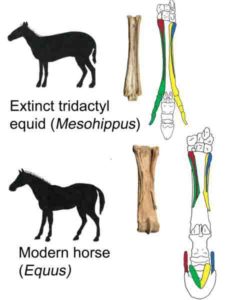
Silhouettes show Mesohippus primigenium, an early ancestor of the modern horse that lived 40 million years ago and was previously believed to have three toes, and the modern horse. Photographs of both animals’ hand bones appear alongside renderings of the researchers’ proposed digit identities. The researchers argue that missing digits one and five are partially expressed on the surfaces of the side toes (shown in red/blue). While the horse is described as being monodactyl, with only one complete digit, the researchers demonstrate that digits two and four are expressed as the splint bones and frog (padding of the foot), as shown in yellow/green. Missing digits one and five are expressed as ridges on the splint bones and as the hoof cartilages, as shown in the lower red/blue areas. Credit: NYITCOM
Scientists have long wondered how the horse evolved from an ancestor with five toes to the animal we know today. While it is largely believed that horses simply evolved with fewer digits, researchers at New York Institute of Technology College of Osteopathic Medicine (NYITCOM) pose a new theory that suggests remnants of all five toes are still present within the hooves of the horse.
Humans and horses are descendants of a common ancestor with five digits. As horses evolved to live on open grassland their anatomy required a more compact design to enable movement across the hard plains. Until now, scientists believed horses adapted to these conditions by gradually evolving with fewer digits than its five-toed ancestor, with the first horse retaining only four digits, its later descendant reduced to three, and today’s horse retaining just the central digit known as the metacarpal, the long bone above the hoof.
For the first time, as published in the January 24 issue of Royal Society Open Science, NYITCOM researcher, Nikos Solounias, Ph.D., paleontologist and anatomy professor, and a team of researchers propose that the reduction in the number of digits is not a matter of simple attrition; instead, they believe that all five digits have merged to form the compacted forelimbs with hooves that we know today.
Currently, scientists accept that splints, small bones found along the outer sides of the metacarpal in modern horses, are partially formed remnants of second and fourth digits. Tapering mid-way down the metacarpal, these fragments were inherited from an earlier ancestor, but ceased to develop into fully formed digits in modern horses. While the NYITCOM researchers note that this explanation of the second and fourth digits is viable, they argue that it is incomplete and fails to account for the animal’s first and fifth digits. Arguing that the horse is not truly monodactyl, that is, one-toed, these researchers contend that fragments of the “missing” digits can be found in the form of ridges on the backside of the splints. According to the researchers, this demonstrates that the first and fifth digits were not simply lost to evolution, but attached to their neighboring second and fourth digits.
“With a distinct surface from the metacarpal, we know the splints on today’s horses to be the remnants of the second and fourth digits,” said Solounias. “However, these partially formed digits also appear to contain their own elevated surfaces which hold additional evolutionary clues. We find these ridges, located on the posterior of each splint, to be the partially formed remains of the first and fifth digits, which were once connected to the cartilages of the hoof.”
Solounias first considered this theory in 1999 while studying fossil evidence from an eight-million-year-old horse known as Hipparion primigenium. The famous Laetoli footprints in Tanzania demonstrate Hipparion walked alongside early humans, and was believed to have had three digits. However, Solounias noticed that the bottom surface of Hipparion’s fossilized forelimb appeared to be divided in five sections, as though small toes had bonded together. After further studying images of the Laetoli footprints, he confirmed his finding in several of the impressions, and considered that Hipparion not only had five compacted toes, but likely passed this trait on to its descendants.
“Interestingly, we not only find hints of the missing digits on the modern horse, but also its ancestors, such as Hipparion and Mesohippus, two species believed to have three toes,” said Solounias.
Melinda Danowitz, D.O., a recent NYITCOM graduate and Solounias’ co-investigator in the study added, “While the horse’s lineage is classically described as having evolved from four to three toes, and eventually one single toe, we show that its extinct ancestors exhibit the reduced toes both at the wrist and at the hoof. These findings show that today’s horse is not truly monodactyl, and earlier ancestors were not in fact tridactyl or tetradactyl, that is, three-toed or four-toed.”
The researchers have also discovered neurovascular evidence in support of the five-digit theory, with dissections of modern equine fetus forelimbs revealing a greater number of arteries and nerves than would be expected in a single digit.
“If today’s horse does indeed have one digit per forelimb, we would expect each forelimb to have a total of two veins, two arteries, and two nerve bundles,” said Danowitz. “However, our dissections found between five and seven neurovascular bundles per forelimb, suggesting that additional toes begin to develop, but do not become fully differentiated.”
Reference:
Nikos Solounias, Melinda Danowitz, Elizabeth Stachtiaris, Abhilasha Khurana, Marwan Araim, Marc Sayegh, Jessica Natale. The evolution and anatomy of the horse manus with an emphasis on digit reduction. Royal Society Open Science, 2018; 5 (1): 171782 DOI: 10.1098/rsos.171782
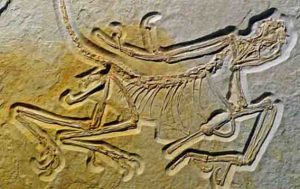
The geologically oldest, but most recently discovered specimen of Archaeopteryx. Credit: O. Rauhut, LMU
Researchers from Ludwig-Maximilians-Universitaet (LMU) in Munich report the first description of the geologically oldest fossil securely attributable to the genus Archaeopteryx, and provide a new diagnostic key for differentiating bird-like dinosaurs from their closest relatives.
Some 150 million years ago in what is now Northern Bavaria, Archaeopteryx — the oldest bird species yet discovered — inhabited a subtropical environment characterized by reef islands and lagoons set in a shallow sea that was part of the primordial Mediterranean. All the specimens of Archaeopteryx so far recovered were found in the valley of the Altmühl River, in geological settings that represent this habitat — the Jurassic Solnhofen Archipelago. The latest find was made there in 2010, and this new specimen has now been analyzed by a team of researchers led by LMU paleontologist Oliver Rauhut, a professor in the Department of Earth and Environmental Sciences who is also affiliated with the Bavarian State Collections for Paleontology and Geology in Munich. Stratigraphic analysis of the find locality reveals that the fossil is the oldest known representative of the genus Archaeopteryx.
“Specimens of Archaeopteryx are now known from three distinct rock units, which together cover a period of approximately 1 million years,” Rauhut explains. Notably, the oldest example exhibits features that were so far not known from the other specimens. “Among other things, they reveal that Archaeopteryx was very similar to advanced predatory dinosaurs in many respects,” says Rauhut. Moreover, in the new study, he and his colleagues provide a diagnosis that allows to reliably distinguish Archaeopteryx from its closest relatives, both non-avialan theropod dinosaurs and basal birds. This key will be very valuable, as a whole series of bird-like predatory dinosaurs has been described in recent years, mainly from China, which has greatly complicated the taxonomical classification of the group.
The new specimen is the 12th fossil to be attributed to the genus. However, in a study published in the online journal BMC Evolutionary Biology last year, Rauhut’s group reported that the first of these to come to light — the so-called Haarlem specimen discovered in 1861 — does not actually belong to the group. This result thus reduces the number of Archaeopteryx fossils to 11, although some doubts remain concerning the assignment of two of these. This underlines the necessity for a diagnosis to clearly identify Archaeopteryx.
Moreover, the investigation of the 11th specimen demonstrates that the known specimens span a remarkable range of anatomical variation. Potential explanations for the broad spectrum of variation extend from intraspecific developmental polymorphism to evolutionary differentiation, i.e., the possibility that the fossil material so far recovered represents more than one species. “The high degree of variation in the teeth is particularly striking — none of the specimens shows the same pattern of dentition as any other, which could reflect differences in diet,” Rauhut points out. “This is very reminiscent of the famous case of Darwin’s finches on the Galapagos, which show remarkable variation in their beak shapes. It is even conceivable that this primeval bird genus might, in a similar fashion, have diversified into several specialized forms on the islands of the Solnhofener Archipelago. In that case, the Archaeopteryx fossils could represent a species flock, a Jurassic analog of Darwin’s finches.”
Reference:
Oliver W.M. Rauhut, Christian Foth, Helmut Tischlinger. The oldest Archaeopteryx (Theropoda: Avialiae): a new specimen from the Kimmeridgian/Tithonian boundary of Schamhaupten, Bavaria. PeerJ, 2018; 6: e4191 DOI: 10.7717/peerj.4191
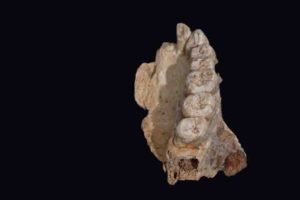
This is the left hemi-maxilla with teeth. Credit: Rolf Quam
A large international research team, led by Israel Hershkovitz from Tel Aviv University and including Rolf Quam from Binghamton University, State University of New York, has discovered the earliest modern human fossil ever found outside of Africa. The finding suggests that modern humans left the continent at least 50,000 years earlier than previously thought.
“Misliya is an exciting discovery,” says Rolf Quam, Binghamton University anthropology professor and a coauthor of the study. “It provides the clearest evidence yet that our ancestors first migrated out of Africa much earlier than we previously believed. It also means that modern humans were potentially meeting and interacting during a longer period of time with other archaic human groups, providing more opportunity for cultural and biological exchanges.”
The fossil, an upper jawbone with several teeth, was found at a site called Misliya Cave in Israel, one of several prehistoric cave sites located on Mount Carmel. Several dating techniques applied to archaeological materials and the fossil itself suggest the jawbone is between 175,000-200,000 years old, pushing back the modern human migration out of Africa by at least 50,000 years.
Researchers analyzed the fossil remains relying on microCT scans and 3D virtual models and compared it with other hominin fossils from Africa, Europe and Asia.
“While all of the anatomical details in the Misliya fossil are fully consistent with modern humans, some features are also found in Neandertals and other human groups,” said Quam, associate professor of anthropology at Binghamton. “One of the challenges in this study was identifying features in Misliya that are found only in modern humans. These are the features that provide the clearest signal of what species the Misliya fossil represents.”
The archaeological evidence reveals that the inhabitants of Misliya Cave were capable hunters of large game species, controlled the production of fire and were associated with an Early Middle Paleolithic stone tool kit, similar to that found with the earliest modern humans in Africa.
While older fossils of modern humans have been found in Africa, the timing and routes of modern human migration out of Africa are key issues for understanding the evolution of our own species, said the researchers. The region of the Middle East represents a major corridor for hominin migrations during the Pleistocene and has been occupied at different times by both modern humans and Neandertals.
This new discovery opens the door to demographic replacement or genetic admixture with local populations earlier than previously thought, said Quam. Indeed, the evidence from Misliya is consistent with recent suggestions based on ancient DNA for an earlier migration, prior to 220,000 years ago, of modern humans out of Africa. Several recent archaeological and fossil discoveries in Asia are also pushing back the first appearance of modern humans in the region and, by implication, the migration out of Africa.
Reference:
Israel Hershkovitz, Gerhard W. Weber, Rolf Quam, Mathieu Duval, Rainer Grün, Leslie Kinsley, Avner Ayalon, Miryam Bar-Matthews, Helene Valladas, Norbert Mercier, Juan Luis Arsuaga, María Martinón-Torres, José María Bermúdez de Castro, Cinzia Fornai, Laura Martín-Francés, Rachel Sarig, Hila May, Viktoria A. Krenn, Viviane Slon, Laura Rodríguez, Rebeca García, Carlos Lorenzo, Jose Miguel Carretero, Amos Frumkin, Ruth Shahack-Gross, Daniella E. Bar-Yosef Mayer, Yaming Cui, Xinzhi Wu, Natan Peled, Iris Groman-Yaroslavski, Lior Weissbrod, Reuven Yeshurun, Alexander Tsatskin, Yossi Zaidner, Mina Weinstein-Evron. The earliest modern humans outside Africa. Science, 26 Jan 2018 456-459 DOI: 10.1126/science.aap8369
Research by a University of Minnesota Duluth (UMD) graduate student Mojtaba Fakhraee and Associate Professor Sergei Katsev has pushed a major milestone in the evolution of Earth’s environment back by about 250 million years. While oxygen is believed to have first accumulated in Earth’s atmosphere around 2.45 billion years ago, new research shows that oceans contained plentiful oxygen long before that time, providing energy-rich habitat for early life. The results of the two UMD scientists and their co-author Sean Crowe from the University of British Columbia have been published in the peer-reviewed journal Science Advances.
“When tiny bacteria in the ocean began producing oxygen, it was a major turning point and changed the chemistry of the Earth,” explained Katsev. “Our work pinpoints the time when the ocean began accumulating oxygen at levels that would substantially change the ocean’s chemistry and it’s about 250 million years earlier than what we knew for the atmosphere. That is about the length of time from the first appearance of dinosaurs till today.”
The results are important, according to the authors, because they deepen our understanding of conditions on Earth when all life consisted of single-cell microbes and their metabolisms that we know today were only just emerging.
“This helps us theorize not only about early life on Earth but also about the signatures of life that we might find on other planets,” said Fakhraee.
The study conclusions are the result of creating a detailed computer model of chemical reactions that took place in the ocean’s sediments. Researchers focused on the cycle of sulfur and simulated the patterns in which three different isotopes of sulfur could combine in ancient sedimentary rocks. By comparing the model results to a large amount of data from ancient rocks and seawater, they were able to determine how sulfur and oxygen levels were linked and constrained the concentrations of oxygen and sulfate in ancient seawater.
“We’re trying to reconstruct the functioning of early life and early environments,” said Katsev. “No one was really looking at how the isotopic signals that were being generated in the atmosphere and the ocean were being transformed in the sediment. But all that we can observe now is what has been preserved as rocks, and the isotopic patterns could have been modified in the process.”
Much of this research builds on the past work of the team members, and the modeling results help put together some of the observations that seemed contradictory. “We’ve resolved some puzzles in the historical timeline and contradictions that existed in the sulfur isotope records,” said Fakhraee.
Reference:
Mojtaba Fakhraee, Sean A. Crowe, Sergei Katsev. Sedimentary sulfur isotopes and Neoarchean ocean oxygenation. Science Advances, 2018; 4 (1): e1701835 DOI: 10.1126/sciadv.1701835
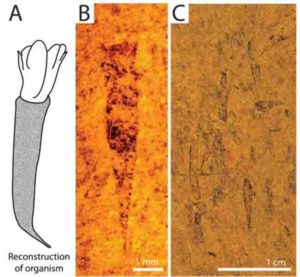
Hummelstown Fossils. A) Typical specimen reconstruction showing body mass (white) poking out of the ‘spindle’-shaped cone (patterned). Note the presence of ‘spikes’ on the sides of the exposed body. B) Typical fossil specimen with body mass (with at least one spike) and ‘spindle’-shaped cone. C) Surface of rock slab showing numerous Hummelstown fossils. Credit: University of Leicester
Researchers from the University of Leicester, working with an international team of geologists, have discovered an enigmatic fossil of a 450 million year-old creature resembling a tiny ice-cream cone.
Fossils of the creature, in which the ‘body’ resembles a scoop of ice cream atop the cone, was located in the Appalachian Mountains, near Hummelstown in Pennsylvania from the Ordovician period.
Intriguingly, the rocks in which the fossil was found have been ‘cooked’ during mountain building, which usually hinders fossil preservation.
Discovered by consulting geologist Bob Ganis, who obtained his PhD from the University of Leicester, and Mike Meyer of the Carnegie Institute of Science, it has now been described in a paper published in the journal Palaios by them and co-authors Professor Jan Zalasiewicz of the University of Leicester, Jacalyn Wittmer of the State University of New York, Geneseo and Kenneth de Baets of Geozentrum Nordbayern in Erlangen Germany.
The paper discusses the possibilities of this newly found soft-bodied creature, which lived among the plankton before being carried to the sea floor and buried within mud slurries.
Professor Jan Zalasiewicz from the University of Leicester’s School of Geography, Geology and the Environment, said: “The ancient world of the Ordovician, some 450 million years ago, was one of a huge expansion of life in the seas of our planet.
“Fossils are abound in Ordovician strata, but almost all of them are of creatures with hard shells or support structures, and so our understanding of booming Ordovician life is almost completely based on skeleton-bearing animals. There are few of those rare, precious localities where softer-bodied animals might be found, to give a wider insight into the life of those times.
“Was this creature an important but usually unpreserved part of ocean life, or just a bit player among the Ordovician animal communities? It is a new puzzle for palaeontologists.”
Mike Meyer, of the Carnegie Institute of Science, said: “That this fossil still has the soft bits preserved, even though the rocks that hold it have been squeezed and twisted, is remarkable. This enigmatic organism has major implications for how we look for well-preserved fossils.”
Bob Ganis added: “It’s a small fossil with a big story.”
Reference:
Mike B. Meyer, G. Robert Ganis, Jacalyn M. Wittmer, Jan A. Zalasiewicz, Kenneth De Baets. A LATE ORDOVICIAN PLANKTIC ASSEMBLAGE WITH EXCEPTIONALLY PRESERVED SOFT-BODIED PROBLEMATICA FROM THE MARTINSBURG FORMATION, PENNSYLVANIA. PALAIOS, 2018; 33 (1): 36 DOI: 10.2110/palo.2017.036
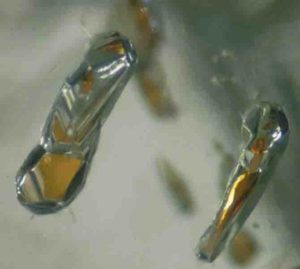
Diamonds with garnet inclusions can form at depths down to 550 kilometres below the surface. Credit: Jeff W. Harris, University of Glasgow.
Scientists digging deep into the Earth’s mantle recently made an unexpected discovery.
Five hundred and fifty kilometres below the Earth’s surface, they found highly oxidized iron, similar to the rust we see on our planet’s surface, within garnets found within diamonds.
The result surprised geoscientists around the globe because there is little opportunity for iron to become so highly oxidized deep below the Earth’s surface.
Surprising discovery
“On Earth’s surface, where oxygen is plentiful, iron will oxidize to rust,” explained Thomas Stachel, professor in the Department of Earth and Atmospheric Sciences at the University of Alberta, who co-authored the study. “In the Earth’s deep mantle, we should find iron in its less oxidized form, known as ferrous iron, or in its metal form. But what we found was the exact opposite — the deeper we go, the more oxidized iron we found.”
This discovery suggests that something oxidized the rocks in which the superdeep diamonds were founds. The scientists suspect that it was molten carbonate, carried to these great depths in sinking slabs of ancient sea floor.
“It’s exciting to find evidence of such profound oxidation taking place deep inside the Earth,” said Stachel, Canada Research Chair in diamonds.
Carbon cycle
The study also has implications for understanding the global carbon cycle that involves the transport of surface carbon back into the Earth’s mantle.
“We know lots about the carbon cycle on Earth’s surface, but what about in the mantle?” explained Stachel. “Our study suggests that surface carbon goes down as carbonates to at least 550 kilometres below the surface. There, these carbonates may melt and react with the surrounding rocks, eventually crystallizing into diamonds. Diamonds can then be taken down even deeper in the mantle.”
The study shows that the carbon cycle extends deep into mantle, possibly all the way down to the core-mantle boundary, with billion year storage times.
Reference:
Ekaterina S. Kiseeva, Denis M. Vasiukov, Bernard J. Wood, Catherine McCammon, Thomas Stachel, Maxim Bykov, Elena Bykova, Aleksandr Chumakov, Valerio Cerantola, Jeff W. Harris, Leonid Dubrovinsky. Oxidized iron in garnets from the mantle transition zone. Nature Geoscience, 2018; DOI: 10.1038/s41561-017-0055-7
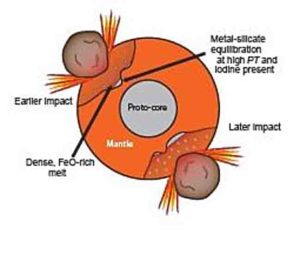
Earth experienced multiple large impacts; the high-pressure and -temperature conditions caused pockets of core and mantle partitioning that persist as chemically distinct today. Credit: Neil Bennett
Plumes of hot rock surging upward from the Earth’s mantle at volcanic hotspots contain evidence that the Earth’s formative years may have been even more chaotic than previously thought, according to new work from a team of Carnegie and Smithsonian scientists published in Nature.
It is well understood that Earth formed from the accretion of matter surrounding the young Sun. Eventually the planet grew to such a size that denser iron metal sank inward, to form the beginnings of the Earth’s core, leaving the silicate-rich mantle floating above.
But new work from a team led by Carnegie’s Yingwei Fei and Carnegie and the Smithsonian’s Colin Jackson argues that this mantle and core separation was not such an orderly process.
“Our findings suggest that as the core was extracted from the mantle, the mantle never fully mixed,” Jackson explained. “This is surprising because core formation happened in the immediate wake of large impacts from other early Solar System objects that Earth experienced during its growth, similar to the giant impact event that later formed the Moon. Before now, it was widely thought that these very energetic impacts would have completely stirred the mantle, mixing all of its components into a uniform state.”
The smoking gun that led the team to their hypothesis comes from unique and ancient tungsten and xenon isotopic signatures found at volcanic hotspots, such as Hawaii. Although it was believed that these plumes originated from the mantle’s deepest regions, the origin of these unique isotopic signatures has been debated. The team believes that the answer lies in the chemical behavior of iodine, the parent element of xenon, at very high pressure.
Isotopes are versions of elements with the same number of protons, but different numbers of neutrons. Radioactive isotope of elements, such as iodine-129, are unstable. To gain stability, iodine-129 decays into xenon-129. Therefore, the xenon isotopic signatures in plume mantle samples are directly related to iodine’s behavior during the period of core-mantle separation.
Using diamond anvil cells to recreate the extreme conditions under which Earth’s core separated from its mantle, Jackson, Fei, and their colleagues — Carnegie’s Neil Bennett and Zhixue Du and Smithsonian’s Elizabeth Cottrell — determined how iodine was partitioning between metallic core and silicate mantle. They also demonstrated that if the nascent core separated from the deepest regions of the mantle while it was still growing, then these pockets of the mantle would possess the chemistry needed to explain the unique tungsten and xenon isotopic signatures, provided these pockets remained unmixed with the rest of the mantle all the way up through the present day.
According to Bennett: “The key behavior we identified was that iodine starts to dissolve into the core under very high pressures and temperatures. At these extreme conditions, iodine and hafnium, which decay radioactively to xenon and tungsten, display opposing preferences for core-forming metal. This behavior would lead to the same unique isotopic signatures now associated with hotspots.”
Calculations from the team also predict that the tungsten and xenon isotopic signatures should be associated with dense pockets of the mantle.
“Like chocolate chips in cookie batter, these dense pockets of the mantle would be very difficult stir back in, and this may be a crucial aspect to the retention of their ancient tungsten and xenon isotopic signatures to the modern day,” Jackson explained.
“Even more exciting is that there is increasing geophysical evidence that there actually are dense regions of mantle, resting just above the core — called ultralow velocity zones and large low shear velocity provinces. This work ties together these observations,” Fei added. “The methodology developed here also opens new opportunities for directly studying the deep Earth processes.”
This work was supported by the National Science Foundation, the Carnegie Institution for Science, and the Smithsonian Institution.
Reference:
Colin R. M. Jackson, Neil R. Bennett, Zhixue Du, Elizabeth Cottrell & Yingwei Fei. Early episodes of high-pressure core formation preserved in plume mantle. Nature, 2018 DOI: 10.1038/nature25446
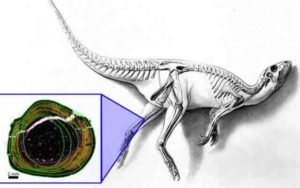
The fossil bone tissue reveals new information about how the Australian “hypsilophodontid” dinosaurs lived. Credit: Peter Trusler
Dinosaurs that lived in what is now known as Victoria more than 120 million years ago would have dealt with prolonged periods of darkness and below freezing temperatures, a new study reveals.
The study, published in the Scientific Reports journal, examines the bone tissue microstructure of plant-eating “hypsilophodontid” dinosaurs known to have lived in the Antarctic Circle—now Victoria, Australia.
“These little dinosaurs would have dealt with prolonged periods of darkness and mean annual temperatures near freezing, and certainly below freezing in the winter,” says one of the study authors, Dr. Patricia Vickers-Rich, a professor of paleobiology at Swinburne.
In studying fossils from seventeen individuals, the International research team from Swinburne University of Technology, Oklahoma State University, Museums Victoria, and Monash University produced the first life history reconstructions for these small Australian polar dinosaurs.
Examining bone microstructure
An examination of the bone microstructure, or histology, of the hypsilophodontid fossils revealed many characteristics of their growth.
Rings in the bone, similar in appearance to tree rings, helped determine individual age. Bone fibre orientation, blood vessel density, and the amount of bone between growth rings, was used to determine annual growth rates.
Bone histology revealed that, in general, growth was most rapid during the first three years of life, and the dinosaurs were fully grown – the size of a medium wallaby or average turkey—in five to seven years.
Uncovering Australia’s past
The hypsilophodontid samples were recovered from two Australian localities along the south Victorian coast stretching from west of Cape Otway to Inverloch, geologically separated by about 12 million years.
However, the trend of rapid growth for three years followed by adult body size between five and seven years, was conserved across the two samples.
“Given the geologic time involved, we may be looking at several polar dinosaur species in this sample, but their growth trajectories are so similar that we cannot differentiate them from one another based on their growth patterns and rates alone,” says Holly Woodward (Oklahoma State University).
“Instead, our life history assessment demonstrates to us that this generalised growth trajectory was a successful lifestyle for surviving in a region experiencing unique conditions.”
Histologic examinations
The tibia (shin-bone) of one hypsilophodontid individual in the sample had clearly suffered from a pathologic condition known as osteomyelitis or bone infection.
Microscopic examination revealed the cause of this pathology was most likely a broken bone, which then became infected. Counting the growth rings preserved in this tibia prior to the formation of the pathologic bone, the team was able to place the timing of the injury as having occurred when this individual was approximately four years old.
The team was also able to tease out how long this little dinosaur lived and how it dealt with the injury: histologic examination of the unaffected femur (thigh bone) of this individual shows that it survived with the injury and pathology for three more years.
“Further investigations of this unique sample will continue to shed light on how these little dinosaurs thrived in high latitudes and under the most stressful of environments during a time when dinosaurs flourished on planet Earth,” Dr. Vickers-Rich says.
Reference:
Holly N. Woodward et al. The bone microstructure of polar “hypsilophodontid” dinosaurs from Victoria, Australia, Scientific Reports (2018). DOI: 10.1038/s41598-018-19362-6
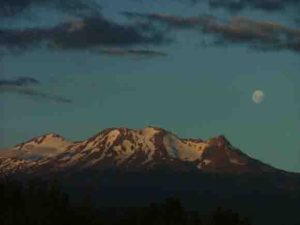
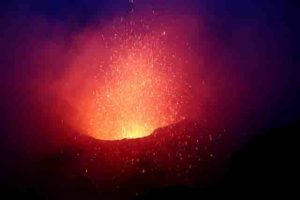
Just before a surprise eruption of New Zealand’s Ruapehu volcano in 2007, seismic tremor near its crater became tightly correlated with twice-monthly changes in the strength of tidal forces, a new study has found. The research, published in the journal Scientific Reports, suggests that signals associated with tidal cycles could potentially provide advanced warning of certain types of volcanic eruptions.
“Looking at data for this volcano spanning about 12 years, we found that this correlation between the amplitude of seismic tremor and tidal cycles developed only in the three months before this eruption,” said Társilo Girona, the study’s lead author. “What that suggests is that the tides could provide a probe for telling us whether or not a volcano has entered a critical state.”
Girona, a NASA postdoctoral fellow at the Jet Propulsion Laboratory, led the research during a postdoctoral appointment at Brown University, working with Brown professor Christian Huber and Corentin Caudron, a postdoctoral researcher at the Ghent University in Belgium.
Earth’s tides rise and fall daily due to the gravitational tug of the Moon as the Earth rotates. During full and new Moons, the lunar gravitational pull lines up with that of the sun, which makes the daily tidal bulges a little larger during those Moon phases. During the first- and third-quarter Moons, the daily tidal bulge is a little smaller. This twice-monthly change in tidal amplitude is sometimes referred to as the fortnightly tide. While we normally think of tides in terms of rising and falling waters, these gravitational stresses also affect the planet’s solid crust. The question of whether gravitational stresses may influence volcanic activity is longstanding in the Earth sciences.
“A lot of research has been focused on whether or not tidal forces can trigger eruptions, and there’s no definitive evidence whatsoever that they do,” Huber said. “We wanted to take a different angle with this study and look at whether there’s some detectable signal associated with tidal forces that can tell us something about a volcano’s criticality.”
The researchers chose to study Ruapehu volcano in part because its activity has been closely monitored for years by GNS Science, a research institute in New Zealand. The mountain is a popular tourist attraction and home to two ski resorts, so officials want to be aware of any warning signs that it might erupt. That monitoring provided a long and continuous data set for the researchers to study.
In particular, the team was interested in data from seismic sensors located near the volcano’s crater. Those sensors pick up volcanic tremor, a low-level seismic rumble that provides a persistent signal of activity within a volcanic system. Using a sophisticated statistical technique, the researchers combed through 12 years of seismic data, looking for any period when the seismicity was correlated with lunar cycles. They found that for most of those 12 years, there was no correlation between tremor and lunar cycles, except the few months before a steam-driven eruption on Sept. 25, 2007, when a strong correlation emerged.
During those three months, the amplitude of tremor rose and fell ever so slightly in lock step with the fortnightly tidal cycle. While the fluctuations in seismic amplitude were subtle, the strength of the correlation to the tidal cycle was not. The correlation was as strong as 5 sigma, the researchers say, meaning that the probability that pattern arose by chance is about one in 3.5 million.
To understand how tidal forces were affecting Ruapehu during those three months, the researchers used a model of seismic tremor that they had developed previously. Volcanoes like Ruapehu have a vertical conduit through which lava rises, and a solid rock plug at the top. Gases released from the lava form a pocket between the rocky plug and the lava pool. That gas pocket can resonate against the plug, which creates seismic tremor.
The model suggests that when the pressure of the gas pocket reaches a critical level — a level at which a steam eruption is possible — the differing stresses associated with changing tidal forces are enough to change the amplitude of tremor.
“That’s what we think was happening in 2007,” Huber said. “When the pressure in the system became critical, it became sensitive to the tides. We were able to show that the signal is detectable.”
None of the other indicators geologists typically use to anticipate eruptions raised any warning flags in 2007. So a tidal signal could be a way of predicting steam-driven eruptions, which are otherwise hard to predict.
“We’d like to collect more data from other eruptions and other volcanos to see if this tidal signal shows up elsewhere,” Huber said. “Then we can start to think about using it as a potential means of predicting future eruptions of this kind.”
The research was funded by the National Science Foundation (1454821).
Reference:
Társilo Girona, Christian Huber, Corentin Caudron. Sensitivity to lunar cycles prior to the 2007 eruption of Ruapehu volcano. Scientific Reports, 2018; 8 (1) DOI: 10.1038/s41598-018-19307-z
They can be as small as a grain of salt, but tiny crystals that form deep in volcanoes may be the key for advance warnings before volcanic eruptions.
University of Queensland vulcanologist Dr Teresa Ubide said the research provided new information that could lead to more effective evacuations and warning communications.
“This could signal good news for the almost one in 10 people around the world who live within 100km of an active volcano,” she said.
“We haven’t yet reached the ‘holy grail’ of being able to predict volcanic eruptions, but our research is a significant step forward in understanding the processes that lead to eruption.”
Dr Ubide, from UQ’s School of Earth and Environmental Sciences, used a new laser technique to examine the composition of tiny crystals forming deep in volcanoes.
The crystals are created when molten rock — magma — from up to 30 km beneath a volcano starts to move upwards towards the Earth’s surface.
The crystals are carried in the erupting magma, continuing to crystallise and change in composition on the way to the surface.
“They effectively ‘record’ the processes that happen deep in the volcano right before the eruption starts,” says Dr Ubide.
“We’ve found by studying these crystals in a specific volcano that, when new magma arrives at depth, up to 90 per cent of the time it can trigger an eruption, and within only two weeks.”
From this, vulcanologists hope to work out how to better monitor volcanoes — for instance, at what depths underground to look for signs of magma movement before an eruption.
Dr Ubide said it was currently very difficult to predict volcanic eruptions — as evidenced by the eruption at Mount Agung in Bali, which started last November after 2 months of precursory earthquakes.
“The Bali eruption led to the evacuation of more than 70,000 people and caused massive disruptions in air traffic and tourism, affecting more than 100,000 travellers,” she said.
“Volcanic ash and gas clouds rose to heights of up to 4 km above the summit and produced ash-fall in downwind areas.
“Lahars (mudflows) impacted houses, roads and agricultural areas.
“Every volcano is different and requires individual monitoring.”
Dr Ubide’s team tracked eruptions, their triggers and time scales at Mount Etna, on Sicily in Italy, Europe’s most active volcano.
The results could provide important information for future volcanic monitoring efforts at the site, she said.
“We plan to apply the same approach to other volcanoes around the world, especially for countries neighbouring Australia like Indonesia and New Zealand,” she says.
Reference:
Teresa Ubide, Balz S. Kamber. Volcanic crystals as time capsules of eruption history. Nature Communications, 2018; 9 (1) DOI: 10.1038/s41467-017-02274-w