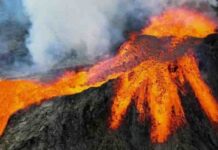

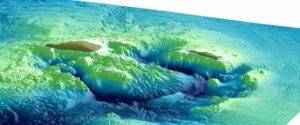
The magma reservoir of the largest volcanic eruption of the Holocene is refilling. This Kobe University insight on the Kikai caldera in Japan allows us to understand giant caldera volcanoes like Yellowstone or Toba more generally and gets us closer to predicting their behavior, too.
Some volcanoes erupt so violently, ejecting more magma than could cover all of Central Park 12 km deep, that all that’s left is just a wide and rather shallow crater, a so-called “caldera.” Examples of such supervolcanoes are the Yellowstone caldera, the Toba caldera and the mostly underwater Kikai caldera in Japan, which last erupted 7,300 years ago in what was the largest volcano eruption in the current geological epoch, the Holocene.
It is known that these volcanoes can and do reerupt but very little is known about the processes that lead up to an eruption and are therefore ill-equipped to make predictions.
“We must understand how such large quantities of magma can accumulate to understand how giant caldera eruptions occur,” says Kobe University geophysicist Seama Nobukazu.
That the Kikai caldera is mostly underwater is, in fact, an advantage in tackling questions like this. Seama explains, “The underwater location allows us to implement systematic, large-scale surveys.”
Thus, the Kobe University researcher teamed up with the Japan Agency for Marine-Earth Science and Technology (JAMSTEC) and used airgun arrays that cause artificial seismic pulses together with ocean bottom seismometers that listen to how that seismic wave propagates through Earth’s crust to understand its condition.
The team has published their findings in the journal Communications Earth & Environment. They found that there is indeed a region that consists of a large degree of magma directly underneath the volcano that erupted 7,300 years ago and characterized the reservoir’s size and shape. Seama says, “Due to its extent and location, it is clear that this is in fact the same magma reservoir as in the previous eruption.”
But this magma is likely not a remnant of that eruption. Researchers had become aware that in the center of the caldera a new lava dome has been forming over the past 3,900 years, and chemical analyses showed that the material produced by this and other recent volcanic activity is of a different composition than what was ejected in the last giant eruption.
“This means that the magma that is now present in the magma reservoir under the lava dome is likely newly injected magma,” summarizes Seama. This allows the researchers to propose a general model for how magma reservoirs under caldera volcanoes refill.
“This magma re-injection model is consistent with the existence of large shallow magma reservoirs beneath other giant calderas like Yellowstone and Toba,” says Seama, hoping that his team’s findings may contribute to understanding the magma supply cycles following giant eruptions.
He concludes, saying, “We want to refine the methods that have proved to be so useful in this study to more deeply understand the re-injection processes. Our ultimate goal is to become better able to monitor the crucial indicators of future giant eruptions.”
Reference:
Melt re-injection into large magma reservoir after giant caldera eruption at Kikai Caldera Volcano, Communications Earth & Environment (2026). DOI: 10.1038/s43247-026-03347-9
Note: The above post is reprinted from materials provided by Kobe University