
Understanding Intrusive Igneous Bodies — How Magma Shapes the Earth’s Crust
Intrusive igneous bodies are masses of crystallized igneous rock that form when magma solidifies beneath Earth’s surface. These bodies, known collectively as plutonic bodies or plutons, cool slowly underground, resulting in coarse-grained, crystalline textures typical of rocks such as granite, diorite, gabbro, and tonalite. Because they form in the subsurface, intrusive bodies preserve critical records of magmatic processes, tectonic settings, crustal evolution, and thermal history (Best & Christiansen, 2001).
Intrusive igneous bodies vary enormously in size, geometry, depth of emplacement, and relationship with surrounding rock. Understanding their types is fundamental to:
- Interpreting magmatic systems
- Mapping tectonic environments
- Reconstructing crustal evolution
- Identifying mineral deposits
- Understanding geothermal and volcanic systems
This article provides a comprehensive scientific overview of the main types of intrusive igneous bodies, integrating geological principles, petrology, structural geology, field relationships, and real scientific research.
What Defines an Intrusive Igneous Body?
An intrusive igneous body forms when magma intrudes into pre-existing rocks and cools in the crust, becoming plutonic rock. The key characteristics include:
- Slow cooling, producing large, visible crystals
- Cross-cutting or concordant relationships with host rock
- Contact metamorphism aureoles caused by heat
- Distinctive textures (phaneritic, porphyritic, pegmatitic)
- Mappable geometry, allowing classification into types
The morphology of intrusive bodies depends on:
- Magma viscosity
- Tectonic stress regime
- Depth of emplacement
- Composition & temperature
- Mechanical properties of the host rock
Major Types of Intrusive Igneous Bodies
Below is a systematic, scientifically grounded explanation of all major intrusive body types, integrating structural relationships and magmatic processes.
1. Batholiths — The Largest Intrusive Bodies
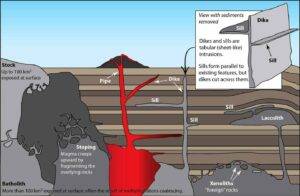
Batholiths are massive, composite intrusive complexes larger than 100 km², formed by the amalgamation of multiple plutons over millions of years.
Key Characteristics
- Irregular shape
- Composed mainly of granitic to dioritic rocks
- Represent continental arc magmatism (subduction zones)
- Display zonation: mafic at margins → felsic at center
- Form deep in the crust (5–30 km depth)
Geological Significance
Batholiths reflect long-lived magmatic arcs associated with orogenies.
Examples
- Sierra Nevada Batholith (USA)
- Andean Coastal Batholith (Peru & Chile)
Research indicates batholiths form through successive pulses of magma rather than single emplacement events (Paterson et al., 1994).
2. Plutons — Discrete Intrusive Bodies
A pluton is any large, blob-like intrusive body that crystallizes underground. Plutons may be:
- Granite plutons (felsic)
- Gabbro plutons (mafic)
- Diorite plutons (intermediate)
Most plutons are sub-batholithic, meaning they may later join others to form a batholith.
Field Indicators
- Coarse-grained texture
- Sharp or diffuse intrusive contacts
- Contact metamorphic aureoles
3. Stocks — Smaller Plutons
A stock is a small pluton less than 100 km² in surface exposure. Stocks often represent the upper tips of larger batholiths.
They show similar textures and mineralogy to plutons but are more restricted spatially.
4. Dikes — Vertical or Steeply Inclined Intrusions
Dikes (or dykes) are discordant tabular intrusions cutting across pre-existing structures.
Key Features
- Steep or vertical orientation
- Fine to medium grain size (faster cooling)
- Often form swarm systems (parallel or radiating groups)
- Transport magma upward during volcanic activity
Dikes record extensional tectonics, such as:
- Rift zones
- Mid-ocean ridges
- Large Igneous Provinces (LIPs)
Example
- The Mackenzie Dyke Swarm (Canada) — the world’s largest dyke swarm.
5. Sills — Horizontal or Gently Inclined Intrusions
A sill is a tabular, concordant intrusive body that injects parallel to sedimentary bedding or metamorphic foliation.
Characteristics
- Typically forms under low differential stress
- May feature columnar jointing
- Can cause significant contact metamorphism in overlying strata
Sills commonly occur in continental flood basalt provinces, such as:
- Karoo Sill Complex (South Africa)
- Palatine Sill (Scotland)
6. Laccoliths — Dome-Shaped Intrusions
A laccolith forms when magma injects between rock layers and pushes the overlying strata upward, forming a dome.
Features
- Flat base, convex upper surface
- Viscous, silica-rich magma (e.g., rhyolite)
- Found in shallow crustal levels
This intrusion geometry requires higher magma pressure than sills.
Classic Example
- Henry Mountains Laccoliths (USA) — studied by Grove Karl Gilbert (1877), foundational to intrusion mechanics.
7. Lopoliths — Saucer-Shaped Intrusions
Lopoliths are large, bowl-shaped intrusive bodies that depress underlying strata.
Characteristics
- Concave-up geometry
- Often associated with mafic magmatism
- Form under extensional tectonics
Notable Example
- Bushveld Complex (South Africa) — the world’s largest layered mafic intrusion.
8. Pipes and Diatremes — Volcanic Conduits
These cylindrical intrusions represent vertical channels through which magma ascends.
Types:
- Volcanic pipes — ultramafic to kimberlite; may host diamonds
- Diatremes — explosive breccia-filled conduits
Pipes provide direct windows into deep mantle-derived magmas.
9. Pegmatites — Extremely Coarse-Grained Intrusions
Pegmatites form from volatile-rich late-stage magmas, yielding giant crystals of:
- Feldspar
- Quartz
- Micas
- Rare earth minerals (Li, Ta, Nb)
Pegmatites are essential for critical mineral resources used in batteries and electronics.
10. Xenolith-Bearing Intrusions
Some intrusive bodies transport xenoliths, fragments of country rock or mantle material.
These xenoliths serve as samples of inaccessible crustal and mantle layers, aiding in geochemical modeling (Hawkesworth & Kemp, 2006).
How Intrusive Bodies Interact with Surrounding Rocks
When magma intrudes, it alters nearby rocks via contact metamorphism, producing:
- Chilled margins (rapid cooling)
- Metamorphic aureoles
- Skarns (fluid–rock reactions)
The thermal gradient and time duration determine metamorphic grade.
Textural and Mineralogical Indicators of Intrusive Emplacement
Intrusive igneous bodies exhibit diagnostic textures, including:
Phaneritic Texture
Large, interlocking crystals formed during slow cooling.
Porphyritic Texture
Large phenocrysts set in a finer groundmass.
Graphic Texture
Intergrowth of quartz and feldspar in pegmatites.
Zoned Minerals
Reflect changing magmatic conditions during crystallization.
How Geologists Identify and Study Intrusive Igneous Bodies
Field Mapping
Noting cross-cutting relationships and intrusive contacts.
Petrography
Microscopic analysis of crystal textures and mineral assemblages.
Geochemical Signatures
Trace elements and isotopes reveal source magmas and crustal contamination.
Geochronology
Radiometric dating (U-Pb zircon) determines magma emplacement ages.
Geophysics
Gravity and magnetic surveys detect subsurface plutons and sills.
Frequently Asked Questions
What are intrusive igneous bodies?
They are rock masses formed when magma cools and solidifies beneath Earth’s surface.
What is the difference between a dike and a sill?
A dike is discordant and cuts across layers; a sill is concordant and forms parallel to them.
Which intrusive body is the largest?
Batholiths are the largest, exceeding 100 km² in surface exposure.
What is a laccolith vs. a lopolith?
A laccolith domes the overlying strata upward, while a lopolith depresses underlying strata downward.
How do intrusive bodies relate to tectonics?
They record magmatic processes linked to plate boundaries, rifts, and crustal thickening.
Key Takeaways
- Intrusive igneous bodies form when magma solidifies underground, producing coarse-grained rocks.
- Their morphology reflects pressure, viscosity, tectonic stress, and host-rock properties.
- Types include plutons, batholiths, stocks, dikes, sills, laccoliths, lopoliths, pipes, pegmatites, and more.
- These bodies reveal critical information about magmatism, crustal growth, mineralization, and tectonic evolution.
- Field observations, petrography, isotopes, and geophysics are essential tools for their study.
References
- Best, M. G., & Christiansen, E. H. (2001). Igneous Petrology. Blackwell Science.
- Paterson, S. R., et al. (1994). “Magmatic processes in batholith construction.” Journal of Structural Geology, 16(11), 1675–1693.
- Gilbert, G. K. (1877). Report on the Geology of the Henry Mountains. U.S. Geological Survey.
- Hawkesworth, C. J., & Kemp, A. I. S. (2006). “Evolution of the continental crust.” Nature, 443, 811–817.
- Winter, J. D. (2010). Principles of Igneous and Metamorphic Petrology. Pearson.
- Wilson, M. (1989). Igneous Petrogenesis. Springer.