
An international team of researchers’ analysis of minerals from the Pilbara region of Western Australia has given new insight into how ancient continents on Earth formed as far back as 3.5 billion years ago. Professor Tony Kemp, from The University of Western Australia’s School of Earth and Oceans, was a co-author of the study published in Science Advances, which was led by researchers at Nanjing University in China.
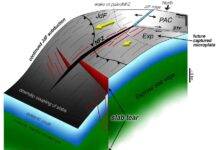
“Among scientists the formation of Earth’s early continental crust is a topic that remains debated,” Professor Kemp said. “The two competing points of view are subduction, when two tectonic plates meet and the denser one gets pushed underneath the other and sinks into Earth, and non-subduction, when hot material from deep within Earth rises upwards and melts or large meteorites impact and melt Earth’s crust.”
Researchers examined tiny crystals of the mineral zircon, contained within granitic rocks of the Pilbara Craton in northwestern Australia, which has some of the most ancient and best-preserved geological formations on Earth.
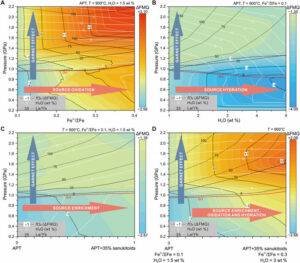
They found evidence in the crystals that indicated the magmas from which the granites formed became more oxidized and richer in water over time, from 3.5 billion years ago to 3.2 billion years ago.
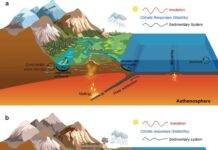
“For this finding to be true, a mechanism must have existed on early Earth to transport water into the deep crust and mantle,” Professor Kemp said. “On modern Earth, this is achieved along the boundaries of tectonic plates through subduction—as one plate sinks beneath the other—a process unique to Earth and responsible for forming continents.”
The findings underscore the role of subduction-driven water recycling in the origin of continental crust. “Our study implies that a very early form of plate subduction existed on Earth as far back as 3.5 billion years ago and could have had a role in the growth of ancient continents,” Professor Kemp said.
Reference:
Di Zhou et al, Paleoarchean deep crustal hydration and oxidation induced by subduction-driven water recycling, Science Advances (2026). DOI: 10.1126/sciadv.aec1040.
Note: The above post is reprinted from materials provided by University of Western Australia.