

Types of Faults in Geology — How Earth’s Crust Breaks, Moves, and Evolves
In geology, faults are fractures or zones of fractures in the Earth’s crust along which measurable displacement has occurred. The study of faults is central to structural geology, tectonics, seismology, and engineering geology, because faults control mountain building, basin formation, earthquakes, and the mechanical behavior of the lithosphere.
Understanding the types of faults allows geologists to interpret:
- Regional and global stress regimes
- Plate tectonic environments
- Earthquake mechanisms and hazards
- Crustal deformation through geological time
Faults are classified primarily based on the direction of movement, orientation of the fault plane, and the stress field responsible for deformation.
Faults, Stress, and Rock Mechanics — The Physical Basis
Before classifying faults, it is essential to understand the three principal stresses acting on rocks:
- σ₁ (maximum principal stress)
- σ₂ (intermediate stress)
- σ₃ (minimum principal stress)
Faulting occurs when applied stress exceeds the shear strength of rocks, as described by the Mohr–Coulomb failure criterion. The orientation of σ₁ and σ₃ determines how rocks break and slide, directly controlling the type of fault that forms.
Main Types of Faults in Geology
Geological faults are grouped into four fundamental categories, each linked to a specific tectonic stress regime.
1. Normal Faults
A normal fault forms when the crust is subjected to extensional stress, causing it to stretch and thin. In a normal fault, the hanging wall moves downward relative to the footwall.
Key Characteristics
- Associated with tensional (extensional) stress
- Hanging wall moves down
- Fault plane typically dips 45–70°
- Produces fault scarps and horst–graben systems
Geological Settings
- Continental rift zones
- Mid-ocean ridges
- Back-arc basins
Geological Significance
Normal faults accommodate crustal extension and are fundamental to the formation of rift valleys and sedimentary basins.
Examples
- East African Rift System
- Basin and Range Province (USA)
Normal faulting dominates regions where σ₃ is vertical and σ₁ is horizontal.
2. Reverse Faults
A reverse fault develops under compressional stress, where the hanging wall moves upward relative to the footwall.
Key Characteristics
- Compression shortens and thickens the crust
- Hanging wall moves up
- Fault plane dips steeply (>45°)
- Commonly associated with folding
Geological Settings
- Convergent plate boundaries
- Continental collision zones
- Active orogenic belts
Reverse faults are crucial indicators of crustal shortening and are often associated with large-scale mountain building.
3. Thrust Faults (Low-Angle Reverse Faults)
A thrust fault is a special type of reverse fault with a low dip angle, typically less than 30°. Thrust faults can transport rock masses tens to hundreds of kilometers.
Key Characteristics
- Low-angle fault plane
- Older rocks may overlie younger rocks
- Formation of nappes and duplex structures
Geological Importance
Thrust faults are dominant in fold-and-thrust belts and represent some of the most dramatic crustal displacements on Earth.
Examples
- Himalaya thrust systems
- Alps and Zagros Mountains
Thrusting reflects a stress regime where σ₁ is horizontal and σ₃ is vertical.
4. Strike-Slip Faults
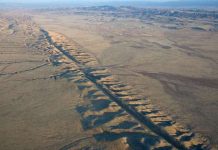
A strike-slip fault is characterized by horizontal movement parallel to the fault’s strike, driven by shear stress.
Subtypes of Strike-Slip Faults
Right-Lateral (Dextral) Faults
The opposite block moves to the right.
Left-Lateral (Sinistral) Faults
The opposite block moves to the left.
Key Characteristics
- Vertical or near-vertical fault plane
- Horizontal displacement dominates
- Linear valleys, offset streams, sag ponds
Tectonic Settings
- Transform plate boundaries
- Continental shear zones
Examples
- San Andreas Fault (USA)
- Alpine Fault (New Zealand)
Strike-slip faulting reflects a stress regime where σ₁ and σ₃ are horizontal.
Oblique-Slip Faults
An oblique-slip fault combines vertical and horizontal movement, meaning both dip-slip and strike-slip components are present.
Why Oblique Faults Are Common
Natural stress fields are rarely perfectly aligned, so many faults record mixed displacement.
Geological Significance
Oblique-slip faults are common along:
- Oblique plate boundaries
- Continental margins
- Reactivated ancient faults
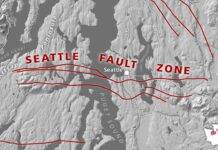
Fault Zones vs Single Fault Planes
In reality, most faults are not single surfaces but fault zones, consisting of:
- Multiple fault strands
- Fracture networks
- Fault breccia
- Fault gouge
These zones may be meters to kilometers wide and strongly influence fluid flow, mineralization, and seismic behavior.
Special Fault Types in Structural Geology
Listric Faults
Curved normal faults that flatten with depth, common in sedimentary basins.
Growth Faults
Active during sediment deposition, producing thickened strata on the downthrown side.
Detachment Faults
Large, low-angle normal faults associated with crustal extension.
Blind Faults
Do not reach the surface but can still generate large earthquakes.
Faults and Earthquakes
Earthquakes occur when accumulated elastic strain is suddenly released along faults.
- Normal faults → shallow extensional earthquakes
- Reverse/thrust faults → large, destructive earthquakes
- Strike-slip faults → lateral rupture and surface offsets
Fault geometry and slip rate control earthquake magnitude and frequency.
How Geologists Identify and Study Faults
Faults are analyzed using multiple complementary approaches:
- Field mapping (slickensides, offsets, breccias)
- Seismic reflection and refraction
- Remote sensing and LiDAR
- Paleoseismology
- Microstructural analysis
Each method helps constrain fault kinematics and evolution.
Engineering and Environmental Importance of Fault Types
Fault classification directly affects:
- Tunnel alignment and support design
- Dam and foundation safety
- Groundwater flow and contamination pathways
- Landslide susceptibility
- Seismic hazard assessment
Faults often act as barriers or conduits for fluids, depending on their internal structure.
References
- Anderson, E. M. (1951). The Dynamics of Faulting and Dyke Formation. Oliver & Boyd.
- Twiss, R. J., & Moores, E. M. (2007). Structural Geology. W.H. Freeman.
- Scholz, C. H. (2019). The Mechanics of Earthquakes and Faulting. Cambridge University Press.
- Fossen, H. (2016). Structural Geology. Cambridge University Press.
- Sibson, R. H. (1977). “Fault rocks and fault mechanisms.” Journal of the Geological Society, 133, 191–213.
- Davis, G. H., Reynolds, S. J., & Kluth, C. F. (2012). Structural Geology of Rocks and Regions. Wiley.