

What Is the Cause of an Earthquake? Understanding Earthquake Origins in Geology
The cause of an earthquake lies in the sudden release of stored elastic energy within the Earth’s crust or upper mantle. This energy is generated by tectonic forces that slowly deform rocks over time until they exceed their mechanical strength. When failure occurs, rocks rupture along faults, releasing energy in the form of seismic waves that propagate through the Earth—what we experience as an earthquake.
From a geological perspective, earthquakes are not random events. They are the direct result of plate tectonics, stress accumulation, rock mechanics, and fault behavior, operating over timescales ranging from seconds to millions of years.
The Fundamental Geological Cause of Earthquakes
At the most basic level, earthquakes are caused by brittle failure of rocks under stress.
Stress Accumulation in the Earth’s Crust
Stress builds up in rocks due to:
- Plate motion
- Gravitational loading
- Thermal expansion
- Isostatic adjustment
Three principal stresses act on rocks:
- σ₁ – maximum principal stress
- σ₂ – intermediate principal stress
- σ₃ – minimum principal stress
As tectonic plates move, stress accumulates along zones of weakness—primarily faults.
Elastic Deformation and Rock Failure
Rocks behave elastically under low stress, meaning they deform but return to their original shape. When stress exceeds the rock’s elastic limit, brittle failure occurs, producing:
- Fractures
- Fault slip
- Sudden energy release
This process is governed by the Mohr–Coulomb failure criterion, a fundamental principle in rock mechanics.
Faults as the Primary Source of Earthquakes
Most earthquakes occur along geological faults, which are fractures with measurable displacement.
Fault Locking and Stick–Slip Behavior
Faults are not continuously moving. Instead, they often remain locked due to friction. As tectonic motion continues, stress accumulates until:
- Frictional resistance is overcome
- Sudden slip occurs
- Stored elastic strain is released
This behavior is known as the elastic rebound theory, first proposed by H. F. Reid after the 1906 San Francisco earthquake.
Types of Faults That Generate Earthquakes
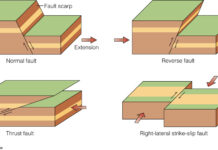
Different fault types produce earthquakes under different stress regimes:
- Normal faults → extensional stress
- Reverse and thrust faults → compressional stress
- Strike-slip faults → shear stress
The type of fault controls:
- Earthquake depth
- Rupture geometry
- Surface deformation
- Seismic hazard
Plate Tectonics and Earthquake Generation
Plate tectonics provides the global framework for understanding earthquake causes.
Convergent Plate Boundaries
At convergent boundaries, plates collide, producing:
- Subduction-zone earthquakes
- Deep-focus earthquakes (up to 700 km)
- Some of the largest earthquakes on Earth
These earthquakes occur due to megathrust faulting, where one plate is forced beneath another.
Divergent Plate Boundaries
At divergent boundaries:
- Plates move apart
- Normal faulting dominates
- Earthquakes are generally shallow and moderate in magnitude
These are common at mid-ocean ridges and continental rifts.
Transform Plate Boundaries
Transform boundaries accommodate horizontal motion:
- Strike-slip faulting
- Shallow but potentially destructive earthquakes
These boundaries produce frequent seismic activity due to high strain rates.
Earthquake Focus, Epicenter, and Seismic Energy Release
Focus (Hypocenter)
The focus is the point inside the Earth where rupture begins. It represents the true origin of the earthquake.
Epicenter
The epicenter is the point on Earth’s surface directly above the focus. Damage is often greatest near the epicenter, but this depends on depth and local geology.
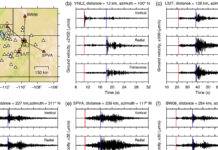
Seismic Waves
Earthquake energy travels as:
- P-waves (compressional)
- S-waves (shear)
- Surface waves (Love and Rayleigh)
Surface waves cause the most damage, as they have large amplitudes near the surface.
Secondary Geological Causes of Earthquakes
While tectonics dominate, other geological processes can also cause earthquakes.
Volcanic Earthquakes
Volcanic activity generates earthquakes due to:
- Magma movement
- Gas pressure changes
- Rock fracturing
These earthquakes are typically shallow and localized.
Isostatic Adjustment Earthquakes
Post-glacial rebound causes earthquakes as the crust responds to unloading after ice-sheet melting. These are common in formerly glaciated regions.
Landslide-Induced Earthquakes
Large landslides or rock avalanches can generate seismic signals, although they are not tectonic in origin.
Human-Induced (Anthropogenic) Earthquakes
Some earthquakes are caused or triggered by human activities.
Reservoir-Induced Seismicity
Large dams alter stress and pore pressure in the crust, sometimes triggering earthquakes.
Fluid Injection and Extraction
Activities such as:
- Wastewater injection
- Hydraulic fracturing
- Geothermal energy extraction
can increase pore pressure, reducing fault friction and triggering seismic events.
Mining-Induced Seismicity
Underground mining redistributes stress, sometimes causing rockbursts and seismic events.
Why Earthquakes Occur Suddenly
Strain Energy Storage
Tectonic motion is slow—typically millimeters per year—but strain accumulates over decades to centuries.
Sudden Stress Release
Once frictional resistance is exceeded, rupture occurs in seconds, releasing:
- Seismic energy
- Heat
- Permanent displacement
This contrast between slow buildup and rapid release explains the sudden nature of earthquakes.
Earthquake Magnitude, Energy, and Rupture Area
The size of an earthquake depends on:
- Fault area that ruptures
- Amount of slip
- Rock rigidity
Large earthquakes involve long fault segments and high slip values, while small earthquakes rupture limited areas.
Geological Conditions That Amplify Earthquake Effects
Earthquake damage is not controlled solely by magnitude.
Local Geology
Soft sediments amplify seismic waves, increasing damage.
Fault Proximity
Shallow earthquakes near populated areas are more destructive.
Basin Effects
Sedimentary basins can trap and amplify seismic waves.
Why Earthquakes Cannot Yet Be Predicted
Although the cause of earthquakes is well understood, exact prediction remains impossible because:
- Stress is heterogeneous
- Fault friction varies
- Subsurface conditions are complex
Modern seismology focuses on probabilistic hazard assessment, not deterministic prediction.
References
- Reid, H. F. (1910). The Mechanics of the Earthquake. Carnegie Institution of Washington.
- Scholz, C. H. (2019). The Mechanics of Earthquakes and Faulting. Cambridge University Press.
- Anderson, E. M. (1951). The Dynamics of Faulting and Dyke Formation. Oliver & Boyd.
- Kanamori, H., & Brodsky, E. E. (2004). “The physics of earthquakes.” Reports on Progress in Physics, 67, 1429–1496.
- Turcotte, D. L., & Schubert, G. (2014). Geodynamics. Cambridge University Press.
- Shearer, P. M. (2009). Introduction to Seismology. Cambridge University Press.