
What Is a Geological Formation? A Scientific, Stratigraphic, and Geochemical Explanation
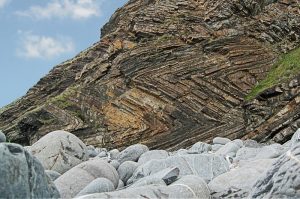
A geological formation is a fundamental unit of stratigraphy used to describe a body of rock with consistent lithological characteristics that distinguish it from adjacent rock layers. In essence, a geological formation is a mappable, identifiable package of rock that formed under specific geological conditions and environments (North American Commission on Stratigraphic Nomenclature, 2005).
Formations may consist of sedimentary, igneous, or metamorphic rocks, and they represent a natural chapter in Earth’s geological history — a period when certain environmental, tectonic, depositional, or magmatic conditions prevailed.
Formal Definition of a Geological Formation
In stratigraphy, a formation is defined as:
“A lithologically distinctive stratigraphic unit that is large enough to be mapped at the Earth’s surface or traced in the subsurface.”
(International Stratigraphic Guide, Salvador 1994)
Key Characteristics:
- Distinct lithology (rock type, color, grain size, mineralogy)
- Clear boundaries that can be mapped
- Internal consistency within the rock body
- Represents a specific geological environment or process
A formation is the basic building block of the geological column, and multiple formations may group together into members (smaller units) or groups (larger units).
Why Geological Formations Matter
Formations are essential because they allow geologists to:
1. Reconstruct Earth’s History
Formations preserve evidence of:
- Ancient seas
- Volcanic eruptions
- Mountain-building events
- Climate shifts
- Biological evolution
2. Interpret Past Environments (Paleoenvironmental Reconstruction)
Sedimentary structures and fossils inside formations reveal:
- River systems
- Deserts
- Glacial environments
- Coral reefs
- Deep-sea basins
3. Identify Natural Resources
Many resources occur within specific formations, including:
- Groundwater aquifers (e.g., sandstone formations)
- Petroleum reservoirs (carbonate & sandstone formations)
- Ore deposits (volcanogenic or metamorphosed formations)
4. Support Engineering and Construction
Engineers use formations to evaluate:
- Bedrock stability
- Slope stability
- Foundation design
- Earthquake risk
How Geological Formations Develop — The Science Behind Their Origins
The development of geological formations depends on the type of rock involved. Below is a detailed breakdown from a geological processes perspective.
Sedimentary Formations
Sedimentary formations arise from the accumulation, compaction, and cementation of sediments over time. They cover about 75% of the Earth’s continents’ surface (Blatt, Middleton & Murray, 1980).
Controls on Sedimentary Formation Creation
1- Depositional Environment
- Marine (continental shelf, deep sea)
- Fluvial (river channels, floodplains)
- Aeolian (dunes)
- Lacustrine (lakes)
2- Sediment Supply & Transport
- Weathering
- Erosion
- River transport
- Oceanic currents
3- Sea-Level Changes
Transgression/regression cycles create distinct mappable formations.
4- Diagenesis
Cementation and chemical changes solidify the rock.
Example of a Sedimentary Formation:
The Navajo Sandstone (USA) — famous for its cross-bedded dunes and pale orange colors, representing an ancient Jurassic desert environment.
Igneous Formations
Igneous geological formations develop from magma crystallization (intrusive) or lava solidification (extrusive).
Key Igneous Processes Influencing Formations
- Cooling rate influences crystal size
- Magma composition (mafic, intermediate, felsic)
- Tectonic setting (subduction zones, mid-ocean ridges, hotspots)
Examples:
- Deccan Traps (India) — basaltic flood lavas
- Skaergaard Intrusion (Greenland) — layered mafic intrusion crucial for igneous petrology research (Wager & Brown, 1968)
Metamorphic Formations
Metamorphic formations arise when existing rocks transform under:
- Heat
- Pressure
- Chemically active fluids
These processes occur during:
- Mountain-building (orogeny)
- Subduction
- Crustal thickening
Types of Metamorphism Shaping Formations
- Regional metamorphism — large-scale, tectonic
- Contact metamorphism — due to magma intrusions
- Hydrothermal alteration — mineralization and ore formation
Example:
The Scottish Highlands Metamorphic Complex, shaped by the Caledonian Orogeny.
Stratigraphy and Naming of Geological Formations
To be officially recognized, a formation must be:
- Described in a scientific publication
- Mapped at a mappable scale (1:25,000 or 1:50,000)
- Defined at a type locality (“type section”)
Naming conventions usually follow:
Geographic location + dominant lithology
Example: Burgess Shale Formation
Examples of Famous Geological Formations Worldwide
Sedimentary
- Grand Canyon Formations (USA) — showcase 2 billion years of stratigraphy
- White Cliffs of Dover (UK) — Upper Cretaceous chalk
Igneous
- Giant’s Causeway (Northern Ireland) — columnar basalt
- Siberian Traps (Russia) — massive volcanic province linked to mass extinction
Metamorphic
- Himalayan Metamorphic Core — high-grade gneisses and migmatites
How Geologists Study Geological Formations
1. Field Mapping
Measuring layers, rock types, structures.
2. Petrographic Analysis
Microscopic examination of minerals.
3. Geochemical Techniques
Isotope analysis (Sr, Nd, Pb isotopes), elemental composition.
4. Geochronology
Radiometric dating (U-Pb, Ar-Ar) determines formation ages.
5. Remote Sensing & GIS
Mapping formations using satellite imagery.
Geological Formation vs. Other Stratigraphic Units
| Unit | Description | Relative Scale |
|---|---|---|
| Group | Several formations | Larger |
| Formation | Primary mappable unit | Standard |
| Member | Sub-unit within a formation | Smaller |
| Bed | Smallest unit (single layer) | Very small |
References
- Salvador, A. (1994). International Stratigraphic Guide. Geological Society of America.
- North American Commission on Stratigraphic Nomenclature (2005). North American Stratigraphic Code. AAPG Bulletin.
- Blatt, H., Middleton, G., & Murray, R. (1980). Origin of Sedimentary Rocks. Prentice Hall.
- Wager, L. R., & Brown, G. M. (1968). Layered Igneous Rocks. W.H. Freeman.
- Tucker, M. E. (2001). Sedimentary Petrology: An Introduction to the Origin of Sedimentary Rocks. Blackwell Science.
- Winter, J. D. (2010). Principles of Igneous and Metamorphic Petrology. Pearson.