
New research from a team at Trinity College Dublin has unearthed a cheap and environmentally friendly new option for removing pollutants from our water. The key? Oyster shells that would ordinarily end up in landfill sites after consumption. The research, just published in the journal Science of the Total Environment, shows that waste seashells—especially those from oysters—can capture and remove rare earth elements from polluted water. And what’s more, they do it entirely naturally, turning them into stable mineral crystals.
What are rare earth elements, and why are they increasingly problematic?
Rare earth elements are essential components of modern technologies, from wind turbines and electric vehicles to smartphones, but their extraction and processing creates environmental risks when these metals leak into water systems. They are also at the center of growing geopolitical tensions, as global supply is heavily concentrated in a few countries and demand for these strategic materials continues to increase.
If released into rivers or lakes, rare earth elements can accumulate in aquatic ecosystems and disrupt microorganisms, plants, and animals. Finding simple and sustainable ways to remove rare earth elements from water is therefore an increasingly urgent environmental challenge.
What have the researchers discovered?
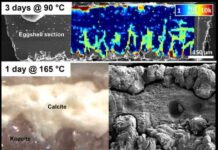
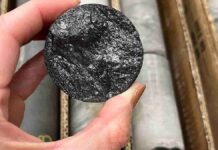
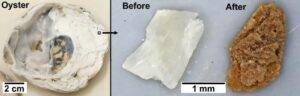
In lab experiments, the team exposed crushed shells (mussels, cockles and oysters) to solutions containing rare earth elements. They discovered that the shells trigger a chemical reaction such that the minerals in the shell dissolve and are replaced by new minerals containing the rare earth elements. In effect, the shells act as a “template” that converts dissolved metals into solid mineral crystals that remain locked inside the shell material.
Among the materials tested, oyster shells performed particularly well. Their natural microstructure allows the chemical reaction to continue deeper into the shell, capturing significantly more rare earth elements than other shells. The results suggest that shell waste could potentially be used as a low-cost and environmentally friendly material to help treat contaminated water—or even to recover valuable metals from industrial streams.
What is the impact of this work?
Dr. Rémi Rateau from Trinity’s School of Natural Sciences, who is first author of the study, said, “Among the most exciting elements of the discovery is that relatively small amounts of shell waste could remove substantial quantities of rare earth metals from contaminated water, meaning a genuine, tangible impact could be created with as little as a few kilograms of oyster shells.”
“Every year, the global aquaculture industry generates millions of tons of shell waste, much of which is discarded or sent to landfill, so repurposing this waste could instead offer both an environmental cleanup tool and a sustainable recycling pathway.”
Dr. Juan Diego Rodriguez-Blanco, Trinity’s School of Natural Sciences, and Principal Investigator of the project, added, “What makes this discovery particularly promising is that the process is entirely mineral-driven—the shells naturally transform dissolved rare earth elements into new solid minerals, so this isn’t a process that is difficult to drive, or one that requires much financial outlay or technical equipment.”
“By understanding how these reactions work, we can start designing low-cost and environmentally friendly strategies to remove critical metals from contaminated waters while also giving new value to a major waste product.”
A deeper dive into the science
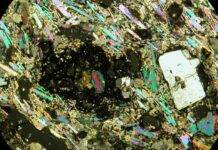
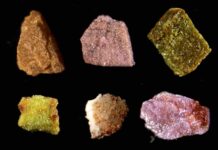
When interacting with rare-earth-rich solutions, calcium carbonate minerals in the shells dissolve and new rare earth carbonate minerals crystallize in their place. The transformation follows a sequence of mineral phases: calcium carbonate → lanthanite → kozoite → hydroxylbastnäsite, with kozoite being the most common product under the tested experimental conditions.
During the reaction, a crust of rare earth carbonate crystals forms on the shell grains. In mussel and cockle shells, this crust rapidly becomes impermeable, limiting further reaction and leaving more than half of the original shell unchanged. In contrast, the porous microstructure of oyster shells allows the reaction to proceed throughout the grain, enabling almost complete replacement of the original calcium carbonate.
As a result, oyster shells showed the highest performance, achieving a rare earth uptake of up to roughly 1.5 grams of rare earth metals captured per gram of oyster shell. Put another way, a relatively small amount of shell waste could remove substantial quantities of rare earth metals from contaminated water—in practical terms, a few kilograms of shell waste could potentially capture kilograms of dissolved rare earth elements from rare-earth-rich polluted waters.
Dr. Rodriguez-Blanco stated, “The work also revealed that different rare earth elements are incorporated into the crystals at different stages of growth, suggesting that such processes could potentially be used for environmentally friendly rare earth separation technologies in the future.”
Reference:
Rémi Rateau et al, Sustainable rare earth capture using seashell carbonates: Mineralogical pathways and comparative uptake behaviour of mussel, cockle, and oyster shells, Science of The Total Environment (2026). DOI: 10.1016/j.scitotenv.2026.181698
Note: The above post is reprinted from materials provided by Trinity College Dublin.