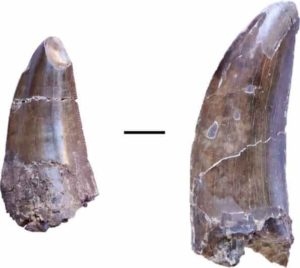
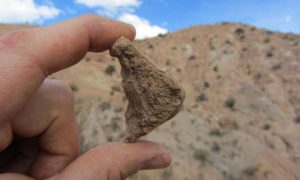
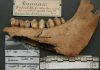
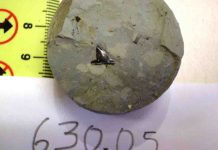
Teeth of a large dinosaur, possibly Metriacanthosauridae, from the Liuhuanggou site in the southern Junggar basin. Scale: 1 cm. Credit: University of Tübingen
The carcass of a large long-necked dinosaur in the Junggar Basin in northwestern China served as food for several other dinosaurs, Tübingen paleontologists say, citing tooth marks on the bones and several dinosaur teeth, which matched the tooth marks perfectly. A research team from the Geoscience Department at the University of Tübingen found that the large number of bite marks on the 20-meter carcass showed that other animals fed on it for a long period of time. The bones and teeth were preserved in situ by favorable climatic and geological conditions for more than 160 million years. For the paleontologists this is a rare stroke of luck, as little is known about the feeding behavior of large predatory dinosaurs. The team’s study has been published in the journal Palaeogeography, Palaeoclimatology, Palaeoecology.
At least one large carnivorous dinosaur of approximately 7.5 meters length and a smaller one some three meters long gnawed on the carcass of the long-necked mamenchisaur, says Felix Augustin, the study’s lead author. Four of the teeth found nearby, and most of the bite marks on the bones, were from the large dinosaur, a carnosaur. “Sometimes the teeth fit exactly into the holes in the bone,” Augustin reports. Another tooth found at the site enabled the researchers to identify a smaller coelurosaur, a diverse group of dinosaurs found the world over. The team believes the teeth fell out while the dinosaurs were eating. In an earlier study, the research team described much smaller tooth marks on the same skeleton as the earliest known evidence that mammals ate dinosaur meat (press release of July 31, 2020).
Trampled bones
The finds originate from today’s Junggar Basin in the province of Xinjiang in northwest China. There, researchers on a Chinese-German expedition in 2000 excavated numerous fossils of vertebrates such as turtles and crocodiles, dinosaurs and mammals from the Jurassic period, the time about 160 million years before today. The bones and teeth are currently being stored in Tübingen, where experts in vertebrate paleontology have been reviewing them since last year.
Many of the mamenchisaurus’ bones were broken in many places or even shattered. “One or more large animals must have trampled the bones when visiting the feeding place; probably it was the large carnivorous dinosaurs,” says Augustin. Some of the bones themselves appear to have been partially or completely eaten. “This is rare in carnivorous dinosaurs. So far, it has mainly been documented in tyrannosaurs.”
Reference:
Felix J. Augustin et al. A theropod dinosaur feeding site from the Upper Jurassic of the Junggar Basin, NW China, Palaeogeography, Palaeoclimatology, Palaeoecology (2020). DOI: 10.1016/j.palaeo.2020.109999
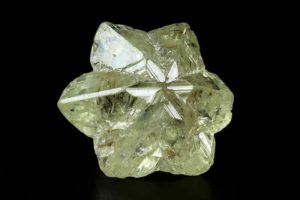
Chrysoberyl, Locality: Governador Valadares, Doce valley, Minas Gerais, BrazilOriginal description: 7.33 mm Chrysoberyl specimen with ” star ” form. Collection: D.Preite, Photo: M.Chinellato
The mineral or gemstone chrysoberyl is a beryllium aluminate with the formula BeAl2O4. The name chrysoberyl is derived from the Greekwords χρυσός chrysos and βήρυλλος beryllos, meaning “a gold-white spar”. Despite the similarity of their names, chrysoberyl and beryl are two entirely different gemstones, although they both contain beryllium. Chrysoberyl is the third hardest commonly encountered natural gemstone and lies at 8.5 on the Mohs scale of mineral hardness, between corundum (9) and topaz (8).
The ordinary chrysoberyl is yellowish-green and transparent to translucent. When the mineral has a good pale green to yellow colour and is transparent, it is used as a gemstone. The three main varieties of chrysoberyl are: ordinary yellow-green chrysoberyl, cat’s eye or cymophane, and alexandrite. Yellow-green chrysoberyl was referred to as “chrysolite” during the Victorian and Edwardian eras, which caused confusion since that name was also used for mineral olivine (‘peridot’ as a gemstone); this name is no longer used in the gemological nomenclature.
Chrysoberyl Occurrence
Chrysoberyl forms as a result of pegmatic processes. Melting in Earth’s crust produces relatively low-density molten magma, which can rise up to the surface. As the main magma body cools, the water initially present at low concentrations became more concentrated in the molten rock because it could not be incorporated into the crystallisation of solid minerals. The remaining magma thus becomes richer in water, and also in rare elements that similarly do not fit into the crystal structures of the major rock-forming minerals. Water extends the temperature range downwards before the magma becomes completely solid, allowing the concentration of rare elements to proceed to the point where they produce their own distinctive minerals. The resulting rock is igneous in appearance but formed at a low temperature by a water-rich melt, with large crystals of common minerals such as quartz and feldspar, but also with elevated concentrations of rare elements such as beryllium, lithium or niobium, often forming their own minerals; this is called pegmatite. The high water content of the magma made it possible for the crystals to grow rapidly, so that the pegmatite crystals are often quite large, increasing the likelihood of gems forming.
Chrysoberyl may also grow in country rocks near pegmatites, when pegmatite-rich be-and al-rich fluids react with surrounding minerals. It can therefore be found in mica shales and in contact with the metamorphic deposits of dolomitic marble. Because it is a hard , dense mineral that is resistant to chemical alteration, it can be wetted out of rocks and deposited in river sands and gravels in alluvial deposits with other gem minerals such as diamonds, corundum, topaz, spinel, granite and tourmaline. When found in such pleasures, there will be rounded edges instead of sharp, wedge-shaped shapes. Much of the chrysoberyl mined in Brazil and Sri Lanka is recovered from pleasure, as the host rocks have been severely weathered and eroded.
If the pegmatite fluid is rich in beryllium, beryllium or chrysoberyl crystals may form. Beryl has a high ratio of beryllium to aluminium, while the opposite is true of chrysoberyl. Both are stable with a common quartz mineral. Some chromium would also have had to be present to form alexandrite. However, beryllium and chromium do not tend to occur in the same rock types. Chromium is most common in mafic and ultramafic rocks where beryllium is extremely rare. Beryllium is concentrated in felsic pegmatites where chromium is almost absent. Therefore, the only situation where alexandrite can grow is when Be-rich pegmatite fluids react with Cr-rich country rock. This unusual requirement explains the rareness of this chrysoberyl variety.
Physical Properties of Chrysoberyl
Cleavage: {110} Distinct, {010} Imperfect, {???} Imperfect
Color: Blue green, Brown, Brownish green, Green, Gray.
Density: 3.5 – 3.84, Average = 3.67
Diaphaneity: Transparent to translucent
Fracture: Brittle – Generally displayed by glasses and most non-metallic minerals.
Habit: Prismatic – Crystals Shaped like Slender Prisms (e.g. tourmaline).
Habit: Tabular – Form dimensions are thin in one direction.
Habit: Twinning Common – Crystals are usually twinned.
Hardness: 8.5 – Chrysoberyl
Luminescence: Non-fluorescent.
Luster: Vitreous (Glassy)
Streak: white
What is chrysoberyl used for?
Chrysoberyl is not present in large deposits to be used as a beryllium ore. Its only used as a gemstone due to its very high hardness and its unique properties.
How much is chrysoberyl worth?
Chrysoberyl has recently been marketed for tens of thousands of dollars, with alexandrite chrysoberyl often hitting over $100,000.
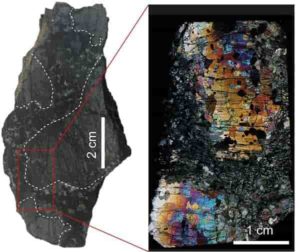
The fluid inclusions inside the olivine contain nanodiamonds, apart from serpentine, magnetite, metallic silicon and pure methane. Credit: University of Barcelona
Natural diamonds can form through low pressure and temperature geological processes on Earth, as stated in an article published in the journal Geochemical Perspectives Letters. The newfound mechanism, far from the classic view on the formation of diamonds under ultra-high pressure, is confirmed in the study, which draws on the participation of experts from the Mineral Resources Research Group of the Faculty of Earth Sciences of the University of Barcelona (UB).
Other participants in the study are the experts from the Institute of Nanoscience and Nanotechnology of the UB (IN2UB), the University of Granada (UGR), the Andalusian Institute of Earth Sciences (IACT), the Institute of Ceramics and Glass (CSIC), and the National Autonomous University of Mexico (UNAM). The study has been carried out within the framework of the doctoral thesis carried out by researcher Núria Pujol-Solà (UB), first author of the article, under the supervision of researchers Joaquín A. Proenza (UB) and Antonio García-Casco (UGR).
Diamond: The toughest of all minerals
A symbol of luxury and richness, the diamond (from the Greek αδ?μας, “invincible”) is the most valuable gem and the toughest mineral (value of 10 in Mohs scale). It is formed by chemically pure carbon, and according to the traditional hypothesis, it crystalizes the cubic system under ultra-high-pressure conditions at great depths in the Earth’s mantle.
The study confirms for the first time the formation of the natural diamond under low pressures in oceanic rocks in the Moa-Baracoa Ophiolitic Massif, in Cuba. This great geological structure is in the north-eastern side of the island and is formed by ophiolites, representative rocks of the Oceanic lithosphere.
These oceanic rocks were deposited on the continental edge of North America during the collision of the Caribbean oceanic island arch, between 70 and 40 million years ago. “During its formation in the abysmal marine seafloors, in the cretaceous period—about 120 million years ago—these oceanic rocks underwent mineral alterations due to marine water infiltrations, a process that led to small fluid inclusions inside the olivine, the most common mineral in this kind of rock,” notes Joaquín A. Proenza, member of the Department of Mineralogy, Petrology and Applied Geology at the UB and principal researcher of the project in which the article appears, and Antonio García-Casco, from the Department of Mineralogy and Petrology of the UGR.
“These fluid inclusions contain nanodiamonds of about 200 and 300 nanometres, apart from serpentine, magnetite, metallic silicon and pure methane. All these materials have formed under low pressure (<200 MPa) and temperature (<350 ºC), during the olivine alteration that contains fluid inclusions,” add the researchers.
“Therefore, this is the first description of ophiolitic diamond formed under low pressure and temperature, whose formation under natural processes does not bear any doubts,” they highlight.
Diamonds formed under low pressure and temperature
It is notable to bear in mind that the team published, in 2019, a first description of the formation of ophiolitic diamonds under low pressure conditions (Geology), a study carried out as part of the doctoral thesis by the UB researcher Júlia Farré de Pablo, supervised by Joaquín A. Proenza and the UGR professor José María González Jiménez. This study was highly debated among the members of the international scientific community.
In the current article in Geochemical Perspectives Letters, a journal of the European Association of Geochemistry, the experts detected the nanodiamonds in small fluid inclusions under the surface of the samples. The finding was carried out by using confocal Raman maps and using focused ion beams (FIB), combined with transmission electron microscopy (FIB-TEM). This is how they could confirm the presence of the diamond in the depth of the sample, and therefore, the formation of a natural diamond under low pressure in exhumed oceanic rocks. The Scientific and Technological Centres of the UB (CCiTUB) have taken part in this study, among other infrastructures supporting the country.
In this case, the study focuses its debate on the validity of some geodynamic models that, based on the presence of ophiolite diamonds, imply circulation in the mantle and large-scale lithosphere recycling. For instance, the ophiolitic diamond was thought to reflect the passing of ophiolitic rocks over the deep earth’s mantle up to the transition area (210-660 km deep) before settling into a normal ophiolite formed under low pressure (~10 km deep).
According to the experts, the low state of oxidation in this geological system would explain the formation of nano-diamonds instead of graphite, which would be expected under physical and chemical formation conditions of fluid inclusions.
Reference:
N. Pujol-Solà et al, Diamond forms during low pressure serpentinisation of oceanic lithosphere, Geochemical Perspectives Letters (2020). DOI: 10.7185/geochemlet.2029
Researchers have long been stumped for an explanation of how tens of millions of years-old giant crystals known as glendonites came to be on the Danish islands of Fur and Mors. A recent study from the University of Copenhagen offers a possible explanation to the conundrum: major volcanic eruptions resulted in episodes of much cooler prehistoric climates than once thought.
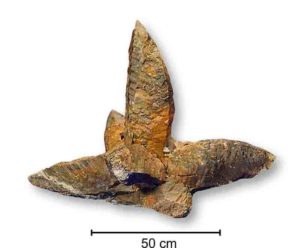
Some of the world’s largest specimens of rare calcium carbonate crystals, known as glendonites, are found in Denmark.
The crystals were formed between 56 and 54 million years ago, during a period that is known to have had some of the highest temperatures in Earth’s geologic history. Their presence has long stirred wonder among researchers the world over.
“Why we find glendonites from a hot period, when temperatures averaged above 35 degrees, has long been a mystery. It shouldn’t be possible,” explains Nicolas Thibault, an associate professor at the University of Copenhagen’s Department of Geosciences and Natural Resource Management.
This is because glendonites are composed of ikaite, a mineral that is only stable, and can therefore only crystallize, at temperatures of less than four degrees Celsius.
Volcanoes responsible for cold intervals
In their new study, Nicolas Thibault, along with department colleagues Madeleine Vickers, Christian Bjerrum and Christoph Korte, performed chemical analyses of the Danish glendonites.
Their work reveals that the early Eocene Epoch, between 56 and 48 million years ago, was not at all as uniformly warm as once thought.
“Our study proves that there must have been periods of cold during the Eocene Epoch. Otherwise, these crystals couldn’t exist—they would have simply melted. We also propose a suggestion for how this cooling might have happened, and in doing so, potentially solve the mystery of how glendonites in Denmark and the rest of the world came to be,” says Nicolas Thibault. He adds:
“There were probably a large number of volcanic eruptions in Greenland, Iceland and Ireland during this period. These released sulphuric acid droplets into the stratosphere, which could have remained there for years, shading the planet from the sun and reflecting sunlight away. This helps to explain how regionally cold areas were possible, which is what affected the climate in early Eocene Denmark.”
Layers of volcanic ash in rock
The presence of volcanic activity is revealed by, among other things, sedimentary layers visible on Fur, where layers of volcanic ash are clearly visible as bands in the coastal bluffs.
“Our study helps solve a mystery about glendonites, as well as demonstrating that cooler episodes are possible during otherwise warmer climates. The same can be said for today, as we wise up to the possibility of abrupt climate change,” concludes Nicolas Thibault.
Reference:
Madeleine L. Vickers et al, Cold spells in the Nordic Seas during the early Eocene Greenhouse, Nature Communications (2020). DOI: 10.1038/s41467-020-18558-7
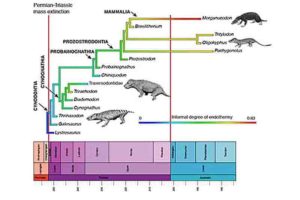
The origin of endothermy in synapsids, including the ancestors of mammals. The diagram shows the evolution of main groups through the Triassic, and the scale from blue to red is a measure of the degree of warm-bloodedness reconstructed based on different indicators of bone structure and anatomy. Credit: Mike Benton, University of Bristol. Animal images are by Nobu Tamura, Wikimedia
Mammals and birds today are warm-blooded, and this is often taken as the reason for their great success.
University of Bristol palaeontologist Professor Mike Benton, identifies in the journal Gondwana Research that the ancestors of both mammals and birds became warm-blooded at the same time, some 250 million years ago, in the time when life was recovering from the greatest mass extinction of all time.
The Permian–Triassic mass extinction killed as much as 95 per cent of life, and the very few survivors faced a turbulent world, repeatedly hit by global warming and ocean acidification crises. Two main groups of tetrapods survived, the synapsids and archosaurs, including ancestors of mammals and birds respectively.
Palaeontologists had identified indications of warm-bloodedness, or technically endothermy, in these Triassic survivors, including evidence for a diaphragm and possible whiskers in the synapsids.
More recently, similar evidence for early origin of feathers in dinosaur and bird ancestors has come to light. In both synapsids and archosaurs of the Triassic, the bone structure shows characteristics of warm-bloodedness. The evidence that mammal ancestors had hair from the beginning of the Triassic has been suspected for a long time, but the suggestion that archosaurs had feathers from 250 million years ago is new.
But a strong hint for this sudden origin of warm-bloodedness in both synapsids and archosaurs at exactly the time of the Permian-Triassic mass extinction was found in 2009. Tai Kubo, then a student studying the Masters in Palaeobiology degree at Bristol and Professor Benton identified that all medium-sized and large tetrapods switched from sprawling to erect posture right at the Permian-Triassic boundary.
Their study was based on fossilised footprints. They looked at a sample of hundreds of fossil trackways, and Kubo and Benton were surprised to see the posture shift happened instantly, not strung out over tens of millions of years, as had been suggested. It also happened in all groups, not just the mammal ancestors or bird ancestors.
Professor Benton said: “Modern amphibians and reptiles are sprawlers, holding their limbs partly sideways.
“Birds and mammals have erect postures, with the limbs immediately below their bodies. This allows them to run faster, and especially further. There are great advantages in erect posture and warm-bloodedness, but the cost is that endotherms have to eat much more than cold-blooded animals just to fuel their inner temperature control.”
The evidence from posture change and from early origin of hair and feathers, all happening at the same time, suggested this was the beginning of a kind of ‘arms race’. In ecology, arms races occur when predators and prey have to compete with each other, and where there may be an escalation of adaptations. The lion evolves to run faster, but the wildebeest also evolves to run faster or twist and turn to escape.
Something like this happened in the Triassic, from 250 to 200 million years ago. Today, warm-blooded animals can live all over the Earth, even in cold areas, and they remain active at night. They also show intensive parental care, feeding their babies and teaching them complex and smart behaviour. These adaptations gave birds and mammals the edge over amphibians and reptiles and in the present cool world allowed them to dominate in more parts of the world.
Professor Benton added: “The Triassic was a remarkable time in the history of life on Earth. You see birds and mammals everywhere on land today, whereas amphibians and reptiles are often quite hidden.
“This revolution in ecosystems was triggered by the independent origins of endothermy in birds and mammals, but until recently we didn’t realise that these two events might have been coordinated.
“That happened because only a tiny number of species survived the Permian-Triassic mass extinction — who survived depended on intense competition in a tough world. Because a few of the survivors were already endothermic in a primitive way, all the others had to become endothermic to survive in the new fast-paced world.”
Reference:
Michael J. Benton. The origin of endothermy in synapsids and archosaurs and arms races in the Triassic. Gondwana Research, 2020; DOI: 10.1016/j.gr.2020.08.003
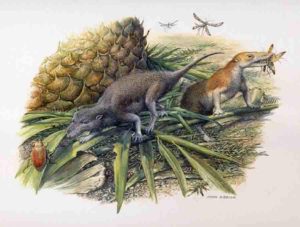
Reconstruction of Morganucodon (left) and Kuehneotherium (right) hunting in Early Jurassic Wales 200 million years ago. Credit: Original painting by John Sibbick, 2013. Copyright: Pam Gill
Pioneering analysis of 200 million-year-old teeth belonging to the earliest mammals suggests they functioned like their cold-blooded counterparts — reptiles, leading less active but much longer lives.
The research, led by the University of Bristol, UK and University of Helsinki, Finland, published today in Nature Communications, is the first time palaeontologists have been able to study the physiologies of early fossil mammals directly, and turns on its head what was previously believed about our earliest ancestors.
Fossils of teeth, the size of a pinhead, from two of the earliest mammals, Morganucodon and Kuehneotherium, were scanned for the first time using powerful X-rays, shedding new light on the lifespan and evolution of these small mammals, which roamed the earth alongside early dinosaurs and were believed to be warm-blooded by many scientists. This allowed the team to study growth rings in their tooth sockets, deposited every year like tree rings, which could be counted to tell us how long these animals lived. The results indicated a maximum lifespan of up to 14 years — much older than their similarly sized furry successors such as mice and shrews, which tend to only survive a year or two in the wild.
“We made some amazing and very surprising discoveries. It was thought the key characteristics of mammals, including their warm-bloodedness, evolved at around the same time,” said lead author Dr Elis Newham, Research Associate at the University of Bristol, and previously PhD student at the University of Southampton during the time when this study was conducted.
“By contrast, our findings clearly show that, although they had bigger brains and more advanced behaviour, they didn’t live fast and die young but led a slower-paced, longer life akin to those of small reptiles, like lizards.”
Using advanced imaging technology in this way was the brainchild of Dr Newham’s supervisor Dr Pam Gill, Senior Research Associate at the University of Bristol and Scientific Associate at the Natural History Museum London, who was determined to get to the root of its potential.
“A colleague, one of the co-authors, had a tooth removed and told me they wanted to get it X-rayed, because it can tell all sorts of things about your life history. That got me wondering whether we could do the same to learn more about ancient mammals,” Dr Gill said.
By scanning the fossilised cementum, the material which locks the tooth roots into their socket in the gum and continues growing throughout life, Dr Gill hoped the preservation would be clear enough to determine the mammal’s lifespan.
To test the theory, an ancient tooth specimen belonging to Morganucodon was sent to Dr Ian Corfe, from the University of Helsinki and the Geological Survey of Finland, who scanned it using high-powered Synchrotron X-ray radiation.
“To our delight, although the cementum is only a fraction of a millimetre thick, the image from the scan was so clear the rings could literally be counted,” Dr Corfe said.
It marked the start of a six-year international study, which focused on these first mammals, Morganucodon and Kuehneotherium, known from Jurassic rocks in South Wales, UK, dating back nearly 200 million years.
“The little mammals fell into caves and holes in the rock, where their skeletons, including their teeth, fossilised. Thanks to the incredible preservation of these tiny fragments, we were able to examine hundreds of individuals of a species, giving greater confidence in the results than might be expected from fossils so old,” Dr Corfe added.
The journey saw the researchers take some 200 teeth specimens, provided by the Natural History Museum London and University Museum of Zoology Cambridge, to be scanned at the European Synchrotron Radiation Facility and the Swiss Light Source, among the world’s brightest X-ray light sources, in France and Switzerland, respectively.
In search of an exciting project, Dr Newham took this up for the MSc in Palaeobiology at the University of Bristol, and then a PhD at the University of Southampton.
“I was looking for something big to get my teeth into and this more than fitted the bill. The scanning alone took over a week and we ran 24-hour shifts to get it all done. It was an extraordinary experience, and when the images started coming through, we knew we were onto something,” Dr Newham said.
Dr Newham was the first to analyse the cementum layers and pick up on their huge significance.
“We digitally reconstructed the tooth roots in 3-D and these showed that Morganucodon lived for up to 14 years, and Kuehneotherium for up to nine years. I was dumbfounded as these lifespans were much longer than the one to three years we anticipated for tiny mammals of the same size,” Dr Newham said.
“They were otherwise quite mammal-like in their skeletons, skulls and teeth. They had specialised chewing teeth, relatively large brains and probably had hair, but their long lifespan shows they were living life at more of a reptilian pace than a mammalian one. There is good evidence that the ancestors of mammals began to become increasingly warm-blooded from the Late Permian, more than 270 million years ago, but, even 70 million years later, our ancestors were still functioning more like modern reptiles than mammals”
While their pace-of-life remained reptilian, evidence for an intermediate ability for sustained exercise was found in the bone tissue of these early mammals. As a living tissue, bone contains fat and blood vessels. The diameter of these blood vessels can reveal the maximum possible blood flow available to an animal, critical for activities such as foraging and hunting.
Dr Newham said: “We found that in the thigh bones of Morganucodon, the blood vessels had flow rates a little higher than in lizards of the same size, but much lower than in modern mammals. This suggests these early mammals were active for longer than small reptiles but could not live the energetic lifestyles of living mammals.”
Reference:
Elis Newham, Pamela G. Gill, Philippa Brewer, Michael J. Benton, Vincent Fernandez, Neil J. Gostling, David Haberthür, Jukka Jernvall, Tuomas Kankaanpää, Aki Kallonen, Charles Navarro, Alexandra Pacureanu, Kelly Richards, Kate Robson Brown, Philipp Schneider, Heikki Suhonen, Paul Tafforeau, Katherine A. Williams, Berit Zeller-Plumhoff, Ian J. Corfe. Reptile-like physiology in Early Jurassic stem-mammals. Nature Communications, 2020; 11 (1) DOI: 10.1038/s41467-020-18898-4
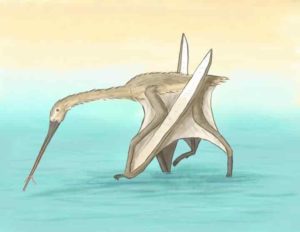
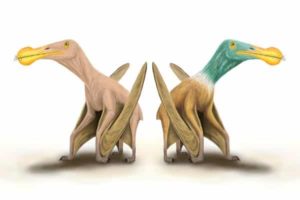
An artist’s impression of Leptostomia begaaensis Credit: Megan Jacobs, University of Portsmouth
A new species of small pterosaur — similar in size to a turkey — has been discovered, which is unlike any other pterosaur seen before due to its long slender toothless beak.
The fossilised piece of beak was a surprising find and was initially assumed to be part of the fin spine of a fish, but a team of palaeontologists from the universities of Portsmouth and Bath spotted the unusual texture of the bone — seen only in pterosaurs — and realised it was a piece of beak.
Professor David Martill of the University of Portsmouth, who co-authored the study, said: “We’ve never seen anything like this little pterosaur before. The bizarre shape of the beak was so unique, at first the fossils weren’t recognised as a pterosaur.”
Careful searching of the late Cretaceous Kem Kem strata of Morocco, where this particular bone was found, revealed additional fossils of the animal, which led to the team concluding it was a new species with a long, skinny beak, like that of a Kiwi.
Lead author of the project, University of Portsmouth PhD student Roy Smith, said: “Just imagine how delighted I was, while on field work in Morocco, to discover the lower jaw to match the upper jaw found by Dr Longrich of this utterly unique fossil animal.”
The new species, Leptostomia begaaensis, used its beak to probe dirt and mud for hidden prey, hunting like present-day sandpipers or kiwis to find worms, crustaceans, and perhaps even small hard-shelled clams.
Pterosaurs are the less well-known cousins of dinosaurs. Over 100 species of these winged-reptiles are known, some as large as a fighter jet and others as small as a sparrow.
Professor Martill said: “The diets and hunting strategies of pterosaurs were diverse — they likely ate meat, fish and insects. The giant 500-pound pterosaurs probably ate whatever they wanted.
“Some species hunted food on the wing, others stalked their prey on the ground. Now, the fragments of this remarkable little pterosaur show a lifestyle previously unknown for pterosaurs.”
The scientists used a computerised tomography (CT) scan to reveal an incredible network of internal canals for nerves that helped detect the prey underground.
Dr Nick Longrich, from the Milner Centre for Evolution at the University of Bath, said: “Leptostomia may actually have been a fairly common pterosaur, but it’s so strange — people have probably been finding bits of this beast for years, but we didn’t know what they were until now.”
Long, slender beaks evolved in many modern birds. Those most similar to Leptostomia are probing birds — like sandpipers, kiwis, curlews, ibises and hoopoes. Some of these birds forage in earth for earthworms while others forage along beaches and tidal flats, feeding on bristle worms, fiddler crabs, and small clams.
Leptostomia could probably have done either, but its presence in the Cretaceous age Kem Kem strata of Africa — representing a rich ecosystem of rivers and estuaries — suggests it was drawn there to feed on aquatic prey.
“You might think of the pterosaur as imitating the strategy used successfully by modern birds, but it was the pterosaur that got there first,” said Dr Longrich. “Birds just reinvented what pterosaurs had already done tens of millions of years earlier.”
Dr Longrich suggests the new species shows how, more than a century after pterosaurs were first discovered, there’s still so much to learn about them. He said: “We’re underestimating pterosaur diversity because the fossil record gives us a biased picture.
“Pterosaur fossils typically preserve in watery settings — seas, lakes, and lagoons — because water carries sediments to bury bones. Pterosaurs flying over water to hunt for fish tend to fall in and die, so they’re common as fossils. Pterosaurs hunting along the margins of the water will preserve more rarely, and many from inland habitats may never preserve as fossils at all.
“There’s a similar pattern in birds. If all we had of birds was their fossils, we’d probably think that birds were mostly aquatic things like penguins, puffins, ducks and albatrosses. Even though they’re a minority of the species, their fossil record is a lot better than for land birds like hummingbirds, hawks, and ostriches.”
Over time, more and more species of pterosaurs with diverse lifestyles have been discovered. That trend, the new pterosaur suggests, is likely to continue.
The paper was published today in Cretaceous Research.
Reference:
Roy E. Smith, David M. Martill, Alexander Kao, Samir Zouhri, Nicholas Longrich. A long-billed, possible probe-feeding pterosaur (Pterodactyloidea: ?Azhdarchoidea) from the mid-Cretaceous of Morocco, North Africa. Cretaceous Research, 2020; 104643 DOI: 10.1016/j.cretres.2020.104643
Researchers have discovered fossils of a tiny burrowing reptile among a vast expanse of petrified wood in eastern Arizona.
The new species has been named Skybalonyx skapter, a part of a group known as drepanosaurs from the Triassic Period, about 220 million years ago.
Petrified Forest National Park outside Holbrook is considered one of the premier places to study plants and animals from that period, sometimes known as the dawning age of dinosaurs.
The researchers say the ancient reptiles are strange because of morphologies that include enlarged second claws, bird-like beaks and tails with claws. They likely looked like a cross between an anteater and a chameleon.
They say the new species could be even stranger because it has claws that allow it to burrow, rather than climb into and live in trees, more like a mole or mole-rat.
The fossils were discovered by a team of researchers from the park, Virginia Tech, the University of Washington, Arizona State University, Idaho State University and the Virginia Museum of Natural History. They published their findings earlier this month in the Journal of Vertebrate Paleontology.
They found the fossils in the summers of 2018 and 2019 using a screen-washing technique.
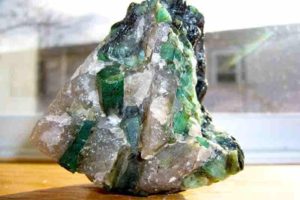
Brazilian emeralds in a quartz-pegmatite matrix. (Photo courtesy of Madereugeneandrew/Wikimedia Commons)
Rome wasn’t built in a day, but some of Earth’s finest gemstones were, according to new research from Rice University.
Aquamarine, emerald, garnet, zircon and topaz are but a few of the crystalline minerals found mostly in pegmatites, veinlike formations that commonly contain both large crystals and hard-to-find elements like tantalum and niobium. Another common find is lithium, a vital component of electric car batteries.
“This is one step towards understanding how Earth concentrates lithium in certain places and minerals,” said Rice graduate student Patrick Phelps, co-author of a study published online in Nature Communications. “If we can understand the basics of pegmatite growth rates, it’s one step in the direction of understanding the whole picture of how and where they form.”
Pegmatites are formed when rising magma cools inside Earth, and they feature some of Earth’s largest crystals. South Dakota’s Etta mine, for example, features log-sized crystals of lithium-rich spodumene, including one 42 feet in length in weighing an estimated 37 tons. The research by Phelps, Rice’s Cin-Ty Lee and Southern California geologist Douglas Morton attempts to answer a question that has long vexed mineralogists: How can such large crystals be in pegmatites?
“In magmatic minerals, crystal size is traditionally linked to cooling time,” said Lee, Rice’s Harry Carothers Wiess Professor of Geology and chair of the Department of Earth, Environmental and Planetary Sciences at Rice. “The idea is that large crystals take time to grow.”
Magma that cools rapidly, like rock in erupted lavas, contains microscopic crystals, for example. But the same magma, if cooled over tens of thousands of years, might feature centimeter-sized crystals, Lee said.
“Pegmatites cool relatively quickly, sometimes in just a few years, and yet they feature some of the largest crystals on Earth,” he said. “The big question is really, ‘How can that be?'”
When Phelps began the research, his most immediate questions were about how to formulate a set of measurements that would allow him, Lee and Morton to answer the big question.
“It was more a question of, ‘Can we figure out how fast they actually grow?'” Phelps said. “Can we use trace elements — elements that don’t belong in quartz crystals — to figure out the growth rate?”
It took more than three years, a field trip to gather sample crystals from a pegmatite mine in Southern California, hundreds of lab measurements to precisely map the chemical composition of the samples and a deep dive into some 50-year-old materials science papers to create a mathematical model that could transform the chemical profiles into crystal growth rates.
“We examined crystals that were half an inch wide and over an inch long,” Phelps said. “We showed those grew in a matter of hours, and there is nothing to suggest the physics would be different in larger crystals that measure a meter or more in length. Based on what we found, larger crystals like that could grow in a matter of days.”
Pegmatites form where pieces of Earth’s crust are drawn down and recycled in the planet’s molten mantle. Any water that’s trapped in the crust becomes part of the melt, and as the melt rises and cools, it gives rise to many kinds of minerals. Each forms and precipitates out of the melt at a characteristic temperature and pressure. But the water remains, making up a progressively higher percentage of the cooling melt.
“Eventually, you get so much water left over that it becomes more of a water-dominated fluid than a melt-dominated fluid,” Phelps said. “The leftover elements in this watery mixture can now move around a lot faster. Chemical diffusion rates are much faster in fluids and the fluids tend to flow more quickly. So when a crystal starts forming, elements can get to it faster, which means it can grow faster.”
Crystals are ordered arrangement of atoms. They form when atoms naturally fall into that arranged pattern based on their chemical properties and energy levels. For example, in the mine where Phelps collected his quartz samples, many crystals had formed in what appeared to be cracks that had opened while the pegmatite was still forming.
“You see these pop up and go through the layers of pegmatite itself, almost like veins within veins,” Phelps said. “When those cracks opened, that lowered the pressure quickly. So the fluid rushed in, because everything’s expanding, and the pressure dropped dramatically. All of a sudden, all the elements in the melt are now confused. They don’t want to be in that physical state anymore, and they rapidly start coming together in crystals.”
To decipher how quickly the sample crystals grew, Phelps used both cathodoluminescence microscopy and laser ablation with mass spectrometry to measure the precise amount of trace elements that had been incorporated into the crystal matrix at dozens of points during growth. From experimental work done by materials scientists in the mid-20th century, Phelps was able to decipher the growth rates from these profiles.
“There are three variables,” he said. “There’s the likelihood of things getting brought in. That’s the partition coefficient. There’s how fast the crystal is growing, the growth rate. And then there’s the diffusivity, so how quickly elemental nutrients are brought to the crystal.”
Phelps said the fast growth rates were quite a surprise.
“Pegmatites are pretty short-lived, so we knew they had to grow relatively fast,” he said. “But we were showing it was a few orders of magnitude faster than anyone had predicted.
“When I finally got one of these numbers, I remember going into Cin-Ty’s office, and saying, ‘Is this feasible? I don’t think this is right.'” Phelps recalled. “Because in my head, I was still kind of thinking about a thousand-year time scale. And these numbers were meaning days or hours.
“And Cin-Ty said, ‘Well, why not? Why can’t it be right?'” Phelps said. “Because we’d done the math and the physics. That part was sound. While we didn’t expect it to be that fast, we couldn’t come up with a reason why it wasn’t plausible.”
The research was supported by the National Science Foundation.
Reference:
Patrick R. Phelps, Cin-Ty A. Lee, Douglas M. Morton. Episodes of fast crystal growth in pegmatites. Nature Communications, 2020; 11 (1) DOI: 10.1038/s41467-020-18806-w
A sample of pebbly rock that U of A researchers took from an outcrop in Nunavut. The rock was found to contain both gold and diamonds—a rare combination similar to that found in the world’s richest gold deposit in South Africa. (Photo: Supplied)
The presence of diamonds in an outcrop atop an unrealized gold deposit in Canada’s Far North mirrors the association found above the world’s richest gold mine, according to University of Alberta research that fills in blanks about the thermal conditions of Earth’s crust three billion years ago.
“The diamonds we have found so far are small and not economic, but they occur in ancient sediments that are an exact analog of the world’s biggest gold deposit — the Witwatersrand Goldfields of South Africa, which has produced more than 40 per cent of the gold ever mined on Earth,” said Graham Pearson, researcher in the Faculty of Science and Canada Excellence Research Chair Laureate in Arctic Resources.
“Diamonds and gold are very strange bedfellows. They hardly ever appear in the same rock, so this new find may help to sweeten the attractiveness of the original gold discovery if we can find more diamonds.”
Pearson explained that ex-N.W.T. Geological Survey scientist Val Jackson alerted his group to an unusual outcropping on the Arctic coast that has close similarities to the Witwatersrand gold deposits.
Pearson said this outcrop of rocks, known as conglomerates, are basically the erosion product of old mountain chains that get deposited in braided river channels.
“They’re high-energy deposits that are good at carrying gold, and they’re good at carrying diamonds,” he said. “Our feeling was if the analogies are that close, then maybe there are diamonds in the Nunavut conglomerate also.”
Pearson said finding new diamond deposits in Canada’s North is critical in Canada continuing to host a $2.5-billion-per-year diamond mining industry.
So, on a hunch, Pearson used the last of his Canada Excellence Research Chair funding that brought him to the U of A, along with funding from the Metal Earth Project and the National Science Foundation, and — accompanied by post-doctoral diamond researcher Adrien Vizinet and former U of A grad student Jesse Reimink, now a professor at Penn State University — travelled to Nunavut.
Once at the site, the group — with the assistance of Silver Range Resources, whose CEO Mike Power is also a U of A alumnus — bashed off a modest 15 kilograms of the conglomerate and dated these rocks using the state-of-the-art mass spectrometry equipment at the U of A, which established their deposition to be about three billion years ago.
The group promptly delivered their samples to the Saskatchewan Research Council, the world leader in quantifying how many diamonds are in a rock.
Pearson remembers the precise moment about a year later, when the council’s Cristiana Mircea, who visits Edmonton to teach Diamond Exploration Research Training School (DERTS) students about diamond indicator mineral identification, matter-of-factly told him the sample produced three diamonds.
“My jaw hit the floor,” said Pearson. “Normally people would take hundreds of kilograms, if not tons of samples, to try and find that many diamonds. We managed to find diamonds in 15 kilos of rock that we sampled with a sledgehammer on a surface outcrop.”
Though the diamonds found are quite small — less than a millimetre in diameter — he said the geologic implications are immense.
First, Pearson said there must have been kimberlite or rock like kimberlite present to carry diamonds to the Earth’s surface in the ancient Earth — a notion many people have doubted.
Kimberlite pipes are the passageways that allow magma to erupt diamonds and other rocks and minerals from the mantle through the crust and onto the Earth’s surface.
It also helps us understand under what conditions these peculiar kimberlite rocks can form.
Pearson said an Italian collaborator, Fabrizio Nestola from the University of Padua, managed to find an inclusion — a non-diamond mineral — in one of the diamond samples. From that, Suzette Timmerman, a researcher in the Canadian Centre for Isotopic Microanalysis and a Banting Postdoctoral Fellowship recipient, began building a theory that the diamonds had to be derived from a small, deep but cool lithospheric root, which is the thickest part of the continental plate.
“This is something completely unexpected from what we think conditions were like three billion years ago on Earth,” said Pearson.
He explained that stable diamonds exist only in cool parts of the mantle, so it suggests there must have been very deep, perhaps 200-kilometre-thick cold roots beneath parts of the continent very early in Earth’s history.
Pearson said despite the U of A’s expertise in dating diamonds around the world, there’s always an argument about the relationship between the inclusion and the diamond deposit.
“Here, there’s no argument because we know when those rocks were eroded onto the Earth’s surface,” he said.
“It tells us there’s an older source, a primary source of diamonds that must have been eroded to form this diamond-plus-gold deposit,” he said.
This also means mining diamonds in the area would not necessarily require very deep mines, if more economic outcrops of these rocks can be found.
“We went up there on a float plane, bashed a piece of rock off with a sledgehammer and found three diamonds,” he said. “That’s actually one of the most astounding parts of this discovery.”
He added that the provincial government, through Alberta Innovates, clearly realized universities can help a lot in expanding and diversifying Alberta’s economy into the mining sector.
“The government’s investment enables us to chase hunches that might otherwise be difficult for industry to go and look at.”
Pearson pointed to the Collaborative Research and Training Experience grant from the Natural Sciences and Engineering Research Council of Canada, which almost instantly turned the U of A into the world’s leading diamond research institution thanks to the formation of DERTS.
“Alberta has several potential diamond deposits and areas ripe for further exploration,” he said. “I believe the University of Alberta can play a key role in helping to find and establish diamond and other mineral mines in Alberta.”
Pearson said more research is continuing on similar nearby outcrops being developed by Silver Range Resources in collaboration with the Metal Earth Project, the Nunavut government and Penn State University, to establish the extent of the diamonds and gold in these rocks, and the possible primary sources of these minerals.
The studies, “Mesoarchean Deposition Age for Diamond-Bearing Metasediment of the Northwestern Slave Craton, Nunavut Territory (Canada)” and “Diamond-Bearing Metasediments Point to Thick, Cool Lithospheric Root Established by the Mesoarchean Beneath Parts of the Slave Craton (Canada),” will be presented at the virtual fall meeting of the American Geophysical Union this December.
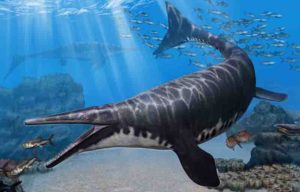
Artist’s rendering of Gavialimimus almaghribensis, a newly discovered species of mosasaur that ruled the seas of what is now Morocco some 72 to 66 million years ago. Credit: Tatsuya Shinmura
A new species of an ancient marine reptile evolved to strike terror into the hearts of the normally safe, fast-swimming fish has been identified by a team of University of Alberta researchers, shedding light on what it took to survive in highly competitive ecosystems.
Gavialimimus almaghribensis, a new type of mosasaur, was catalogued and named by an international research team led by master’s student Catie Strong, who performed the research a year ago as part of an undergrad honours thesis guided by vertebrate paleontologist Michael Caldwell, professor in the Faculty of Science, along with collaborators from the University of Cincinnati and Flinders University.
More than a dozen types of mosasaur — which can reach 17 metres in length and resemble an overgrown komodo dragon — ruled over the marine environment in what is now Morocco at the tail end of the Late Cretaceous period between 72 and 66 million years ago.
What differentiates Strong’s version, however, is that it features a long, narrow snout and interlocking teeth — similar to the crocodilian gharials, a relative of crocodiles and alligators.
Strong said this discovery adds a layer of clarity to a diverse picture seemingly overcrowded with mega-predators all competing for food, space and resources.
“Its long snout reflects that this mosasaur was likely adapted to a specific form of predation, or niche partitioning, within this larger ecosystem.”
Strong explained there is evidence that each species of the giant marine lizard shows adaptations for different prey items or styles of predation.
“For some species, these adaptations can be very prominent, such as the extremely long snout and the interlocking teeth in Gavialimimus, which we hypothesized as helping it to catch rapidly moving prey,” she said.
She added another distinctive species would be Globidens simplex — described last year by the Caldwell lab — which has stout, globular teeth adapted for crushing hard prey like shelled animals.
“Not all of the adaptations in these dozen or so species are this dramatic, and in some cases there may have been some overlap in prey items, but overall there is evidence that there’s been diversification of these species into different niches,” Strong noted.
Alternatively, the main contrasting hypothesis would be a scenario of more direct competition among species. Strong said given the anatomical differences among these mosasaurs, though, the idea of niche partitioning seems more consistent with the anatomy of these various species.
“This does help give another dimension to that diversity and shows how all of these animals living at the same time in the same place were able to branch off and take their own paths through evolution to be able to coexist like that,” she said.
The remains of the G. almaghribensis included a metre-long skull and some isolated bones. There was nothing to explain the cause of death of the specimen, which was uncovered in a phosphate mine in Morocco that is rich in fossils.
“Morocco is an incredibly good place to find fossils, especially in these phosphate mines,” Strong said. “Those phosphates themselves reflect sediments that would have been deposited in marine environments, so there are a lot of mosasaurs there.”
Reference:
Catherine R. C. Strong, Michael W. Caldwell, Takuya Konishi, Alessandro Palci. A new species of longirostrine plioplatecarpine mosasaur (Squamata: Mosasauridae) from the Late Cretaceous of Morocco, with a re-evaluation of the problematic taxon ‘Platecarpus’ ptychodon. Journal of Systematic Palaeontology, 2020; 1 DOI: 10.1080/14772019.2020.1818322
Pioneering new research has helped geologists solve a long-standing puzzle that could help pinpoint new, untapped concentrations of some the most valuable rare earth deposits. Credit: Michael Anenburg, ANU.
Pioneering new research has helped geologists solve a long-standing puzzle that could help pinpoint new, untapped concentrations of some the most valuable rare earth deposits.
A team of geologists, led by Professor Frances Wall from the Camborne School of Mines, have discovered a new hypothesis to predict where rare earth elements neodymium and dysprosium could be found.
The elements are among the most sought after, because they are an essential part of digital and clean energy manufacturing, including magnets in large wind turbines and electric cars motors.
For the new research, scientists conducted a series of experiments that showed sodium and potassium — rather than chlorine or fluorine as previously thought — were the key ingredients for making these rare earth elements soluble.
This is crucial as it determines whether they crystalise — making them fit for extraction — or stayed dissolved in fluids.
The experiments could therefore allow geologists to make better predictions about where the best concentrations of neodymium and dysprosium are likely to be found.
The results are published in the journal, Science Advances on Friday, October 9th 2020.
University of Exeter researchers, through the ‘SoS RARE’ project, have previously studied many natural examples of the roots of very unusual extinct carbonatite volcanoes, where the world’s best rare earth deposits occur, in order to try and identify potential deposits of the rare earth minerals.
However, in order to gain a greater insight into their results, they invited Michael Anenburg to join the team to carry out experiments at the Australian National University (ANU).
He simulated the crystallisation of molten carbonate magma to find out which elements would be concentrated in the hot waters left over from the crystallisation process.
It showed that sodium and potassium make the rare earths soluble in solution. Without sodium and potassium, rare earth minerals precipitate in the carbonatite itself. With sodium, intermediate minerals like burbankite form and are then replaced. With potassium, dysprosium is more soluble than neodymium and carried out to the surrounding rocks.
Professor Frances Wall, leader of the SoS RARE project said: “This is an elegant solution that helps us understand better where ‘heavy’ rare earths like dysprosium and ‘light’ rare earths like neodymium’ may be concentrated in and around carbonatite intrusions. We were always looking for evidence of chloride-bearing solutions but failing to find it. These results give us new ideas.”
Michael Anenburg , a Postdoctoral Fellow at ANU said: “My tiny experimental capsules revealed minerals that nature typically hides from us. It was a surprise how well they explain what we see in natural rocks and ore deposits.”
Reference:
Michael Anenburg, John A. Mavrogenes, Corinne Frigo and Frances Wall. Rare earth element mobility in and around carbonatites controlled by sodium, potassium, and silica. Science Advances, 2020 DOI: 10.1126/sciadv.abb6570
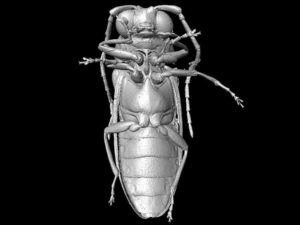
Micro-CT reconstruction of Mysteriomorphus pelevini Credit: D. Peris & R. Kundrata et al. / Scientific Reports
About a year ago, researchers found fossil specimens of beetles in an amber deposit in Myanmar, thereby describing a new beetle family that lived about 99 million years ago. However, the scientists had not been able to fully describe the morphology of the insects in the amber sample, which is why the beetles were subsequently given the mysterious name Mysteriomorphidae. An international research team led by the University of Bonn (Germany) and Palacky University (Czech Republic) has now examined four newly found specimens of the Mysteriomorphidae using computer tomography and has been able to reconstruct them. The results allow to draw conclusions about the evolution of the species during the Cretaceous period. The study has been published in the journal Scientific Reports.
Small creatures enclosed in amber can provide scientists with important information about past times, some of which date back many millions of years. In January 2019, the Spanish paleontologist Dr. David Peris, one of the two main authors of the study, collected several amber samples from the northern state of Kachin in Myanmar during a scientific trip to China and found beetle specimens from the same group as the Mysteriomorphidae.
Some of the newly found specimens showed a very good state of preservation – a good prerequisite for David Peris and his colleagues to carry out a virtual reconstruction of one of the beetles using computer tomography (CT scan). The technique used in paleontology allows researchers to study many small features of the fossils – even internal structures such as genitalia, if preserved.
While David Peris and his colleagues started to study and describe the morphology, i.e. the outer shape of the beetles, another research group also described the new family of Mysteriomorphidae by means of further specimens, that also came from the amber deposit in Myanmar. “However, the first study left some open questions about the classification of these fossils which had to be answered. We used the opportunity to pursue these questions with new technologies,” explains David Peris, researcher now at the Institute for Geosciences and Meteorology at the University of Bonn.
“We used the morphology to better define the placement of the beetles and discovered that they were very closely related to Elateridae, a current family,” explains Dr. Robin Kundrata from Palacky University, the second main author of the study and also an expert on this group of beetles. The scientists discovered important diagnostic characters that these beetle lineages share on mouthparts, thorax and abdomen.
Analysis of the evolution of beetles
Apart from the morphology, the researchers also analyzed the evolutionary history of the beetles. Earlier models had suggested that the beetles had a low extinction rate throughout their long evolutionary history, even during the Cretaceous period. However, the researchers provided a list of fossil groups of beetles described from the Cretaceous amber findings that, as Mysteriomorphidae, are only known as fossils from that time and had not survived the end of the Cretaceous period.
Background: During the Cretaceous period, flowering plants spread all over the world, replacing the old plants in the changing environment. This distribution of plants was connected with new possibilities for many associated animals and also with the development of new living beings, for example pollinators of flowers. However, most previous theories had not described that the animal species that were previously well adapted to the old plants were under pressure to adapt to the new resources and possibly became extinct. “Our results support the hypothesis that beetles, but perhaps some other groups of insects, suffered a decrease in their diversity during the time of plant revolution,” states David Peris.
Reference:
David Peris, Robin Kundrata, Xavier Delclòs, Bastian Mähler, Michael A. Ivie, Jes Rust, Conrad C. Labandeira. Unlocking the mystery of the mid-Cretaceous Mysteriomorphidae (Coleoptera: Elateroidea) and modalities in transiting from gymnosperms to angiosperms. Scientific Reports, 2020; 10 (1) DOI: 10.1038/s41598-020-73724-7
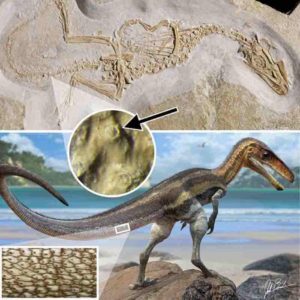
Fossil and life reconstruction of Juravenator, a small carnivorous dinosaur from the Jurassic of Germany. The arrow points to the sensory organ, which are found on polygonal scales covering the lower part of the tail. Credit: Jake Baardse.
Paleontologists have discovered remarkable evidence of the sensory capabilities in the fossilized skin of a 155-million-year-old carnivorous dinosaur.
The juvenile dinosaur, named Juravenator, comes from the Jurassic of Germany and is perfectly preserved from nose to tail, including remains of its scaly skin and other soft tissues.
Dr. Phil Bell, from the Palaeoscience Research Center at the University of New England in Armidale, Australia, is a leading researcher in the study of dinosaur skin. “Few people pay much attention to dinosaur skin, because it is assumed that they are just big, scaly reptiles,” he said. “But when I looked closely at the scales on the side of the tail, I kept finding these little ring-like features that didn’t make sense; they were certainly unlike other dinosaur scales.”
The researchers found that the ring-like features were very similar to special sensory nodes found on the scales of modern crocodiles. These nodes, called integumentary sense organs (ISOs), are responsive to touch, chemistry, and temperature information, providing crocodiles with important sensory from their surroundings.
Dinosaur specialist Dr. Christophe Hendrickx, from the Unidad Ejecutora Lillo in San Miguel de Tucumán, Argentina, who co-authored the study points out, “very little in known about dinosaur sensory organs. Sensory scales were recently assumed to be present on the snout of tyrannosaurs like T. rex based on the texture of their facial bones, but this is the first direct evidence of their presence in a dinosaur.”
Because crocodiles are aquatic predators, the researchers also speculated that Juravenator too might have hunted fish and other aquatic animals. Whereas alligators only have ISOs on the face, crocodiles have ISOs all over the body, including the tail. Although the skin on other parts of the body of Juravenator is unknown, it may have submerged its tail to detect the movement of prey underwater.
The study was published in the journal Current Biology.
Reference:
Bell, P.R. and Hendrickx, C. 2020. Crocodile-like sensory scales in a Late Jurassic theropod dinosaur. Current Biology 30: doi.org/10.1016/j.cub.2020.08.066
The debate about when dinosaurs developed feathers has taken a new turn with a paper refuting earlier claims that feathers were also found on dinosaurs’ relatives, the flying reptiles called pterosaurs.
Pterosaur expert Dr David Unwin from the University of Leicester’s Centre for Palaeobiology Research, and Professor Dave Martill, of the University of Portsmouth have examined the evidence that these creatures had feathers and believe they were in fact bald.
They have responded to a suggestion by a group of his colleagues led by Zixiao Yang that some pterosaur fossils show evidence of feather-like branching filaments, ‘protofeathers’, on the animal’s skin.
Dr Yang, from Nanjing University, and colleagues presented their argument in a 2018 paper in the journal Nature Ecology and Evolution. Now Unwin and Martill, have offered an alternative, non-feather explanation for the fossil evidence in the same journal.
While this may seem like academic minutiae, it actually has huge palaeontological implications. Feathered pterosaurs would mean that the very earliest feathers first appeared on an ancestor shared by both pterosaurs and dinosaurs, since it is unlikely that something so complex developed separately in two different groups of animals.
This would mean that the very first feather-like elements evolved at least 80 million years earlier than currently thought. It would also suggest that all dinosaurs started out with feathers, or protofeathers but some groups, such as sauropods, subsequently lost them again — the complete opposite of currently accepted theory.
The evidence rests on tiny, hair-like filaments, less than one tenth of a millimetre in diameter, which have been identified in about 30 pterosaur fossils. Among these, Yang and colleagues were only able to find just three specimens on which these filaments seem to exhibit a ‘branching structure’ typical of protofeathers.
Unwin and Martill propose that these are not protofeathers at all but tough fibres which form part of the internal structure of the pterosaur’s wing membrane, and that the ‘branching’ effect may simply be the result of these fibres decaying and unravelling.
Dr Unwin said: “The idea of feathered pterosaurs goes back to the nineteenth century but the fossil evidence was then, and still is, very weak. Exceptional claims require exceptional evidence — we have the former, but not the latter.”
Professor Martill noted that either way, palaeontologists will have to carefully reappraise ideas about the ecology of these ancient flying reptiles. He said, “If they really did have feathers, how did that make them look, and did they exhibit the same fantastic variety of colours exhibited by birds. And if they didn’t have feathers, then how did they keep warm at night, what limits did this have on their geographic range, did they stay away from colder northern climes as most reptiles do today. And how did they thermoregulate? The clues are so cryptic, that we are still a long way from working out just how these amazing animals worked.”
The paper “No protofeathers on pterosaurs” is published this week in Nature Ecology and Evolution.
Reference:
David M. Unwin, David M. Martill. No protofeathers on pterosaurs. Nature Ecology & Evolution, 2020; DOI: 10.1038/s41559-020-01308-9
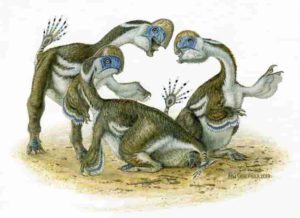
Artist’s impression of Oksoko avarsan dinosaurs (credit: Michael Skrepnick)
A newly discovered species of toothless, two-fingered dinosaur has shed light on how a group of parrot-like animals thrived more than 68 million years ago.
The unusual species had one less finger on each forearm than its close relatives, suggesting an adaptability which enabled the animals to spread during the Late Cretaceous Period, researchers say.
Multiple complete skeletons of the new species were unearthed in the Gobi Desert in Mongolia by a University of Edinburgh-led team.
Dinosaur family
Named Oksoko avarsan, the feathered, omnivorous creatures grew to around two metres long and had only two functional digits on each forearm. The animals had a large, toothless beak similar to the type seen in species of parrot today.
The remarkably well-preserved fossils provided the first evidence of digit loss in the three-fingered family of dinosaurs known as oviraptors.
The discovery that they could evolve forelimb adaptations suggests the group could alter their diets and lifestyles, and enabled them to diversify and multiply, the team says.
Finger loss
Researchers studied the reduction in size, and eventual loss, of a third finger across the oviraptors’ evolutionary history. The group’s arms and hands changed drastically in tandem with migrations to new geographic areas — specifically to what is now North America and the Gobi Desert.
The team also discovered that Oksoko avarsan — like many other prehistoric species — were social as juveniles. The fossil remains of four young dinosaurs were preserved resting together.
The study, published in the journal Royal Society Open Science, was funded by The Royal Society and the Natural Sciences and Engineering Council of Canada. It also involved researchers from the University of Alberta and Philip J. Currie Dinosaur Museum in Canada, Hokkaido University in Japan, and the Mongolian Academy of Sciences.
Dr Gregory Funston, of the University of Edinburgh’s School of GeoSciences, who led the study, said: “Oksoko avarsan is interesting because the skeletons are very complete and the way they were preserved resting together shows that juveniles roamed together in groups. But more importantly, its two-fingered hand prompted us to look at the way the hand and forelimb changed throughout the evolution of oviraptors — which hadn’t been studied before. This revealed some unexpected trends that are a key piece in the puzzle of why oviraptors were so diverse before the extinction that killed the dinosaurs.”
Reference:
Gregory F. Funston, Tsogtbaatar Chinzorig, Khishigjav Tsogtbaatar, Yoshitsugu Kobayashi, Corwin Sullivan, Philip J. Currie. A new two-fingered dinosaur sheds light on the radiation of Oviraptorosauria. Royal Society Open Science, 2020; 7 (10): 201184 DOI: 10.1098/rsos.201184
Representative Image : An artist’s rendering of Colobops noviportensis, a new species of reptile from prehistoric Connecticut. Credit: Michael Hanson
Challenging a 75-year-old notion about how and when reptiles evolved during the past 300 million-plus years involves a lot of camerawork, loads of CT scanning, and, most of all, thousands of miles of travel. Just check the stamps in Tiago R. Simões ‘ passport.
Simões is the Alexander Agassiz Postdoctoral Fellow in the lab of Harvard paleontologist Stephanie Pierce. From 2013 to 2018, he traveled to more than 20 countries and more than 50 different museums to take CT scans and photos of nearly 1,000 reptilian fossils, some hundreds of millions of years old. It amounted to about 400 days of active collection, helping form what is believed to be the largest available timeline on the evolution of major living and extinct reptile groups.
Now, a statistical analysis of that vast database is helping scientists better understand the evolution of these cold-blooded vertebrates by contradicting a widely held theory that major transitions in evolution always happened in big, quick (geologically speaking) bursts, triggered by major environmental shifts. The findings are described in a recently published paper in Nature Communications.
In it, researchers show that the evolution of extinct lineages of reptiles from more than 250 million years ago took place through many small bursts of morphological changes, such as developing armored body plans or wings for gliding, over a period of 50 million years instead of during a single major evolutionary event, as previously thought. They also show that the early evolution of most lizard lineages was a continuously slower and more incremental process than previously understood.
“It wasn’t a sudden jump that kind of established the wide diversity that we see today in reptiles,” Simões said. “There was an initial jump, but relatively small, and then a sustained increase over time of those rates [of evolution] and different diversity values.”
Evidence of this has been seen in other types of animals, but this is the first time it’s been seen in reptiles — one of the most diverse animals on the planet, with more than 10,000 different species and a dizzying variety of abilities and traits. Consider how some lizard species can freeze solid overnight then thaw the next morning, or how turtles grow protective armor.
The findings run contrary to the evolutionary theory of adaptive radiation that Harvard paleontologist George G. Simpson popularized in the 1940s, which sought to explain the origins of the planet’s biological diversity. Adaptive radiation has been the focus of intense investigation for decades, but wasn’t until recent years that the technology, methods, and data have existed to precisely measure rapid rates of evolution in the fossil record in terms of different animal species, morphologies, and at the molecular level using DNA.
Researchers of this study also included Pierce, the Thomas D. Cabot Associate Professor of Organismic and Evolutionary Biology and curator of vertebrate paleontology in the Museum of Comparative Zoology; Oksana Vernygora, a graduate student from the University of Alberta in Canada; and Professor Michael Wayne Caldwell at Alberta.
Simões traveled to almost all of the world’s major natural history museums to collect the data for the study, including the national natural history museums in London, Paris, Berlin, Ottawa, Beijing, and Tokyo. In the U.S., he visited the Smithsonian National Museum of Natural History, the Carnegie Museum of Natural History, and Harvard’s Museum of Comparative Zoology.
The scientists believe that by understanding how animals evolve over longer periods of time, they can glean a number of lessons on ecology and how organisms are affected by environmental changes. Using the database, researchers can determine when major reptile lineages or morphologies originated, see how those changes affected reptile DNA, and learn important lessons about how species were impacted by historical events.
Reptiles, for instance, have survived three major mass extinction events. The biggest was the Permian–Triassic mass extinction about 250 million years ago that killed about 90 percent of the planet’s species, earning it the moniker the Great Dying. It’s believed to have been caused by a buildup of natural greenhouse gases.
The timeline researchers created found that the rates at which reptiles were evolving and the anatomical differences among them before the Great Dying were nearly as high as after the event. However, it was only much after the Great Dying that reptiles became dominant in many ecosystems and extremely diverse in terms of the number of different species.
That finding cemented that fast rates of anatomical change don’t need to coincide with genetic diversity or an abundance of species (called taxonomic diversity), and further rebutted adaptive radiation as the only explanation for the origin of new animal groups and body plans. The researchers also note that it took reptiles almost 10 million years to recover to previous levels of anatomical diversity.
“That kind of tells you on the broad scheme of things and on a global scale how much impact, throughout the history of life, sudden environmental changes may have,” Simões said.
Further evidence that contradicted adaptive radiation included similar but surprising findings on the origins of snakes, which achieved the major aspects of their skinny, elongated body plans early in their evolution about 170 million years ago (but didn’t fully lose their limbs for another 105 million years). They also underwent rapid changes to their skulls about 170 to 165 million years ago that led to such powerful and flexible mouths that today they can swallow whole prey many times their size. But while snakes experienced the fastest rates of anatomical change in the history of reptile evolution, these changes did not coincide with increases in taxonomic diversity or high rates of molecular evolution as predicted by adaptive radiations, the researchers said.
The scientists weren’t able to pinpoint why this mismatch happens, and suggested more research is needed. In particular they want to understand how body plans evolve and how changes in DNA relate to it.
“We can see better now what are the big changes in the history of life and especially in the history of reptile life on Earth,” Simões said. “We will keep digging.”
Reference:
Tiago R. Simões, Oksana Vernygora, Michael W. Caldwell, Stephanie E. Pierce. Megaevolutionary dynamics and the timing of evolutionary innovation in reptiles. Nature Communications, 2020; 11 (1) DOI: 10.1038/s41467-020-17190-9
Note: The above post is reprinted from materials provided by Harvard University. Original written by Juan Siliezar.
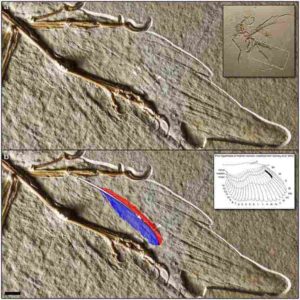
Altmühl specimen of Archaeopteryx, showing the dorsal surface of the right wing. (a) Key anatomical features denoted include two slightly curved rachis impressions (white arrows), two leading vane widths (small double arrows), the leading edge of the best-preserved UMPC (arrowhead), and a representative barb angle, which measures 25.1° (yellow lines; corresponding barb in isolated feather measures 25.2°; see Supplementary Fig. S15). Also note the posterior orientation of the UMPCs with respect to the manus and primaries, suggesting an absence of S-shaped centerlines. Inset: overview of specimen, denoting enlarged region. (b) Reconstruction of the isolated feather is overlaid at scale. Note the match in both size and shape to the underlying distal UMPC in the Altmühl specimen. Inset: black feather denotes prior hypothesis of the isolated feather’s approximate location, as a distal member of the UMPC tract9 (shown as a right wing to match that of the Altmühl specimen). Scale bar: 1 cm.
A new study provides substantial evidence that the first fossil feather ever to be discovered does belong to the iconic Archaeopteryx, a bird-like dinosaur named in Germany on this day in 1861. This debunks a recent theory that the fossil feather originated from a different species.
The research published in Scientific Reports finds that the Jurassic fossil matches a type of wing feather called a primary covert. Primary coverts overlay the primary feathers and help propel birds through the air. The international team of scientists led by the University of South Florida analyzed nine attributes of the feather, particularly the long quill, along with data from modern birds. They also examined the 13 known skeletal fossils of Archaeopteryx, three of which contain well-preserved primary coverts. The researchers discovered that the top surface of an Archaeopteryx wing has primary coverts that are identical to the isolated feather in size and shape. The isolated feather was also from the same fossil site as four skeletons of Archaeopteryx, confirming their findings.
“There’s been debate for the past 159 years as to whether or not this feather belongs to the same species as the Archaeopteryx skeletons, as well as where on the body it came from and its original color,” said lead author Ryan Carney, assistant professor of integrative biology at USF. “Through scientific detective work that combined new techniques with old fossils and literature, we were able to finally solve these centuries-old mysteries.”
Using a specialized type of electron microscope, the researchers determined that the feather came from the left wing. They also detected melanosomes, which are microscopic pigment structures. After refining their color reconstruction, they found that the feather was entirely matte black, not black and white as another study has claimed.
Carney’s expertise on Archaeopteryx and diseases led to the National Geographic Society naming him an “Emerging Explorer,” an honor that comes with a $10,000 grant for research and exploration. He also teaches a course at USF, called “Digital Dinosaurs.” Students digitize, animate and 3D-print fossils, providing valuable experience in paleontology and STEAM fields.
Reference:
Ryan M. Carney, Helmut Tischlinger, Matthew D. Shawkey. Evidence corroborates identity of isolated fossil feather as a wing covert of Archaeopteryx. Scientific Reports, 2020; 10 (1) DOI: 10.1038/s41598-020-65336-y
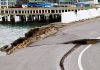
Soldiers remove bricks from the road after earthquake in Rongxian county on 25 February 2019. | Credit: IC
An unusually shallow earthquake triggered by hydraulic fracturing in a Chinese shale gas field could change how experts view the risks of fracking for faults that lie very near the Earth’s surface.
In the journal Seismological Research Letters, Hongfeng Yang of The Chinese University of Hong Kong and colleagues suggest that the magnitude 4.9 earthquake that struck Rongxian County, Sichuan, China on 25 February 2019 took place along a fault about one kilometer (0.6 miles) deep.
The earthquake, along with two foreshocks with magnitudes larger than 4, appear to be related to activity at nearby hydraulic fracturing wells. Although earthquakes induced by human activity such as fracking are typically more shallow than natural earthquakes, it is rare for any earthquake of this size to take place at such a shallow depth.
“Earthquakes with much smaller magnitudes, for example magnitude 2, have been reported at such shallow depths. They are understood by having small scale fractures in such depths that can slip fast,” said Yang. “However, the dimensions of earthquakes are scale-dependent. Magnitude 4 is way bigger than magnitude 2 in term of rupture length and width, and thus needs a sizeable fault as the host.”
“The results here certainly changed our view in that a shallow fault can indeed slip seismically,” he added. “Therefore, we should reconsider our strategies of evaluating seismic risk for shallow faults.”
Two people died and twelve were injured in the 25 February earthquake, and the economic loss due to the event has been estimated at 14 million RMB, or about $2 million. There have been few historic earthquakes in the region, and before 2019 there had been no earthquakes larger than magnitude 3 on the fault where the main earthquake took place.
Since 2018, there have been at least 48 horizontal fracking wells drilled from 13 well pads in the region, with three well pads less than two kilometers (1.2 miles) from the Molin fault, where the main earthquake took place.
Yang and his colleagues located the earthquakes and were able to calculate the length of the main rupture using local and regional seismic network data, as well as InSAR satellite data.
It is unusual to see clear satellite data for a small earthquake like this, Yang said. “InSAR data are critical to determine the depth and accurate location of the mainshock, because the ground deformation was clearly captured by satellite images,” he noted. “Given the relatively small size of the mainshock, it would not be able to cause deformation above the ‘noise’ level of satellite data if it were deeper than about two kilometers.”
The two foreshocks took place on a previously unmapped fault in the area, the researchers found, underscoring how difficult it can be to prevent fracking-induced earthquakes in an area where fault mapping is incomplete.
The researchers note that the Molin fault is separated from the geologic formation where fracking took place by a layer of shale about 800 meters (2625 feet) thick. The separating layer sealed off the fault from fracking fluids, so it is unlikely that the pressures of fluid injected into rock pores around the fault caused the fault to slip. Instead, Yang and colleagues suggest that changes in elastic stress in rock may have triggered the main earthquake on the Molin fault, which was presumed to be stable.
“The results here certainly pose a significant concern: we cannot ignore a shallow fault that was commonly thought to be aseismic,” Yang said, who said more public information on fracking injection volume, rate and duration could help calculate safe distances for well placement in the future.
Reference:
Hongfeng Yang, Pengcheng Zhou, Nan Fang, Gaohua Zhu, Wenbin Xu, Jinrong Su, Fanbao Meng, Risheng Chu. A Shallow Shock: The 25 February 2019 ML 4.9 Earthquake in the Weiyuan Shale Gas Field in Sichuan, China. Seismological Research Letters, 2020; DOI: 10.1785/0220200202
A skeletal mount of the mosasaur ‘Gnathomortis stadtmani’ at BYU’s Eyring Science Center. USU Eastern paleontologist Josh Lively named the giant marine lizard that roamed the oceans of North America toward the end of the Age of Dinosaurs. Courtesy BYU.
Some 92 to 66 million years ago, as the Age of Dinosaurs waned, giant marine lizards called mosasaurs roamed an ocean that covered North America from Utah to Missouri and Texas to the Yukon. The air-breathing predators were streamlined swimmers that devoured almost everything in their path, including fish, turtles, clams and even smaller mosasaurs.
Coloradoan Gary Thompson discovered mosasaur bones near the Delta County town of Cedaredge in 1975, which the teen reported to his high school science teacher. The specimens made their way to Utah’s Brigham Young University, where, in 1999, the creature that left the fossils was named Prognathodon stadtmani.
“I first learned of this discovery while doing background research for my Ph.D.,” says newly arrived Utah State University Eastern paleontologist Joshua Lively, who recently took the reins as curator of the Price campus’ Prehistoric Museum. “Ultimately, parts of this fossil, which were prepared since the original description in 1999, were important enough to become a chapter in my 2019 doctoral dissertation.”
Upon detailed research of the mosasaur’s skeleton and a phylogenetic analysis, Lively determined the BYU specimen is not closely related to other species of the genus Prognathodon and needed to be renamed. He reclassified the mosasaur as Gnathomortis stadtmani and reports his findings in the most recent issue of the Journal of Vertebrate Paleontology.
His research was funded by the Geological Society of America, the Evolving Earth Foundation, the Texas Academy of Science and the Jackson School of Geosciences at The University of Texas at Austin.
“The new name is derived from Greek and Latin words for ‘jaws of death,'” Lively says. “It was inspired by the incredibly large jaws of this specimen, which measure four feet (1.2 meters) in length.”
An interesting feature of Gnathomortis’ mandibles, he says, is a large depression on their outer surface, similar to that seen in modern lizards, such as the Collared Lizard. The feature is indicative of large jaw muscles that equipped the marine reptile with a formidable biteforce.
“What sets this animal apart from other mosasaurs are features of the quadrate — a bone in the jaw joint that also forms a portion of the ear canal,” says Lively, who returned to the fossil’s Colorado discovery site and determined the age interval of rock, in which the specimen was preserved.
“In Gnathomortis, this bone exhibits a suite of characteristics that are transitional from earlier mosasaurs, like Clidastes, and later mosasaurs, like Prognathodon. We now know Gnathomortis swam in the seas of Colorado between 79 and 81 million years ago, or at least 3.5 million years before any species of Prognathodon.”
He says fossil enthusiasts can view Gnathomortis’ big bite at the BYU Museum of Paleontology in Provo, Utah, and see a cast of the skull at the Pioneer Town Museum in Cedaredge, Colorado. Reconstructions of the full skeleton are on display at the John Wesley Powell River History Museum in Green River, Utah, and in BYU’s Eyring Science Center.
“I’m excited to share this story, which represents years of effort by many citizen scientists and scholars, as I kick off my new position at USU Eastern’s Prehistoric Museum,” Lively says. “It’s a reminder of the power of curiosity and exploration by people of all ages and backgrounds.”
Reference:
Joshua R. Lively. Redescription and phylogenetic assessment of ‘Prognathodon’ stadtmani: implications for Globidensini monophyly and character homology in Mosasaurinae. Journal of Vertebrate Paleontology, 2020; e1784183 DOI: 10.1080/02724634.2020.1784183
Note: The above post is reprinted from materials provided by Utah State University. Original written by Mary-Ann Muffoletto.