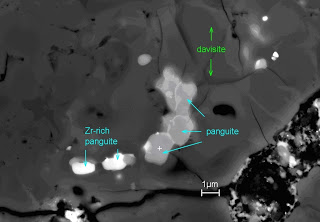
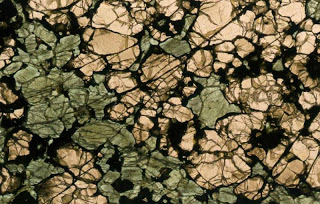
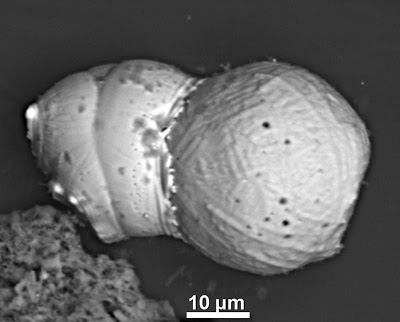
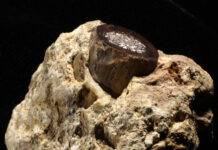
Panguite is embedded in a piece of the Allende meteorite. – Chi Ma / Caltech
In 1969, an exploding fireball tore through the sky over Mexico, scattering thousands of pieces of meteorite across the state of Chihuahua. More than 40 years later, the Allende meteorite is still serving the scientific community as a rich source of information about the early stages of our solar system’s evolution. Recently, scientists from the California Institute of Technology (Caltech) discovered a new mineral embedded in the space rock-one they believe to be among the oldest minerals formed in the solar system.
Dubbed panguite, the new titanium oxide is named after Pan Gu, the giant from ancient Chinese mythology who established the world by separating yin from yang to create the earth and the sky. The mineral and the mineral name have been approved by the International Mineralogical Association’s Commission on New Minerals, Nomenclature and Classification. A paper outlining the discovery and the properties of this new mineral will be published in the July issue of the journal American Mineralogist, and is available online now.
“Panguite is an especially exciting discovery since it is not only a new mineral, but also a material previously unknown to science,” says Chi Ma, a senior scientist and director of the Geological and Planetary Sciences division’s Analytical Facility at Caltech and corresponding author on the paper.
The Allende meteorite is the largest carbonaceous chondrite-a diverse class of primitive meteorites-ever found on our planet and is considered by many the best-studied meteorite in history. As a result of an ongoing nanomineralogy investigation of primitive meteorites-which Ma has been leading since 2007-nine new minerals, including panguite, have been found in the Allende meteorite. Some of those new finds include the minerals allendeite, hexamolybdenum, tistarite, and kangite. Nanomineralogy looks at tiny particles of minerals and the minuscule features within those minerals.
“The intensive studies of objects in this meteorite have had a tremendous influence on current thinking about processes, timing, and chemistry in the primitive solar nebula and small planetary bodies,” says coauthor George Rossman, the Eleanor and John R. McMillan Professor of Mineralogy at Caltech.
Panguite was observed first under a scanning electron microscope in an ultra-refractory inclusion embedded in the meteorite. Refractory inclusions are among the first solid objects formed in our solar system, dating back to before the formation of Earth and the other planets. “Refractory” refers to the fact that these inclusions contain minerals that are stable at high temperatures and in extreme environments, which attests to their likely formation as primitive, high-temperature liquids produced by the solar nebula.
According to Ma, studies of panguite and other newly discovered refractory minerals are continuing in an effort to learn more about the conditions under which they formed and subsequently evolved. “Such investigations are essential to understand the origins of our solar system,” he says.
Note: This story has been adapted from a news release issued by the California Institute of Technology
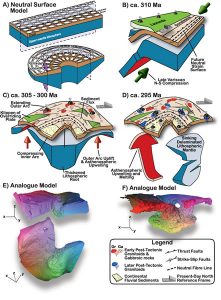
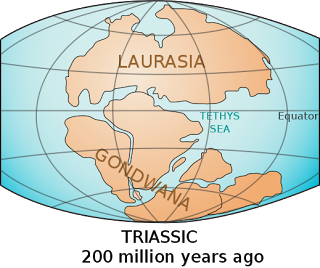
(A) Block diagram depicting the effect of lithospheric bending around a vertical axis and the resultant strain field (modified tangential longitudinal strain). Strain ellipses depict arc-parallel shortening in the inner arc and arc-parallel stretching in the outer arc. Note the different behavior of the mantle lithosphere in the inner and outer arcs and the increase in thickness of mantle lithosphere below the inner arc and thinning below the outer arc. (B) Snapshot illustration of arc development starting with a linear belt resulting from a Gondwana–Laurentia collision. (C) Second snapshot illustrating oroclinal bending, which causes lithospheric stretching in the outer arc and thickening beneath the inner arc (Gutiérrez-Alonso et al., 2004). (D) The final stage of oroclinal bending, depicting delamination and collapse of thickened lithospheric root beneath the inner arc, replacement of sinking lithosphere by upwelling asthenospheric mantle, and associated magmatism in the inner and outer arc regions. (E) Two tomographic views of the analogue modeled mantle lithosphere geometry after buckling around a vertical axis where the lithospheric root is developed under the inner arc (top—frontal view from the concave part of the model; bottom—view from below); 3-D coordinate axes given. (F) Tomographic 3-D image of the delaminated lithospheric root obtained with analogue modeling; 3-D coordinate axes given.
Mountain belts on Earth are most commonly formed by collision of one or more tectonic plates. The process of collision, uplift, and subsequent erosion of long mountain belts often produces profound global effects, including changes in regional and global climates, as well as the formation of important economic resources, including oil and gas reservoirs and ore deposits. Understanding the formation of mountain belts is thus a very important element of earth science research.
One common but poorly understood aspect of mountain belts are the many examples of curved (arcuate) mountain ranges. The Appalachian range in Pennsylvania, the Rocky Mountains in central Montana, the Blue Mountains in Oregon, the Bolivian Andes of South America, and the Cantabrian Arc in Spain and northern Africa are among many examples of noticeably curved mountain belts.
The cause of these curvy mountains is among the oldest topics of research in geology, and there is still extensive debate on what mechanisms are most important for making a curvy mountain range.
A common question is whether these presently curvy mountain ranges were originally straight and then later bent or whether they were uplifted in more or less their present shape.
Another important aspect of the origin of these curved mountain ranges is the thickness of the rock units involved in their formation. Some workers have proposed that these ranges are composed of relatively thin slices of crustal rocks (limited to several kilometers in thickness), while others have argued that at least some of these curvy ranges involve the entire thickness of the lithospheric plates (30 to 100 km thick). One of the most promising ways to answer these questions utilizes comparisons of the orientation of structural features in rocks (fault planes and joints), records of the ancient magnetic field directions found in rocks, and the timing of deformation and uplift of the mountain belts.
An international group of researchers from Spain, Canada, and the United States, led by Dr. Gabriel Gutiérrez-Alonso, have presented a compelling study of one of the best examples of curved mountain ranges: the Cantabrian Arc in Spain and northern Africa. They have compiled an extensive collection of fault and joint orientation data and directions of the ancient geomagnetic field recorded by Paleozoic rocks collected in Spain.
The Cantabrian Arc was formed during the collision of a southern set of continents (Gondwanaland [present day Africa-South America-Australia-India-Antarctica]) with a northern set of continents (Laurentia [present day North America and Eurasia]) to produce the supercontinent Pangea. In a nutshell, their combined study has found that the curved pattern of the Cantabrian Arc was produced by the bending of an originally straight mountain range.
The main line of evidence supporting this view is the patterns of rotation that are obtained from the directions of the ancient geomagnetic field recorded by the rocks of these mountain ranges. Combined with an analysis of the faults and joints in the rocks, and the ages of rocks that have variations in the amount of rotation indicated by the magnetic directions, the age of the bending of the Cantabrian Arc is confined to a relatively narrow window of geological time between 315 and 300 million years ago.
Gutiérrez-Alonso and colleagues compare the age range of this mountain bending event to the ages of igneous activity and uplift of the region and propose that widespread changes in the deeper (mantle) portion of the lithospheric plate in the area are coeval, and likely linked to, the rotation of the Cantabrian Arc to produce its characteristic sharp curviness. Based on this linkage, they propose that this, and perhaps many other, curvy mountain ranges are produced by rotation of entire portions of the lithosphere of tectonic plates, rather than just thin slices of crustal rocks.
Note : The above story is reprinted from materials provided by Geological Society of America.
An artistic expression of how a large meteorite impact into the sea might have looked in the first second of the impacting. We do not know if the area that was hit was actually covered by water or if there was just a sea nearby. Source: (Credit: Carsten Egestal Thuesen, GEUS)
A 100 kilometre-wide crater has been found in Greenland, the result of a massive asteroid or comet impact a billion years before any other known collision on Earth.
The spectacular craters on the Moon formed from impacts with asteroids and comets between 3 and 4 billion years ago. The early Earth, with its far greater gravitational mass, must have experienced even more collisions at this time — but the evidence has been eroded away or covered by younger rocks. The previously oldest known crater on Earth formed 2 billion years ago and the chances of finding an even older impact were thought to be, literally, astronomically low.
Now, a team of scientists from Cardiff, the Geological Survey of Denmark and Greenland (GEUS) in Copenhagen, Lund University in Sweden and the Institute of Planetary Science in Moscow has upset these odds. Following a detailed programme of fieldwork, funded by GEUS and the Danish ‘Carlsbergfondet’ (Carlsberg Foundation), the team have discovered the remains of a giant 3 billion year old impact near the Maniitsoq region of West Greenland.
“This single discovery means that we can study the effects of cratering on the Earth nearly a billion years further back in time than was possible before,” according to Dr Iain McDonald of the School of Earth and Ocean Sciences, who was part of the team.
Finding the evidence was made all the harder because there is no obvious bowl-shaped crater left to find. Over the 3 billion years since the impact, the land has been eroded down to expose deeper crust 25 km below the original surface. All external parts of the impact structure have been removed, but the effects of the intense impact shock wave penetrated deep into the crust — far deeper than at any other known crater — and these remain visible.
However, because the effects of impact at these depths have never been observed before it has taken nearly three years of painstaking work to assemble all the key evidence. “The process was rather like a Sherlock Holmes story,” said Dr McDonald. “We eliminated the impossible in terms of any conventional terrestrial processes, and were left with a giant impact as the only explanation for all of the facts.”
Only around 180 impact craters have ever been discovered on Earth and around 30% of them contain important natural resources of minerals or oil and gas. The largest and oldest known crater prior to this study, the 300 kilometre wide Vredefort crater in South Africa, is 2 billion years in age and heavily eroded.
Dr McDonald added that “It has taken us nearly three years to convince our peers in the scientific community of this but the mining industry was far more receptive. A Canadian exploration company has been using the impact model to explore for deposits of nickel and platinum metals at Maniitsoq since the autumn of 2011.”
Note : The above story is reprinted from materials provided by Cardiff University.
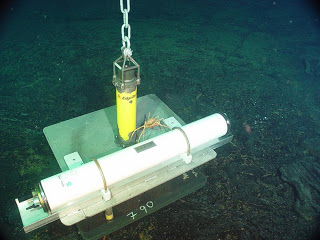
A spider crab inspects an ocean-bottom hydrophone (OBH) as it sits on the seafloor at Axial Seamount before the 2011 eruption. The OBH is a monitoring instrument designed to detect undersea earthquakes. The chain is connected to flotation above the view of the photo. (Credit: Bill Chadwick, Oregon State University)
A team of scientists that last year created waves by correctly forecasting the 2011 eruption of Axial Seamount years in advance now says that the undersea volcano located some 250 miles off the Oregon coast gave off clear signals just hours before its impending eruption.
The researchers’ documentation of inflation of the undersea volcano from gradual magma intrusion over a period of years led to the long-term eruption forecast. But new analyses using data from underwater hydrophones also show an abrupt spike in seismic energy about 2.6 hours before the eruption started, which the scientists say could lead to short-term forecasting of undersea volcanoes in the future.
They also say that Axial could erupt again — as soon as 2018 — based on the cyclic pattern of ground deformation measurements from bottom pressure recorders.
Results of the research, which was funded by the National Science Foundation, the National Oceanic and Atmospheric Administration, and the Monterey Bay Aquarium Research Institute (MBARI), are being published this week in three separate articles in the journal Nature Geoscience.
Bill Chadwick, an Oregon State University geologist and lead author on one of the papers, said the link between seismicity, seafloor deformation and the intrusion of magma has never been demonstrated at a submarine volcano, and the multiple methods of observation provide fascinating new insights.
“Axial Seamount is unique in that it is one of the few places in the world where a long-term monitoring record exists at an undersea volcano — and we can now make sense of its patterns,” said Chadwick, who works out of Oregon State’s Hatfield Marine Science Center in Newport, Ore. “We’ve been studying the site for years and the uplift of the seafloor has been gradual and steady beginning in about 2000, two years after it last erupted.
“But the rate of inflation from magma went from gradual to rapid about 4-5 months before the eruption,” added Chadwick. “It expanded at roughly triple the rate, giving a clue that the next eruption was coming.”
Bob Dziak, an Oregon State University marine geologist, had previously deployed hydrophones on Axial that monitor sound waves for seismic activity. During a four-year period prior to the 2011 eruption, there was a gradual buildup in the number of small earthquakes (roughly magnitude 2.0), but little increase in the overall “seismic energy” resulting from those earthquakes.
That began to change a few hours before the April 6, 2011, eruption, said Dziak, who also is lead author on one of the Nature Geoscience articles.
“The hydrophones picked up the signal of literally thousands of small earthquakes within a few minutes, which we traced to magma rising from within the volcano and breaking through the crust,” Dziak said. “As the magma ascends, it forces its way through cracks and creates a burst of earthquake activity that intensifies as it gets closer to the surface.
“Using seismic analysis, we were able to clearly see how the magma ascends within the volcano about two hours before the eruption,” Dziak said. “Whether the seismic energy signal preceding the eruption is unique to Axial or may be replicated at other volcanoes isn’t yet clear — but it gives scientists an excellent base from which to begin.”
The researchers also used a one-of-a-kind robotic submersible to bounce sound waves off the seafloor from an altitude of 50 meters, mapping the topography of Axial Seamount both before and after the 2011 eruption at a one-meter horizontal resolution. These before-and-after surveys allowed geologists to clearly distinguish the 2011 lava flows from the many previous flows in the area.
MBARI researchers used three kinds of sonar to map the seafloor around Axial, and the detailed images show lava flows as thin as eight inches, and as thick as 450 feet.
“These autonomous underwater vehicle-generated maps allowed us, for the first time, to comprehensively map the thickness and extent of lava flows from a deep-ocean submarine in high resolution,” said David Caress, an MBARI engineer and lead author on one of the Nature Geoscience articles. “These new observations allow us to unambiguously differentiate between old and new lava flows, locate fissures from which these flows emerged, and identify fine-scale features formed as the lava flowed and cooled.”
The researchers also used shipboard sonar data to map a second, thicker lava flow about 30 kilometers south of the main flow — also a likely result of the 2011 eruption.
Knowing the events leading up to the eruption — and the extent of the lava flows — is important because over the next few years researchers will be installing many new instruments and underwater cables around Axial Seamount as part of the Ocean Observatories Initiative. These new instruments will greatly increase scientists’ ability to monitor the ocean and seafloor off of the Pacific Northwest.
“Now that we know some of the long-term and short-term signals that precede eruptions at Axial, we can monitor the seamount for accelerated seismicity and inflation,” said OSU’s Dziak. “The entire suite of instruments will be deployed as part of the Ocean Observatories Initiative in the next few years — including new sensors, samplers and cameras — and next time they will be able to catch the volcano in the act.”
The scientists also observed and documented newly formed hydrothermal vents with associated biological activity, Chadwick said.
“We saw snowblower vents that were spewing out nutrients so fast that the microbes were going crazy,” he pointed out. “Combining these biological observations with our knowledge of the ground deformation, seismicity and lava distribution from the 2011 eruption will further help us connect underwater volcanic activity with the life it supports.”
Scientists from Columbia University, the University of Washington, North Carolina State University, and the University of California at Santa Cruz also participated in the project and were co-authors on the Nature Geoscience articles.
Note : The above story is reprinted from materials provided by Oregon State University.
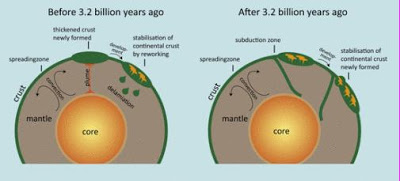
“Plate tectonics theory can be applied to about 3 billion years of the Earth’s history. However, the Earth is older, up to 4.567 billion years old. We can now demonstrate that there has been a significant shift in the Earth’s dynamics. Thus, the Earth, under the first third of its history, developed under conditions other than what can be explained using the plate tectonics model,” explains Tomas Næraa. (Credit: Image courtesy of University of Copenhagen)
The current theory of continental drift provides a good model for understanding terrestrial processes through history. However, while plate tectonics is able to successfully shed light on processes up to 3 billion years ago, the theory isn’t sufficient in explaining the dynamics of Earth and crust formation before that point and through to the earliest formation of planet, some 4.6 billion years ago. This is the conclusion of Tomas Naæraa of the Nordic Center for Earth Evolution at the Natural History Museum of Denmark, a part of the University of Copenhagen. His new doctoral dissertation has just been published by the journal Nature.
“Using radiometric dating, one can observe that Earth’s oldest continents were created in geodynamic environments which were markedly different than current environments characterised by plate tectonics. Therefore, plate tectonics as we know it today is not a good model for understanding the processes at play during the earliest episodes of Earths’s history, those beyond 3 billion years ago. There was another crust dynamic and crust formation that occurred under other processes,” explains Tomas Næraa, who has been a PhD student at the Natural History Museum of Denmark and the Geological Survey of Denmark and Greenland — GEUS.
Plate tectonics is a theory of continental drift and sea floor spreading. A wide range of phenomena from volcanism, earthquakes and undersea earthquakes (and pursuant tsunamis) to variations in climate and species development on Earth can be explained by the plate tectonics model, globally recognized during the 1960’s. Tomas Næraa can now demonstrate that the half-century old model no longer suffices.
“Plate tectonics theory can be applied to about 3 billion years of the Earth’s history. However, the Earth is older, up to 4.567 billion years old. We can now demonstrate that there has been a significant shift in the Earth’s dynamics. Thus, the Earth, under the first third of its history, developed under conditions other than what can be explained using the plate tectonics model,” explains Tomas Næraa. Tomas is currently employed as a project researcher at GEUS.
Central research topic for 30 years
Since 2006, the 40-year-old Tomas Næraa has conducted studies of rocks sourced in the 3.85 billion year-old bedrock of the Nuuk region in West Greenland. Using isotopes of the element hafnium (Hf), he has managed to shed light upon a research topic that has puzzled geologists around the world for 30 years. Næraa’s instructor, Professor Minik Rosing of the Natural History Museum of Denmark considers Næraa’s dissertation a seminal work:
“We have come to understand the context of the Earth’s and continent’s origins in an entirely new way. Climate and nutrient cycles which nourish all terrestrial organisms are driven by plate tectonics. So, if the Earth’s crust formation was controlled and initiated by other factors, we need to find out what controlled climate and the environments in which life began and evolved 4 billion years ago. This fundamental understanding can be of great significance for the understanding of future climate change,” says Minik Rosing, who adds that: “An enormous job waits ahead, and Næraas’ dissertation is an epochal step.”
Note : The above story is reprinted from materials provided by University of Copenhagen.
Yifeng Wang examines a sedimentary outcrop in New Mexico’s Tijeras Canyon. Wang is the lead author of a paper published recently in Nature Communications that offers new insights into pore size and distribution in horizontal slices of sedimentary rock. (Credit: Randy Montoya)
A Sandia modeling study contradicts a long-held belief of geologists that pore sizes and chemical compositions are uniform throughout a given strata, which are horizontal slices of sedimentary rock.
By understanding the variety of pore sizes and spatial patterns in strata, geologists can help achieve more production from underground oil reservoirs and water aquifers. Better understanding also means more efficient use of potential underground carbon storage sites, and better evaluations of the possible movement of radionuclides in nuclear waste depositories to determine how well the waste will be isolated.
“I think our paper for the first time provides a reasonable explanation for the origin of patterns,” said lead researcher Yifeng Wang. “We found we could predict the variations in pores as well as the heterogeneity of a reservoir.”
The analysis, published Feb. 21 in Nature Communications, was able to match the field observations published in 2006 by second author David Budd, professor of geological sciences at the University of Colorado at Boulder.
Budd said Wang put together a session at the 2010 annual meeting of the Geochemical Society at which Budd presented field studies of porosity and chemical composition. “He recognized that the data I showed could be explained by stress-induced chemical waves. He subsequently developed the numerical model to test his idea. Then we used the 2006 data set to demonstrate the correspondence between his model’s outcomes and the field data.”
A chemical wave in this context relies upon mineral dissolution and precipitation, powered by geologic stress, to penetrate surrounding material, just as an ocean wave powered by the moon’s gravitational pull rides up on a beach. Ocean waves shift sand; Wang found that chemical waves modify the spatial distribution of rock porosity.
As Wang puts it, a chemical wave is “like water rippling. The concentration of a chemical species varies periodically in space (a standing wave) or sometime such variations propagate through space (a travelling wave).
“The one we revealed in dolomite (a type of sedimentary rock) may be the largest chemical wave ever known, because no one has thought to look for chemical waves in strata. It occurred on the scale of meters to tens of meters and propagated between a hundred to a thousand years.” Chemical waves are usually observed on much smaller scales in laboratories.
Using the chemical wave concept and well-known equations for material stresses, Wang formulated a mathematical model.
The upper diagram portrays the mechanism driving a chemical wave, with stress from surrounding formations acting to percolate water through a horizontal layer of dolomite. The bottom graph shows the results of high-resolution sampling performed every 0.3 meters showing complex patterns of lateral porosity and permeability in dolomite strata. The solid red line is a three-day moving average. The images are modified from the technical paper. (Image by Yifeng Wang) Click on thumbnail for high-resolution image.
“The remarkable thing is that the model predictions match very well with many seemingly uncorrelated observations. The model predictions not only match the observed porosity patterns, but also match very well with chemical and isotopic signatures. This is the power of mathematical analysis,” Wang said.
Wang’s model isn’t large enough yet to derive equations meaningful to an entire reservoir — a process called upscaling. Still, he said, “Another way to capture this variability is to use mathematical analysis to derive upscaled flow-transport equations. This work is on the way.”
The work may help trounce geologists’ belief that each layer of sedimentary rock, deposited over eons, is more or less homogenous in porosity and composition. Thus a single core sample obtained from a given depth was thought to chemically represent the entire layer.
But Budd’s findings showed that horizontal variations within a layer of sedimentary rock could be quite significant — in some cases, as large as vertical variations. This would affect not only the amount of fluid stored or percolating through a rock but the amount of pressure needed to shoot liquids to Earth’s surface. No one knew why these variations occurred, nor had anyone measured their magnitude.
The problem has always been how to extend horizontally the knowledge gained from vertical bore holes that may be 1,300 feet apart, Budd said.
Wang’s model also reveals important information about Earth’s geological changes.
“Even the shape of a variation may reveal important facts about past times,” he said. “Our work may have geologists rethinking their method of field sampling and their interpretation of data about Earth’s evolution.”
Note : The above story is reprinted from materials provided by Sandia National Laboratories, via Newswise.
The influence of the ground beneath us on the air around us could be greater than scientists had previously thought, according to new research that links the long-ago proliferation of oxygen in Earth’s atmosphere to a sudden change in the inner workings of our planet. (Credit: Copyright Michele Hogan)
Princeton University researchers report in the journal Nature that rocks preserved in Earth’s crust reveal that a steep decline in the intensity of melting within the planet’s mantle — the hot, heat-transferring rock layer between the crust and molten outer core — brought about ideal conditions for the period known as the Great Oxygenation Event (GOE) that occurred roughly 2.5 billion years
During the GOE — which may have lasted up to 900 million years — oxygen levels in the atmosphere exploded and eventually gave rise to our present atmosphere.
Blair Schoene, a Princeton assistant professor of geosciences, and lead author C. Brenhin Keller, a Princeton geosciences doctoral student, compiled a database of more than 70,000 geological samples to construct a 4-billion-year geochemical timeline. Their analysis uncovered a sharp drop in mantle melting 2.5 billion years ago that coincides with existing rock evidence of atmospheric changes related to the GOE.
Based on this correlation, the researchers suggest in Nature that diminished melting in the mantle decreased the depth of melting in Earth’s crust, which in turn reduced the output of reactive, iron oxide-based volcanic gases into the atmosphere. A lower concentration of these gases — which react with and remove oxygen from the atmosphere — allowed free oxygen molecules to proliferate.
The Princeton research offers the strongest data-driven correlation yet between deep Earth processes and the GOE, Schoene said. Previous hypotheses are largely based on qualitative observations of the rock record and computational models that simulate how this rapid oxygenation might have occurred. The Princeton research, however, is based on a statistical analysis of the geologic record and the chemical traces of deep-Earth activity it has preserved, Schoene said.
“The perspective behind past efforts to connect geologic processes to the Great Oxygenation Event has been hypothetical, saying that ‘If the Earth had been X, there would have been reaction Y,'” Schoene said. “But these ideas cannot be tested experimentally because they are largely notional. In our paper, we have the evidence to say, ‘The Earth was like this,’ and then propose a hypothesis that can be tested by examining the same rich database of mantle and deep-crust changes we used in our work.”
A change in subsurface activity around the time of the GOE has been noted before, Keller explained. But evidence of that shift is geochemically subtle, especially after billions of years. The database he and Schoene created allowed them to show more precisely how the geochemical makeup of the crust changed through time, resulting in a more detailed hypotheses about how this would affect the atmosphere, Keller said.
“Research in this area has been largely qualitative, but with this much data, we can pick up finer features in the geologic record, particularly a level of detail related to this sudden change 2.5 billion years ago that people had not seen with such clarity before,” Keller said.
A missing piece of the GOE puzzle?
Woodward Fischer, an assistant professor of geobiology at the California Institute of Technology who specializes in the GOE, said that the Princeton research could help shed more light on an important factor in Earth’s oxygenation that is not well understood. Fischer is familiar with the paper but had no role in it.
The dominant theory of oxygenation is that an abundance of photosynthetic life emerged some hundreds of millions of years before the GOE and began producing oxygen via photosynthesis, Fischer said. The problem is that this output would not have been enough to overcome “sinks” that were absorbing more oxygen from the atmosphere than was being put into it. So, a lingering question is what happened to those sinks to bring about oxygenation.
Keller and Schoene show how one of the primary sinks — volcanic gases — might have suddenly been neutralized, Fischer said. The exact effect this would have had on atmospheric oxygen levels is difficult to know — even recent fluctuations are hard to gauge, he said. Nonetheless, the clear and objective data the researchers use strongly suggests that a quick reduction in volcanic gases brought about by a drop in mantle-melt intensity was an important precursor to oxygenation, Fischer said.
“This paper offers a really striking assessment of changes occurring in the solid Earth that greatly helped set the stage for one of the most marked environmental transitions in Earth history,” Fischer said.
“And their methodology precludes a strong tendency that researchers, as humans invested in our work, have to look for anecdotal geological evidence and conclude based on coincidence that events co-occurring in time must have been related,” Fischer said. “The statistical approach taken by the authors in this paper really lets the data shine and reveals that there were important secular changes in the way the Earth made igneous rocks, and that these changes were possibly part of an interplay between life and deep-Earth processes.”
Keller and Schoene fashioned their expansive database from previously reported rock and trace element analyses, which are increasingly available through online databases. They focused on changes in the chemical composition of basalt, a byproduct of melting in Earth’s mantle.
When melting in the mantle is high, Keller said, basalt contains greater concentrations of “compatible” elements such as chromium and magnesium that are ordinarily found in the mantle. Less intense melting, on the other hand, results in basalt with a higher content of incompatible elements such as sodium and potassium that are found closer to Earth’s surface.
From their examination, Keller and Schoene saw that Earth’s mantle has undergone a gradual cooling since the planet’s early history, which is consistent with scientists’ expectations based on heat loss at Earth’s surface. Around 2.5 billion years ago, however, the levels of compatible elements in the sampled basalt plummeted, indicating that the magnitude of melting deep in the mantle dropped off suddenly.
Keller and Schoene confirmed their findings by checking them against existing analyses of crust-level “felsic” rocks such as granite, which form when hot basalt merges with other minerals. Heightened melt activity in the mantle leads to deeper melting in Earth’s crust, and felsic rocks can indicate the intensity of mantle melting, Keller said.
The researchers conclude that when melting happens at a great depth in the crust then the concentration of the iron-oxide gases in magma increases. When emitted into the air by volcanoes, these gases bond with free oxygen and essentially remove it from the air. On the other hand, when crust melting becomes shallower, as they observed, atmospheric levels of those volcanic gases drop and free oxygen molecules can flourish.
Connecting the Earth’s systems
In a broader sense, said Schoene, his and Keller’s research depicts a close interaction between Earth’s geologic and biological systems that is becoming more apparent. “In science, it is becoming increasingly obvious that seemingly different systems act together and the question is how,” Schoene said.
“Overall, this analysis strengthens emerging arguments that interaction between the solid Earth and biosphere are very intimate and important,” he said. “This is strong evidence of how biological and geological systems might work together, and it suggests that important planetary change is not simply the result of life dragging the rest of the planet along.”
Fischer of Caltech added that this interplay of systems applies to various events in the planet’s history — such as mass extinctions — that are the result of multiple factors both above and below Earth’s surface. Decidedly more difficult is tracing how these events influenced one another and ultimately led to a greater planetary change, he said.
“Because of the complicated questions of how solid Earth changes lead to biological innovations, scientists now have to start thinking deeply and working across the boundaries of what have traditionally been pretty rigid subdisciplines in the Earth sciences,” Fischer said.
“It’s clear from research like this,” he said, “that there is hay to be made by interdisciplinary efforts to connect processes and mechanisms from the solid to the fluid Earth, and to understand that interplay with an ever-evolving biology.”
Note : The above story is reprinted from materials provided by Princeton University.
Stalagmites like these from northern Borneo are the ice cores of the tropics. – Adkins/Caltech
There is an old trick for remembering the difference between stalactites and stalagmites in a cave: Stalactites hold tight to the ceiling while stalagmites might one day grow to reach the ceiling. Now, it seems, stalagmites might also fill a hole in our understanding of Earth’s climate system and how that system is likely to respond to the rapid increase in atmospheric carbon dioxide since preindustrial times.
Many existing historical climate records are biased to the high latitudes- coming from polar ice cores and North Atlantic deep ocean sediments. Yet a main driver of climate variability today is El Niño, which is a completely tropical phenomenon. All of this begs the question: How do we study such tropical climate influences? The answer: stalagmites.
“Stalagmites are the ice cores of the tropics,” says Jess Adkins, professor of geochemistry and global environmental science at the California Institute of Technology (Caltech). He and geochemist Kim Cobb of the Georgia Institute of Technology led a team that collected samples from stalagmites in caves in northern Borneo and measured their levels of oxygen isotopes to reconstruct a history of the tropical West Pacific’s climate over four glacial cycles during the late Pleistocene era (from 570,000 to 210,000 years ago).
The results appear in the May 3 issue of Science Express. The lead author of the paper, Nele Meckler, completed most of the work as a postdoctoral scholar at Caltech and is now at the Geological Institute of ETH Zürich.
Throughout Earth’s history, global climate has shifted between periods of glacial cooling that led to ice ages, and interglacial periods of relative warmth, such as the present. Past studies from high latitudes have indicated that about 430,000 years ago-at a point known as the Mid-Brunhes Event (MBE)-peak temperatures and levels of atmospheric carbon dioxide in interglacial cycles were suddenly bumped up by about a third. But no one has known whether this was also the case closer to the equator.
By studying the records from tropical stalagmites, Adkins and his team found no evidence of such a bump. Instead, precipitation levels remained the same across the glacial cycles, indicating that the tropics did not experience a major shift in peak interglacial conditions following the MBE. “The stalagmite records have glacial cycles in them, but the warm times-the interglacials-don’t change in the same way as they do at high latitudes,” Adkins says. “We don’t know what that tells us yet, but this is the first time the difference has been recorded.”
At the same time, some changes did appear in the climate records from both the high latitudes and the tropics. The researchers found that extreme drying in the tropics coincided with abrupt climate changes in the North Atlantic, at the tail end of glacial periods. It is thought that these rapid climate changes, known as Heinrich events, are triggered by large ice sheets suddenly plunging into the ocean.
“In the tropics, we see these events as very sharp periods of drying in the stalagmite record,” Adkins says. “We think that these droughts indicate that the tropics experienced a more El Niño-like climate at those times, causing them to dry out.” During El Niño events, warm waters from the tropics, near Borneo, shift toward the center of the Pacific Ocean, often delivering heavier rainfall than usual to the western United States while leaving Indonesia and its neighbors extremely dry and prone to forest fires.
The fact that the tropics responded to Heinrich events, but not to the shift that affected the high latitudes following the MBE, suggests that the climate system has two modes of responding to significant changes. “It makes you wonder if maybe the climate system cares about what sort of hammer you hit it with,” Adkins says. “If you nudge the system consistently over long timescales, the tropics seem to be able to continue independently of the high latitudes. But if you suddenly whack the climate system with a big hammer, the impact spreads out and shows up in the tropics.”
This work raises questions about the future in light of recent increases in atmospheric carbon dioxide: Is this increase more like a constant push? Or is it a whack with a big hammer? A case could be made for either one of these scenarios, says Adkins, but he adds that it would be easiest to argue that the forcing is more like a sudden whack, since the amount of carbon dioxide in the atmosphere has increased at such an unprecedented rate.
Note: This story has been adapted from a news release issued by the California Institute of Technology
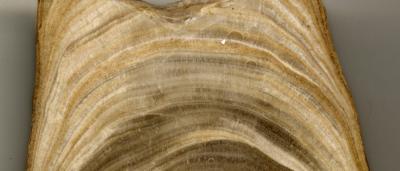
A slice through a stalagmite from a cave in northern Borneo reveals the gradual growth of the calcite structure. By measuring the ratio of oxygen isotopes in such samples, Caltech’s Adkins and his colleagues were able to reconstruct a history of the climate in the tropics throughout the late Pleistocene era. (Credit: Adkins/Caltech)
There is an old trick for remembering the difference between stalactites and stalagmites in a cave: Stalactites hold tight to the ceiling while stalagmitesmight one day grow to reach the ceiling. Now, it seems, stalagmites might also fill a hole in our understanding of Earth’s climate system and how that system is likely to respond to the rapid increase in atmospheric carbon dioxide since preindustrial times.
Many existing historical climate records are biased to the high latitudes — coming from polar ice cores and North Atlantic deep ocean sediments. Yet a main driver of climate variability today is El Niño, which is a completely tropical phenomenon. All of this begs the question: How do we study such tropical climate influences? The answer: stalagmites.
“Stalagmites are the ice cores of the tropics,” says Jess Adkins, professor of geochemistry and global environmental science at the California Institute of Technology (Caltech). He and geochemist Kim Cobb of the Georgia Institute of Technology led a team that collected samples from stalagmites in caves in northern Borneo and measured their levels of oxygen isotopes to reconstruct a history of the tropical West Pacific’s climate over four glacial cycles during the late Pleistocene era (from 570,000 to 210,000 years ago).
The results appear in the May 3 issue of Science Express. The lead author of the paper, Nele Meckler, completed most of the work as a postdoctoral scholar at Caltech and is now at the Geological Institute of ETH Zürich.
Throughout Earth’s history, global climate has shifted between periods of glacial cooling that led to ice ages, and interglacial periods of relative warmth, such as the present. Past studies from high latitudes have indicated that about 430,000 years ago — at a point known as the Mid-Brunhes Event (MBE) — peak temperatures and levels of atmospheric carbon dioxide in interglacial cycles were suddenly bumped up by about a third. But no one has known whether this was also the case closer to the equator.
By studying the records from tropical stalagmites, Adkins and his team found no evidence of such a bump. Instead, precipitation levels remained the same across the glacial cycles, indicating that the tropics did not experience a major shift in peak interglacial conditions following the MBE. “The stalagmite records have glacial cycles in them, but the warm times — the interglacials — don’t change in the same way as they do at high latitudes,” Adkins says. “We don’t know what that tells us yet, but this is the first time the difference has been recorded.”
At the same time, some changes did appear in the climate records from both the high latitudes and the tropics. The researchers found that extreme drying in the tropics coincided with abrupt climate changes in the North Atlantic, at the tail end of glacial periods. It is thought that these rapid climate changes, known as Heinrich events, are triggered by large ice sheets suddenly plunging into the ocean.
“In the tropics, we see these events as very sharp periods of drying in the stalagmite record,” Adkins says. “We think that these droughts indicate that the tropics experienced a more El Niño-like climate at those times, causing them to dry out.” During El Niño events, warm waters from the tropics, near Borneo, shift toward the center of the Pacific Ocean, often delivering heavier rainfall than usual to the western United States while leaving Indonesia and its neighbors extremely dry and prone to forest fires.
The fact that the tropics responded to Heinrich events, but not to the shift that affected the high latitudes following the MBE, suggests that the climate system has two modes of responding to significant changes. “It makes you wonder if maybe the climate system cares about what sort of hammer you hit it with,” Adkins says. “If you nudge the system consistently over long timescales, the tropics seem to be able to continue independently of the high latitudes. But if you suddenly whack the climate system with a big hammer, the impact spreads out and shows up in the tropics.”
This work raises questions about the future in light of recent increases in atmospheric carbon dioxide: Is this increase more like a constant push? Or is it a whack with a big hammer? A case could be made for either one of these scenarios, says Adkins, but he adds that it would be easiest to argue that the forcing is more like a sudden whack, since the amount of carbon dioxide in the atmosphere has increased at such an unprecedented rate.
In addition to Adkins, Cobb, and Meckler, other coauthors on the paper, “Interglacial hydroclimate in the tropical West Pacific through the late Pleistocene,” are Matthew Clarkson of the University of Edinburgh and Harald Sodemann of ETH Zürich. Cobb is also a former postdoctoral scholar in Adkins’s group and has been collaborating on this project since her time at Caltech. The work was supported by the National Science Foundation, the Swiss National Science Foundation, the German Research Foundation, and by an Edinburgh University Principal’s Career Development PhD Scholarship.
Note : The above story is reprinted from materials provided by California Institute of Technology. The original article was written by Kimm Fesenmaier.
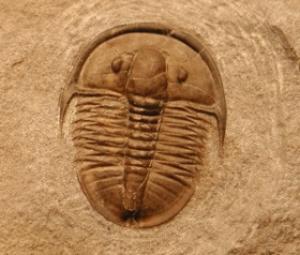
Cambrian trilobite, with a shell made of calcium carbonate. (Credit: Shanan Peters)
The oceans teemed with life 600 million years ago, but the simple, soft-bodied creatures would have been hardly recognizable as the ancestors of nearly all animals on Earth today.
Then something happened. Over several tens of millions of years — a relative blink of an eye in geologic terms — a burst of evolution led to a flurry of diversification and increasing complexity, including the expansion of multicellular organisms and the appearance of the first shells and skeletons.
The results of this Cambrian explosion are well documented in the fossil record, but its cause — why and when it happened, and perhaps why nothing similar has happened since — has been a mystery.
New research shows that the answer may lie in a second geological curiosity — a dramatic boundary, known as the Great Unconformity, between ancient igneous and metamorphic rocks and younger sediments.
“The Great Unconformity is a very prominent geomorphic surface and there’s nothing else like it in the entire rock record,” says Shanan Peters, a geoscience professor at the University of Wisconsin-Madison who led the new work. Occurring worldwide, the Great Unconformity juxtaposes old rocks, formed billions of years ago deep within Earth’s crust, with relatively young Cambrian sedimentary rock formed from deposits left by shallow ancient seas that covered the continents just a half billion years ago.
Named in 1869 by explorer and geologist John Wesley Powell during the first documented trip through the Grand Canyon, the Great Unconformity has posed a longstanding puzzle and has been viewed — by Charles Darwin, among others — as a huge gap in the rock record and in our understanding of Earth’s history.
But Peters says the gap itself — the missing time in the geologic record — may hold the key to understanding what happened.
In the April 19 issue of the journal Nature, he and colleague Robert Gaines of Pomona College report that the same geological forces that formed the Great Unconformity may have also provided the impetus for the burst of biodiversity during the early Cambrian.
“The magnitude of the unconformity is without rival in the rock record,” Gaines says. “When we pieced that together, we realized that its formation must have had profound implications for ocean chemistry at the time when complex life was just proliferating.”
“We’re proposing a triggering mechanism for the Cambrian explosion,” says Peters. “Our hypothesis is that biomineralization evolved as a biogeochemical response to an increased influx of continental weathering products during the last stages in the formation of the Great Unconformity.”
Peters and Gaines looked at data from more than 20,000 rock samples from across North America and found multiple clues, such as unusual mineral deposits with distinct geochemistry, that point to a link between the physical, chemical, and biological effects.
During the early Cambrian, shallow seas repeatedly advanced and retreated across the North American continent, gradually eroding away surface rock to uncover fresh basement rock from within the crust. Exposed to the surface environment for the first time, those crustal rocks reacted with air and water in a chemical weathering process that released ions such as calcium, iron, potassium, and silica into the oceans, changing the seawater chemistry.
The basement rocks were later covered with sedimentary deposits from those Cambrian seas, creating the boundary now recognized as the Great Unconformity.
Evidence of changes in the seawater chemistry is captured in the rock record by high rates of carbonate mineral formation early in the Cambrian, as well as the occurrence of extensive beds of glauconite, a potassium-, silica-, and iron-rich mineral that is much rarer today.
The influx of ions to the oceans also likely posed a challenge to the organisms living there. “Your body has to keep a balance of these ions in order to function properly,” Peters explains. “If you have too much of one you have to get rid of it, and one way to get rid of it is to make a mineral.”
The fossil record shows that the three major biominerals — calcium phosphate, now found in bones and teeth; calcium carbonate, in invertebrate shells; and silicon dioxide, in radiolarians — appeared more or less simultaneously around this time and in a diverse array of distantly related organisms.
The time lag between the first appearance of animals and their subsequent acquisition of biominerals in the Cambrian is notable, Peters says. “It’s likely biomineralization didn’t evolve for something, it evolved in response to something — in this case, changing seawater chemistry during the formation of the Great Unconformity. Then once that happened, evolution took it in another direction.” Today those biominerals play essential roles as varied as protection (shells and spines), stability (bones), and predation (teeth and claws).
Together, the results suggest that the formation of the Great Unconformity may have triggered the Cambrian explosion.
“This feature explains a lot of lingering questions in different arenas, including the odd occurrences of many types of sedimentary rocks and a very remarkable style of fossil preservation. And we can’t help but think this was very influential for early developing life at the time,” Gaines says.
Far from being a lack of information, as Darwin thought, the gaps in the rock record may actually record the mechanism as to why the Cambrian explosion occurred in the first place, Peters says.
“The French composer Claude Debussy said, ‘Music is the space between the notes.’ I think that is the case here,” he says. “The gaps can have more information, in some ways, about the processes driving Earth system change, than the rocks do. It’s both together that give the whole picture.”
The work was supported by the National Science Foundation.
Note : The above story is reprinted from materials provided by University of Wisconsin-Madison, via Newswise. The original article was written by Jill Sakai.
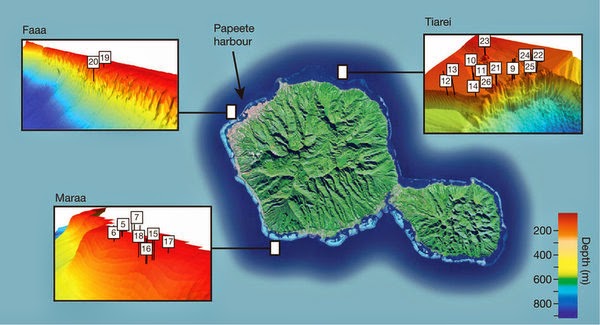
International scientists have shown that a dramatic sea-level rise occurred at the onset of the first warm period of the last deglaciation, known as the Bølling warming, approximately 14,600 years ago. This event, referred to as Melt-Water Pulse 1A (MWP-1A), corresponds to a rapid collapse of massive ice sheets 14,600 years ago and resulted in global sea-level rise of ~14 m. These findings are published in the 29 March 2012 issue of the journal Nature (Volume 483, Issue 7391).
Collaboration between CEREGE (UMR Aix-Marseille Univ. – CNRS – IRD – College de France) and the Universities of Oxford and Tokyo, allowed an international science team to publish on research stemming from the Tahiti Sea-Level Expedition 310 of the Integrated Ocean Drilling Program (IODP). The Tahiti Sea-Level Expedition was carried out in 2005 by the European Consortium for Ocean Research Drilling (ECORD) and the ECORD Science Operator (ESO) on behalf of IODP.
Using U-Th dating of coral samples obtained from cores drilled in the Tahiti coral reefs, the researchers were able to reconstruct sea-level rise over the last deglaciation. Coral is extremely sensitive to sea-level changes and fossilized corals are therefore an excellent indicator for sea-level changes over time.
“Corals are outstanding archives to reconstruct past sea-level changes as they can be dated to within plus or minus 30 years stretching back thousands of years. Moreover, Tahitian reefs are ideally located to reconstruct the deglacial sea-level rise and to constrain short-term events that are thought to have punctuated the period between the Last Glacial Maximum and the present days. Tahiti is located at a sufficiently considerable distance from the major former ice sheets to give us close to the average of sea levels across the globe, as a non-volcanic island it is also subsiding into the ocean at a steady pace that we can easily adjust for.” Pierre Deschamps, first author based at CEREGE said.
The Nature article presents the view that most of the melting water that contributed to MWP-1A was sourced from the Antarctic ice sheet, highlighting dynamical behavior of this ice sheet in the past. The authors note that further research is needed using cored fossilized corals to better understand the sequence of events related to ice sheet collapse during the last deglaciation.
Today, half of world’s population, approximately 3.2 billion people, lives within 200 km of coastline, and a tenth of the population lives less than 10 meters above sea level. Tahiti itself is, of course, at risk from modern sea-level rise. The government of Tahiti cooperated on the IODP Expedition 310 by providing the necessary regulatory clearances to drill on the fossilized coral reefs.
Pierre Deschamps says “Insights into past sea-level changes may help to better constrain future changes. Our work sheds light onto an extreme event of rise in global sea levels in which ice-sheet collapse coincided with a rapid warming. Whether the freshwater pulse was a result of an already warming word or helped to warm the climate is currently unclear. However, our finding will help scientists currently modelling future climate change scenarios to factor in the dynamic behaviour of major ice sheets and finally to provide more reliable predictions of ice sheet responses to a warming climate”.
Much is yet unknown about the dynamics of sea-level change, in response to massive water discharge. However, IODP Expedition 310 has helped international scientists shed light on one of the most important climate event of the last deglaciation, the MWP-1A event, based on fossil corals obtained from off the coast of Tahiti.
Note: This story has been adapted from a news release issued by the Integrated Ocean Drilling Program Management International
This garnet pyroxenite xenolith from Sierra Nevada, Calif., is an example of the deepest products of crystallization within the magmatic belts of subduction zones. Rice University’s Cin-Ty Lee and colleagues showed that most of the copper in arc magmas eventually end up in these deep-seated rocks. (Credit: Image courtesy of Rice University)
Earth is clingy when it comes to copper. A new Rice University study recently published in the journal Science finds that nature conspires at scales both large and small — from the realms of tectonic plates down to molecular bonds — to keep most of Earth’s copper buried dozens of miles below ground.
“Everything throughout history shows us that Earth does not want to give up its copper to the continental crust,” said Rice geochemist Cin-Ty Lee, the lead author of the study. “Both the building blocks for continents and the continental crust itself, dating back as much as 3 billion years, are highly depleted in copper.”
Finding copper is more than an academic exercise. With global demand for electronics growing rapidly, some studies have estimated the world’s demand for copper could exceed supply in as little as six years. The new study could help, because it suggests where undiscovered caches of copper might lie.
But the copper clues were just a happy accident.
“We didn’t go into this looking for copper,” Lee said. “We were originally interested in how continents form and more specifically in the oxidation state of volcanoes.”
Earth scientists have long debated whether an oxygen-rich atmosphere might be required for continent formation. The idea stems from the fact that Earth may not have had many continents for at least the first billion years of its existence and that Earth’s continents may have begun forming around the time that oxygen became a significant component of the atmosphere.
In their search for answers, Lee and colleagues set out to examine Earth’s arc magmas — the molten building blocks for continents. Arc magmas get their start deep in the planet in areas called subduction zones, where one of Earth’s tectonic plates slides beneath another. When plates subduct, two things happen. First, they bring oxidized crust and sediments from Earth’s surface into the mantle. Second, the subducting plate drives a return flow of hot mantle upwards from Earth’s deep interior. During this return flow, the hot mantle not only melts itself but may also cause melting of the recycled sediments. Arc magmas are thought to form under these conditions, so if oxygen were required for continental crust formation, it would mostly likely come from these recycled segments.
“If oxidized materials are necessary for generating such melts, we should see evidence of it all the way from where the arc magmas form to the point where the new continent-building material is released from arc volcanoes,” Lee said.
Lee and colleagues examined xenoliths, rocks that formed deep inside Earth and were carried up to the surface in volcanic eruptions. Specifically, they studied garnet pyroxenite xenoliths thought to represent the first crystallized products of arc magmas from the deep roots of an arc some 50 kilometers below Earth’s surface. Rather than finding evidence of oxidation, they found sulfides — minerals that contain reduced forms of sulfur bonded to metals like copper, nickel and iron. If conditions were highly oxidizing, Lee said, these sulfide minerals would be destabilized and allow these elements, particularly copper, to bond with oxygen.
Because sulfides are also heavy and dense, they tend to sink and get left behind in the deep parts of arc systems, like a blob of dense material that stays at the bottom of a lava lamp while less dense material rises to the top.
“This explains why copper deposits, in general, are so rare,” Lee said. “The Earth wants to hold it deep and not give it up.”
Lee said deciding where to look for undiscovered copper deposits requires an understanding of the conditions needed to overcome the forces that conspire to keep it deep inside the planet.
“As a continental arc matures, the copper-rich sulfides are trapped deep and accumulate,” he said. “But if the continental arc grows thicker over time, the accumulated copper-bearing sulfides are driven to deeper depths where the higher temperatures can re-melt these copper-rich dregs, releasing them to rejoin arc magmas.”
These conditions were met in the Andes Mountains and in western North America. He said other potential sources of undiscovered copper include Siberia, northern China, Mongolia and parts of Australia.
Lee noted that a high school intern played a role in the research paper. Daphne Jin, now a freshman at the University of Chicago, made her contribution to the research as a high school intern from Clements High School in the Houston suburb of Sugarland.
“The paper really wouldn’t have been as broad without Daphne’s contribution,” Lee said. “I originally struggled with an assignment for her because I didn’t and still don’t have large projects where a student can just fit in. I try to make sure every student has a chance to do something new, but often I just run out of ideas.”
Lee eventually asked Jin to compile information from published studies about the average concentration of all the first-row of transition elements in the periodic table in various samples of continental crust and mantle collected the world over.
“She came back and showed me the results, and we could see that the average continental crust itself, which has been built over 3 billion years of Earth’s history in Africa, Siberia, North America, South America, etc., was all depleted in copper,” Lee said. “Up to that point we’d been looking at the building blocks of continents, but this showed us that the continents themselves followed the same pattern. It was all internally consistent.”
In addition to Jin, Lee’s co-authors on the report include Rajdeep Dasgupta, assistant professor of Earth science at Rice; Rice postdoctoral researchers Peter Luffi and Veronique Roux; Rice graduate student Emily Chin; visiting graduate student Romain Bouchet of the École Normale Supérieure in Lyon, France; Douglas Morton, professor of geology at the University of California, Riverside; and Qing-zhu Yin, professor of geology at the University of California, Davis.
The research was funded by the National Science Foundation.
Note : The above story is reprinted from materials provided by Rice University.
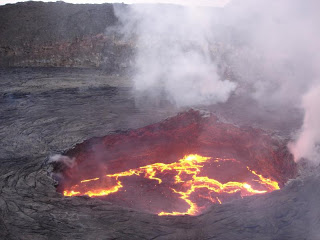
Erta Ale lava lake at the Afar rift. (Credit: James Hammond)
Two new studies into the “plumbing systems” that lie under volcanoes could bring scientists closer to predicting large eruptions.
International teams of researchers, led by the University of Leeds, studied the location and behaviour of magma chambers on Earth’s mid-ocean ridge system — a vast chain of volcanoes along which Earth forms new crust.
They worked in Afar (Ethiopia) and Iceland — the only places where mid-ocean ridges appear above sea level. Volcanic ridges (or “spreading centres”) occur when tectonic plates “rift” or pull apart. Magma (hot molten rock) injects itself into weaknesses in the brittle upper crust, erupting as lava and forming new crust upon cooling.
Magma chambers work like plumbing systems, channelling pressurised magma through networks of underground “pipes.”
The studies, published in Nature Geoscience, reveal new information about where magma is stored and how it moves through the geological plumbing network. Finding out where magma chambers lie and how they behave can help identify early warning signs of impending eruptions.
Scientists used images taken by the European Space Agency satellite Envisat to measure how the ground moved before, during and after eruptions. Using this data, they built and tested computer models to find out how rifting occurs.
Data in one study showed magma chambers that fed an eruption in November 2008 in the Afar rift of Northern Ethiopia were only about 1 km below the ground. The standard model had predicted a depth of more than 3 km.
It is highly unusual for magma chambers to lie in shallow depths on slow spreading centres such as the Afar rift, where tectonic plates pull apart at about the same speed as human fingernails grow.
Dr Carolina Pagli from the University of Leeds’ School of Earth and Environment, who led the study, says: “It was a complete surprise to see that a magma chamber could exist so close to the Earth’s surface in an area where the tectonic plates move apart so slowly. The results have changed the way we think about volcanoes.”
Dr Pagli also noticed that the ground started “uplifting” (elevating) four months before the eruption, due to new magma increasing pressure in one of the underground chambers. Understanding these precursory signals is fundamental to predicting eruptions.
A wider study of eruptions in Afar and Iceland, two vastly different environments, found remarkable similarities. Many events occurred within a short space of time. Researchers identified multiple magma chambers positioned horizontally and vertically, allowing magma to shoot in several directions. Moving magma triggered earthquakes, and separate magma chambers fed single eruptions.
The 2008 eruption is part of an unusual period of recent volcanic unrest in Ethiopia, and is enabling scientists to learn more about volcanoes at spreading centres. Most spreading centres are under 2 km of water at the bottom of the ocean, making detailed observations extremely challenging. The new knowledge derived from Ethiopian volcanoes will help scientists understand volcanoes in Iceland, where eruptions can have a bigger impact on the UK.
Dr Tim Wright from the School of Earth and Environment, who leads the international Afar Rift Consortium, said: “The dramatic events we have been witnessing in Afar in the past six years are transforming our understanding of how the crust grows when tectonic plates pull apart. Our work in one of the hottest place on Earth is having a direct impact on our understanding of eruptions from the frozen volcanoes of Iceland.”
Note : The above story is reprinted from materials provided by University of Leeds.
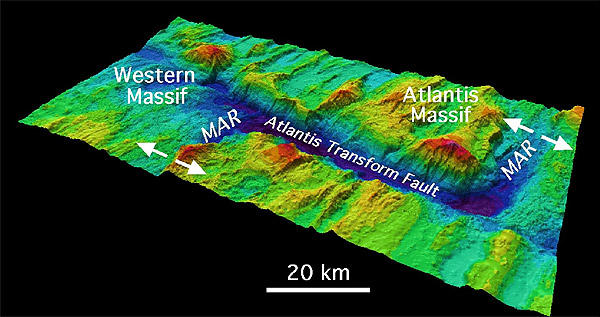
Atlantis Massif, showing the fault that borders this Atlantic Ocean seamount. (Credit: NOAA)
Scientists recently concluded an expedition aboard the research vessel JOIDES Resolution to learn more about Atlantis Massif, an undersea mountain, or seamount, that formed in a very different way than the majority of the seafloor in the oceans.
Unlike volcanic seamounts, which are made of the basalt that’s typical of most of the seafloor, Atlantis Massif includes rock types that are usually only found much deeper in the ocean crust, such as gabbro and peridotite.
The expedition, known as Integrated Ocean Drilling Program (IODP) Expedition 340T, marks the first time the geophysical properties of gabbroic rocks have successfully been measured directly in place, rather than via remote techniques such as seismic surveying.
With these measurements in hand, scientists can now infer how these hard-to-reach rocks will “look” on future seismic surveys, making it easier to map out geophysical structures beneath the seafloor.
“This is exciting because it means that we may be able to use seismic survey data to infer the pattern of seawater circulation within the deeper crust,” says Donna Blackman of the Scripps Institution of Oceanography in La Jolla, Calif., co-chief scientist for Expedition 340T.
“This would be a key step for quantifying rates and volumes of chemical, possibly biological, exchange between the oceans and the crust.”
Atlantis Massif sits on the flank of an oceanic spreading center that runs down the middle of the Atlantic Ocean.
As the tectonic plates separate, new crust is formed at the spreading center and a combination of stretching, faulting and the intrusion of magma from below shape the new seafloor.
Periods of reduced magma supplied from the underlying mantle result in the development of long-lived, large faults. Deep portions of the crust shift upward along these faults and may be exposed at the seafloor.
This process results in the formation of an oceanic core complex, or OCC, and is similar to the processes that formed the Basin and Range province of the Southwest United States.
“Recent discoveries from scientific ocean drilling have underlined that the process of creating new oceanic crust at seafloor spreading centers is complex,” says Jamie Allan, IODP program director at the U.S. National Science Foundation (NSF), which co-funds the program.
“This work significantly adds to our ability to infer ocean crust structure and composition, including predicting how ocean crust has ‘aged’ in an area,” says Allan, “thereby giving us new tools for understanding ocean crust creation from Earth’s mantle.”
Atlantis Massif is a classic example of an oceanic core complex.
Because it’s relatively young–formed within the last million years–it’s an ideal place, scientists say, to study how the interplay between faulting, magmatism and seawater circulation influences the evolution of an OCC within the crust.
“Vast ocean basins cover most of the Earth, yet their crust is formed in a narrow zone,” says Blackman. “We’re studying that source zone to understand how rifting and magmatism work together to form a new plate.”
The JOIDES Resolution first visited Atlantis Massif about seven years ago; the science team on that expedition measured properties in gabbro.
But they focused on a shallower section, where pervasive seawater circulation had weathered the rock and changed its physical properties.
For the current expedition, the team did not drill new holes.
Rather, they lowered instruments into a deep existing hole drilled on a previous expedition, and made measurements from inside the hole.
The new measurements, at depths between 800 and 1,400 meters (about 2,600-4,600 feet) below the seafloor, include only a few narrow zones that had been altered by seawater circulation and/or by fault slip deformation.
The rest of the measurements focused on gabbroic rocks that have remained unaltered thus far.
The properties measured in the narrow zones of altered rock differ from the background properties measured in the unaltered gabbroic rocks.
The team found small differences in temperature next to two sub-seafloor faults, which suggests a slow percolation of seawater within those zones.
There were also significant differences in the speed at which seismic waves travel through the altered vs. unaltered zones.
“The expedition was a great opportunity to ground-truth our recent seismic analysis,” says Alistair Harding, also from the Scripps Institution of Oceanography and a co-chief scientist for Expedition 340T.
“It also provides vital baseline data for further seismic work aimed at understanding the formation and alteration of the massif.”
Note : The above story is reprinted from materials provided by National Science Foundation.
From The National Oceanography Centre, Southampton (UK).
Even if humankind manages to limit global warming to 2 degrees C (3.6 degrees F), as the Intergovernmental Panel on Climate Change recommends, future generations will have to deal with sea levels 12 to 22 meters (40 to 70 feet) higher than at present, according to research published in the journal Geology.
The researchers, led by Kenneth G. Miller, professor of earth and planetary sciences in the School of Arts and Sciences at Rutgers University, reached their conclusion by studying rock and soil cores in Virginia, Eniwetok Atoll in the Pacific and New Zealand. They looked at the late Pliocene epoch, 2.7 million to 3.2 million years ago, the last time the carbon dioxide level in the atmosphere was at its current level, and atmospheric temperatures were 2 degrees C higher than they are now.
“The difference in water volume released is the equivalent of melting the entire Greenland and West Antarctic Ice Sheets, as well as some of the marine margin of the East Antarctic Ice Sheet,” said H. Richard Lane, program director of the National Science Foundation’s Division of Earth Sciences, which funded the work. “Such a rise of the modern oceans would swamp the world’s coasts and affect as much as 70 percent of the world’s population.”
“You don’t need to sell your beach real estate yet, because melting of these large ice sheets will take from centuries to a few thousand years,” Miller said. “The current trajectory for the 21st century global rise of sea level is 2 to 3 feet (0.8 to1 meter) due to warming of the oceans, partial melting of mountain glaciers, and partial melting of Greenland and Antarctica.”
Miller said, however, that this research highlights the sensitivity of Earth’s great ice sheets to temperature change, suggesting that even a modest rise in temperature results in a large sea-level rise. “The natural state of the Earth with present carbon dioxide levels is one with sea levels about 20 meters higher than at present,” he said.
Miller was joined in the research by Rutgers colleagues James G. Wright, associate professor of earth and planetary sciences; James V. Browning, assistant research professor of earth and planetary sciences; Yair Rosenthal, professor of marine science in the School of Environmental and Biological Sciences; Sindia Sosdian, research scientist in marine science and a postdoctoral scholar at Cardiff University in Wales; and Andrew Kulpecz, a Rutgers doctoral student when the work was done, now with Chevron Corp. Other co-authors were Michelle Kominz, professor of geophysics and basin dynamics at Western Michigan University; Tim R. Naish, director of the Antarctic Research Center at Victoria University of Wellington, in New Zealand; Benjamin S. Cramer of Theiss Research in Eugene, Ore.; and W. Richard Peltier, professor of physics and director of the Center for Global Change Science at the University of Toronto.
Note : The above story is reprinted from materials provided by Rutgers University.
Geologists from the Universities of Bonn and Cologne have demonstrated new scientific results in the April issue of the journal Geology, which provide a new theory on the earliest phase of continental formation.
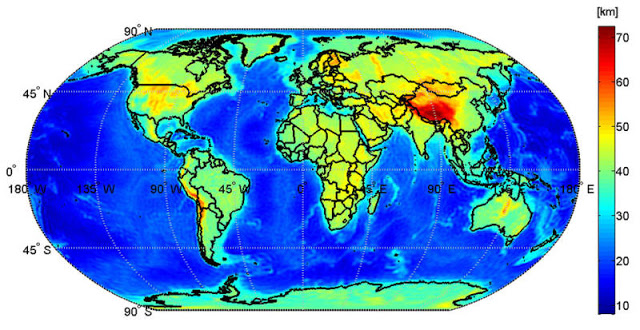
Earth’s structure can be compared to an orange: its crust is the peel supported by Earth’s heavy mantle. That peel is made up of a continental crust 30 to 40 kilometers thick. It is much lighter than the thinner oceanic crust and protrudes from Earth’s mantle because of its lower density, like an iceberg in the sea. “According to the current theory, the first continental crusts were formed when tectonic plates would collide, submerging oceanic crusts into Earth’s mantle, where they would partially melt at a depth of approximately 100 kilometers. That molten rock then ascended to Earth’s surface and formed the first continents,” says adjunct professor Dr. Thorsten Nagel of the Steinmann Institute of Geosciences at the University of Bonn, lead author of the study. The theory has been supported by the oldest known continental rocks — approximately 3.8 billion years old — found in western Greenland.
The results presented by Nagel and colleagues challenge the traditional view of continental crust formation via melting of normal oceanic crust in a down-going slab and support scenarios of melting within tectonically thickened, hot crust.
Following trace elements:
The composition of the continental crust corresponds to a semiliquid version of the oceanic crust melted by 10 to 30 percent of its original state. Unfortunately, the concentrations of the main chemical components in the re-solidified rock do not provide much information about what depth the fusion occurred at. “In order to find that out, you have to know what minerals the remaining 70 to 90 percent of the oceanic crust consisted of,” explains Prof. Dr. Carsten Münker of the Institute of Geology and Mineralogy at the University of Cologne. Researchers from Bonn and Cologne have now analyzed the Greenlandic rocks for different elements occurring at various high concentrations, also know as trace elements. “Trace elements provide geologists with a window to the origin of continental crust,” says Prof. Münker. “With their help, we can identify minerals in the residual rock that were deposited in the depths by the molten rock.”
Before the magma separated from the bedrock, the semifluid rock and the leftover solid minerals actively exchanged trace elements. “Different minerals have characteristic ways of separating when trace elements are smelted. In other words, the concentration of trace elements in the molten rock provide a fingerprint of the residual bedrock,” explains Dr. Elis Hoffmann from Bonn, coauthor of the study. The concentration of trace elements in the oldest continental rock allows geoscientists to reconstruct possible bedrock based on their minerals and thus determine at what depth the continental crust originated.
The oceanic crust did not have to descend:
Using computers, the scientists simulated the composition of bedrock and molten rock that would emerge from partially melting the oceanic crust at various depths and temperatures. They then compared the data calculated for the molten rock with the actual concentration of trace elements in the oldest continental rocks. “Our results paint a surprising picture,” Dr. Nagel reports. “The oceanic crust did not have to descend to a depth of 100 kilometers to create the molten rock that makes up the rocks of the first continents.” According to the calculations, a depth of 30 to 40 kilometers is much more probable.
The primeval oceanic crust could have ‘oozed’ continents…it could definitely have had the power to do so in the Archean eon. Four billion years ago, the gradually cooling earth was still significantly warmer than it is today. The oceanic crust could have simply ‘oozed’ continents at the same time that other geological processes were occurring, like volcanism, orogeny, and the influx of water. “We think it is unlikely that the contents were formed into subduction zones. Whether or not tectonic plates of the primordial earth had such zones of subsidence is still a matter of debate,” says the geologist from Bonn.
Note : The above story is reprinted from materials provided by University of Bonn, via AlphaGalileo.
Auroras are beautiful light shows caused by solar activity. Sky watchers say it’s the greatest show on Earth but it is also the greatest show in Earth orbit. (Credit: Science@NASA)
Glowing green and red, shimmering hypnotically across the night sky, the aurora borealis is a wonder to behold. Longtime sky watchers say it is the greatest show on Earth.
It might be the greatest show in Earth orbit, too. High above our planet, astronauts onboard the International Space Station (ISS) have been enjoying an up-close view of auroras outside their windows as the ISS flys through geomagnetic storms.
“We can actually fly into the auroras,” says eye-witness Don Pettit, a Flight Engineer for ISS Expedition 30. “It’s like being shrunk down and put inside of a neon sign.”
Auroras are caused by solar activity. Gusts of solar wind and coronal mass ejections strike Earth’s magnetic field, rattling our planet’s protective shell of magnetism. This causes charged particles to rain down over the poles, lighting up the atmosphere where they hit. The physics is akin to what happens in the picture tube of a color TV.
Incoming particles are guided by Earth’s magnetic field to a pair of doughnut-shaped regions called “auroral ovals.” There’s one around the North Pole and one around the South. Sometimes, when solar activity is high, the ovals expand, and the space station orbits right through them.
That’s exactly what happened in late January 2012, when a sequence of M-class and X-class solar flares sparked a light show that Pettit says he won’t soon forget. “The auroras could be seen [as brightly as] city lights on the Earth below — and even in the day-night terminator of the rising and setting sun. It was simply amazing.”
Pettit is a skilled astrophotographer. He and other members of the crew video-recorded the displays, producing footage that officials say is some of the best-ever taken from Earth orbit.
The videos capture the full range of aurora colors — red, green, and many shades of purple. These hues correspond to different quantum transitions in excited atoms of oxygen and nitrogen. The precise color at any altitude depends on the temperature and density of the local atmosphere.
“Red auroras reach all the way up to our altitude 400 km above Earth,” says Pettit. “Sometimes you feel like you can reach out and touch them.”
“Green emissions, on the other hand, tend to stay below the space station,” he says. They move like a living ‘shag carpet’ of lights. “We fly right over them.”
Surprisingly, Pettit does not find this unsettling. “It is not disorienting to see auroras underfoot,” he says. “Perhaps it is because I have been up here so long.”
What he does find disorienting is the meteors.
“Occasionally we see a meteor burning up in the atmosphere below — and this does look strange. You should be looking up for meteors not down.”
As marvelous as these sights are, Petit has seen better. He was the science officer for ISS expedition 6 back in 2003 when the auroras were even stronger than they were now.
“But this expedition is not over yet,” he points out hopefully.
Indeed, more auroras are in the offing. Following some recent years of deep quiet, the sun is waking up again. Solar activity is now trending upward with a maximum expected in early 2013.
This means the greatest show on Earth — and in Earth orbit — is about to get even better.
Note : The above story is reprinted from materials provided by NASA. The original article was written by Dr. Tony Phillips, Science@NASA.
This map shows the global Mohorovičić discontinuity – known as Moho – based on data from the GOCE satellite. Moho is the boundary between the crust and the mantle, ranging from about 70 km in depth in mountainous areas, like the Himalayas, to 10 km beneath the ocean floor. (Credit: GEMMA project)
The first global high-resolution map of the boundary between Earth’s crust and mantle — the Moho — has been produced based on data from ESA’s GOCE gravity satellite. Understanding the Moho will offer new clues into the dynamics of Earth’s interior.
Earth’s crust is the outermost solid shell of our planet. Even though it makes up less than 1% of the volume of the planet, the crust is exceptionally important not just because we live on it, but because is the place where all our geological resources like natural gas, oil and minerals come from.
The crust and upper mantle is also the place where most geological processes of great importance occur, such as earthquakes, volcanism and orogeny.
Until just a century ago, we didn’t know Earth has a crust. In 1909, Croatian seismologist Andrija Mohorovičić found that at about 50 km underground there is a sudden change in seismic speed.
Ever since, that boundary between Earth’s crust and underlying mantle has been known as the Mohorovičić discontinuity, or Moho.
Even today, almost all we know about Earth’s deep layers comes from two methods: seismic and gravimetric.
Seismic methods are based on observing changes in the propagation velocity of seismic waves between the crust and mantle.
Gravimetry looks at the gravitational effect due to the density difference caused by the changing composition of crust and mantle.
But the Moho models based on seismic or gravity data are usually limited by poor data coverage or data being only available along single profiles.
The GOCE Exploitation for Moho Modelling and Applications project — or GEMMA — has now generated the first global high-resolution map of the boundary between Earth’s crust and mantle based on data from the GOCE satellite.
GOCE measures the gravity field and models the geoid with unprecedented accuracy to advance our knowledge of ocean circulation, which plays a crucial role in energy exchanges around the globe, sea-level change and Earth interior processes.
GEMMA’s Moho map is based on the inversion of homogenous well-distributed gravimetric data.
For the first time, it is possible to estimate the Moho depth worldwide with unprecedented resolution, as well as in areas where ground data are not available. This will offer new clues for understanding the dynamics of Earth’s interior, unmasking the gravitational signal produced by unknown and irregular subsurface density distribution.
GEMMA is being carried out by Italian scientist Daniele Sampietro, and is funded by the Politecnico di Milano and ESA’s Support To Science Element under the Changing Earth Science Network initiative.
This initiative supports young scientists at post-doctoral level in ESA Member States to advance our knowledge in Earth system science by exploiting the observational capacity of ESA missions.
Note : The above story is reprinted from materials provided by European Space Agency (ESA), via AlphaGalileo.
An artist’s rendering of the lunar core as identified in new findings by a NASA-led research team. (NASA/MSFC/Renee Weber)
Apollo Data Revealed Moon’s Internal Structure:
NASA deployed the frist seismographs on the moon as part of the Apollo Mission in 1969. These seismographs collected data and enabled researchers to determine that the moon’s structure consisted of a thin crust of about 65 kilometers, a mantle about 100 kilometers thick and a core with a radius of about 500 kilometers. At that time seismic data processing was not advanced enough to determine the characteristics of the core.
NASA researchers have recently applied state-of-the-art seismological techniques applied to the Apollo-era data and discovered that the moon probably has a core that is very similar to Earth’s.
Moon’s Formation and Magnetic Field :
Uncovering details about the lunar core is critical for developing accurate models of the moon’s formation. The data sheds light on the evolution of a lunar dynamo — a natural process by which our moon may have generated and maintained its own strong magnetic field.
The team’s findings suggest the moon possesses a solid, iron-rich inner core with a radius of nearly 150 miles and a fluid, primarily liquid-iron outer core with a radius of roughly 205 miles. Where it differs from Earth is a partially molten boundary layer around the core estimated to have a radius of nearly 300 miles. The research indicates the core contains a small percentage of light elements such as sulfur, echoing new seismology research on Earth that suggests the presence of light elements — such as sulfur and oxygen — in a layer around our own core.
Data from Apollo-Era Seismometers :
The researchers used extensive data gathered during the Apollo-era moon missions. The Apollo Passive Seismic Experiment consisted of four seismometers deployed between 1969 and 1972, which recorded continuous lunar seismic activity until late-1977.
“We applied tried and true methodologies from terrestrial seismology to this legacy data set to present the first-ever direct detection of the moon’s core,” said Renee Weber, lead researcher and space scientist at NASA’s Marshall Space Flight Center in Huntsville, Ala.
The team also analyzed Apollo lunar seismograms using array processing, techniques that identify and distinguish signal sources of moonquakes and other seismic activity. The researchers identified how and where seismic waves passed through or were reflected by elements of the moon’s interior, signifying the composition and state of layer interfaces at varying depths.
Comparison with Apollo-Era Results :
Although sophisticated satellite imaging missions to the moon made significant contributions to the study of its history and topography, the deep interior of Earth’s sole natural satellite remained a subject of speculation and conjecture since the Apollo era. Researchers previously had inferred the existence of a core, based on indirect estimates of the moon’s interior properties, but many disagreed about its radius, state and composition.
A primary limitation to past lunar seismic studies was the wash of “noise” caused by overlapping signals bouncing repeatedly off structures in the moon’s fractionated crust. To mitigate this challenge, Weber and the team employed an approach called seismogram stacking, or the digital partitioning of signals. Stacking improved the signal-to-noise ratio and enabled the researchers to more clearly track the path and behavior of each unique signal as it passed through the lunar interior.
“We hope to continue working with the Apollo seismic data to further refine our estimates of core properties and characterize lunar signals as clearly as possible to aid in the interpretation of data returned from future missions,” Weber said.
New Data From the GRAIL Mission : Future NASA missions will help gather more detailed data. The Gravity Recovery and Interior Laboratory, or GRAIL, is a NASA Discovery-class mission set to launch this year. The mission consists of twin spacecraft that will enter tandem orbits around the moon for several months to measure the gravity field in unprecedented detail. The mission also will answer longstanding questions about Earth’s moon and provide scientists a better understanding of the satellite from crust to core, revealing subsurface structures and, indirectly, its thermal history.
The Research Team :
In addition to Weber, the team consisted of scientists from Marshall; Arizona State University; the University of California at Santa Cruz; and the Institut de Physique du Globe de Paris in France. Their findings are published in the online edition of the journal Science.
NASA and other space agencies have been studying concepts to establish an International Lunar Network — a robotic set of geophysical monitoring stations on the moon — as part of efforts to coordinate international missions during the coming decade
Note : Republished from a January, 2011 press release by NASA.
The ‘tectonic’ effects of the collision of one spherule with another during the cosmic impact. (Credit: Image courtesy of University of California – Santa Barbara)
A 16-member international team of researchers that includes James Kennett, professor of earth science at UC Santa Barbara, has identified a nearly 13,000-year-old layer of thin, dark sediment buried in the floor of Lake Cuitzeo in central Mexico. The sediment layer contains an exotic assemblage of materials, including nanodiamonds, impact spherules, and more, which, according to the researchers, are the result of a cosmic body impacting Earth.
These new data are the latest to strongly support of a controversial hypothesis proposing that a major cosmic impact with Earth occurred 12,900 years ago at the onset of an unusual cold climatic period called the Younger Dryas. The researchers’ findings appear in the Proceedings of the National Academy of Sciences.
Conducting a wide range of exhaustive tests, the researchers conclusively identified a family of nanodiamonds, including the impact form of nanodiamonds called lonsdaleite, which is unique to cosmic impact. The researchers also found spherules that had collided at high velocities with other spherules during the chaos of impact. Such features, Kennett noted, could not have formed through anthropogenic, volcanic, or other natural terrestrial processes. “These materials form only through cosmic impact,” he said.
The data suggest that a comet or asteroid — likely a large, previously fragmented body, greater than several hundred meters in diameter — entered the atmosphere at a relatively shallow angle. The heat at impact burned biomass, melted surface rocks, and caused major environmental disruption. “These results are consistent with earlier reported discoveries throughout North America of abrupt ecosystem change, megafaunal extinction, and human cultural change and population reduction,” Kennett explained.
The sediment layer identified by the researchers is of the same age as that previously reported at numerous locations throughout North America, Greenland, and Western Europe. The current discovery extends the known range of the nanodiamond-rich layer into Mexico and the tropics. In addition, it is the first reported for true lake deposits.
In the entire geologic record, there are only two known continent-wide layers with abundance peaks in nanodiamonds, impact spherules, and aciniform soot. These are in the 65-million-year-old Cretaceous-Paleogene boundary layer that coincided with major extinctions, including the dinosaurs and ammonites; and the Younger Dryas boundary event at 12,900 years ago, closely associated with the extinctions of many large North American animals, including mammoths, mastodons, saber-tooth cats, and dire wolves.
“The timing of the impact event coincided with the most extraordinary biotic and environmental changes over Mexico and Central America during the last approximately 20,000 years, as recorded by others in several regional lake deposits,” said Kennett. “These changes were large, abrupt, and unprecedented, and had been recorded and identified by earlier investigators as a ‘time of crisis.’ “
Other scientists contributing to the research include Isabel Israde-Alcántara and Gabriela Dominguez-Vásquez of the Universidad Michoacana de San Nicólas de Hidalgo; James L. Bischoff of the U.S. Geological Survey; Hong-Chun Li of National Taiwan University; Paul S. DeCarli of SRI International; Ted E. Bunch and James H. Wittke of Northern Arizona University; James C. Weaver of Harvard University; Richard B.
Firestone of Lawrence Berkeley National Laboratory; Allen West of GeoScience Consulting; Chris Mercer of the National Institute for Materials Science; Sujing Zie and Eric K. Richman of the University of Oregon, Eugene; and Charles R. Kinzie and Wendy S. Wolbach of DePaul University.
Note : The above story is reprinted from materials provided by University of California – Santa Barbara.