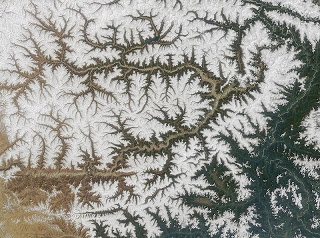
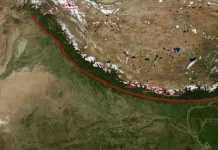
Dendritic drainage: the Yarlung Tsangpo River, Tibet, seen from space: snow cover has melted in the valley system.
Introduction
In geomorphology, a drainage system is the pattern formed by the streams, rivers, and lakes in a particular drainage basin. They are governed by the topography of the land, whether a particular region is dominated by hard or soft rocks, and the gradient of the land. Geomorphologists and hydrologists often view streams as being part of drainage basins. A drainage basin is the topographic region from which a stream receives runoff, through flow, and groundwater flow. Drainage basins are divided from each other by topographic barriers called a watershed. A watershed represents all of the stream tributaries that flow to some location along the stream channel. The number, size, and shape of the drainage basins found in an area varies and the larger the topographic map, the more information on the drainage basin is available.
Drainage patterns
According to the configuration of the channels, drainage systems can fall into one of several categories known as drainage patterns. Drainage patterns depend on the topography and geology of the land.
Accordant drainage pattern
A drainage system is described as accordant if its pattern correlates to the structure and relief of the landscape over which it flows.
Dendritic drainage pattern
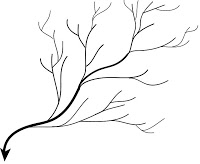
Dendritic drainage pattern
Dendritic drainage systems (from Greek δενδρίτης, dendrites, “of or pertaining to a tree”) are the most common form of drainage system. In a dendritic system, there are many contributing streams (analogous to the twigs of a tree), which are then joined together into the tributaries of the main river (the branches and the trunk of the tree, respectively). They develop where the river channel follows the slope of the terrain. Dendritic systems form in V-shaped valleys; as a result, the rock types must be impervious and non-porous.
Parallel drainage pattern
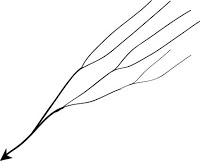
Parallel drainage pattern
A parallel drainage system is a pattern of rivers caused by steep slopes with some relief. Because of the steep slopes, the streams are swift and straight, with very few tributaries, and all flow in the same direction. This system forms on uniformly sloping surfaces, for example, rivers flowing southeast from the Aberdare Mountains in Kenya.
Trellis drainage pattern
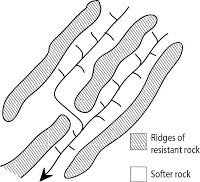
Trellis drainage pattern
The geometry of a trellis drainage system is similar to that of a common garden trellis used to grow vines. Asthe river flows along a strike valley, smaller tributaries feed into it from the steep slopes on the sides of mountains. These tributaries enter the main river at approximately 90 degree angles, causing a trellis-like appearance of the drainage system. Trellis drainage is characteristic of folded mountains, such as the Appalachian Mountains in North America.
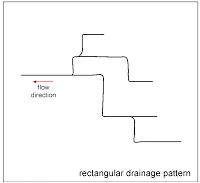
Rectangular drainage pattern
Rectangular drainage patternRectangular drainage develops on rocks that are of approximately uniform resistance to erosion, but which have two directions of jointing at approximately right angles. The joints are usually less resistant to erosion than the bulk rock so erosion tends to preferentially open the joints and streams eventually develop along the joints. The result is a stream system in which streams consist mainly of straight line segments with right angle bends and tributaries join larger streams at right angles.
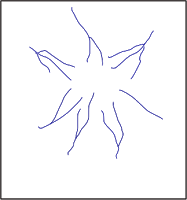
Radial drainage pattern
Radial drainage patterngeological features on which radial drainage commonly develops are domes and laccoliths. On these features the drainage may exhibit a combination of radial and annular patterns.
In a radial drainage system, the streams radiate outwards from a central high point. Volcanos usually display excellent radial drainage. Other
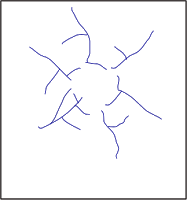
Centripetal drainage pattern
Centripetal drainage systems are similar to radial drainage systems except the rivers flow in the opposite direction. They drain from the sides of hills to a central depression[2] where a lake is formed.[4] This is common in western and south-western US, where centripetal drainage systems form intermittent lakes. These lakes leave behind salt flats when they evaporate during dry seasons.
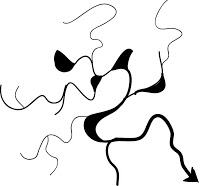
Deranged drainage pattern
Deranged drainage pattern
A deranged drainage system is a drainage system in drainage basins where there is no coherent pattern to the rivers and lakes. It happens in areas where there has been much geological disruption. The classic example is the Canadian Shield. During the last ice age, the topsoil was scraped off, leaving mostly bare rock. The melting of the glaciers left land with many irregularities of elevation, and a great deal of water to collect in the low points, explaining the large number of lakes which are found in Canada. The watersheds are young and are still sorting themselves out. Eventually the system will stabilize.
Annular drainage pattern
Annular drainage pattern
In an annular drainage pattern streams follow a roughly circular or concentric path along a belt of weak rock, resembling in plan a ringlike pattern. It is best displayed by streams draining a maturely dissected structural dome or basin where erosion has exposed rimming sedimentary strata of greatly varying degrees of hardness, as in the Red Valley, which nearly encircles the domal structure of the Black Hills of South Dakota.
Note : The above story is reprinted from materials provided by Wikipedia
Mar. 20, 2013 — The first red alga genome has just been sequenced by an international team coordinated by CNRS and UPMC at the Station Biologique de Roscoff (Brittany), notably involving researchers from CEA-Genoscope, the universities of Lille 1 and Rennes 1 and the Muséum National d’Histoire Naturelle. The genome of Chondrus crispus, also known by the Breton name ‘pioka’, turns out to be small and compact for a multicellular organism. It has fewer genes than several other species of unicellular algae, which raises a number of questions about the evolution of red algae. This low number of genes could explain why these organisms never colonized dry land, unlike their green counterparts-from which all terrestrial plants are descended. These findings open up new perspectives on the natural history of algae and of terrestrial plants.
They are published online in the journal PNAS on March 11th 2013.
Chondrus crispus is a multicellular red alga of about 20 cm in length. It is very common on the rocky coasts of the North Atlantic where it plays an essential role as a primary producer in these ecosystems. Certain red algae are now used in the agri-food industry for the thickening properties of the carrageenans from their cell walls. These sulfated polysaccharides correspond to the food additive E-407, which goes into many desserts and other dishes. Beyond industrial applications, this first sequencing of a red alga genome sheds new light on plant evolution as a whole.
The Chondrus genome had some surprises in store for the researchers. With only 9,606 genes and 105 million base pairs, it is indeed very small for a multicellular organism. By way of comparison, the unicellular green alga Chlamydomonas reinhardtii has 14,516 genes, while the multicellular terrestrial plant Arabadopsis thaliana has 27,416. The Chondrus genome is also very compact, with each function generally corresponding to a single gene. Gene families are small, and genes closely spaced.
To explain these surprising characteristics, the researchers proposed the hypothesis that, more than a billion years ago, red algae experienced a massive loss of genetic material as a result of extreme environmental conditions. This dramatic event in their evolutionary history would have had many consequences. One result could be the loss of flagellar genes, still present in most other organisms and responsible for the motility of certain cells (such as the gametes during sexual reproduction in most organisms, including humans).
Had this massive gene loss never occurred, red algae might have extensively colonized the terrestrial environment, in the same way as green algae, which are the ancestors of all land plants. Yet this event-a real evolutionary bottleneck-has denied red algae the plasticity and genetic potential necessary to adapt to life on land.
The sequence of the Chondrus genome thus opens the archives of more than 1,500 million years of evolutionary history of terrestrial and marine plants. It provides a new basis for the study of red algae biology and is the first step in a program aiming to improve our understanding of the origin of life on Earth, the adaptation of red algae to their environment and the biosynthesis pathways of biomolecules of interest, such as carrageenans. The scientists of the group are also hoping to discover new enzymes of interest for marine biotechnology.
Note : The above story is reprinted from materials provided by CNRS (Délégation Paris Michel-Ange), via AlphaGalileo.
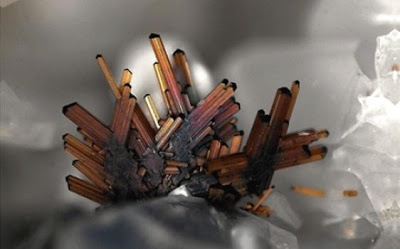
“We can identify the rock from which the rutile originates, even if we only have a tiny grain of rutile,” says researcher Thomas Zack, University of Gothenburg. (Credit: Image courtesy of University of Gothenburg)
Mar. 25, 2013 — Researchers can use the mineral rutile to learn about rock types and their history. Two articles published in the journal Geology now present a new application of a method for more easily tracing the mineral rutile. The co-authors of the articles are researchers at the University of Gothenburg.Rutile is used in ceramics and paints, but is particularly useful for finding out about the history of a rock.
Where mineral deposits are found, rutile is often also present. The new methods therefore bring opportunities for strategies to find other mineral deposits, such as gold.
Until now, rutile has been a relatively unknown mineral, despite not being rare. For example, rutile can be found on most sandy beaches around the world, including in Sweden.
“It’s incredible to see how little attention was paid to rutile until around five years ago,” says geologist and researcher Thomas Zack, from the University of Gothenburg’s Department of Earth Sciences, who has devoted much of his scientific career to studying the mineral.
Now, geologists can identify rock types containing rutile and follow the changes in temperature and pressure that they have been exposed to throughout its history, even if rutile is barely visible to the naked eye. Previously, researchers had to investigate considerably more rutile-bearing samples in order to carry out analyses.
“But now we can identify the rock from which the rutile originates, even if we only have a tiny grain of rutile,” adds Thomas Zack.
The new method is called “Laser Ablation ICP-MS,” and produces results much faster than previous methods.
“In analytical terms, this is one of the most important analytical instruments at the Department of Earth Sciences here in Gothenburg,” concludes Thomas Zack.
Note : The above story is reprinted from materials provided by University of Gothenburg, via AlphaGalileo.
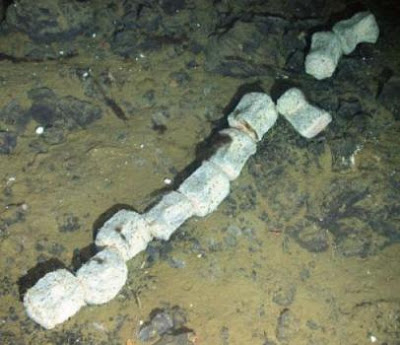
This shows the backbone of a whale skeleton on seafloor. (Credit: UK Natural Environment Research Council ChEsSo Consortium)
Mar. 18, 2013 — Marine biologists have, for the first time, found a whale skeleton on the ocean floor near Antarctica, giving new insights into life in the sea depths. The discovery was made almost a mile below the surface in an undersea crater and includes the find of at least nine new species of deep-sea organisms thriving on the bones.
The research, involving the University of Southampton, Natural History Museum, British Antarctic Survey, National Oceanography Centre (NOC) and Oxford University, is published today in Deep-Sea Research II: Topical Studies in Oceanography.
“The planet’s largest animals are also a part of the ecology of the very deep ocean, providing a rich habitat of food and shelter for deep sea animals for many years after their death,” says Diva Amon, lead author of the paper based at University of Southampton Ocean and Earth Science (which is based at NOC) and the Natural History Museum. “Examining the remains of this southern Minke whale gives insight into how nutrients are recycled in the ocean, which may be a globally important process in our oceans.”
Worldwide, only six natural whale skeletons have ever been found on the seafloor. Scientists have previously studied whale carcasses, known as a ‘whale fall’, by sinking bones and whole carcasses. Despite large populations of whales in the Antarctic, whale falls have not been studied in this region until now.
“At the moment, the only way to find a whale fall is to navigate right over one with an underwater vehicle,” says co-author Dr Jon Copley of University of Southampton Ocean and Earth Science. Exploring an undersea crater near the South Sandwich Islands gave scientists just that chance encounter. “We were just finishing a dive with the UK’s remotely operated vehicle, Isis, when we glimpsed a row of pale-coloured blocks in the distance, which turned out to be whale vertebrae on the seabed,” continues Dr Copley.
When a whale dies and sinks to the ocean floor, scavengers quickly strip its flesh. Over time, other organisms then colonise the skeleton and gradually use up its remaining nutrients. Bacteria break down the fats stored in whale bones, for example, and in turn provide food for other marine life. Other animals commonly known as zombie worms can also digest whale bone.
“One of the great remaining mysteries of deep ocean biology is how these tiny invertebrates can spread between the isolated habitats these whale carcasses provide on the seafloor,” says co-author Dr Adrian Glover at the Natural History Museum. ‘Our discovery fills important gaps in this knowledge.’
The team surveyed the whale skeleton using high-definition cameras to examine the deep-sea animals living on the bones and collected samples to analyse ashore. Researchers think that the skeleton may have been on the seafloor for several decades. Samples also revealed several new species of deep-sea creatures thriving on the whale’s remains, including a ‘bone-eating zombie worm’ known as Osedax burrowing into the bones and a new species of isopod crustacean, similar to woodlice, crawling over the skeleton. There were also limpets identical to those living at nearby deep-sea volcanic vents.
Note :The above story is reprinted from materials provided by National Oceanography Centre.
Feb. 7, 2013 — The demise of the dinosaurs is the world’s ultimate whodunit. Was it a comet or asteroid impact? Volcanic eruptions? Climate change?In an attempt to resolve the issue, scientists at the Berkeley Geochronology Center (BGC), the University of California, Berkeley, and universities in the Netherlands and the United Kingdom have now determined the most precise dates yet for the dinosaur extinction 66 million years ago and for the well-known impact that occurred around the same time.
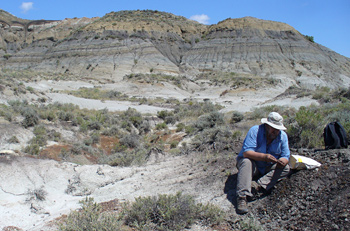
Team leader Paul Renne in Montana collecting a volcanic ash sample from a coal bed within a few centimeters of the dinosaur extinction horizon. Photo by Courtney Sprain.
The dates are so close, the researchers say, that they now believe the comet or asteroid, if not wholly responsible for the global extinction, at least dealt the dinosaurs their death blow.
“The impact was clearly the final straw that pushed Earth past the tipping point,” said Paul Renne, BGC director and UC Berkeley professor in residence of earth and planetary science. “We have shown that these events are synchronous to within a gnat’s eyebrow, and therefore the impact clearly played a major role in extinctions, but it probably wasn’t just the impact.”
The revised dates clear up lingering confusion over whether the impact actually occurred before or after the extinction, which was characterized by the almost overnight disappearance from the fossil record of land-based dinosaurs and many ocean creatures. The new date for the impact — 66,038,000 years ago — is the same within error limits as the date of the extinction, said Renne, making the events simultaneous.
He and his colleagues will report their findings in the Feb. 8 issue of the journal Science.
The crater of doom
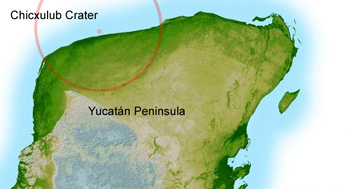
The extinction of the dinosaurs was first linked to a comet or asteroid impact in 1980 by the late UC Berkeley Nobel Laureate Luis Alvarez and his son, Walter, who is a UC Berkeley professor emeritus of earth and planetary science. A 110-mile-wide crater in the Caribbean off the Yucatan coast of Mexico is thought to be the result of that impact. Called Chicxulub (cheek’-she-loob), the crater is thought to have been excavated by an object six miles across that threw into the atmosphere debris still be found around the globe as glassy spheres or tektites, shocked quartz and a layer of iridium-enriched dust.
Renne’s quest for a more accurate dating of the extinction began three years ago when he noticed that the existing date conflicted with other estimates of the timing of the extinction and that the existing dates for the impact and the extinction did not line up within error margins.
Renne and his BGC colleagues first went to work recalibrating and improving the existing dating method,
A comet or asteroid impact 66 million years ago excavated a 110 mile-diameter crater, dubbed Chicxulub, centered off the coast of Mexico’s Yucatan peninsula. Courtesy of Wikipedia.
known as the argon-argon technique. They then collected volcanic ash from the Hell Creek area in Montana and analyzed them with the recalibrated argon-argon technique to determine the date of the extinction. The formation below the extinction horizon is the source of many dinosaur fossils and one of the best sites to study the change in fossils from before and after the extinction.
They also gathered previously dated tektites from Haiti and analyzed them using the same technique to determine how long ago the impact had occurred. The new extinction and impact dates are precise to within 11,000 years, the researchers said.
“When I got started in the field, the error bars on these events were plus or minus a million years,” said paleontologist William Clemens, a UC Berkeley professor emeritus of integrative biology who has led research in the Hell Creek area for more than 30 years, but was not directly involved in the study. “It’s an exciting time right now, a lot of which we can attribute to the work that Paul and his colleagues are doing in refining the precision of the time scale with which we work. This allows us to integrate what we see from the fossil record with data on climate change and changes in flora and fauna that we see around us today.”
Dinosaurs at the tipping point
Despite the synchronous impact and extinction, Renne cautions that this doesn’t mean that the impact was the sole cause. Dramatic climate variation over the previous million years, including long cold snaps amidst a general Cretaceous hothouse environment, probably brought many creatures to the brink of extinction, and the impact kicked them over the edge.
“These precursory phenomena made the global ecosystem much more sensitive to even relatively small triggers, so that what otherwise might have been a fairly minor effect shifted the ecosystem into a new state,” he said. “The impact was the coup de grace.”
One cause of the climate variability could have been a sustained series of volcanic eruptions in India that produced the extensive Deccan Traps. Renne plans to re-date those volcanic rocks to get a more precise measure of their duration and onset relative to the dinosaur extinction.
“This study shows the power of high precision geochronology,” said coauthor Darren F. Mark of the Scottish Universities Environmental Research Center, who conducted independent argon-argon analyses on samples provided by Renne. “Many people think precision is just about adding another decimal place to a number. But it’s far more exciting than that. It’s more like getting a sharper lens on a camera. It allows us to dissect the geological record at greater resolution and piece together the sequence of Earth history.”
Renne’s colleagues, in addition to Mark, are UC Berkeley graduate student William S. Mitchell III; BGC scientists Alan L. Deino and Roland Mundil; Leah E. Morgan of the Scottish Universities Environmental Research Center in Kilbride, Scotland; Frederik J Hilgen of Utrecht University; and Klaudia F. Kuiper and Jan Smit of Vrije University in Amsterdam.
The work was supported by the Ann and Gordon Getty Foundation, UC Berkeley’s Esper S. Larsen Jr. Fund and the National Science Foundation.
Note : The above story is reprinted from materials provided by University of California – Berkeley. The original article was written by Robert Sanders.
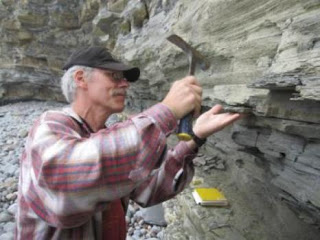
Along sea cliffs in southern England, geologist Paul Olsen of Columbia University’s Lamont-Doherty Earth Observatory samples rocks from near the 201,564,000-year Triassic extinction boundary. (Credit: Kevin Krajick/Earth Institute)
Mar. 21, 2013 — Scientists examining evidence across the world from New Jersey to North Africa say they have linked the abrupt disappearance of half of earth’s species 200 million years ago to a precisely dated set of gigantic volcanic eruptions. The eruptions may have caused climate changes so sudden that many creatures were unable to adapt — possibly on a pace similar to that of human-influenced climate warming today. The extinction opened the way for dinosaurs to evolve and dominate the planet for the next 135 million years, before they, too, were wiped out in a later planetary cataclysm.
In recent years, many scientists have suggested that the so-called End-Triassic Extinction and at least four other known past die-offs were caused at least in part by mega-volcanism and resulting climate change. However, they were unable to tie deposits left by eruptions to biological crashes closely in time. This study
Geologist Dennis Kent of Lamont-Doherty Earth Observatory drills into rocks near a layer where fossils of half the species of life on earth suddenly vanish, at 201,564,000 years ago.
provides the tightest link yet, with a newly precise date for the ETE–201,564,000 years ago, exactly the same time as a massive outpouring of lava. “This may not quench all the questions about the exact mechanism of the extinction itself. However, the coincidence in time with the volcanism is pretty much ironclad,” said coauthor Paul Olsen, a geologist at Columbia University’s Lamont-Doherty Earth Observatory who has been investigating the boundary since the 1970s.
The new study unites several pre-existing lines of evidence by aligning them with new techniques for dating rocks. Lead author Terrence Blackburn (then at Massachusetts Institute of Technology; now at the Carnegie Institution) used the decay of uranium isotopes to pull exact dates from basalt, a rock left by eruptions. The basalts analyzed in the study all came from the Central Atlantic Magmatic Province (CAMP), a series of huge eruptions known to have started around 200 million years ago, when nearly all land was massed into one huge continent. The eruptions spewed some 2.5 million cubic miles of lava in four sudden spurts over a 600,000-year span, and initiated a rift that evolved into the Atlantic Ocean; remnants of CAMP lavas are found now in North and South America, and North Africa. The scientists analyzed samples from what are now Nova Scotia, Morocco and the New York City suburbs. (Olsen hammered one from a road cut in the Hudson River Palisades, about 1,900 feet from the New Jersey side of the George Washington Bridge.)
Previous studies have suggested a link between the CAMP eruptions and the extinction, but other researchers’ dating of the basalts had a margin of error of 1 to 3 million years. The new margin of error is only a few thousand years — in geology, an eye blink. Blackburn and his colleagues showed that the eruption in Morocco was the earliest, with ones in Nova Scotia and New Jersey coming about 3,000 and 13,000 years later, respectively. Sediments below that time contain pollen, spores and other fossils characteristic of the Triassic era; in those above, the fossils disappear. Among the creatures that vanished were eel-like fish called conodonts, early crocodilians, tree lizards and many broad-leaved plants. The dating is further strengthened by a layer of sediment just preceding the extinction containing mineral grains providing evidence of one of earth’s many periodic reversals of magnetic polarity. This particular reversal, labeled E23r, is consistently located just below the boundary, making it a convenient marker, said coauthor Dennis Kent, a paleomagnetism expert who is also at Lamont-Doherty. With the same layers found everywhere the researchers have looked so far, the eruptions “had to be a hell of an event,” said Kent.
The third piece of chronological evidence is the sedimentary layers themselves. Sedimentary rocks cannot be dated directly — one reason why the timing of the extinction has been hard to nail. Olsen and some others have long contended that Earth’s precession — a cyclic change in the orientation of the axis toward the sun and resulting temperature changes — consistently created layers reflecting the alternate filling and drying of large lake basins on a fairly steady 20,000-year schedule. This idea is well accepted for more recent time, but many scientists have had doubts about whether it could be applied much farther back. By correlating the precisely dated basalts with surrounding sedimentary layers, the new study shows that precession operated pretty much the same way then, allowing dates with a give or take of 20,000 years to be assigned to most sediments holding fossils, said Olsen.
Olsen has painstakingly cataloged the layers around the time of the End Triassic, and the initial phase of the
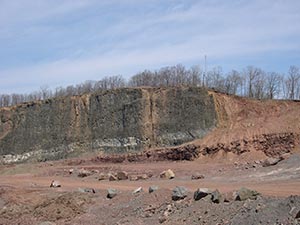
In suburban Clifton, New Jersey, a massive basalt flow (black rock, left) from the time of the End Triassic Extinction lies exposed in a former rock quarry, now behind a retirement home. A thin layer of sedimentary rock mostly covered in debris, at far right, records the sudden disappearance of many creatures.
extinction occurs in just one layer — meaning the event took 20,000 years at most. But, he said, “it could have taken much less. This is the level of resolution we have now, but it’s the ‘less’ part that is the more important, and that’s what we are working on now.”
Many scientists assume that giant eruptions would have sent sulfurous particles into the air that darkened the skies, creating a multi-year winter that would have frozen out many creatures. A previous study by Kent and Rutgers University geochemist Morgan Schaller has also shown that each pulse of volcanism doubled the air’s concentration of carbon dioxide — a major component of volcanic gases. Following the cold pulses, the warming effects of this greenhouse gas would have lasted for millennia, wiping out creatures that could not take too much heat. (It was already quite hot to begin with at that time; even pre-eruption CO2 levels were higher than those of today.) Fossils show that heat-sensitive plants especially suffered; there is also evidence that the increased CO2 caused chemical reactions that made the oceans more acidic, causing populations of shell-building creatures to collapse. As if this were not enough, there is also some evidence that a large meteorite hit Earth at the time of the extinction–but that factor seems far less certain. A much stronger case has been made for the extinction of the dinosaurs by a meteorite some 65 million years ago — an event that opened the way for the evolution and dominance of mammals, including human beings. Volcanism may have been involved in that extinction as well, with the meteorite delivering the final blow.)
The End Triassic was the fourth known global die-off; the extinction of the dinosaurs was the fifth. Today, some scientists have proposed that we are on the cusp of a sixth, humanmade, extinction. Explosive human population growth, industrial activity and exploitation of natural resources are rapidly pushing many species off the map. Burning of fossil fuels in particular has had an effect, raising the air’s CO2 level more than 40 percent in just 200 years — a pace possibly as fast, or faster, than that of the End Triassic. Resulting temperatures increases now appear to be altering ecosystems; and CO2 entering seawater is causing what could be the fastest ongoing acidification of the oceans for at least the last 300 million years, according to a 2012 study. “In some ways, the End Triassic Extinction is analogous to today,” said Blackburn. “It may have operated on a similar time scale. Much insight on the possible future impact of doubling atmospheric CO2 on global temperatures, ocean acidity and life on earth may be gained by studying the geologic record.”
Paul Renne, a researcher at the Berkeley Geochronology Center in California, who studies the End Triassic but was not involved in the Science paper, said the study was “part of a growing pattern in which we see that the major ecosystem crises were triggered” by volcanism. He said the new data “make the case stronger than it was. … The pendulum continues to swing in favor of that idea.” Of the actual mechanism that killed creatures, he said climate change was the most popular suspect. But, he added, “We still don’t have any way yet of knowing exactly how much CO2 was put into the atmosphere at that time, and what it did. If we did, we would then be able to say to people, ‘Look folks, this is what we’re facing now, and here’s what we have to do about it. But we don’t know that yet.”
Note : The above story is reprinted from materials provided by The Earth Institute at Columbia University.
Continental collision is a phenomenon of the plate tectonics of Earth that occurs at convergent boundaries. Continental collision is a variation on the fundamental process of subduction, whereby the subduction zone is destroyed, mountains produced, and two continents sutured together. Continental collision is known only from this planet and is an interesting example of how our different crusts, oceanic and continental, behave during subduction.
Continental collision is not an instantaneous event, but may take several tens of millions of years before the faulting and folding caused by collision stop. Collision between India and Asia has been going on for about 50 million years already and shows no signs of abating. Collision between East and West Gondwana to form the East African Orogen took about 100 million years from beginning (610 Ma) to end (510 Ma). Collision between Gondwana and Laurasia to form Pangea occurred in a relatively brief interval, about 50 million years long.
Subduction zone: the collision site
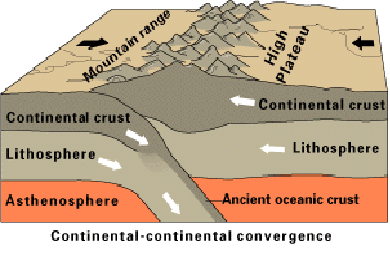
The process begins as two continents (different bits of continental crust), separated across a tract of ocean (and oceanic crust), approach each other, while the oceanic crust is slowly consumed at a subduction zone.
The subduction zone runs along the edge of one of the continents and dips under it, raising volcanic mountain chains at some distance behind it, such as the Andes of South America today. Subduction involves the whole lithosphere, the density of which is largely controlled by the nature of the crust it carries.
Oceanic crust is thin (~6 km thick) and dense (about 3.3 g/cm³), consisting of basalt, gabbro, and peridotite. Consequently, most oceanic crust is subducted easily at an oceanic trench. In contrast, continental crust is thick (~45 km thick) and buoyant, composed mostly of granitic rocks (average density about 2.5 g/cm³). Continental crust is subducted with difficulty, but is subducted to depths of 90-150 km or more, as evidenced by ultra-high pressure (UHP) metamorphic suites.
Normal subduction continues as long as the ocean exists, but the subduction system is disrupted as the continent carried by the downgoing plate enters the trench. Because it contains thick continental crust, this lithosphere is less dense than the underlying asthenospheric mantle and normal subduction is disrupted.
The volcanic arc on the upper plate is slowly extinguished. Resisting subduction, the crust buckles up and under, raising mountains where a trench used to be. The position of the trench becomes a zone that marks the suture between the two continental terranes. Suture zones are often marked by fragments of the pre-existing oceanic crust and mantle rocks, known as ophiolites.
Deep subduction of continental crust
The continental crust on the downgoing plate is deeply subducted as part of the downgoing plate during collision, defined as buoyant crust entering a subduction zone. An unknown proportion of subducted continental crust returns to the surface as ultra-high pressure (UHP) metamorphic terranes, which contain metamorphic coesite and/or diamond plus or minus unusual silicon-rich garnets and/or potassium-bearing pyroxenes.
The presence of these minerals demonstrate subduction of continental crust to at least 90–140 km deep. Examples of UHP terranes are known from the Dabie–Sulu belt of east-central China, the Western Alps, the Himalaya of India, the Kokchetav Massif of Kazakhstan, the Bohemian Massif of Europe, the Western Gneiss Region of Norway, and Mali. Most UHP terranes consist of an imbricated sheets or nappes.
The fact that most UHP terranes consist of thin sheets suggests that much thicker, volumetrically dominant tracts of continental crust are more deeply subducted.
Orogeny and collapse
An orogeny is underway when mountains begin to grow in the collision zone. There are other modes of mountain formation and orogeny but certainly continental collision is one of the most important. Rainfall and snowfall increase on the mountains as these rise, perhaps at a rate of a few millimeters per year (at a growth rate of 1 mm/year, a 5,000 m tall mountain can form in 5 million years, a time period that is less than 10% of the life of a typical collision zone). River systems form, and glaciers may grow on the highest peaks.
Erosion accelerates as the mountains rise, and great volumes of sediment are shed into the rivers, which carry sediment away from the mountains to be deposited in sedimentary basins in the surrounding lowlands. Crustal rocks are thrust faulted over the sediments and the mountain belt broadens as it rises in height. A crustal root also develops, as required by isostasy; mountains can be high if underlain by thicker crust.
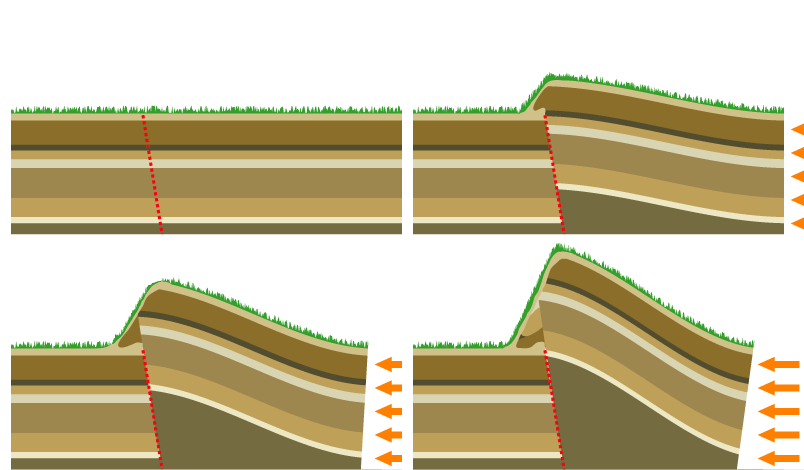
Mountain formation by a reverse fault movement
Crustal thickening may happen as a result of crustal shortening or when one crust overthrusts the other. Thickening is accompanied by heating, so the crust becomes weaker as it thickens. The lower crust begins to flow and collapse under the growing mountain mass, forming rifts near the crest of the mountain range. The lower crust may partially melt, forming anatectic granites which then rise into the overlying units, forming granite intrusions.
Crustal thickening provides one of two negative feedbacks on mountain growth in collision zones, the other being erosion. The popular notion that erosion is responsible for destroying mountains is only half correct – viscous flow of weak lower mantle also reduces relief with time, especially once the collision is complete and the two continents are completely sutured. Convergence between the continents continues because the crust is still being pulled down by oceanic lithosphere sinking in the subduction zone to either side of the collision as well as beneath the impinging continent.
The pace of mountain building associated with the collision is measured by radiometric dating of igneous rocks or units that have been metamorphosed during the collision and by examining the record of sediments shed from the rising mountains into the surrounding basins. The pace of ancient convergence can be determined with paleomagnetic measurements, while the present rate of convergence can be measured with GPS.
Note : The above story is reprinted from materials provided by Wikipedia.
The Schlumberger Oilfield Glossary is now available as a free Apple ; iPhone, iPod touch, and iPad app via iTunes.
The Oilfield Glossary contains definitions for more than 4,600 industry terms refined by technical experts. Respected as a publicly available resource on the Web, the glossary can now be accessed on the Apple iPhone, iPod touch, and iPad devices.
The iTunes application can be installed in two ways
To install iTunes software on your PC or Mac computer, go to the Apple Web site to download. (Please note that iTunes software must be installed on your computer to download the app.)
Search for “Schlumberger Oilfield Glossary” in the iTunes App Store from your iPhone.
Finding a term is quick and easy
The user interface is intuitive and has been optimized for search. You can search for a specific term or browse the entire glossary. To search for a specific term, such as “waveform,” or search for part of a term name, such as “wave,” simply enter the text in the “Search for Term” box on the first page and press the “Search” button. A short list of terms will be displayed.
To browse the entire glossary, leave the Search box blank and press the Search button. All terms in the glossary will display. You can then jump to terms beginning with a specific letter or use discipline and image filters to narrow the results.
Accessing the glossary on the go
Whether you are looking up a term during a conference, at the wellsite, or in the office, the application has been streamlined to take full advantage of the mobile device’s capabilities. Support for other mobile devices is being explored, and users can still access the Oilfield Glossary using mobile Web browsers.
For more information or help installing the application on your device, please send an e-mail to: [email protected]
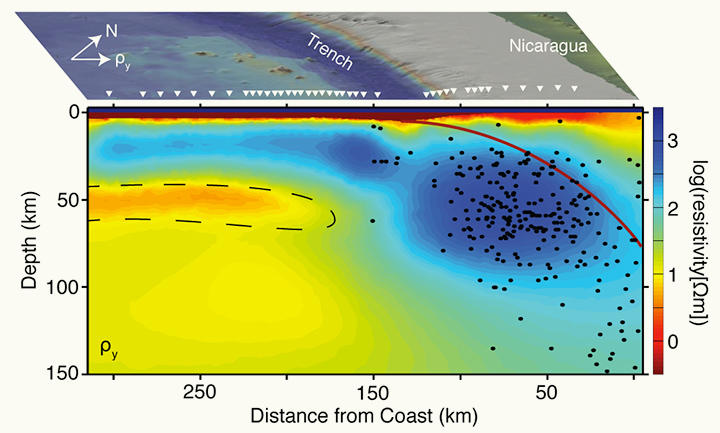
The orange colored area enclosed by a dashed line denotes a magma layer that scientists believe is facilitating the motion of the Cocos plate off Nicaragua. The blue areas represent the Cocos plate sliding across the mantle and eventually diving beneath the Central American continent, while the black dots signify earthquake locations. The discovery was made by analyzing data collected by an array of seafloor electromagnetic instruments, shown as inverted triangles. (Credit: Image courtesy of University of California – San Diego)
Scientists at Scripps Institution of Oceanography at UC San Diego have found a layer of liquefied molten rock in Earth’s mantle that may be acting as a lubricant for the sliding motions of the planet’s massive tectonic plates. The discovery may carry far-reaching implications, from solving basic geological functions of the planet to a better understanding of volcanism and earthquakes.The scientists discovered the magma layer at the Middle America trench offshore Nicaragua. Using advanced seafloor electromagnetic imaging technology pioneered at Scripps, the scientists imaged a 25-kilometer- (15.5-mile-) thick layer of partially melted mantle rock below the edge of the Cocos plate where it moves underneath Central America.
The discovery is reported in the March 21 issue of the journal Nature by Samer Naif, Kerry Key, and Steven Constable of Scripps, and Rob Evans of Woods Hole Oceanographic Institution.
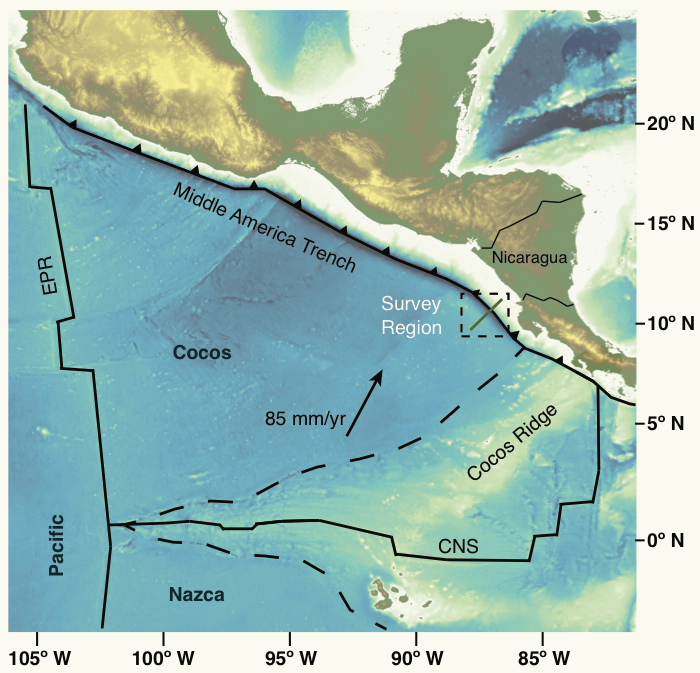
The new images of magma were captured during a 2010 expedition aboard the U.S. Navy-owned and Scripps-operated research vessel Melville. After deploying a vast array of seafloor instruments that recorded natural electromagnetic signals to map features of the crust and mantle, the scientists realized they found magma in a surprising place.
Map of the 2010 survey region. Click to view larger image.
“This was completely unexpected,” said Key, an associate research geophysicist in the Cecil H. and Ida M. Green Institute of Geophysics and Planetary Physics at Scripps. “We went out looking to get an idea of how fluids are interacting with plate subduction, but we discovered a melt layer we weren’t expecting to find at all — it was pretty surprising.”For decades scientists have debated the forces and circumstances that allow the planet’s tectonic plates to slide across Earth’s mantle. Studies have shown that dissolved water in mantle minerals results in a more ductile mantle that would facilitate tectonic plate motions, but for many years clear images and data required to confirm or deny this idea were lacking.
“Our data tell us that water can’t accommodate the features we are seeing,” said Naif, a Scripps graduate student and lead author of the paper. “The information from the new images confirms the idea that there needs to be some amount of melt in the upper mantle and that’s really what’s creating this ductile behavior for plates to slide.”
The marine electromagnetic technology employed in the study was originated by Charles “Chip” Cox, an emeritus professor of oceanography at Scripps, and in recent years further advanced by Constable and Key. Since 2000 they have been working with the energy industry to apply this technology to map offshore oil and gas reservoirs.
The researchers say their results will help geologists better understand the structure of the tectonic plate boundary and how that impacts earthquakes and volcanism.
“One of the longer-term implications of our results is that we are going to understand more about the plate boundary, which could lead to a better understanding of earthquakes,” said Key.
The researchers are now seeking to find the source that supplies the magma in the newly discovered layer.
The National Science Foundation and the Seafloor Electromagnetic Methods Consortium at Scripps supported the research.
Note : The above story is reprinted from materials provided by University of California – San Diego. The original article was written by Mario Aguilera.
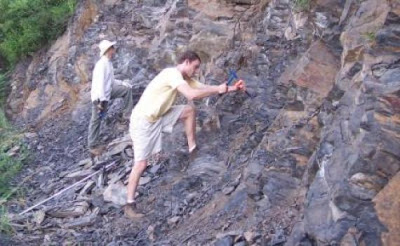
Researchers Chris Reinhard (front) and Noah Planavsky dig into a shale exposure in north China. (Credit: Chu Research Group, Institute of Geology and Geophysics, Chinese Academy of Sciences.)C
A research team led by biogeochemists at the University of California, Riverside has filled in a billion-year gap in our understanding of conditions in the early ocean during a critical time in the history of life on Earth.
It is now well accepted that appreciable oxygen first accumulated in the atmosphere about 2.4 to 2.3 billion years ago. It is equally well accepted that the build-up of oxygen in the ocean may have lagged the atmospheric increase by well over a billion years, but the details of those conditions have long been elusive because of the patchiness of the ancient rock record.
The period 1.8 to 0.8 billion years ago is of particular interest because it is the essential first chapter in the history of eukaryotes, which are single-celled and multicellular organisms with more complex cellular structures compared to prokaryotes such as bacteria. Their rise was a milestone in the history of life, including that of animals, which first appear around 0.6 to 0.7 billion years ago.
The most interesting thing about the billion-year interval is that despite the rise of oxygen and eukaryotes, the first steps forward were small and remarkably unchanging over a very long period, with oxygen likely remaining low in the atmosphere and ocean and with marine life dominated by bacteria rather than diverse and large populations of more complex eukaryotes. In fact, chemical and biological conditions in this middle age of Earth history were sufficiently static to earn this interval an unflattering nickname — ‘the boring billion.’
But lest it be thought that such a ‘boring’ interval is uninteresting, the extraordinary circumstances required to maintain such biological and chemical stasis for a billion years are worthy of close study, which is what motivated the UC Riverside-led team.
By compiling data for metals with very specific and well-known chemical responses to oxygen conditions in the ocean, emphasizing marine sediments from this critical time interval from around the world, the researchers revealed an ancient ocean that was oxygen-free (anoxic) and iron-rich in the deepest waters and hydrogen sulfide-containing over limited regions on the ocean margins.
“Oxygen, by contrast, was limited, perhaps at very low levels, to the surface layers of the ocean,” said Christopher T. Reinhard, the first author of the research paper and a former UC Riverside graduate student. “What’s most unique about our study, however, is that by applying numerical techniques to the data, we were able to place estimates, for the first time, on the full global extent of these conditions. Our results suggest that most of the deep ocean was likely anoxic, compared to something much less than 1 percent today.”
Study results appear online this week in the Proceedings of the National Academy of Sciences.
“A new modeling approach we took allowed us to build on our past work, which was mostly limited to defining very localized conditions in the ancient ocean,” Reinhard said. “The particular strength of the method lies in its ability to define chemical conditions on the seafloor that have long since been lost to plate tectonic recycling.”
Reinhard, now a postdoctoral fellow at Caltech and soon to be an assistant professor at Georgia Institute of Technology, explained that chromium and molybdenum enrichments in ancient organic-rich sedimentary rocks, the focus of the study, actually track the amount of the metals present in ancient seawater. Critically, those concentrations are fingerprints of global ocean chemistry.
Beyond the utility of chromium and molybdenum for tracking oxygen levels in the early ocean, molybdenum is also a bioessential element critical in the biological cycling of nitrogen, a major nutrient in the ocean.
“Molybdenum’s abundance in our ancient rocks is also a direct measure of its availability to early life,” said Timothy W. Lyons, a professor of biogeochemistry at UCR and the principal investigator of the research project. “Our recent results tell us that poor supplies of molybdenum and their impact on nitrogen availability may have limited the rise of oxygen in the ocean and atmosphere and the proliferation of eukaryotic life. There is more to do, certainly, but this is a very tantalizing new read of a chapter in Earth history that is anything but boring.”
Note :The above story is reprinted from materials provided by University of California – Riverside, via EurekAlert!, a service of AAAS.
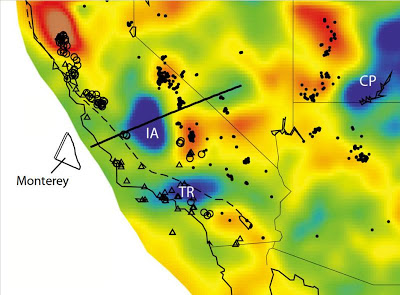
Mostly gone, not forgotten. The Isabella anomaly (IA, above), is at the same depth (ca. 100 km) as other fragments of the Farallon plate under Oregon and Washington, is on a line with fragments off the California coast, and has a similar seismic tomography signature. (Credit: Forsyth lab/Brown University
Mar. 18, 2013 — The Isabella anomaly — indications of a large mass of cool, dehydrated material about 100 kilometers beneath central California — is in fact a surviving slab of the Farallon oceanic plate. Most of the Farallon plate was driven deep into the Earth’s mantle as the Pacific and North American plates began converging about 100 million years ago, eventually coming together to form the San Andreas fault.
Large chunks of an ancient tectonic plate that slid under North America millions of years ago are still present under parts of central California and Mexico, according to new research led by Brown University geophysicists.
Around 100 million years ago, the Farallon oceanic plate lay between the converging Pacific and North American plates, which eventually came together to form the San Andreas fault. As those plates converged, much of the Farallon was subducted underneath North America and eventually sank deep into the mantle. Off the west coast of North America, the Farallon plate fragmented, leaving a few small remnants at the surface that stopped subducting and became part of the Pacific plate.
But this new research suggests that large slabs from Farallon remain attached to these unsubducted fragments. The researchers used seismic tomography and other data to show that part of the Baja region and part of central California near the Sierra Nevada mountains sit atop “fossil” slabs of the Farallon plate.
“Many had assumed that these pieces would have broken off quite close to the surface,” said Brown geophysicist Donald Forsyth, who led the research with Yun Wang, a former Brown graduate student now at the University of Alaska. “We’re suggesting that they actually broke off fairly deep, leaving these large slabs behind.”
The findings are published in the Proceedings of the National Academy of Sciences.
Geologists had known for years about a “high velocity anomaly” in seismic tomography data near the Sierra Nevada mountains in California. Seismic tomography measures the velocity of seismic waves deep underground. The speed of the waves provides information about the composition and temperature of the subsurface. Generally, slower waves mean softer and hotter material; faster waves mean stiffer and cooler material.
The anomaly in California, known as the Isabella anomaly, indicated that a large mass of relatively cool and dehydrated material is present at a depth of 100 to 200 kilometers below the surface. Just what that mass was wasn’t known, but there were a few theories. It was often explained by a process called delamination. The crust beneath the eastern part of the mountains is thin and the mantle hot, indicating that part of the lithospheric plate under the mountains had delaminated — broken off. The anomaly, scientists thought, might be the signature of that sunken hunk of lithosphere, which would be cooler and dryer than the surrounding mantle.
But a few years ago, scientists detected a new anomaly under the Mexico’s Baja Peninsula, due east of one of the known coastal remains of the Farallon plate. Because of its proximity to the Farallon fragment, Forsyth and Wang thought it was very likely that the anomaly represented an underground extension of the fragment.
A closer look at the region showed that there are high-magnesium andesite deposits on the surface near the eastern edge of the anomaly. These kinds of deposits are volcanic rocks usually associated with the melting of oceanic crust material. Their presence suggests that the eastern edge of the anomaly represents the spots where Farallon finally gave way and broke off, sending andesites to the surface as the crust at the end of the subducted plate melted.
That led Forsyth and his colleagues to suspect that perhaps the Isabella anomaly in California might also represent a slab still connected to an unsubducted fragment of the Farallon plate. So they re-examined the tomography data along the entire West Coast. They compared the Baja and Isabella anomalies to anomalies associated with known Farallon slabs underneath Washington and Oregon.
The study found that all of the anomalies are strongest at the same depth — right around 100 kilometers. And all of them line up nearly due east of known fragments from Farallon.
“The geometry was the kicker,” Forsyth said. “The way they line up just makes sense.”
The findings could force scientists to re-examine the tectonic history of western North America, Forsyth said. In particular, it forces a rethinking of the delamination of the Sierra Nevada, which had been used to explain the Isabella anomaly.
“However the Sierra Nevada was delaminated,” Forsyth said, “it’s probably not in the way that many people had been thinking.”
His research colleague asnd co-author Brian Savage of the University of Rhode Island agrees. “This work has radically changed our understanding of the makeup of the west coast of North America,” Savage said. “It will cause a thorough rethinking of the geological history of North America and undoubtedly many other continental margins.””
The work was supported by the National Science Foundation. Other authors on the paper were Brown graduate student Christina Rau, Brown undergraduate Nina Carriero, Brandon Schmandt from the University of Oregon, and James Gaherty from Columbia University.
Note : The above story is reprinted from materials provided by Brown University.
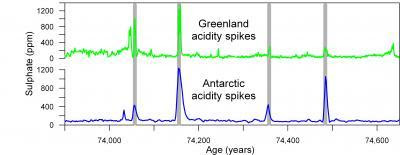
This shows the bipolar matching of volcanic acidity spikes (sulphate) in Greenland and Antarctic ice cores at around the Toba eruption. (Credit: Niels Bohr Institute
Nov. 5, 2012 — The largest volcanic eruption on Earth in the past millions of years took place in Indonesia 74,000 years ago and researchers from the Niels Bohr Institute can now link the colossal eruption with the global climate and the effects on early humans. The results are published in the scientific journal Climate of the Past.
The volcano Toba is located in Indonesia on the island Sumatra, which lies close to the equator. The colossal eruption, which occurred 74,000 years ago, left a crater that is about 50 km wide. Expelled with the eruption was 2,500 cubic kilometers of lava — equivalent to double the volume of Mount Everest. The eruption was 5,000 times larger than the Mount St. Helens eruption in 1980 in the United States. Toba is the largest volcanic eruption on Earth in the last 2 million years.
The volcanic eruption threw huge clouds of ash and sulphuric acid into the atmosphere and up into the stratosphere, from where it spread across the entire globe in both the northern and southern hemispheres and fell down as acid rain.
Traces of acid rain in the ice caps
“We have now traced this acid rain in the ice caps on Greenland and Antarctica. We have long had an idea of at what depth the Toba eruption could be found in the Greenland ice cap, but we found no ash, so we could not be sure. But now we have found the same series of acid layers from Toba in the Greenland ice sheet and in the ice cap in Antarctica. We have counted the annual layers between acid peaks in ice cores from the two ice caps and it fits together,” explains glaciologist Anders Svensson, Centre for Ice and Climate at the Niels Bohr Institute at the University of Copenhagen.
“This means that we can compare the ice cores from Greenland and Antarctica with a annual accuracy and thus combine our knowledge of climate change in the northern and southern hemispheres,” emphasizes Anders Svensson.
There has been much speculation about how such a huge eruption affected the climate. The giant clouds of sulphur particles that are thrown up into the stratosphere form a blanket that shields from the sun’s radiation and this causes Earth to cool. But how much and for how long? Modelling has shown that such an enormous eruption could cause a cooling of up to 10 degrees in the global temperature for decades..
“In the temperature curves from the ice cores we can see that there is no general global cooling as a result of the eruption. There is certainly a cooling and large fluctuations in temperature in the northern hemisphere, but it becomes warmer in the southern hemisphere, so the global cooling has been short,” says Anders Svensson.
Consequences for man
But the eruption may still have had major consequences for nature, the environment and humans in large areas of Asia, where a clear layer of ash from the eruption has been found.
The eruption occurred at a fateful time in human history, around the time when there was a mass exodus of our ancestors, Homo sapiens, from Africa to Asia and researchers believe that early people living as far as 2000 km away in eastern India were affected by the eruption, which raged for weeks.
Archaeologist, however, strongly disagree about what the consequences of the Toba eruption were for people living in the areas of Asia that were affected by the eruption. Speculation ranges from almost no effect to total or partial extermination of the population in large areas. Material from this period is too old to be dated using the carbon-14 method and the Toba ash layer is therefore a very important reference horizon.
“The new precise location of the Toba eruption in the ice cores will place the archaeological finds in a climatic context, which will help to shed light on this critical period of human history,” says Anders Svensson.
Note : The above story is reprinted from materials provided by University of Copenhagen, via EurekAlert!, a service of AAAS.
Book Name : The Earth’s Magnetism “An Introduction for Geologists” Authors : – Prof. Dr. Roberto Lanza Dipartimento di Scienze della Terra Università di Torino – Dr. Antonio Meloni Istituto Nazionale di Geofisica e Vulcanologia
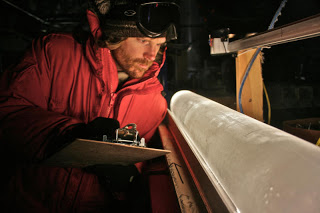
This ice core sample from West Antarctica provides information on historic temperatures recorded in that location. (Credit: Photo courtesy of Oregon State University)
Using data from 73 sites around the world, scientists have been able to reconstruct Earth’s temperature history back to the end of the last Ice Age, revealing that the planet today is warmer than it has been during 70 to 80 percent of the time over the last 11,300 years.
Of even more concern are projections of global temperature for the year 2100, when virtually every climate model evaluated by the Intergovernmental Panel on Climate Change (IPCC) shows that temperatures will exceed the warmest temperatures during that 11,300-year period known as the Holocene — under all plausible greenhouse gas emission scenarios.
Results of the study, by researchers at Oregon State University and Harvard University, were published this week in the journal Science. It was funded by the National Science Foundation’s Paleoclimate Program.
Lead author Shaun Marcott, a post-doctoral researcher in Oregon State’s College of Earth, Ocean, and Atmospheric Sciences, noted that previous research on past global temperature change has largely focused on the last 2,000 years. Extending the reconstruction of global temperatures back to the end of the last Ice Age puts today’s climate into a larger context.
“We already knew that on a global scale, Earth is warmer today than it was over much of the past 2,000 years,” Marcott said. “Now we know that it is warmer than most of the past 11,300 years. This is of particular interest because the Holocene spans the entire period of human civilization.”
Peter Clark, an OSU paleoclimatologist and co-author on the Science article, said many previous temperature reconstructions were regional in nature and were not placed in a global context. Marcott led the effort to combine data from 73 sites around the world, providing a much broader perspective.
“When you just look at one part of the world, the temperature history can be affected by regional climate processes like El Niño or monsoon variations,” noted Clark. “But when you combine the data from sites all around the world, you can average out those regional anomalies and get a clear sense of the Earth’s global temperature history.”
What that history shows, the researchers say, is that over the past 5,000 years, Earth on average cooled about 1.3 degrees (Fahrenheit) — until the past 100 years, when it warmed ̴ 1.3 degrees (F). The largest changes were in the northern hemisphere, where there are more land masses and greater human populations.
Climate models project that global temperature will rise another 2.0 to 11.5 degrees (F) by the end of this century, largely dependent on the magnitude of carbon emissions. “What is most troubling,” Clark said, “is that this warming will be significantly greater than at any time during the past 11,300 years.”
Marcott said that one of the natural factors affecting global temperatures over the past 11,300 years is gradual change in the distribution of solar insolation associated with Earth’s position relative to the sun.
“During the warmest period of the Holocene, the Earth was positioned such that Northern Hemisphere summers warmed more,” Marcott said. “As the Earth’s orientation changed, Northern Hemisphere summers became cooler, and we should now be near the bottom of this long-term cooling trend — but obviously, we are not.”
Clark said that other studies, including those outlined in past IPCC reports, have attributed the warming of the planet over the past 50 years to anthropogenic, or human-caused activities — and not solar variability or other natural causes.
“The last century stands out as the anomaly in this record of global temperature since the end of the last ice age,” said Candace Major, program director in the National Science Foundation’s Division of Ocean Sciences, which co-funded the research with NSF’s Division of Atmospheric and Geospace Sciences. “This research shows that we’ve experienced almost the same range of temperature change since the beginning of the industrial revolution as over the previous 11,000 years of Earth history — but this change happened a lot more quickly.”
The research team, which included Jeremy Shakun of Harvard University and Alan Mix of Oregon State, primarily used fossils from ocean sediment cores and terrestrial archives to reconstruct the temperature history. The chemical and physical characteristics of the fossils — including the species as well as their chemical composition and isotopic ratios — provide reliable proxy records for past temperatures by calibrating them to modern temperature records.
Using data from 73 sites around the world allows a global picture of Earth’s history and provides new context for climate change analysis.
“The Earth’s climate is complex and responds to multiple forcings, including CO2 and solar insolation,” Marcott said. “Both of those changed very slowly over the past 11,000 years. But in the last 100 years, the increase in CO2 through increased emissions from human activities has been significant. It is the only variable that can best explain the rapid increase in global temperatures.”
Note : The above story is reprinted from materials provided by Oregon State University.
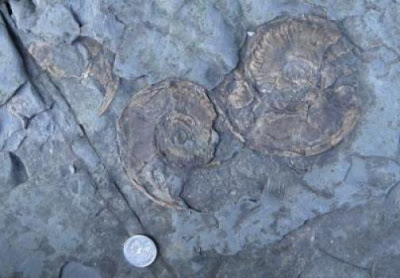
This shows Early Jurassic ammonite. (Credit: Plymouth University
The risk posed by global warming and rising ocean temperatures to the future health of the world’s marine ecosystem has been highlighted by scientists studying fossil records.
Researchers at Plymouth University believe that findings from fieldwork along the North Yorkshire coast reveal strong parallels between the Early Jurassic era of 180 million years ago and current climate predictions over the next century.
Through geology and palaeontology, they’ve shown how higher temperatures and lower oxygen levels caused drastic changes to marine communities, and that while the Jurassic seas eventually recovered from the effects of global warming, the marine ecosystems that returned were noticeably different from before.
The results of the Natural Environment Research Council-funded project are revealed for the first time in this month’s PLOS ONE scientific journal.
Professor Richard Twitchett, from the University’s School of Geography, Earth and Environmental Sciences, and a member of its Marine Institute, said: “Our study of fossil marine ecosystems shows that if global warming is severe enough and lasts long enough it may cause the extinction of marine life, which irreversibly changes the composition of marine ecosystems.”
Professor Twitchett, with Plymouth colleagues Dr Silvia Danise and Dr Marie-Emilie Clemence, undertook fieldwork between Whitby and Staithes, studying the different sedimentary rocks and the marine fossils they contained. This provided information about the environmental conditions on the sea floor at the time the rocks were laid down.
The researchers, working with Dr Crispin Little from the University of Leeds, were then able to correlate the ecological data with published data on changes in temperature, sea level and oxygen concentrations.
Dr Danise said: “Back in the laboratory, we broke down the samples and identified all of the fossils, recording their relative abundance much like a marine biologist would do when sampling a modern environment. Then we ran the ecological analyses to determine how the marine seafloor community changed through time.”
The team found a ‘dead zone’ recorded in the rock, which showed virtually no signs of life and contained no fossils. This was followed by evidence of a return to life, but with new species recorded.
Professor Twitchett added: “The results show in unprecedented detail how the fossil Jurassic communities changed dramatically in response to a rise in sea level and temperature and a decline in oxygen levels.
“Patterns of change suffered by these Jurassic ecosystems closely mirror the changes that happen when modern marine communities are exposed to declining levels of oxygen. Similar ecological stages can be recognised in the fossil and modern communities despite differences in the species present and the scale of the studies.”
The NERC project – ‘The evolution of modern marine ecosystems: environmental controls on their structure and function’ – runs until March 2015, and is one of four funded under their Coevolution of Life and the Planet research programme.
Note : The above story is reprinted from materials provided by University of Plymouth.
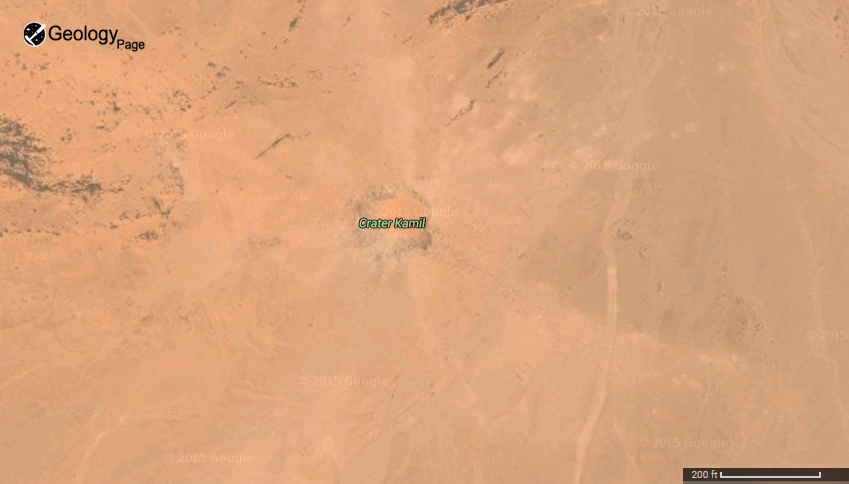
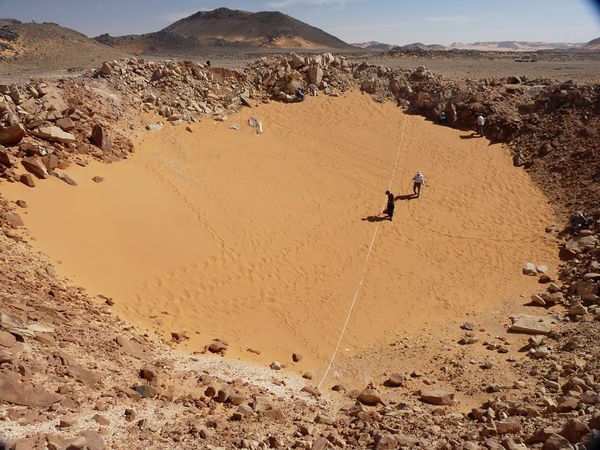
The impact crater 23 September 2010: A 2008 Google Earth search led to the discovery of Kamil crater, one of the best-preserved meteorite impact sites ever found. Earlier this year, a gritty, sand-blown expedition reached the site deep in the Egyptian desert to collect iron debris and determine the crater’s age and origins.
One day within the last several thousand years, a rare metallic meteorite travelling over 12 000 km/hour smashed into Earth’s surface near what is today the trackless border region between Egypt, Sudan and Libya. The impact of the 1.3 m, 10-tonne chunk of iron generated a fireball and plume that would have been visible over 1000 km away, and drilled a hole 16 m deep and 45 m wide into the rocky terrain.
Since then, the crater had sat undisturbed by Earth’s geologic and climatic processes, which usually render all but the very largest terrestrial impact craters invisible. It was also, as far as is recorded, unseen by humans
Searching for craters in Google Earth
But that changed in 2008, when the crater was spotted during a Google Earth study conducted by mineralologist Vincenzo De Michele, then with the Civico Museo di Storia Naturale in Milan, Italy. He was searching for natural features, when by chance he saw the rounded impact crater on his PC screen.
De Michele contacted an astrophysicist, Dr Mario Di Martino, at the INAF (National Institute for Astrophysics) observatory in Turin, who, together with Dr Luigi Folco, of Siena’s Museo Nazionale dell’Antartide, organised an expedition to the site in February this year.
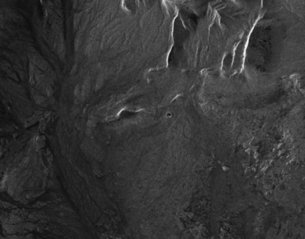
It took over a year to plan and obtain permissions for the journey; in the meantime, and in collaboration with Telespazio, e-Geos and the Italian space agency ASI, the Kamil region was analysed using satellite data and in particular high-resolution radar images provided by the ASI-operated COSMO-SkyMed satellite constellation.
Expedition to the Egyptian desert
Kamil crater seen by satellite (small round dot near centre of image)
The two-week, 40-person expedition included Egyptian and Italian scientists, as well as numerous local support workers, and was conducted as part of the 2009 Italian-Egyptian Year of Science and Technology (EISY). It was also supported with funding by ESA’s Space Situational Awareness (SSA) programme.
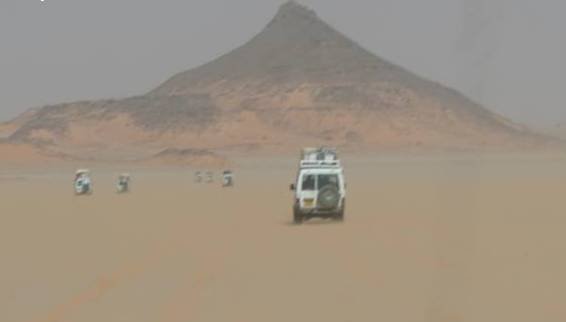
Three-day drive to reach Kamil crater
After a tiring, GPS-guided, three-day drive across the desert in 40°C heat, the team reached the crater.
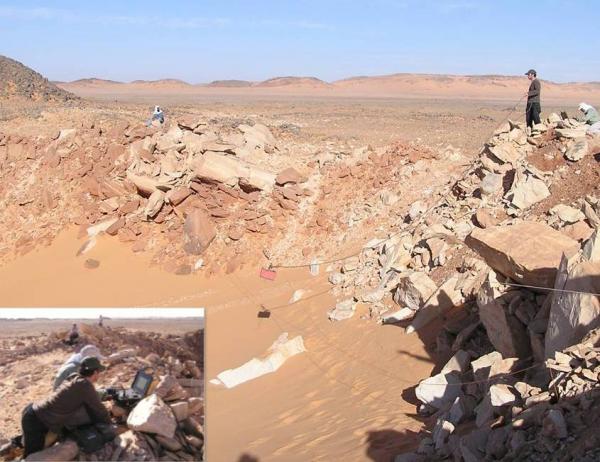
Three-day drive to reach Kamil crater They collected over 1000 kg of metallic meteorite fragments, including one 83-kg chunk thought to have split from the main meteorite body shortly before impact (it was found 200 m away from the crater). The joint team also conducted a thorough geological and topographical survey, using ground-penetrating radar to create a 3D digital terrain model. Geomagnetic and seismic surveys were also carried out.
Ground truth for small-scale impact craters
Using ground-penetrating radar to study the impact crater. (Credit: L. Folco/The Kamillers)
The researchers were stunned to find that Kamil crater, named after a nearby rocky outcrop, remains pristine, and must have been created relatively recently.
“This demonstrates that metallic meteorites having a mass on the order of 10 tonnes do not break up in the atmosphere, and instead explode when they reach the ground and produce a crater,” says ESA’s Dr Detlef Koschny, Head of Near Earth Objects segment for the SSA programme.
Kamil crater has become the target of intense interest for geologists, astrophysicists and even archaeologists.
“We are still determining the geochronology of the impact site, but the crater is certainly less than ten thousand years old — and potentially less than a few thousand. The impact may even have been observed by humans, and archaeological investigations at nearby ancient settlements may help fix the date,” says Dr Folco.
The data gathered during the expedition will be very useful to ESA’s SSA activities for risk assessment of small asteroids with orbits that approach Earth, a category to which the Kamil impactor originally belonged.
Kamil Crater in Google Maps
Photo:
Geophysicists work in the newfound Kamil crater in an undated picture. Photograph courtesy Museo Nazionale dell’Antartide Università di Siena
Note : The above story is reprinted from materials provided by European Space Agency.
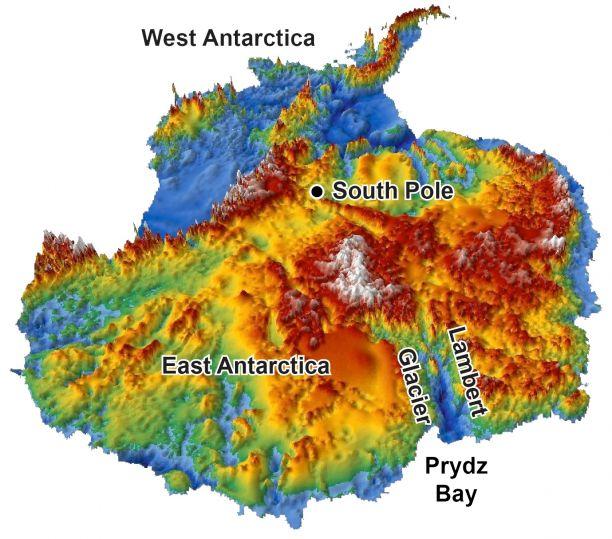
This 3-D reconstruction of the topography hidden under Antarctica’s two-mile-thick coating of ice was made using data from radar surveys. Glaciers started carving Antarctica into the current mountain-and-fjord landscape 34 million years ago, according to new findings from UA geoscientist Stuart N. Thomson and his colleagues. (Credit: Image courtesy of Stuart N. Thomson/UA department of geosciences
Antarctica’s topography began changing from flat to fjord-filled starting about 34 million years ago, according to a new report from a University of Arizona-led team of geoscientists.
Knowing when Antarctica’s topography started shifting from a flat landscape to one with glaciers, fjords and mountains is important for modeling how the Antarctic ice sheet affects global climate and sea-level rise.
Although radar surveys have revealed a rugged alpine landscape under Antarctica’s two-mile-thick ice sheet, the surveys tell nothing about when the continent’s deep valleys formed.
“We have worked out how the landscape under the ice has changed through time,” said lead author Stuart N. Thomson.
“People have speculated when the big fjords formed under the ice,” he said. “But no one knows for sure until you sample the rocks or the sediments.”
He and his colleagues sampled East Antarctica’s rocks by examining the sediments that built up off-shore for millions of years as rocks and dirt eroded off the continent into Prydz Bay.
“We use the sediments to trace what was happening under the ice in the past,” said Thomson, a research scientist in the UA department of geosciences.
The team found that between 250 and 34 million years ago, erosion from the region now covered by the huge Lambert Glacier was slow, suggesting the area was relatively flat and drained by slow-moving rivers.
About 34 million years ago, at the same time the climate shifted and Antarctica was becoming covered with ice, the rate of erosion more than doubled, Thomson said.
“The only way that could happen is from glaciers,” he said. “They started grinding and forming deep valleys.”
Co-author Peter W. Reiners, a UA professor of geosciences, said, “East Antarctica’s landscape changed dramatically when big glaciers appeared there.
“Glaciers can carve deep valleys quickly — and did so on Antarctica before it got so cold that the most of it got covered by one or two miles of thick, stationary ice.”
The team’s paper, “The contribution of glacial erosion to shaping the hidden landscape of East Antarctica,” is published in the March issue of Nature Geoscience.
Other co-authors are Sidney R. Hemming of Columbia University’s Lamont-Doherty Earth Observatory in Palisades, N.Y. and UA geoscientist George E. Gehrels. The National Science Foundation funded the research.
Geologists generally figure out a landscape’s history by hiking around to look at the area’s rocks and then toting some of them back to the lab for analysis.
“The trouble is, in Antarctica, 97 percent of the continent is covered in ice, and you can’t directly access the rocks,” Thomson said.
To reconstruct the history of East Antarctica’s landscape, he and his colleagues instead studied bits of Antarctic rocks from cores of sediment taken just offshore of the Lambert Glacier by the Ocean Drilling Program.
The team used 1,400 individual sand-sized grains of minerals from various locations throughout three different cores to figure out how quickly the surface of Antarctica had eroded at various times in the past.
Because other researchers had used microfossils to pinpoint when in geological time each layer of the core had been deposited, Thomson and his colleagues knew when each of those 1,400 samples had been washed from Antarctica’s surface into the sea.
To link a time in the landscape’s history to an erosion rate, geologists can use the “cooling age” of rocks. The cooling age tells how fast the rock was uncovered from a particular depth in the Earth.
As a rock is moved deeper into the Earth, it warms, and as it moves toward the surface of the Earth, it cools. A particular depth in the Earth corresponds to a particular temperature. Minerals in the rock, apatite and zircon, record when they were last at a certain depth/temperature.
For each of the 1,400 samples, Thomson and his UA colleagues used three independent dating techniques to see how fast the mineral grain was exposed by erosion. Thomson’s lab did the fission-track dating; Reiners’ lab did the uranium-thorium-helium dating; and Gehrels’ lab did the uranium-lead dating.
The different methods of analysis all point to the same answer.
Reiners said, “We can say when and in what way this mysterious sub-ice landscape changed and how. East Antarctica’s landscape changed dramatically when big glaciers appeared there.”
Knowing how the ice sheets changes in the past is important for predicting future changes in ice sheet growth, sea-level change and climate, Thomson said.
His next step is looking offshore in other regions of Antarctica to see if they show the same pattern.
Note : The above story is reprinted from materials provided by University of Arizona. The original article was written by Mari N. Jensen, College of Science.
Book Name : Hydrology Principles, Analysis and Design
Revised Second Edition By: H. M. Raghunath Publisher : New Age Books
Hydrology Principles Analysis Design About the Book:An attempt is made to place before students (degree and post-degree) and professionals in the fields of Civil and Agricultural Engineering, Geology and Earth Sciences, this important branch of Hydro science, i.e. Hydrology. It deals with all phases of the Hydrologic cycle and related topics in a lucid style and in metric system.There is a departure from empiricism, with emphasis on collection of hydrological data, processing and analysis of data, and hydrological design on sound principles and matured judgment.Large number of hydrological design problems are worked out at the end of each article, to illustrate the principles involved and the design procedure. Problems for assignment are given at the end of each chapter, along with objective type and intelligence questions.
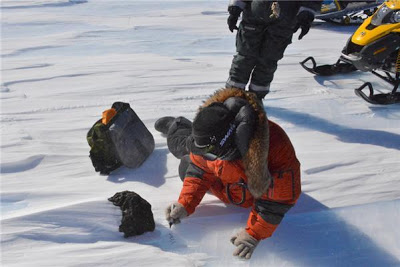
An international team of scientists, working at Princess Elisabeth Antarctica research station, have discovered a meteorite with a mass of 18kg embedded in the East Antarctic ice sheet, the largest such meteorite found in the region since 1988. (Credit: Image courtesy of International Polar Foundation)
An international team of scientists, working at Princess Elisabeth Antarctica research station, have discovered a meteorite with a mass of 18 kilograms embedded in the East Antarctic ice sheet, the largest such meteorite found in the region since 1988.
The eight members of the SAMBA project, from Université Libre de Bruxelles (ULB) and Vrije Universiteit Brussel (VUB), Japan’s National Institute of Polar Research (NIPR) and Tokyo University were searching for meteorites scattered across the Nansen Ice Field on January 28, when they found the 18kg ordinary chondrite. The team discovered a total of 425 meteorites, with a total weight of 75kg during the 40 day expedition, at an altitude of 2,900m, 140km south of Belgium’s Princess Elisabeth Antarctica research base.
“This meteorite was a very unexpected find for us, not only due to its weight, but because we don’t normally find such large meteorites in Antarctica,” said Vinciane Debaille, a geologist from Université Libre de Bruxelles, who led the Belgian part of the team during the expedition. “This is the biggest meteorite found in East Antarctica for 25 years, so it’s a very special discovery for us, only made possible by the existence and location of Princess Elisabeth Antarctica.”
The SAMBA project contributes to the US and Japan-led global collection of Antarctic meteorites, and is an initiative of VUB and ULB, in collaboration with the Japanese Institute of Polar Research. SAMBA is supported by the Belgian Science Policy (BELSPO) and the International Polar Foundation.
Initial field analysis by the scientists suggests that the 18kg meteorite is an ordinary chondrite, the most abundant kind of meteorite. The fusion crust — the meteorite’s outer casing — was eroded, allowing the scientists to inspect the rock underneath. The meteorite is currently undergoing a special thawing process in Japan — to ensure water doesn’t get inside the rock.
“We study meteorites in order to better understand how the solar system formed, how it evolved, how the Earth became such a unique planet in our solar system,” said Debaille. “This season’s SAMBA mission was a success both in terms of the number and weight of the meteorites we found. Two years ago, we found less than 10kg. This year, we found so much that we had to call the travel agency — because we had 75kg of meteorites to take home.”
Princess Elisabeth Antarctica is the world’s first zero emission polar research station, and is operated by the International Polar Foundation, in partnership with the Belgian Polar Secretariat. Princess Elisabeth Antarctica’s design and construction seamlessly integrates passive building technologies, renewable wind and solar energy, water treatment facilities, continuously monitored power demand and a smart grid for maximising energy efficiency. Located in East Antarctica’s Sør Rondane Mountains, Princess Elisabeth Antarctica welcomes scientists from around the world to conduct research in this little-studied and pristine environment.
Note : The above story is reprinted from materials provided by International Polar Foundation.
Image of southwest Greenland. (Credit: Jacques Descloitres, MODIS Land Rapid Response Team, courtesy of NASA Visible Earth)
Researchers still have much to learn about the volcanism that shaped our planet’s early history. New evidence from a team led by Carnegie’s Frances Jenner demonstrates that some of the tectonic processes driving volcanic activity, such as those taking place today, were occurring as early as 3.8 billion years ago. Their work is published in Geology.
Upwelling and melting of Earth’s mantle at mid-ocean ridges, as well as the eruption of new magmas on the seafloor, drive the continual production of the oceanic crust. As the oceanic crust moves away from the mid-ocean ridges and cools it becomes denser than the underlying mantle. Over time the majority of this oceanic crust sinks back into the mantle, which can trigger further volcanic eruptions. This process is known as subduction and it takes place at plate boundaries.
Volcanic eruptions that are triggered by subduction of oceanic crust are chemically distinct from those erupting at mid-ocean ridges and oceanic island chains, such as Hawaii. The differences between the chemistry of magmas produced at each of these tectonic settings provide ‘geochemical fingerprints’ that can be used to try to identify the types of tectonic activity taking place early in Earth’s history.
Previous geochemical studies have used similarities between modern subduction zone magmas and those erupted about 3.8 billion years ago, during the Eoarchean era, to argue that subduction-style tectonic activity was taking place early in Earth’s history. But no one was able to locate any suites of volcanic rocks with compositions comparable to modern mid-ocean ridge or oceanic island magmas that were older than 3 billion years and were also free from contamination by continental crust.
Because of this missing piece of the puzzle, it has been ambiguous whether the subduction-like compositions of volcanic rocks erupted 3.8 billion years ago really were generated at subduction zones, or whether this magmatism should be attributed to other processes taking place early in Earth’s history. Consequently, evidence for subduction-related tectonics earlier than 3 billion years ago has been highly debated in scientific literature.
Jenner and her team collected 3.8 billion-year-old volcanic rocks from Innersuartuut, an island in southwest Greenland, and found the samples have compositions comparable to modern oceanic islands, such as Hawaii.
“The Innersuartuut samples may represent the world’s oldest recognized suite of oceanic island basalts, free from contamination by continental crust,” Jenner said. “This evidence strengthens previous arguments that subduction of oceanic crust into the mantle has been taking place since at least 3.8 billion years ago.”
Note: The above story is reprinted from materials provided by Carnegie Institution.