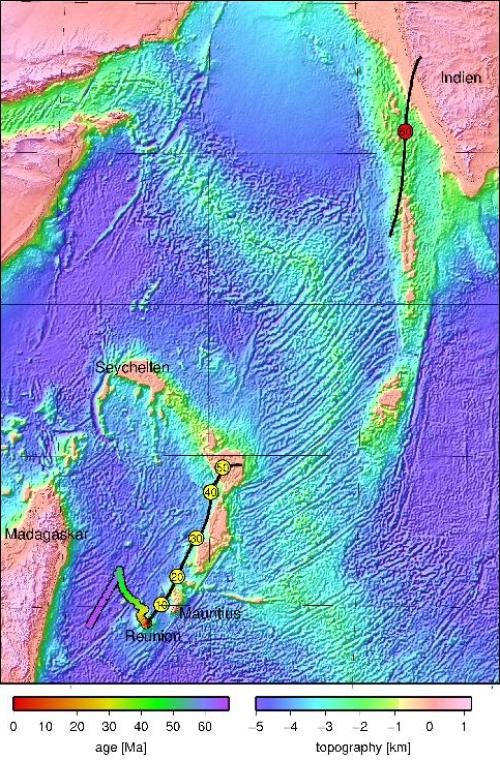
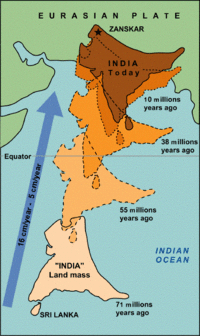
The islands Reunion and Mauritius, both well-known tourist destinations, are hiding a micro-continent, which has now been discovered. The continent fragment known as Mauritia detached about 60 million years ago while Madagascar and India drifted apart, and had been hidden under huge masses of lava.
Such micro-continents in the oceans seem to occur more frequently than previously thought, says a study in the latest issue of Nature Geoscience.
The break-up of continents is often associated with mantle plumes: These giant bubbles of hot rock rise from the deep mantle and soften the tectonic plates from below, until the plates break apart at the hotspots. This is how Eastern Gondwana broke apart about 170 million years ago. At first, one part was separated, which in turn fragmented into Madagascar, India, Australia and Antarctica, which then migrated to their present position.
Plumes currently situated underneath the islands Marion and Reunion appear to have played a role in the emergence of the Indian Ocean. If the zone of the rupture lies at the edge of a land mass (in this case Madagascar / India), fragments of this land mass may be separated off. The Seychelles are a well-known example of such a continental fragment.
A group of geoscientists from Norway, South Africa, Britain and Germany have now published a study that suggests, based on the study of lava sand grains from the beach of Mauritius, the existence of further fragments. The sand grains contain semi-precious zircons aged between 660 and 1970 million years, which is explained by the fact that the zircons were carried by the lava as it pushed through subjacent continental crust of this age.
This dating method was supplemented by a recalculation of plate tectonics, which explains exactly how and where the fragments ended up in the Indian Ocean. Dr. Bernhard Steinberger of the GFZ German Research Centre for Geosciences and Dr. Pavel Doubrovine of Oslo University calculated the hotspot trail: “On the one hand, it shows the position of the plates relative to the two hotspots at the time of the rupture, which points towards a causal relation,” says Steinberger. “On the other hand, we were able to show that the continent fragments continued to wander almost exactly over the Reunion plume, which explains how they were covered by volcanic rock.” So what was previously interpreted only as the trail of the Reunion hotspot, are continental fragments which were previously not recognized as such because they were covered by the volcanic rocks of the Reunion plume. It therefore appears that such micro-continents in the ocean occur more frequently than previously thought.
Note : The above story is reprinted from materials provided by Helmholtz Centre Potsdam – GFZ German Research Centre for Geosciences.
Surfer is a full-function 3D visualization, contouring and surface modeling package that runs under Microsoft Windows. Surfer is used extensively for terrain modeling, bathymetric modeling, landscape visualization, surface analysis, contour mapping, watershed and 3D surface mapping, gridding, volumetrics, and much more.
Surfer’s sophisticated interpolation engine transforms your XYZ data into publication-quality maps. Surfer provides more gridding methods and more control over gridding parameters, including customized variograms, than any other software package on the market. You can also use grid files obtained from other sources, such as USGS DEM files or ESRI grid files. Display your grid as outstanding contour, 3D surface, 3D wireframe, watershed, vector, image, shaded relief, and post maps. Add base maps and combine map types to create the most informative display possible. Virtually all aspects of your maps can be customized to produce exactly the presentation you want. Generating publication quality maps has never been quicker or easier.
What’s New in Surfer 11?
Create Watershed Maps
Include Feature Attributes
Use the Text Editor
Create Automatic Profiles
Perform Advanced Boundary Editing
Measure Distances and Areas
Grid Only Inside Your Data Limits
Use the Grid Node Editor Enhancements
More Resolution for Your Surface Map
Keep Your Layers Organized
More Classes for Your Classed Post Map
International Font Support
Reference Your Map
Set Symbol Line Color
Lock Your Objects
Convert Text Data to Numbers
Increased File Compatibility
New Coordinate Systems, Projections and Datums
More Surfer Features
Map Projections – Load maps in any map production, and covert between projections.
Contour Maps – Surfer software’s contour maps give you full control over all map parameters.
3D Surface Maps – The 3D surface map uses shading and color to emphasize your data features.
3D Wireframe Maps – Surfer wireframe maps provide an impressive three dimensional display of your data.
Vector Maps – Instantly create vector maps in Surfer to show direction and magnitude of data at points on a map.
Image Maps – Surfer image maps use different colors to represent elevations of a grid file.
Shaded Relief Maps – Surfer Shaded Relief maps create a shaded relief map from a grid [.GRD] file or USGS DEM file.
Post Maps – Post maps show X,Y locations with fixed size symbols or proportionally scaled symbols of any color.
Base Maps – Surfer can import maps in many different formats to display geographic information.
Map Overlays – Map overlays give you a way to combine any number of contour, wireframe, vector, base, and post maps.
Gridding – The gridding methods in Surfer allow you to produce accurate contour, surface, wireframe, vector, image, and shaded relief maps from your XYZ data.
Variogram modeling – Use the variogram modeling subsystem to quantitatively assess the spatial continuity of data.
Faults and Breaklines – Define faults and breaklines when gridding your data.
USGS Digital Elevation Model (DEM) Files – Use DEM files with any Surfer command that uses GRD files
Digitize Boundaries – Surfer makes it easy to digitize boundaries.
Automation – Virtually any operation that you can perform interactively can be controlled using an Automation-compatible programming language such as Visual Basic, C++, or Perl.
Worksheet – Surfer includes a full-featured worksheet for creating, opening, editing, and saving data files.
Object Manager – The object manager makes the editing of any object simple.
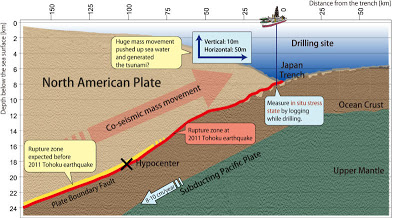
The 11 March 2011 Tohoku-Oki earthquake (Mw9.0) produced the largest slip ever recorded in an earthquake, over 50 meters. Such huge fault movement on the shallow portion of the megathrust boundary came as a surprise to seismologists because this portion of the subduction zone was not thought to be accumulating stress prior to the earthquake. In a recently published study, scientists from the Integrated Ocean Drilling Program (IODP) shed light on the stress state on the fault that controls the very large slip. The unexpectedly large fault displacements resulted in the devastating tsunamis that caused tremendous damage and loss of lives along the coast of Japan.
The study, published in 8 February 2013 issue of the journal Science, presents compelling evidence that large slips are the results of a complete stress drop during the earthquake. These new findings from IODP Japan Trench Fast Drilling Project (JFAST) research are relevant to better understanding earthquakes and tsunamis in many areas of the world.
“The study investigated the stress change associated with the 2011 Tohoku-Oki earthquake and tested the hypothesis by determining the in-situ stress state of the frontal prism from the drilled holes,” says a lead author Weiren Lin of Japan Agency for Marine-Earth Science and Technology (JAMSTEC). “We have established a new framework that the large slips in this region are an indication of coseismic fault zone and nearly the total stress accumulated was released during the earthquake.”
JFAST was designed and undertaken by the international scientific community to better understand the 2011 Tohoku-Oki earthquake. The expedition was carried out aboard the scientific drilling vessel Chikyu from April to July 2012. JFAST drill sites were located approximately 220 km from the eastern coast of Honshu, Japan, in nearly 7000 m of water.
“The project is looking at the stress and physical properties of the fault zone soon after a large earthquake,” co-author James Mori of Kyoto University, Co-Chief Scientist who led the JFAST expedition explains.
It is the first time that “rapid-response drilling” (within 13 months after the earthquake) has been attempted to measure the temperature across a subduction fault zone. The fast mobilization is necessary to observe time sensitive data, such as the temperature signal. JAMSTEC successfully mobilized a research expedition for IODP to investigate the large displacement by drilling from the ocean floor to the plate boundary, reaching a maximum depth of more than 850 m below seafloor (mbsf).
“Understanding the stress conditions that control the very large slip of this shallow portion of the megathrust may be the most important seismological issue for this earthquake.” Mori says.
The research published this week determined the stress field from breakouts observed in a borehole around 820 mbsf, in a region thought to contain the main slip zone of the 2011 earthquake. Lin and his co-authors analyzed a suite of borehole-logging data collected while drilling with Logging-While-Drilling (LWD) tools during IODP Expedition 343. Local compressive failures (borehole breakouts) are formed in the borehole wall during the drilling and are imaged with the LWD tools. The orientation and size of the breakouts are used to infer the present direction and magnitudes of the stress field. An important finding of the paper is that the present shear stress on the fault is nearly zero, indicating that there was a nearly complete stress change during the earthquake. Usually, earthquakes are thought to release only a portion of the stress on the fault.
“This was the first time for such nearly complete stress change has been recognized by direct measurement in drilling through the ruptured fault. This is the first time direct stress measurements have been reported, a little over a year after a great subduction zone earthquake.” Lin says.
The expedition set new milestones in scientific ocean drilling by drilling a borehole to 854.81 mbsf in water depths of 6897.5 meters. Deep core was obtained and analyzed from this depth. The Japan Trench plate boundary was sampled and a parallel borehole was instrumented with a borehole observatory system. The core samples and borehole observatory provide scientists with valuable opportunities to learn about residual heat, coseismic frictional stress, fluid and rock properties, and other factors related to megathrust earthquakes.
“We will be able to address very fundamental and important questions about the physics of slip of the thrust near the trench, and how to identify past events in the rock record.” says Frederick Chester, Texas A&M University, co-author of the Science report and the other expedition Co-Chief Scientist.
The expedition science party, comprising both ship-board and shore-based scientists, is conducting further investigations of core samples and borehole logging data. Data from the borehole observatory are expected to be retrieved later this month using the JAMSTEC ROV Kaiko7000II, and those data will be combined with the current results to continue to increase understanding of the processes involved in this large slip earthquake.
“We anticipate that the results from the JFAST expedition will provide us with a better understanding of the faulting mechanisms for this critical location,” says Mori. “Investigations and research findings from the expedition have obvious consequences for evaluating future tsunami hazards at other subduction zones around the world, such as the Nankai Trough in Japan and Cascadia in the Pacific of North America.”
Note : The above story is reprinted from materials provided by Integrated Ocean Drilling Program Management International.
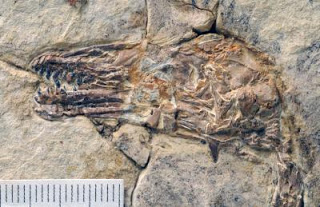
Photograph of Sulcavis geeorum skull, a fossil bird from the Early Cretaceous (120 million-years-ago) of Liaoning Province, China with scale bar in millimeters. (Credit: Photograph by Stephanie Abramowicz)
Beak shape variation in Darwin’s finches is a classic example of evolutionary adaptation, with beaks that vary widely in proportions and shape, reflecting a diversity of ecologies. While living birds have a beak to manipulate their food, their fossil bird ancestors had teeth. Now a new fossil discovery shows some fossil birds evolved teeth adapted for specialized diets.
A study of the teeth of a new species of early bird, Sulcavis geeorum, published in the latest issue of the Journal of Vertebrate Paleontology, suggests this fossil bird had a durophagous diet, meaning the bird’s teeth were capable of eating prey with hard exoskeletons like insects or crabs. The researchers believe the teeth of the new specimen greatly increase the known diversity of tooth shape in early birds, and hints at previously unrecognized ecological diversity.
Sulcavis geeorum is an enantiornithine bird from the Early Cretaceous (121-125 million years ago) of Liaoning Province, China. Enantiornithine birds are an early group of birds, and the most numerous birds from the Mesozoic (the time of the dinosaurs). Sulcavis is the first discovery of a bird with ornamented tooth enamel. The dinosaurs — from which birds evolved — are mostly characterized by carnivorous teeth with special features for eating meat. The enantiornithines are unique among birds in showing minimal tooth reduction and a diversity of dental patterns. This new enantiornithine has robust teeth with grooves on the inside surface, which likely strengthened the teeth against harder food items.
No previous bird species have preserved ridges, striations, serrated edges, or any other form of dental ornamentation. “While other birds were losing their teeth, enantiornithines were evolving new morphologies and dental specializations. We still don’t understand why enantiornithines were so successful in the Cretaceous but then died out — maybe differences in diet played a part.” says Jingmai O’Connor, lead author of the new study.
“This study highlights again how uneven the diversity of birds was during the Cretaceous. There are many more enantiornithines than any other group of early birds, each one with its own anatomical specialization.” offers study co-author Luis Chiappe, from Natural History Museum of Los Angeles County.
Note : The above story is reprinted from materials provided by Society of Vertebrate Paleontology.
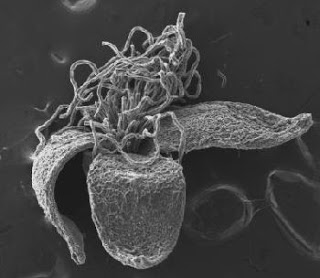
This is an electron microscope image of a fossil Acacia flower from the study fossil site in Southern Australia. – Greg Jordan
Researchers have shown that part of Australia’s rich plant diversity was wiped out by the ice ages, proving that extinction, instead of evolution, influences biodiversity.
The research led by the University of Melbourne and University of Tasmania has shown that plant diversity in South East Australia was as rich as some of the most diverse places in the world, and that most of these species went extinct during the ice ages, probably about one million years ago.
The team’s work was published in the prestigious journal Proceedings of the National Academy of Sciences.
Dr Kale Sniderman of the University of Melbourne’s School of Earth Sciences said the findings show extinction is just as important to diversity of organisms as evolution.
“Traditionally scientists believed some places have more species than others because species evolved more rapidly in these places. We have overthrown this theory, which emphasizes evolution, by showing that extinction may be more important, ” he said.
The study compared two regions of Southern Australia and South Africa.
“South-western Australia has a huge diversity of tough-leaved shrubs and trees such as eucalypts, Banksia, Grevilleas and Acacias, making it one of the most biodiverse places on earth,” Dr Sniderman said.
“The southern tip of South Africa is even richer, with astonishing numbers of similar kinds of plants like proteas and ericas.”
Scientists have long maintained that this diversity is somehow related to the poor soils and dry summers of these places.
For the study researchers analysed plant fossils that accumulated in an ancient lake in South Eastern Australia. They found the region had at least as many tough-leaved plants 1.5 million years ago as Western Australia and South Africa do today.
The results were entirely unexpected.
“As Australia dried out over the past several million years, rainforest plants largely disappeared from most of the continent,” said Dr Sniderman
“It has been thought that this drying trend allowed Australia’s characteristic tough-leaved plants to expand and became more diverse. We have shown that the climate variability of the ice ages not only drove rainforest plants to extinction but also a remarkable number of tough-leaved, shrubby plants,” he said.
Dr Greg Jordan of the School of Plant Sciences at the University of Tasmanian said not only has the study overturned current thought on the role of extinction in plant diversity, it has implications for understanding how Australian plant diversity will deal with current and future climate change.
“The species that went extinct in SE Australia during the ice ages were likely to be the ones most sensitive to rapid climate change, meaning that the species that now grow in eastern Australia may be more capable of tolerating rapid changes than predicted by current science,” he said.
“However, the species in hotspots of diversity like Western Australia may be much more sensitive to future climate change, because they have been protected from past climate changes.”
Note: This story has been adapted from a news release issued by the University of Melbourne
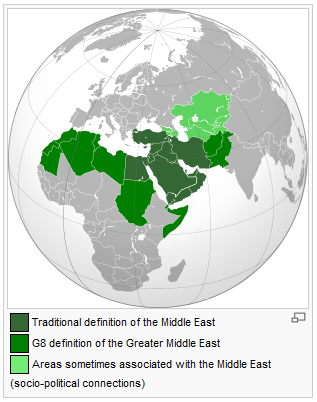
From Wikipedia Already strained by water scarcity and political tensions, the arid Middle East along the Tigris and Euphrates rivers is losing critical water reserves at a rapid pace, from Turkey upstream to Syria, Iran and Iraq below.
Unable to conduct measurements on the ground in the politically unstable region, UC Irvine scientists and colleagues used data from space to uncover the extent of the problem. They took measurements from NASA’s Gravity Recovery and Climate Experiment satellites, and found that between 2003 and 2010, the four nations lost 144 cubic kilometers (117 million acre feet) of water — nearly equivalent to all the water in the Dead Sea. The depletion was especially striking after a drought struck the area in 2007. Researchers attribute the bulk of it — about 60 percent — to pumping of water from underground reservoirs.
They concluded that the Tigris-Euphrates watershed is drying up at a pace second only to that in India. “This rate is among the largest liquid freshwater losses on the continents,” the scientists report in a paper to be published online Feb. 15 in Water Resources Research, a journal of the American Geophysical Union.
Water management is a complex issue in the Middle East, “a region that is dealing with limited water resources and competing stakeholders,” said Katalyn Voss, lead author and a water policy fellow with the University of California’s Center for Hydrologic Modeling in Irvine.
Turkey has jurisdiction over the Tigris and Euphrates headwaters, as well as the reservoirs and infrastructure of its Southeastern Anatolia Project, which dictates how much water flows downstream into Syria, Iran and Iraq. And due to varied interpretations of international laws, the basin does not have coordinated water management. Turkey’s control of water distribution to adjacent countries has caused tension, such as during the 2007 drought, when it continued to divert water to irrigate its own agricultural land.
“That decline in stream flow put a lot of pressure on downstream neighbors,” Voss said. “Both the United Nations and anecdotal reports from area residents note that once stream flow declined, the northern part of Iraq had to switch to groundwater. In a fragile social, economic and political environment, this did not help.”
The Gravity Recovery and Climate Experiment, which NASA launched in 2002 to measure Earth’s local gravitation pull from space, is providing a vital picture of global trends in water storage, said hydrologist Jay Famiglietti, the study’s principal investigator and a UC Irvine professor of Earth system science.
GRACE is “like having a giant scale in the sky,” he said. “Whenever you do international work, it’s exceedingly difficult to obtain data from different countries. For political, economic or security reasons, neighbors don’t want each other to know how much water they’re using. In regions like the Middle East, where data are relatively inaccessible, satellite observations are among the few options.”
Rising or falling water reserves alter Earth’s mass in particular areas, influencing the strength of the local gravitational attraction. By periodically quantifying that gravity, the satellites provide information about how much each region’s water storage changes over time.
The 754,000-square-kilometer (291,000-square-mile) Tigris-Euphrates River Basin jumped out as a hot spot when researchers from UC Irvine, NASA’s Goddard Space Flight Center and the National Center for Atmospheric Research looked at global water trends. Over the seven-year period, they calculated that available water there shrank by an average of 20 cubic kilometers (16 million acre feet) annually.
Meanwhile, the area’s demand for freshwater is rising at the worst possible time. “They just do not have that much water to begin with, and they’re in a part of the world that will be experiencing less rainfall with climate change. Those dry areas are getting drier,” Famiglietti said. “Everyone in the world’s arid regions needs to manage their available water resources as best they can.”
Other authors are MinHui Lo of National Taiwan University, Caroline de Linage of the University of California’s Center for Hydrologic Modeling, Matthew Rodell of NASA’s Goddard Space Flight Center, and Sean Swenson of the National Center for Atmospheric Research.
Note : The above story is reprinted from materials provided by University of California – Irvine.
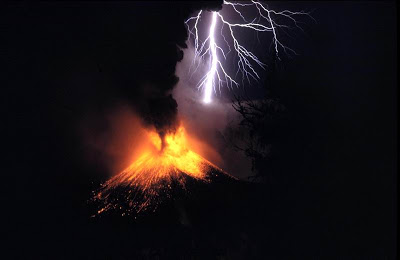
A small eruption of Mount Rinjani, with volcanic lightning. Location: Lombok, Indonesia
It has long been known that volcanic activity can cause short-term variations in climate. Now, researchers at the GEOMAR Helmholtz Centre for Ocean Research Kiel (Germany), together with colleagues from Harvard University (Cambridge, Massachusetts, USA) have found evidence that the reverse process also occurs: Climate affects volcanic activity.
Their study is now online in the international journal Geology.
In 1991, it was a disaster for the villages nearby the erupting Philippine volcano Pinatubo. But the effects were felt even as far away as Europe. The volcano threw up many tons of ash and other particles into the atmosphere causing less sunlight than usual to reach Earth’s surface. For the first few years after the eruption, global temperatures dropped by half a degree. In general, volcanic eruptions can have a strong short-term impact on climate. Conversely, the idea that climate may also affect volcanic eruptions on a global scale and over long periods of time is completely new. Researchers at GEOMAR Helmholtz Centre for Ocean Research Kiel (Germany) and Harvard University in Massachusetts (USA) have now found strong evidence for this relationship from major volcanic eruptions around the Pacific Ocean over the past 1 million years. They have presented their results in the latest issue of the international journal “Geology.”
The basic evidence for the discovery came from the work of the Collaborative Research Centre “Fluids and Volatiles in Subduction Zones (SFB 574). For more than ten years the project has been extensively exploring volcanoes of Central America. “Among others pieces of evidence, we have observations of ash layers in the seabed and have reconstructed the history of volcanic eruptions for the past 460,000 years,” says GEOMAR volcanologist Dr Steffen Kutterolf, who has been with SFB 574 since its founding. Particular patterns started to appear. “There were periods when we found significantly more large eruptions than in others” says Kutterolf, the lead author of the Geology article.After comparing these patterns with the climate history, there was an amazing match. The periods of high volcanic activity followed fast, global temperature increases and associated rapid ice melting.
To expand the scope of the discoveries, Dr Kutterolf and his colleagues studied other cores from the entire Pacific region. These cores had been collected as part of the International Integrated Ocean Drilling Program (IODP) and its predecessor programmes. They record more than a million years of Earth’s history. “In fact, we found the same pattern from these cores as in Central America” says geophysicist Dr Marion Jegen from GEOMAR, who also participated in the recent study.Together with colleagues at Harvard University, the geologists and geophysicists searched for a possible explanation. They found it with the help of geological computer models. “In times of global warming, the glaciers are melting on the continents relatively quickly. At the same time the sea level rises. The weight on the continents decreases, while the weight on the oceanic tectonic plates increases. Thus, the stress changes within in the Earth to open more routes for ascending magma” says Dr Jegen.
The rate of global cooling at the end of the warm phases is much slower, so there are less dramatic stress changes during these times. “If you follow the natural climate cycles, we are currently at the end of a really warm phase. Therefore, things are volcanically quieter now. The impact from human-made warming is still unclear based on our current understanding” says Dr Kutterolf. The next step is to investigate shorter-term historical variations to better understand implications for the present day.
Reference:
S. Kutterolf, M. Jegen, J. X. Mitrovica, T. Kwasnitschka, A. Freundt, P. J. Huybers. A detection of Milankovitch frequencies in global volcanic activity. Geology, 2012; DOI: 10.1130/G33419.1
Note : The above story is reprinted from materials provided by Helmholtz Centre for Ocean Research Kiel (GEOMAR)
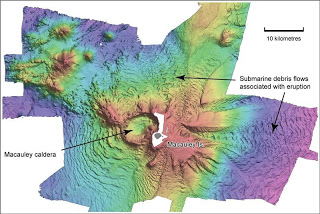
Macauley volcano. (Credit: Courtesy of National Oceanography Centre & National Institute of Water and Atmospheric Research)
Scientists based in the UK and New Zealand have described a “new” type of volcanic eruption.
Volcanic eruptions are commonly categorised as either explosive or effusive. But now, in research published this month in Nature Geoscience, researchers at Victoria University, Wellington and the National Oceanography Centre in Southampton have uncovered a previously undocumented type of eruption in underwater volcanoes — by looking at tiny original bubble spaces trapped in volcanic rock.
Inside volcanoes, gases are dissolved in the molten magma as a function of the very high pressures and chemistry of the magma. In the same way that gases dissolved in carbonated drinks bubble up when you take the lid off, when magma is erupted as lava, the pressure is relieved and the gases exsolve to form small gas bubbles or so-called “vesicles.” In explosive eruptions these vesicles expand so quickly they fragment the magma, violently ejecting lava, which cools and degasses to form solidified pumice that can be sufficiently light to float on water.
In air pumice is obviously associated with violent, explosive eruptions. Consequently underwater volcanoes flanked by highly vesicular pumice have, to date, also been interpreted as having erupted explosively.
But the results of this study indicate that there is a third eruptive style unique to underwater volcanoes, which is neither effusive nor explosive.
“By documenting the shape and density of bubbles in pumices generated by an underwater caldera volcano in the southwest Pacific Ocean — the Macauley volcano — we found large differences in the number and shape of “bubbles” in the same pebble-sized samples, different to anything previously documented,” said Professor Ian Wright of the National Oceanography Centre, who co-authored the paper.
“This range of bubble densities distinct in these pumice samples indicates that the lava erupting from the caldera was neither vigorous enough for an explosive eruption, nor gentle enough for an effusive flow.”
The study proposes that rather than exploding in the neck of the volcano, the formation and expansion of bubbles in the magma created a buoyant foam, which rose to the seafloor and then buoyantly detached from the volcano as molten pumice balloons but with chilled margins. During its ascent to the sea surface, the vesicles within the molten interior would have continued to expand as the pressure — this time from the weight of the seawater — reduced.
“These processes explain the unique bubble structure seen in the samples analysed, which could have only occurred with an intermediate eruption style and in an underwater setting,” said Professor Wright.
“We conclude that the presence of widespread deposits of pumice on underwater volcanoes does not necessarily indicate large-scale explosive volcanism.”
The authors proposed that this style of eruption be named Tangaroan, the Maori god of the sea, and name of the research vessel used to collect the samples.
The study was led by Melissa Rotella, Professor Colin Wilson and Simon Barker from the School of Geography, Environment and Earth Sciences at the Victoria University of Wellington, New Zealand.
Note : The above story is reprinted from materials provided by National Oceanography Centre.
This chunk of ice has made history. A National Science Foundation-funded Replicate Core Drilling Team was able to retrieve cylinders of ice from the original ice core hole while leaving the borehole intact. (Credit: Image courtesy of South Dakota State University)
Studying Ice Cores from West Antarctica for Clues as to Why the Earth Began to Emerge from the Ice Age
A slice of ice from 17,500 years ago can help scientists figure out how Earth came out of the Ice Age and how climate change can happen in the future, according to South Dakota State University Professor Jihong Cole-Dai of the chemistry and biochemistry department. He and graduate student, Kari Peterson, spent nearly a month in Antarctica during Christmas break as part of the West Antarctica Ice Sheet Divide Ice Core project.
The main goal of the ice core project, Cole-Dai said “was to get an ice core more than two miles deep to give us nearly 70,000 years of history of the Earth’s climate.”
The National Science Foundation-funded project, which began eight years ago, involves more than 20 universities and national laboratories. The SDSU Ice Core and Environment Chemistry Lab, headed by Cole-Dai, has been a part of the project since 2006.
It took eight years to build the field camp and to collect the original ice core, because the harsh Antarctica conditions allow only a 60-day window each year in which to work. That task was completed in January 2012.
“This year was significant because of the completion of additional field work,” Cole-Dai said. Scientists wanted more ice to do further work on specific time periods. To do so, the team retrieved additional ice from five spots along the original ice core hole, while also leaving the lower portion of the hole intact.
“That in itself was quite a challenge and accomplishment,” Cole-Dai said. His former postdoctoral researcher, David Ferris, was part of the drilling team. Ferris became part of the project through the SDSU Ice Core and Environment Chemistry Lab during his doctoral work.
To accomplish this task, engineers had to design a special bit and drilling apparatus that used an actuator to push off to the side of the original borehole, explained Tony Wendricks, project coordinator for the Ice Drilling Design and Operations group at the University of Wisconsin, Madison. Ferris has worked on ice drilling team for three years and on the core handling team for one year.
“It’s a tricky thing — to maintain the parent hole,” Wendricks said.
“It’s never been done anywhere in the world,” Cole-Dai said. “You have a tool hanging at the end of a two-mile-long rope or cable and you want it to do very precise things, to move one degree in the direction you want and to bring the ice out.”
When the drillers brought up cylinders of ice, they handed them over to the core-processing team, Cole-Dai said. He and Peterson were on the team that took measurements and logged the information regarding the cores from the designated time periods. Then they packaged the ice cylinders to transport to the National Ice Core Laboratory in Denver.
Once the cores have been processed in Denver, each university lab will get its slice of the ice for analysis, which will likely take a year, Cole-Dai said. His SDSU team will work on a section of ice from 17,500 years ago that offers clues as to why Earth began to emerge from the Ice Age.
At that point in history, Cole-Dai said, “something big happened — a large volcanic eruption or a number of them.” Others speculate that it might have been an object from outer space that struck Earth.
“We want to gather more information from the ice and hopefully it will lead to better ideas, or support some of the ideas and disprove some of the others,” Cole-Dai said.
For this research, Cole-Dai’s team collaborates with a lab at the University of California, San Diego. SDSU analyzes the trace chemicals, while the California lab does the isotope measurements. Cole-Dai has three doctoral students working in his lab; two of them have been to Antarctica.
Researchers found fluoride, which is commonly associated with a volcanic eruption, in a previous ice core, explained Peterson. However, the levels were higher than those expected from an eruption. For her dissertation, Peterson will analyze the fluoride levels in the replicate core to confirm the original results.
In addition, Peterson took samples from a snow pit more than eight feet deep to look for signs of two volcanic eruptions a couple of years ago, one in Indonesia and one in Africa. “The eruptions were pretty small but very powerful,” Peterson said, “so the plume may have gotten into the stratosphere.”
When this happens, Cole-Dai explained, the wind patterns can carry the volcanic material to the entire world, including both poles. Because the snow at the Western Antarctica drill site never melts, the ice contains a history of the changing atmospheric environment and of the dynamic climate. As for the location to drill the ice core in the center of West Antarctica, Cole-Dai explained, “It’s like the continental divide. Ice flows away from this point; it doesn’t get ice from other locations.”
By measuring the kinds and quantities of chemicals in the ice cores and determining how those change over time, scientists can study the events that lead to global climate change, Cole-Dai said. This will lead to a better understanding of how human activities can influence climate. By studying Earth’s past, Cole-Dai said, “we can better predict the future.”
Note : The above story is reprinted from materials provided by South Dakota State University.
Book Name : The Origin of Mountains By : Cliff Ollier and Colin Pain Information about book :
The Origin of Mountains
The Origin of Mountains is ground breaking. This highly illustrated book describes
mountains from all over the world, emphasising their landforms, their rocks, and their
structure and age. This leads to a deduction on the mechanism that formed them, causing
the authors to reject the pre-conceived well-known hypothesis that plate tectonics and
folding creates mountains.
The Origins of Mountains approaches mountains from facts about mountain landscape
rather than from theory. It uses old and recent references, as well as field evidence. It
shows that mountains are not made directly by folding, but result from vertical uplift of
plains (planation surfaces) to form plateaus, which may later be eroded into rugged
mountains. It also assembles the evidence that this uplift occurred in the last few million
years, a time scale which does not fit the plate tectonic theory.
Another fascinating story is that the age of uplift correlates very well with climatic
change. Mountain building could have been responsible for the onset of the ice age and
the monsoon climate, and certainly created many new environments. Fossil plants and
animals are used to work out the time of mountain formation, which in turn helps to
explain biogeographic distributions.
Cliff Ollier is a Visiting Fellow, Centre for Resource and Environmental Studies,
Australian National University and also Emeritus Professor, University of New England.
Colin Pain is Assistant Director, Cooperative Research Centre for Landscape Evolution
and Mineral Exploration, Australian Geological Survey Organisation.
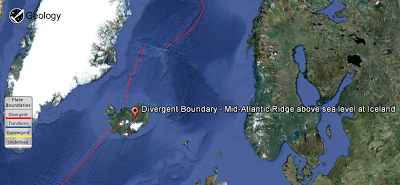
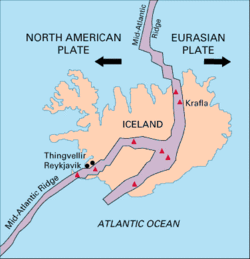
Mid-Atlantic Ridge above sea level at Iceland A geologically young land, Iceland is located on both the Iceland hotspot and the Mid-Atlantic Ridge, which runs right through it. This location means that the island is highly geologically active with many volcanoes, notably Hekla, Eldgjá, Herðubreið and Eldfell.
Iceland has many geysers, including Geysir, from which the English word is derived, and the famous Strokkur, which erupts every 5–10 minutes. After a phase of inactivity, Geysir started erupting again after a series of earthquakes in 2000. Geysir has since then grown quieter and does not erupt often.
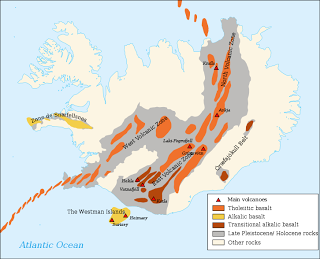
With the widespread availability of geothermal power, and the harnessing of many rivers and waterfalls for hydroelectricity, most residents have access to inexpensive hot water, heating and electricity. The island itself is composed primarily of basalt, a low-silica lava associated with effusive volcanism as has occurred also in Hawaii. Iceland, however, has a variety of volcanic types (composite and fissure), many producing more evolved lavas such as rhyolite and andesite. Iceland has hundreds of volcanoes within approx. 30 volcanic systems active
Surtsey, one of the youngest islands in the world, is part of Iceland. Named after Surtr, it rose above the ocean in a series of volcanic eruptions between 8 November 1963 and 5 June 1968. Only scientists researching the growth of new life are allowed to visit the island.
On 21 March 2010, a volcano in Eyjafjallajökull in the south of Iceland erupted for the first time since 1821, forcing 600 people to flee their homes. Further eruptions on 14 April forced hundreds of people to abandon their homes. The resultant cloud of volcanic ash brought major disruption to air travel across Europe.
Another large eruption occurred on 21 May 2011. This time it was the Grímsvötn volcano, located under the thick ice of Europe’s largest glacier, Vatnajökull. Grímsvötn is one of Iceland’s most active volcanoes and this eruption was much more powerful than the 2010 Eyjafjallajökull activity. The eruption hurled ash and lava 20 km (12.43 mi) up into the atmosphere, creating a large cloud that for a while was thought to pose a danger to jet aircraft over a wide area of northern Europe.
Volcanology of Iceland
Active volcanic areas and systems in Iceland
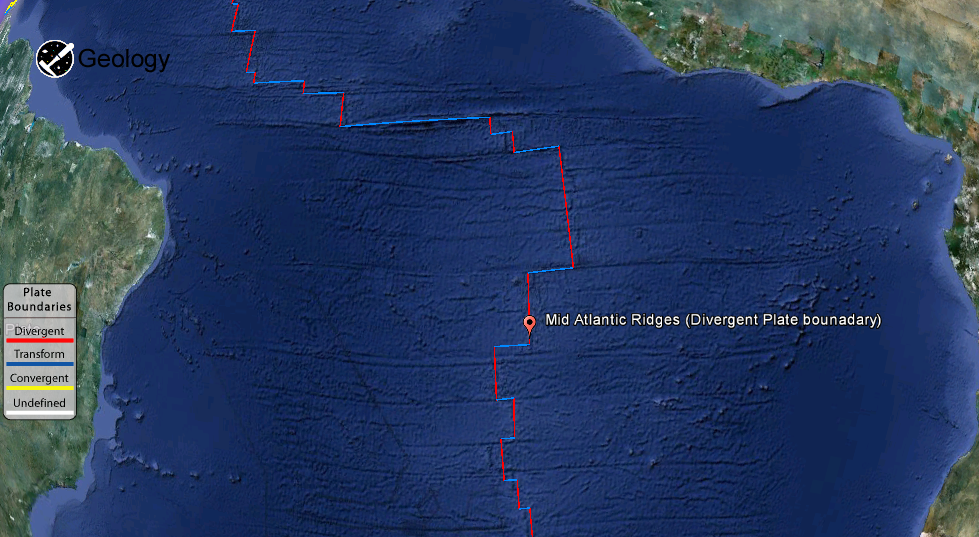
Iceland has a high concentration of active volcanoes due to its location on the mid-Atlantic Ridge, a divergent tectonic plate boundary. The island has 30 active volcanic systems, of which 13 have erupted since the settlement of Iceland in AD 874.
Of these 30 volcanic systems, the most active/volatile is Grímsvötn. Over the past 500 years, Iceland’s volcanoes have erupted a third of the total global lava output.
The most fatal volcanic eruption of Iceland’s history was the so-called Skaftáreldar (fires of Skaftá) in 1783-84. The eruption was in the crater row Lakagígar (craters of Laki) southeast of Vatnajökull glacier. The craters are a part of a larger volcanic system with the subglacial Grímsvötn as a central volcano. Roughly a quarter of the Icelandic nation died because of the eruption. Most died not because of the lava flow or other direct effects of the eruption, but from indirect effects, including changes in climate and illnesses in livestock in the following years caused by the ash and poisonous gases from the eruption. The 1783 eruption in Lakagígar is thought to have erupted the largest quantity of lava from a single eruption in historic times.
The eruption under Eyjafjallajökull (“glacier of Eyjafjöll”) in 2010 was notable because the volcanic ash plume disrupted air travel in northern Europe for several weeks; however this volcano is minor in Icelandic terms. In the past, eruptions of Eyjafjallajökull have been followed by eruption of the larger volcano Katla, but after the 2010 eruption no signs of an imminent eruption of Katla were seen.
The eruption in May 2011 at Grímsvötn under the Vatnajökull glacier sent thousands of tonnes of ash into the sky in a few days, raising concerns of a repeat of the travel chaos seen across northern Europe.
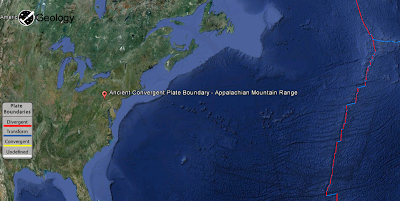
Ancient Convergent Plate Boundary – Appalachian Mountain Range
The Appalachian Mountains , often called the Appalachians, are a system of mountains in eastern North America. The Appalachians first formed roughly 480 million years ago during the Ordovician Period, and once reached elevations similar to those of the Alps and the Rocky Mountains before they were eroded. The Appalachian chain is a barrier to east-west travel as it forms a series of alternating ridgelines and valleys oriented in opposition to any road running east-west.
Definitions vary on the precise boundaries of the Appalachians. The United States Geological Survey (USGS) defines the Appalachian Highlands physiographic division as consisting of thirteen provinces: the Atlantic Coast Uplands, Eastern Newfoundland Atlantic, Maritime Acadian Highlands, Maritime Plain, Notre Dame and Mégantic Mountains, Western Newfoundland Mountains, Piedmont, Blue Ridge, Valley and Ridge, Saint Lawrence Valley, Appalachian Plateaus, New England province, and the Adirondack provinces. A common variant definition does not include the Adirondack Mountains, which geologically belong to the Grenville Orogeny and have a different geological history to the rest of the Appalachians.
Overview
The range is mostly located in the United States but extends into southeastern Canada, forming a zone from 100 to 300 mi (160 to 480 km) wide, running from the island of Newfoundland 1,500 mi (2,400 km) southwestward to Central Alabama in the United States. The range covers parts of the islands of Saint Pierre and Miquelon, which comprise an overseas territory of France. The system is divided into a series of ranges, with the individual mountains averaging around 3,000 ft (910 m). The highest of the group is Mount Mitchell in North Carolina at 6,684 feet (2,037 m), which is the highest point in the United States east of the Mississippi River.
The term Appalachian refers to several different regions associated with the mountain range. Most broadly, it refers to the entire mountain range with its surrounding hills and the dissected plateau region. However, the term is often used more restrictively to refer to regions in the central and southern Appalachian Mountains, usually including areas in the states of Kentucky, Tennessee, Virginia, Maryland, West Virginia, and North Carolina, as well as sometimes extending as far south as northern Georgia and western South Carolina, as far north as Pennsylvania and southern Ohio.
The Ouachita Mountains in Arkansas and Oklahoma were originally part of the Appalachians as well, but became disconnected through geologic history.
Geology of the Appalachians
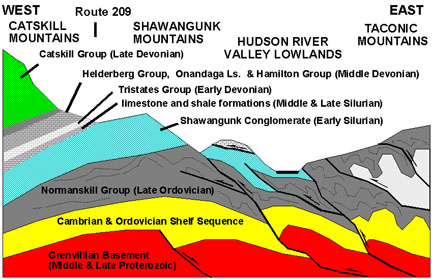
Generalized east-to-west cross section through the central Hudson Valley region. USGS image
The geology of the Appalachians dates back to more than 480 million years ago. A look at rocks exposed in today’s Appalachian Mountains reveals elongate belts of folded and thrust faulted marine sedimentary rocks, volcanic rocks and slivers of ancient ocean floor – strong evidence that these rocks were deformed during plate collision. The birth of the Appalachian ranges marks the first of several mountain building plate collisions that culminated in the construction of the supercontinent Pangaea with the Appalachians and neighboring Little Atlas (now in Morocco) near the center. These mountain ranges likely once reached elevations similar to those of the Alps and the Rocky Mountains before they were eroded.
Geological history
Paleozoic Era
During the earliest Paleozoic Era, the continent that would later become North America straddled the equator. The Appalachian region was a passive plate margin, not unlike today’s Atlantic Coastal Plain Province. During this interval, the region was periodically submerged beneath shallow seas. Thick layers of sediment and carbonate rock were deposited on the shallow sea bottom when the region was submerged. When seas receded, terrestrial sedimentary deposits and erosion dominated.
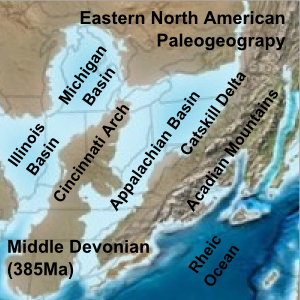
Paleogeographic reconstruction showing the Appalachian Basin area during the Middle Devonian period.
During the middle Ordovician Period (about 480-440 million years ago), a change in plate motions set the stage for the first Paleozoic mountain building event (Taconic orogeny) in North America. The once quiet Appalachian passive margin changed to a very active plate boundary when a neighboring oceanic plate, the Iapetus, collided with and began sinking beneath the North American craton. With the creation of this new subduction zone, the early Appalachians were born.
Along the continental margin, volcanoes grew, coincident with the initiation of subduction. Thrust faulting uplifted and warped older sedimentary rock laid down on the passive margin. As mountains rose, erosion began to wear them down. Streams carried rock debris downslope to be deposited in nearby lowlands.
This was just the first of a series of mountain building plate collisions that contributed to the formation of the Appalachians. Mountain building continued periodically throughout the next 250 million years (Caledonian, Acadian, Ouachita, Hercynian, and Allegheny orogenies). Continent after continent was thrust and sutured onto the North American craton as the Pangean supercontinent began to take shape. Microplates, smaller bits of crust, too small to be called continents, were swept in, one by one, to be welded to the growing mass.
By about 300 million years ago (Pennsylvanian Period) Africa was approaching the North American craton. The collisional belt spread into the Ozark-Ouachita region and through the Marathon Mountains area of Texas. Continent vs. continent collision raised the Appalachian-Ouachita chain to a lofty mountain range on the scale of the present-day Himalaya. The massive bulk of Pangea was completed near the end of the Paleozoic Era (Permian Period) when Africa (Gondwana) plowed into the continental agglomeration, with the Appalachian-Ouachita mountains near the core.
Mesozoic Era and later
Pangea began to break up about 220 million years ago, in the Early Mesozoic Era (Late Triassic Period). As Pangea rifted apart a new passive tectonic margin was born and the forces that created the Appalachian, Ouachita, and Marathon Mountains were stilled. Weathering and erosion prevailed, and the mountains began to wear away.
By the end of the Mesozoic Era, the Appalachian Mountains had been eroded to an almost flat plain. It was not until the region was uplifted during the Cenozoic Era that the distinctive topography of the present formed. Uplift rejuvenated the streams, which rapidly responded by cutting downward into the ancient bedrock. Some streams flowed along weak layers that define the folds and faults created many millions of years earlier. Other streams downcut so rapidly that they cut right across the resistant folded rocks of the mountain core, carving canyons across rock layers and geologic structures.
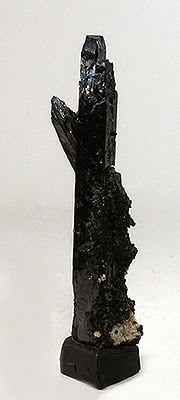
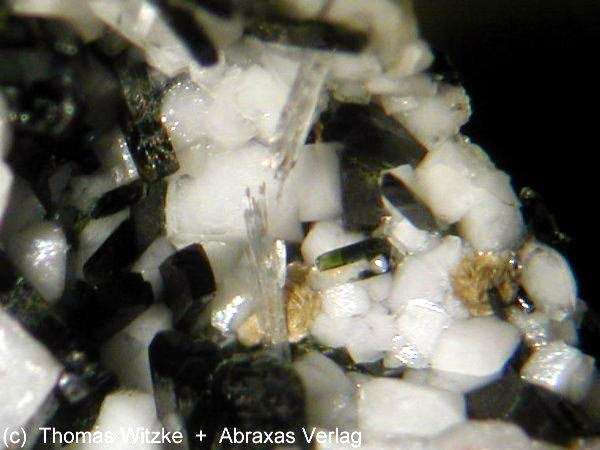
Aegerine Malosa,Malawi Cabinet, 10.5 x 3.5 x 1.7 cm “Courtesy of Rob Lavinsky, The Arkenstone, www.iRocks.com”
Chemical Formula: NaFe3+Si2O6 Locality: Norway, Buskerud, Kongsberg. Magnet Cove, Hot Spring County, Arkansas. Name Origin: Named after the Teutonic god of the sea. Acmite is from the Greek “point” in allusion to the pointed crystals.
Aegirine is a member of the clinopyroxene group of inosilicates. Aegirine is the sodium endmember of the aegirine-augite series. Aegirine has the chemical formula NaFe3+Si2O6 in which the iron is present as Fe3+. In the aegirine-augite series the sodium is variably replaced by calcium with iron(II) and magnesium replacing the iron(III) to balance the charge. Aluminium also substitutes for the iron(III). It is also known as acmite, which is a fibrous, green-colored variety.
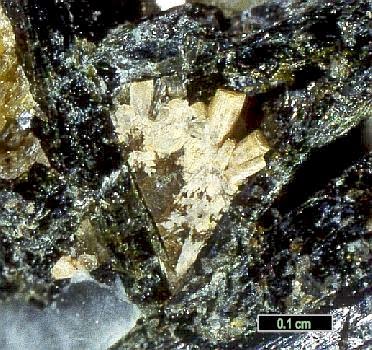
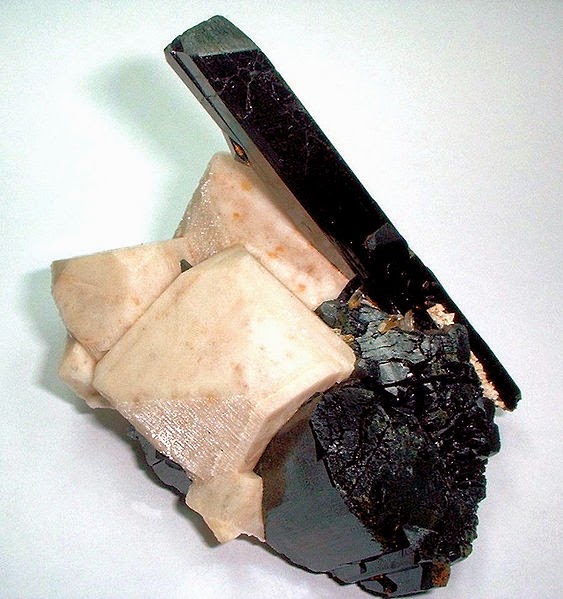
Aegirine occurs as dark green monoclinic prismatic crystals. It has a glassy luster and perfect cleavage. The Mohs hardness varies from 5 to 6 and the specific gravity is 3.2 to 3.4.
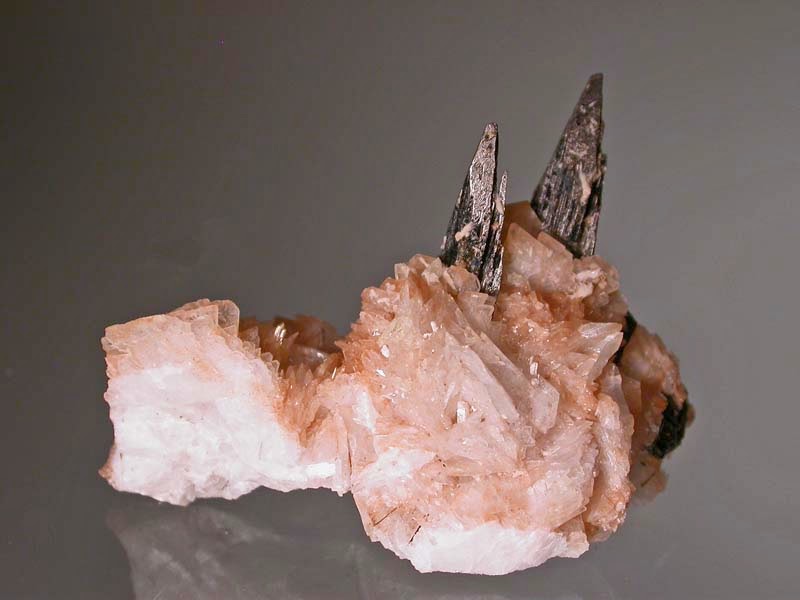
Commonly occurs in alkalic igneous rocks, nepheline syenites, carbonatites and pegmatites. Also in regionally metamorphosed schists, gneisses, and iron formations; in blueschist facies rocks, and from sodium metasomatism in granulites. It may occur as an authigenic mineral in shales and marls. It occurs in association with potassic feldspar, nepheline, riebeckite, arfvedsonite, aenigmatite, astrophyllite, catapleiite, eudialyte, serandite and apophyllite.
Localities include Mont Saint-Hilaire, Quebec, Canada; Kongsberg, Norway; Narsarssuk, Greenland; Kola Peninsula, Russia; Magnet Cove, Arkansas, USA; Kenya; Scotland and Nigeria.
It was first described in 1835 for an occurrence in Rundemyr, Øvre Eiker, Buskerud, Norway. Aegirine was named after Ægir, the Teutonic god of the sea. A synonym for the mineral is acmite (from Greek ἀκμή “point, edge”) in reference to the typical pointed crystals.
Physical Properties
Color: Green, Greenish black, Reddish brown, Black. Density: 3.5 – 3.54, Average = 3.52 Diaphaneity: Subtransparent to translucent to opaque Fracture: Brittle – Generally displayed by glasses and most non-metallic minerals. Hardness: 6-6.5 – Orthoclase-Pyrite Luminescence: Non-fluorescent. Luster: Vitreous – Resinous Streak: yellowish gray
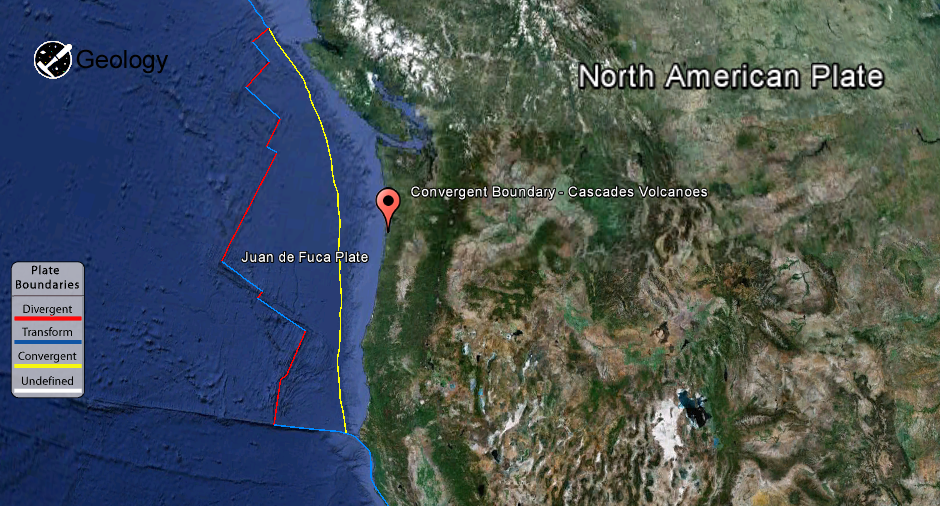
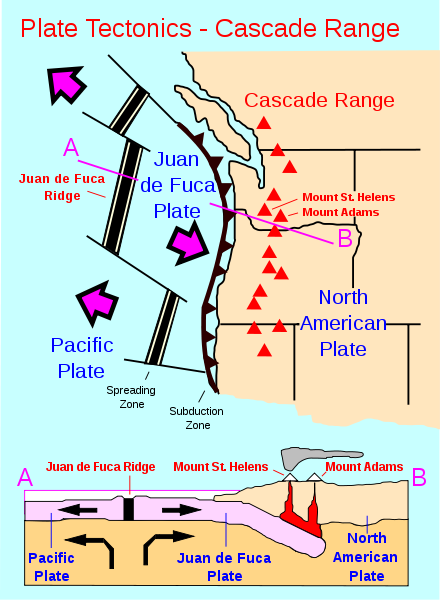
The Cascade Volcanoes (also known as the Cascade Volcanic Arc or the Cascade Arc) are a number of volcanoes in a volcanic arc in western North America, extending from southwestern British Columbia through Washington and Oregon to Northern California, a distance of well over 700 mi (1,100 km). The arc has formed due to subduction along the Cascadia subduction zone. Although taking its name from the Cascade Range, this term is a geologic grouping rather than a geographic one, and the Cascade Volcanoes extend north into the Coast Mountains, past the Fraser River which is the northward limit of the Cascade Range proper.
Some of the major cities along the length of the arc include Portland, Seattle, and Vancouver, and the population in the region exceeds 10,000,000. All could be potentially affected by volcanic activity and great subduction-zone earthquakes along the arc. Because the population of the Pacific Northwest is rapidly increasing, the Cascade volcanoes are some of the most dangerous, due to their past eruptive history, potential eruptions and because they are underlain by weak, hydrothermally altered volcanic rocks that are susceptible to failure. Mount Rainier is one of the Decade Volcanoes due to the danger it poses to Seattle and Tacoma. Many large, long-runout landslides originating on Cascade volcanoes have inundated valleys tens of kilometers from their sources, and some of the inundated areas now support large populations.
The Cascade Volcanoes are part of the Pacific Ring of Fire, the ring of volcanoes and associated mountains around the Pacific Ocean. All of the known historic eruptions in the contiguous United States have been from the Cascade Volcanoes. Two most recent were Lassen Peak in 1914 to 1921 and a major eruption of Mount St. Helens in 1980. It is also the site of Canada’s most recent major eruption about 2,350 years ago at the Mount Meager volcanic complex.
Geology
The Cascade Arc includes nearly 20 major volcanoes, among a total of over 4,000 separate volcanic vents including numerous stratovolcanoes, shield volcanoes, lava domes, and cinder cones, along with a few isolated examples of rarer volcanic forms such as tuyas. Volcanism in the arc began about 37 million years ago, however, most of the present-day Cascade
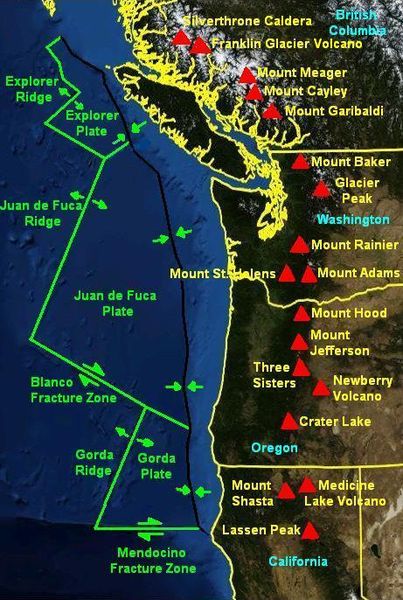
Map of the Cascadia Volcanic Arc.
volcanoes are less than 2,000,000 years old, and the highest peaks are less than 100,000 years old. Twelve volcanoes in the arc are over 10,000 ft (3,000 m) in elevation, and the two highest, Mount Rainier and Mount Shasta, exceed 14,000 ft (4,300 m). By volume, the two largest Cascade volcanoes are the broad shields of Medicine Lake Volcano and Newberry Volcano, which are about 145 mi³ (600 km³) and 108 mi³ (450 km³) respectively. Mount Garibaldi and Glacier Peak are the only two Cascade volcanoes that are made exclusively of dacite.
Over the last 37 million years, the Cascade Arc has been erupting a chain of volcanoes along the Pacific Northwest. Several of the volcanoes in the arc are frequently active. The volcanoes of the Cascade Arc share some general characteristics, but each has its own unique geological traits and history. Lassen Peak in California, which last erupted in 1917, is the southernmost historically active volcano in the arc, while Mount Meager in British Columbia, which erupted about 2,350 years ago, is generally considered the northernmost member of the arc. A few isolated volcanic centers northwest of Mount Meager such as the Silverthrone Caldera, which is a circular 20 km wide, deeply dissected caldera complex, may also be the product of Cascadia subduction because andesite, basaltic andesite, dacite and rhyolite can be found at these volcanoes and elsewhere along the subduction zone. At issue are the current plate configuration and rate of subduction but based on chemistry is for these volcanoes to be subduction related and are therefore part of the Cascade Volcanic Arc. The Cascade Volcanic Arc appears to be segmented; the central portion of the arc is the most active and the northern end least active.
Lavas representing the earliest stage in the development of the Cascade Volcanic Arc mostly crop out south of the North Cascades proper, where uplift of the Cascade Range has been less, and a thicker blanket of Cascade Arc volcanic rocks has been preserved. In the North Cascades, geologists have not yet identified with any certainty any volcanic rocks as old as 35 million years, but remnants of the ancient arc’s internal plumbing system persist in the form of plutons, which are the crystallized magma chambers that once fed the early Cascade volcanoes. The greatest mass of exposed Cascade Arc plumbing is the Chilliwack batholith, which makes up much of the northern part of North Cascades National Park and adjacent parts of British Columbia beyond. Individual plutons range in age from about 35 million years old to 2.5 million years old. The older rocks invaded by all this magma were affected by the heat. Around the plutons of the batholith, the older rocks recrystallized. This contact metamorphism produced a fine mesh of interlocking crystals in the old rocks, generally strengthening them and making them more resistant to erosion. Where the recrystallization was intense, the rocks took on a new appearance dark, dense and hard. Many rugged peaks in the North Cascades owe their prominence to this baking. The rocks holding up many such North Cascade giants, as Mount Shuksan, Mount Redoubt, Mount Challenger, and Mount Hozomeen, are all partly recrystallized by plutons of the nearby and underlying Chilliwack batholith.
The Pemberton Volcanic Belt is an eroded volcanic belt north of the Garibaldi Volcanic Belt, which appears to have formed during the Miocene before fracturing of the northern end of the Juan de Fuca Plate. The Silverthrone Caldera is the only volcano within the belt that appears related to seismic activity since 1975.
The Garibaldi Volcanic Belt is the northern extension of the Cascade Arc. Volcanoes within the volcanic belt are mostly stratovolcanoes along with the rest of the arc, but also include calderas, cinder cones, and small isolated lava masses. The eruption styles within the belt range from effusive to explosive, with compositions from basalt to rhyolite. Due to repeated continental and alpine glaciations, many of the volcanic deposits in the belt reflect complex interactions between magma composition, topography, and changing ice configurations. Four volcanoes within the belt appear related to seismic activity since 1975, including: Mount Meager, Mount Garibaldi and Mount Cayley.
Mount Meager is the most unstable volcanic massif in Canada. It has dumped clay and rock several meters deep into the Pemberton Valley at least three times during the past 7,300 years. Recent drilling into the Pemberton Valley bed encountered remnants of a debris flow that had travelled 50 kilometers from the volcano shortly before it last erupted 2350 years ago. About 1,000,000,000 m³ of rock and sand extended over the width of the valley. Two previous debris flows, about 4,450 and 7,300 years ago, sent debris at least 32 kilometers from the volcano. Recently, the volcano has created smaller landslides about every ten years, including one in 1975 that killed four geologists near Meager Creek. The possibility of Mount Meager covering stable sections of the Pemberton Valley in a debris flow is estimated at about one in 2400 years. There is no sign of volcanic activity with these events. However scientists warn the volcano could release another massive debris flow over populated areas anytime without warning.
In the past, Mount Rainier has had large debris avalanches, and has also produced enormous lahars due to the large amount of glacial ice present. Its lahars have reached all the way to the Puget Sound. Around 5,000 years ago, a large chunk of the volcano slid away and that debris avalanche helped to produce the massive Osceola Mudflow, which went all the way to the site of present-day Tacoma and south Seattle. This massive avalanche of rock and ice took out the top 1,600 feet (500 m) of Rainier, bringing its height down to around 14,100 feet (4,300 m). About 530 to 550 years ago, the Electron Mudflow occurred, although this was not as large-scale as the Osceola Mudflow.
While the Cascade volcanic arc (a geological term) includes volcanoes such as Mount Meager and Mount Garibaldi, which lie north of the Fraser River, the Cascade Range (a geographic term) is considered to have its northern boundary at the Fraser.
Cascadia subduction zone
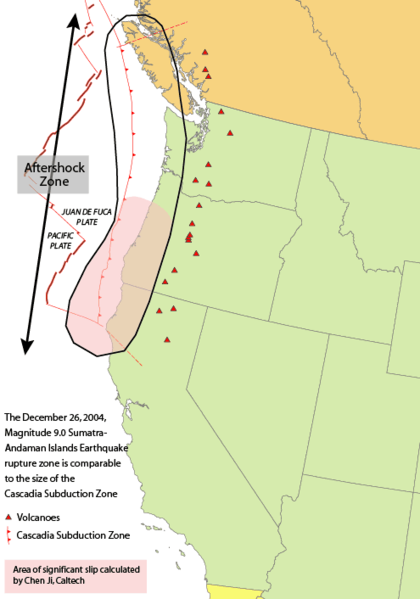
Area of the Cascadia subduction zone, including Cascade volcanoes (red triangles)
The Cascade Volcanoes were formed by the subduction of the Juan de Fuca, Explorer and the Gorda Plate (remnants of the much larger Farallon Plate) under the North American Plate along the Cascadia subduction zone. This is a 680 mi (1,094 km) long fault, running 50 mi (80 km) off the west-coast of the Pacific Northwest from northern California to Vancouver Island, British Columbia. The plates move at a relative rate of over 0.4 inches (10 mm) per year at a somewhat oblique angle to the subduction zone.
Because of the very large fault area, the Cascadia subduction zone can produce very large earthquakes, magnitude 9.0 or greater, if rupture occurred over its whole area. When the “locked” zone stores up energy for an earthquake, the “transition” zone, although somewhat plastic, can rupture. Thermal and deformation studies indicate that the locked zone is fully locked for 60 kilometers (about 40 miles) downdip from the deformation front. Further downdip, there is a transition from fully locked to aseismic sliding.
Plate tectonics of the Cascade Range
Unlike most subduction zones worldwide, there is no oceanic trench present along the continental margin in Cascadia. Instead, terranes and the accretionary wedge have been uplifted to form a series of coast ranges and exotic mountains. A high rate of sedimentation from the outflow of the three major rivers (Fraser River, Columbia River, and Klamath River) which cross the Cascade Range contributes to further obscuring the presence of a trench. However, in common with most other subduction zones, the outer margin is slowly being compressed, similar to a giant spring. When the stored energy is suddenly released by slippage across the fault at irregular intervals, the Cascadia subduction zone can create very large earthquakes such as the magnitude 9 Cascadia earthquake of 1700.
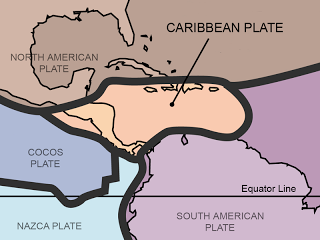
The Caribbean Plate is a mostly oceanic tectonic plate underlying Central America and the Caribbean Sea off the north coast of South America.
Roughly 3.2 million square kilometers (1.2 million square miles) in area, the Caribbean
Plate borders the North American Plate, the South American Plate, the Nazca Plate and the Cocos Plate. These borders are regions of intense seismic activity, including frequent earthquakes, occasional tsunamis, and volcanic eruptions.
Boundary types
Caribbean Plate.
The northern boundary with the North American plate is a transform or strike-slip boundary which runs from the border area of Belize, Guatemala (Motagua Fault), and Honduras in Central America, eastward through the Cayman trough on south of the southeast coast of Cuba, and just north of Hispaniola, Puerto Rico, and the Virgin Islands. Part of the Puerto Rico Trench, the deepest part of the Atlantic Ocean (roughly 8,400 meters), lies along this border. The Puerto Rico trench is at a complex transition from the subduction boundary to the south and the transform boundary to the west.
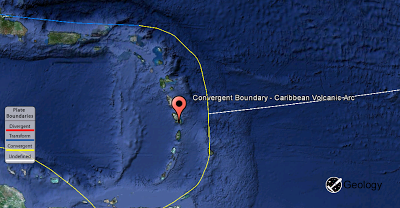
The eastern boundary is a subduction zone, the Lesser Antilles subduction zone, where oceanic crust of the South American Plate is being subducted under the Caribbean Plate. Subduction forms the volcanic islands of the Lesser Antilles Volcanic Arc from the Virgin Islands in the north to the islands off the coast of Venezuela in the south. This boundary contains seventeen active volcanoes, most notably Soufriere Hills on Montserrat;, Mount Pelée on Martinique; La Grande Soufrière on Guadeloupe; Soufrière Saint Vincent on Saint Vincent; and the submarine volcano Kick-’em-Jenny which lies about 10 km north of Grenada. Large historical earthquakes in 1839 and 1843 in this region are possibly megathrust earthquakes.
Along the geologically complex southern boundary, the Caribbean Plate interacts with the South American Plate forming Barbados, Trinidad and Tobago (all on the Caribbean Plate), and islands off the coast of Venezuela (including the Leeward Antilles) and Colombia. This boundary is in part the result of transform faulting along with thrust faulting and some subduction. The rich Venezuelan petroleum fields possibly result from this complex plate interaction.
The western portion of the plate is occupied by Central America. The Cocos Plate in the Pacific Ocean is subducted beneath the Caribbean Plate, just off the western coast of Central America. This subduction forms the volcanoes of Guatemala, El Salvador, Nicaragua, and Costa Rica, also known as the Central America Volcanic Arc.
Origin
There are two contending theories as to the origin of the Caribbean Plate.
One holds that it is a large igneous province that formed in the Pacific Ocean tens of millions of years ago. As the Atlantic Ocean widened, North America and South America were pushed westward, separated for a time by oceanic crust. The Pacific Ocean floor subducted under this oceanic crust between the continents. The Caribbean Plate drifted into the same area, but as it was less dense (although thicker) than the surrounding oceanic crust, it did not subduct, but rather overrode the ocean floor, continuing to move eastward relative to North America and South America. With the formation of the Isthmus of Panama 3 million years ago, it ultimately lost its connection to the Pacific.
A more recent theory asserts that the Caribbean Plate came into being from an Atlantic hotspot which no longer exists. This theory points to evidence of the absolute motion of the Caribbean Plate which indicates that it moves westward, not east, and that its apparent eastward motion is only relative to the motions of the North American Plate and the South American Plate.
Transform Boundary – Alpine Fault, South Island, New Zealand
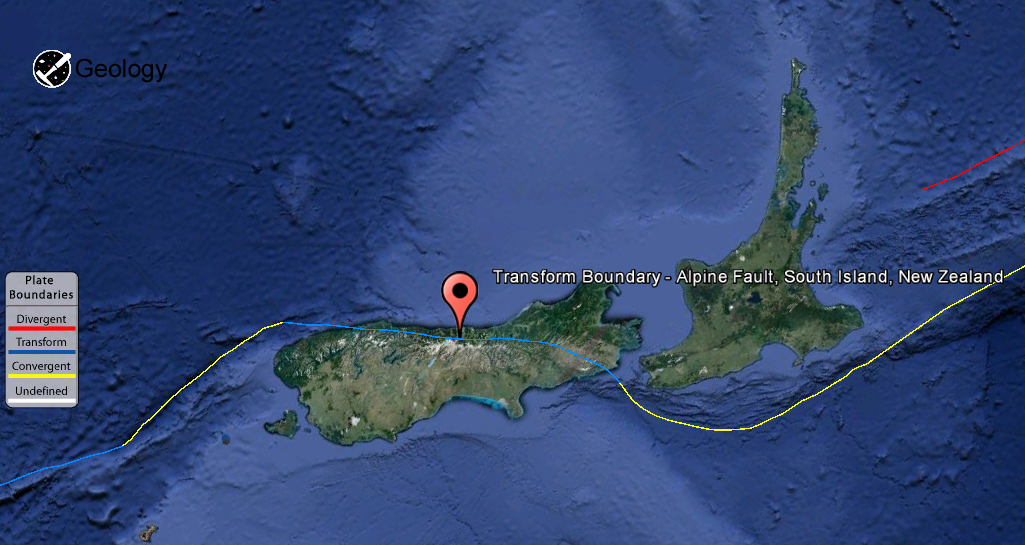
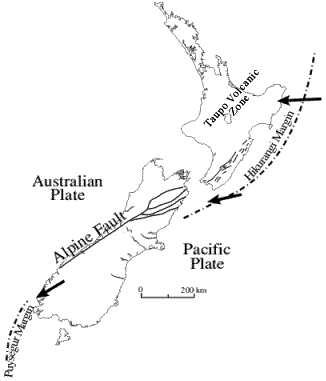
The Alpine Fault is a geological fault, specifically a right-lateral strike-slip fault, that runs almost the entire length of New Zealand’s South Island. It forms a transform boundary between the Pacific Plate and the Indo-Australian Plate. Earthquakes along the fault, and the associated earth movements, have formed the Southern Alps. The uplift to the southeast of the fault is due to an element of convergence between the plates, meaning that the fault has a significant high-angle reverse oblique component to its displacement.Transform Boundary – Alpine Fault, South Island, New Zealand The Alpine Fault is a geological fault, specifically a right-lateral strike-slip fault, that runs almost the entire length of New Zealand’s South Island. It forms a transform boundary between the Pacific Plate and the Indo-Australian Plate. Earthquakes along the fault, and the associated earth movements, have formed the Southern Alps. The uplift to the southeast of the fault is due to an element of convergence between the plates, meaning that the fault has a significant high-angle reverse oblique component to its displacement.
The Alpine Fault is believed to align with the Macquarie Fault Zone in the Puysegur Trench off the southwestern corner of the South Island. From there, the Alpine Fault runs along the western edge of the Southern Alps, before splitting into a set of smaller dextral strike-slip faults north of Arthur’s Pass, known as the Marlborough Fault System. This set of faults, which includes the Wairau Fault, the Hope Fault, the Awatere Fault, and the Clarence Fault, transfer displacement between the Alpine Fault and the Hikurangi subduction zone to the north. The Hope fault is thought to represent the primary continuation of the Alpine fault.
Tectonic setting of New Zealand: astride a plate boundary which includes the Alpine Fault
New Zealand lies at the edge of both the Australian and Pacific tectonic plates. To the northeast of New Zealand, and underneath North Island, the Pacific Plate is moving towards, and being subducted below the Australian Plate. To the south of New Zealand, and underneath Fiordland, the two plates are also moving toward each other but here the Australian Plate is being subducted under the Pacific Plate.
The Australian and Pacific Plates generally don’t move smoothly past each other. They move in a series in a small rapid motions each of which is accompanied by one or more earthquakes.
Deep earthquakes under North Island form a well defined band (seismic zone) running northeast from Marlborough through White Island. Shallow earthquakes tend to occur to the southeast of this seismic zone, while the deeper ones occur towards the northwest. The earthquakes form this pattern occur where the Pacific Plate is being subducted under the Australian Plate. This pattern of deeper earthquakes towards the northwest of North Island reflects the northwest dip (or slope) of the boundary between the two plates (the Benioff zone).
Conversely, in the southwest of South Island where the Australian Plate is being subducted below the Pacific Plate, the deeper earthquakes occur on the southeast edge of the seismic zone where the Benioff zone dips steeply to the southeast.
Volcanoes
As the Pacific Plate is subducted below North Island, the part of the Australian Plate that makes up the central North Island is stretched and has, over many millions of years, become thinner than normal crust. Water released from the Pacific Plate deep under North Island combines with the hot rock of the Australian Plate at about 100km depth and causes a small amount of that rock to melt. This molten rock rises to the surface through the thinned crust and is either erupted from volcanoes like Ruapehu, Tongariro and Ngaruhoe or sits within the crust and heats it, and the water it contains, up causing geothermal activity around Taupo and Rotorua. The area of volcanic activity is referred to as the Taupo Volcanic Zone (see map above).
South Island Faults
The subduction zone in the north is linked to the subduction zone in the south by a series of very large faults that run through Marlborough (Marlborough Fault System) and down the west coast of South Island (Alpine Fault). The Marlborough Fault System is a series of subparallel strike-slip faults which run northeast-southwest. Relative movement across the Marlborough Fault System is dextral or right-lateral.
Note : The above story is reprinted from materials provided by Wikipedia & Department of Geology, University of Otago, New Zealand Plate Boundary By : USGS
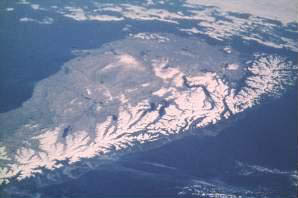
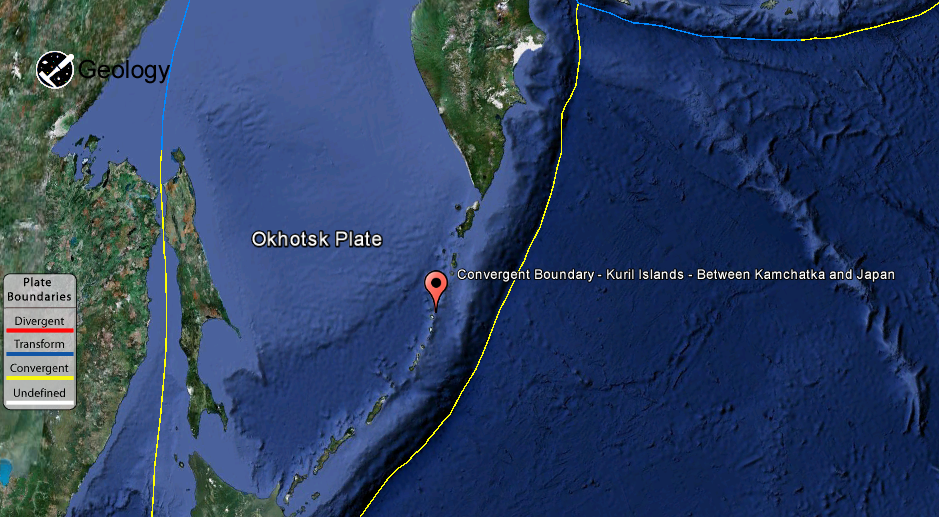
Convergent Boundary – Kuril Islands – Between Kamchatka and Japan
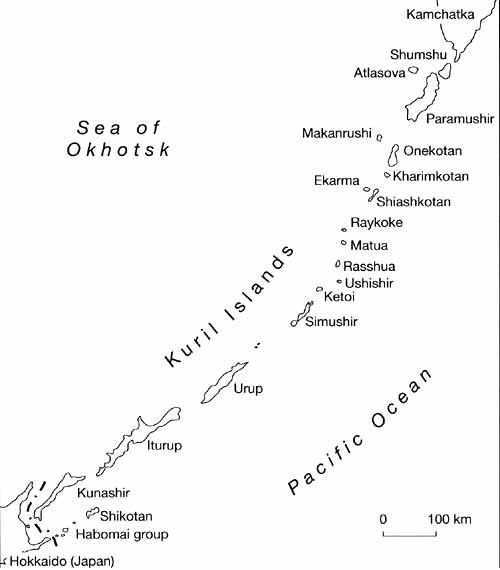
The Kuril islands, extending from north to south for 1200 km, are a part of the submarine
Fig(1)
uplift located between the Sea of Okhotsk basin and the Kuril oceanic trench*. The archipelago comprises 30 large islands and numerous small ones. Two sectors, different in the history of development and morphology are distinguished within the archipelago (Luchitsky, 1974; Piskunov, 1987). The inner arc, known as the Greater Kuril,
extends from Shumshu island to Kunashir and the outer arc, termed the Lesser Kuril, which includes Shikotan and the small isles of the Habomai group (Figure1).
Tectonics and Environmental Change
Tectonically the Kurils belong to the Kuril-Kamchatka island arc which is related, as all island arcs, to an oceanic trench located 150-170 km from the volcanic front. Pronounced seismic activity is associated with the arc and the Benioff zone can be traced to a depth of 650 km (Tarakanov, 1972). The Greater Kurils and the Lesser Kurils differ in their morphology, geological structure, and history of development.
The Lesser Kurils, as well as the submarine Vityaz uplift to which they are connected and the peninsulas of eastern Kamchatka, are interpreted as an outer non-volcanic arc of the Kuril-Kamchatka system. The Lesser Kurils are formed mainly by late Cretaceous volcanic rocks. Volcanism of a submarine nature, as a result of which the islands emerged, was active in the Campanian (85-80 Ma BP) and the geological complex of this age is represented mainly by basalts. In the Maastrichtian (73-65 Ma BP), volcanic activity faded and flysh with olistostromes accumulated. Volcanic activity of the time was represented mainly by magmatic intrusions into sediments (Piskunov and Sergeev, 1992). At the end of the Cretaceous, volcanism occurred in terrestrial conditions. The completion of the magmatic activity was marked by gabbro intrusions. At present, there are no active volcanoes in the Lesser Kurils. The ancient calderas have been eroded and gentle hills with a height of 150-250 m dominate the islands.
The Greater Kurils are a younger formation where volcanism commenced at about 30 Ma BP in the late Oligocene-early Miocene. There were three major stages of arc development and these are reflected in the sequence of Cenozoic rocks (Fedorchenko et al., 1989; Piskunov and Sergeev, 1992). The most ancient rocks of the lower Miocene age comprise basalts, andesites, rhyolites, and their tuffs. The latter are abundant and can be correlated with the Green Tuff Formation of Japan. During the next stage in the middle Miocene, volcanism occurred mainly under terrestrial conditions and the stratigraphy is characterized by the occurrence of both volcanic rocks and flysh-type sequences.
Clastic material contains rocks which are not found in the Greater Kurils and which have apparently been derived from the dissected terrain in the back-arc area. The composition of these sequences shows that the Sea of Okhotsk basin did not exist at the time, while their inclined position reflects block rotation along faults during rifting and the opening of the Sea of Okhotsk basin at about 15 Ma BP (Zonenshain et al., 1990). The latest stage, during which the modern volcanic cones emerged, began in the late Miocene and is continuing at present. Its geology is a typical cal-calkaline volcanic sequence.
Similarly to Kamchatka, there were major periods of enhanced volcanic activity in the Kurils in the late Pleistocene and early Holocene (e.g., the Medeleev and Golovnin calderas formed 38-40 Ka BP). Over a hundred terrestrial volcanoes occur on the islands at present and 39 of them are active. The most active volcanoes are the tallest Kuril volcano, the Alaid (2339 m) located in the north of the arc and the Sarychev located on Matua island. The last powerful eruption of the Alaid occurred in 1972 when a new slag cone 150 m high formed in the centre of the volcano. The Sarychev is known for its regular activity. The most violent eruptions occurred in 1930 and 1946 when the ashfalls reached central Kamchatka. By contrast, another major volcano, the Golovnin caldera (the southernmost Kuril volcano located in Kunashir island) has not erupted for more than a century although it accommodates geothermal springs and two large lakes formed 640-680 years BP (Razjigaeva et al., 1998).
Typical of the Kurils is low to middle mountainous relief with altitudes of 500-1300 m. Five major morphological types of relief are distinguished: volcanic, seismo-tectonic, erosive-denudational, coastal (of abrasion and accumulation types), and aeolian (Grabkov and Isachenko, 1982). Aeolian forms date back to about 4.5-4.7 Ka BP when an extensive marine regression occurred (Bazarova et al., 1998). Most islands have volcanic relief and the landscape is that of individual volcanoes or volcanic ridges linked by sediment-filled isthmuses. Six to seven marine terraces occur in the coastal zone with altitudes ranging between 2-3 and 200-250 m a.s.l. Both marine terraces and volcanic massifs are strongly dissected which indicates a high rate of erosion and marine abrasion.
The landscapes of the Kuril islands were formed under the influence of two major factors: volcanism and seismic activity, and climate change. Climate is strongly influenced by the physical and chemical properties of the ocean, such as sea surface temperature and salinity, and variability in the paths of the oceanic currents may result in regional climatic change. Periodic changes in ocean circulation patterns due to changes in trade wind intensity in the eastern equatorial North Pacific Ocean and movements of the ocean plate have been discussed in relation to the warm Kuroshio current and climate change in Japan (Taira, 1980; Sawada and Handa, 1998). The islands of Japan and the Kurils are located in close proximity (as early as in the middle Holocene the islands of Hokkaido and Kunashir were connected by a landbridge) and climatic and environmental changes in northern Japan and the southern Kurils are closely correlated (Bazarova et al., 1998). However, the paleooceanography of the Kurils and its impact on the landscape development require further independent investigation.
*Kuril–Kamchatka Trench
The Kuril–Kamchatka Trench or Kuril Trench (Russian: Курило-Камчатский жёлоб) is an oceanic trench in the northwest Pacific Ocean. It lies off the southeast coast of Kamchatka and parallels the Kuril Island chain to meet the Japan Trench east of Hokkaido. It extends from a triple junction with the Ulakhan Fault and the Aleutian Trench near the Commander Islands, Russia, in the northeast, to the intersection with the Japan Trench in the southwest.
The trench formed as a result of the subduction zone, which formed in the late Cretaceous, that created the Kuril island arc as well as the Kamchatka volcanic arc. The Pacific Plate is being subducted beneath the Okhotsk Plate along the trench, resulting in intense volcanism.
Convergent Boundary – India and Asia – Himalaya Range
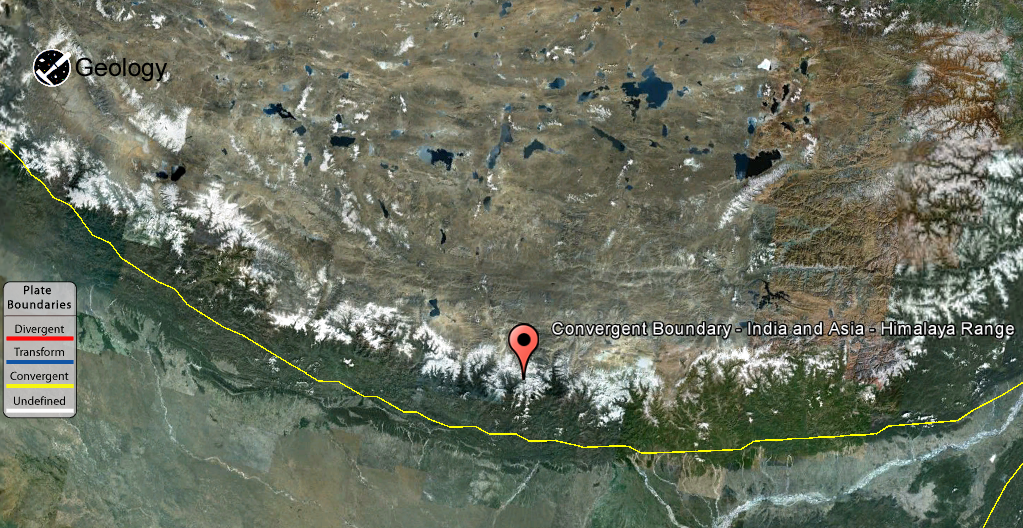
The geology of the Himalaya is a record of the most dramatic and visible creations of modern plate tectonic forces. The Himalayas, which stretch over 2400 km between the Namche Barwa syntaxis in Tibet and the Nanga Parbat syntaxis in Pakistan, are the result of an ongoing orogeny — the result of a collision between two continental tectonic plates. This immense mountain range was formed by tectonic forces and sculpted by weathering and erosion.
The Himalaya-Tibet region supplies freshwater for more than one-fifth of the world population, and accounts for a quarter of the global sedimentary budget. Topographically, the belt has many superlatives: the highest rate of uplift (nearly 10 mm/year at Nanga Parbat), the highest relief (8848 m at Mt. Everest Chomolangma), among the highest erosion rates at 2–12 mm/yr, the source of some of the greatest rivers and the highest concentration of glaciers outside of the polar regions. This last feature earned the Himalaya its name, originating from the Sanskrit for “the abode of the snow”.
The making of the Himalaya
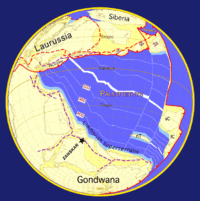
During Late Precambrian and the Palaeozoic, the Indian sub-continent, bounded to the
Fig 1
north by the Cimmerian Superterranes, was part of Gondwana and was separated from Eurasia by the Paleo-Tethys Ocean (Fig. 1). During that period, the northern part of India was affected by a late phase of the Pan-African orogeny which is marked by an unconformity between Ordovician continental conglomerates and the underlying Cambrian marine sediments. Numerous granitic intrusions dated at around 500 Ma are also attributed to this event.
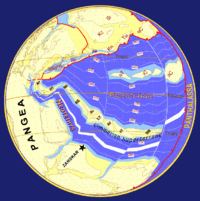
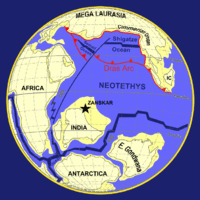
In the Early Carboniferous, an early stage of rifting developed between the Indian continent and the Cimmerian Superterranes. During the Early Permian, this rift developed into the Neotethys ocean (Fig. 2). From that time on, the Cimmerian Superterranes drifted away from Gondwana towards the north. Nowadays, Iran, Afghanistan and Tibet are partly made up of these terranes.
Fig 2
In the Norian (210 Ma), a major rifting episode split Gondwana in two parts. The Indian continent became part of East Gondwana, together with Australia and Antarctica. However, the separation of East and West Gondwana, together with the formation of oceanic crust, occurred later, in the Callovian (160-155 Ma). The Indian plate then broke off from Australia and Antarctica in the Early Cretaceous (130-125 Ma) with the opening of the “South Indian Ocean” (Fig. 3).
In the Upper Cretaceous (84 Ma), the Indian plate began its
Fig 3
very rapid northward drift covering a distance of about 6000 km, with the oceanic-oceanic subduction continuing until the final closure of the oceanic basin and the obduction of oceanic ophiolite onto India and the beginning of continent-continent tectonic interaction starting at about 65 Ma in the Central Himalaya. The change of the relative speed between the Indian and Asian plates from very fast (18-19.5 cm/yr) to fast (4.5 cm/yr) at about 55 Ma is circumstantial support for collision then. Since then there has been about 2500 km of crustal shortening and rotating of India by 45° counterclockwise in Northwestern Himalaya to 10°-15° counterclockwise in North Central Nepal relative to Asia (Fig. 4).
While most of the oceanic crust was “simply” subducted below the Tibetan block during the northward motion of India, at least three major mechanisms have been put forward, either separately or jointly, to explain what happened, since collision, to the 2500 km of “missing continental crust”. The first mechanism also calls upon the subduction of the Indian continental crust below Tibet. Second is the extrusion or escape tectonics mechanism (Molnar & Tapponnier 1975) which sees the Indian plate as an indenter that squeezed the Indochina block out of its way. The third proposed mechanism is that a large part (~1000 km (Dewey, Cande & Pitman 1989) or ~800 to ~1200 km) of the 2500 km of crustal shortening was accommodated by thrusting and folding of the sediments of the passive Indian margin together with the deformation of the Tibetan crust.
Even though it is more than reasonable to argue that this huge amount of crustal shortening most probably results from a combination of these three mechanisms, it is nevertheless the last mechanism which created the high topographic relief of the Himalaya.
Fig 4
Fig 1: The earth in the Early Permian. At that time, India is part of Gondwana and bordered to the north by the Cimmerian Superterrane. Paleogeographic reconstructions. By Dèzes (1999), based on Stampfli & Borel (2002) and Patriat & Achache (1984)
Fig 2: The earth at the Permian-Triassic boundary. The opening of the Neotethys separates the Cimmeridian Superterrane from Gondwana. Based on Stampfli & Borel (2002) and Patriat & Achache (1984)
Fig 3: The earth in the Cretaceous. The Cimmeridian Superterrane has accreted to Mega Laurasia, the oceanic crust of the Neotethys is subducted to the north along the Dras volcanic arc , the Shigatze Ocean opens as a consequence of back-arc spreading, India is separated from Africa and E. Gondwana and the Indian Ocean opens. Paleogeographic reconstructions based by Dèzes (1999), on Stampfli & Borel (2002) and Patriat & Achache (1984).
Fig 4: The northward drift of India from 71 Ma ago to present time. Note the simultaneous counter-clockwise rotation of India. Collision of the Indian continent with Eurasia occurred at about 55 Ma. Source: www.usgs.org (modified)
The Mid-Atlantic Ridge (MAR) is a mid-ocean ridge, a divergent tectonic plate boundary located along the floor of the Atlantic Ocean, and the longest mountain range in the world.
It separates the Eurasian Plate and North American Plate in the North Atlantic, and the African Plate from the South American Plate in theSouth Atlantic.
The Ridge extends from a junction with the Gakkel Ridge (Mid-Arctic Ridge) northeast of Greenland southward to the Bouvet Triple Junction in the South Atlantic. Although the Mid-Atlantic Ridge is mostly an underwater feature, portions of it have enough elevation to extend above sea level. The section of the ridge which includes the island of Iceland is also known as the Reykjanes Ridge. The average spreading rate for the ridge is about 2.5 cm per year.
Discovery
A ridge under the Atlantic Ocean was first inferred by Matthew Fontaine Maury in 1850. The ridge was discovered during the expedition of HMS Challenger in 1872. A team of scientists on board, led by Charles Wyville Thomson, discovered a large rise in the middle of the Atlantic while investigating the future location for a transatlantic telegraph cable. The existence of such a ridge was confirmed by sonar in 1925 and was found to extend around the Cape of Good Hope into the Indian Ocean by the German Meteor expedition.
In the 1950s, mapping of the Earth’s ocean floors by Bruce Heezen, Maurice Ewing, Marie Tharp and others revealed the Mid-Atlantic Ridge to have a strange bathymetry of valleys and ridges, with its central valley being seismologically active and the epicentre of many earthquakes. Ewing and Heezen discovered the ridge to be part of a 40,000-km-long essentially continuous system of mid-ocean ridges on the floors of all the Earth’s oceans. The discovery of this worldwide ridge system led to the theory of seafloor spreading and general acceptance of Wegener’s theory of continental drift and expansion as plate tectonics.
Geology
The ridge sits atop a geologic feature known as the Mid-Atlantic Rise which is a progressive bulge that runs the length of the Atlantic Ocean, with the ridge resting on the highest point of this linear bulge. This bulge is thought to be caused by upward convective forces in the asthenosphere pushing the oceanic crust and lithosphere.
This divergent boundary first formed in the Triassic period when a series of three-armed grabens coalesced on the supercontinent Pangaea to form the ridge. Usually only two arms of any given three-armed graben become part of a divergent plate boundary. The failed arms are called aulacogens, and the aulacogens of the Mid-Atlantic Ridge eventually became many of the large river valleys seen along the Americas and Africa (including the Mississippi River, Amazon River and Niger River).
The ridge is about 2,500 meters (8,200 ft) below sea level, while its flank is about 5,000 metres deeper.
The Fundy Basin on the Atlantic coast of North America between New Brunswick and Nova Scotia in Canada is evidence of the ancestral Mid-Atlantic Ridge.
Notable Features Along the Ridge
The Mid-Atlantic Ridge includes a deep rift valley which runs along the axis of the ridge along nearly its entire length. This rift marks the actual boundary between adjacent tectonic plates, where magma from the mantle reaches the seafloor, erupting as lava and producing new crustal material for the plates.
Near the equator, the Mid-Atlantic Ridge is divided into the North Atlantic Ridge and the South Atlantic Ridge by the Romanche Trench, a narrow submarine trench with a maximum depth of 7,758 m (25,453 ft), one of the deepest locations of the Atlantic Ocean. This trench, however, is not regarded as the boundary between the North and South American Plates, nor the Eurasian and African Plates.
Islands on the Mid-Atlantic Ridge
The islands, from north to south, with their respective highest peaks and location, are:
Northern Hemisphere (North Atlantic Ridge):
– Jan Mayen in the Arctic Ocean Iceland through which the ridge runs
– Azores (Ponta do Pico or Pico Alto, on Pico Island)
– Bermuda was formed on the ridge, but is now considerably west of it
– Saint Peter and Paul Rocks
Southern Hemisphere (South Atlantic Ridge):
– Ascension Island (The Peak, Green Mountain) Tristan da Cunha (Queen Mary’s Peak)
The Aleutian Trench (or Aleutian Trough) is a subduction zone and oceanic trench which runs along the southern coastline of Alaska and the adjacent waters of northeastern Siberia off the coast of Kamchatka Peninsula. It is classified as a “marginal trench” in the east as it runs along the margin of the continent.
The trench gives rise to the island arc Aleutian Islands where it runs through the open sea. The trench extends for 3,400 km from a triple junction in the west with the Ulakhan Fault and the northern end of the Kuril-Kamchatka Trench, to a junction with the northern end of the Queen Charlotte Fault system in the east. The Aleutian Trench is a convergent plate boundary. The trench forms part of the boundary between two tectonic plates. Here, the Pacific Plate is being subducted under the North American Plate at an angle of nearly 45 degrees. The rate of closure is 3in. (8 cm) per year.
The Aleutian Islands are a chain of 14 large volcanic islands and 55 smaller ones, forming part of the Aleutian Arc in the Northern Pacific Ocean, occupying an area of 6,821 sq mi (17,666 km²) and extending about 1,200 mi (1,900 km) westward from the Alaska Peninsula toward the Kamchatka Peninsula, marking a line between the Bering Sea and the Pacific Ocean. Crossing longitude 180°, they are the westernmost part of the United States . Nearly all the archipelago is part of Alaska and usually considered as being in the “Alaskan Bush”, but at the extreme western end the small, geologically related, and remote Commander Islands are in Russia. The islands, with their 57 volcanoes, are in the northern part of the Pacific Ring of Fire. The Alaska Marine Highway (a ferry service) passes through the islands.
The north side of the trench slopes 3°–4° and the south side l°–4°. This process has created the Aleutian Arc. The deepest part of the Aleutian trench has been measured at 7,822 metres (25,663 ft) at 51.21°N, 174.83°E., located about 145 km SSW of Buldir Island. North of the trench, a string of volcanoes and associated islands have formed where melting of the crust has been caused by the descending plate beneath them. Center pressure: 10762psi (732atm), 74 MPa (732atm) Metric units.[ Variations in total magnetic intensity (residual) of more than 600 γ were found in the center of the trench and more than 1100 γ on the southern flank.
More Information About : Plate Tectonics Map Plate Boundary Map Note : The above story is reprinted from materials provided by Wikipedia Plate Boundary By : USGS