
Home Blog Page 319

Crystals in Picabo’s Rocks Point to ‘Recycled’ Super-Volcanic Magma Chambers

Map showing Picabo and Heise fields. (Credit: University of Oregon)

A thorough examination of tiny crystals of zircon, a mineral found in rhyolites, an igneous rock, from the Snake River Plain has solidified evidence for a new way of looking at the life cycle of super-volcanic eruptions in the long track of the Yellowstone hotspot, say University of Oregon scientists.

The pattern emerging from new and previous research completed in the last five years under a National Science Foundation career award, said UO geologist Ilya N. Bindeman, is that another super-eruption from the still-alive Yellowstone volcanic field is less likely for the next few million years than previously thought (see related story, “Not in a million years, says Oregon geologist about Yellowstone eruption”). The last eruption 640,000 years ago created the Yellowstone Caldera and the Lava Creek Tuff in what is now Yellowstone National Park.

The Yellowstone hotspot creates a conveyor belt style of volcanism because of the southwest migration of the North American plate at 2-4 centimeters (about .8 to 1.6 inches) annually over the last 16 million years of volcanism. Due to the movement of the North American plate, the plume interaction with the crust leaves footprints in the form of caldera clusters, in what is now the Snake River Plain, Bindeman said.

The Picabo volcanic field of southern Idaho, described in a new paper by a six-member team, was active between 10.4 and 6.6 million years ago and experienced at least three, and maybe as many as six, violent caldera-forming eruptions. The field has been difficult to assess, said lead author Dana Drew, a UO graduate student, because the calderas have been buried by as much as two kilometers of basalt since its eruption cycle died.

The work at Picabo is detailed in a paper online ahead of publication in the journal Earth and Planetary Science Letters.

The team theorized that basalt from the mantle plume, rocks from Earth’s crust and previously erupted volcanoes are melted together to form the rhyolites erupted in the Snake River Plain. Before each eruption, rhyolite magma is stored in dispersed pockets throughout the upper crust, which are later mixed together, according to geochemical evidence. “We think that this batch-assembly process is an important part of caldera-forming eruptions, and generating rhyolites in general,” Drew said.

In reaching their conclusions, Drew and colleagues analyzed radiogenic and stable isotopic data — specifically oxygen and hafnium — in zircons detected in rhyolites found at the margins of the Picabo field and from a deep borehole. That data, in combination with whole rock geochemistry and zircon uranium-lead geochronology helped provide a framework to understand the region’s ancient volcanic past.

Previous research on the related Heise volcanic field east of Picabo yielded similar results. “There is a growing database of the geochemistry of rhyolites in the Yellowstone hotspot track,” Drew said. “Adding Picabo provides a missing link in the database.

Drew and colleagues, through their oxygen isotope analyses, identified a wide diversity of oxygen ratios occurring in erupted zircons near the end of the Picabo volcanic cycle. Such oxygen ratios are referred to as delta-O-18 signatures based on oxygen 18 levels relative to seawater. (Oxygen 18 contains eight protons and 10 neutrons; Oxygen 16, with eight protons and eight neutrons, is the most commonly found form of oxygen in nature.)

The approach provided a glimpse into the connection of surface and subsurface processes at a caldera cluster. The interaction of erupted rhyolite with groundwater and surface water causes hydrothermal alteration and the change in oxygen isotopes, thereby providing a fingerprinting tool for the level of hydrothermal alteration, Drew said.

“Through the eruptive sequence, we begin to generate lower delta-O-18 signatures of the magmas and, with that, we also see a more diverse signature,” Drew said. “By the time of the final eruption there is up to five per mil diversity in the signature recorded in the zircons.” The team attributes these signatures to the mixing of diverse magma batches dispersed in the upper crust, which were formed by melting variably hydrothermally altered rocks — thus diverse delta-O-18 — after repeated formation of calderas and regional extension or stretching of the crust.

When the pockets of melt are rapidly assembled, the process could be the trigger for caldera forming eruptions, Bindeman said. “That leads to a homogenized magma, but in a way that preserves these zircons of different signatures from the individual pockets of melt,” he said. This research, he added, highlights the importance of using new micro-analytical isotopic techniques to relate geochemistry at the crystal-scale to processes occurring at the crustal-wide scale in generating and predicting large-volume rhyolitic eruptions.

“This important research by Dr. Bindeman and his team demonstrates the enormous impact an NSF CAREER award can have,” said Kimberly Andrews Espy, vice president for research and innovation and dean of the graduate school at the University of Oregon. “The five-year project is providing new insights into the eruption cycles of the Yellowstone hotspot and helping scientists to better predict future volcanic activity.”

Note : The above story is based on materials provided by University of Oregon. 

Iron in Earth’s Core Weakens Before Melting

The iron in Earth’s inner core weakens dramatically before it melts, explaining the unusual properties that exist in the moon-sized solid center of our planet that have, up until now, been difficult to understand. (Credit: iStockphoto)

The iron in the Earth’s inner core weakens dramatically before it melts, explaining the unusual properties that exist in the moon-sized solid centre of our planet that have, up until now, been difficult to understand.

Scientists use seismic waves — pulses of energy generated during earthquakes — to measure what is happening in the Earth’s inner core, which at 6000 km beneath our feet is completely inaccessible.

Problematically for researchers, the results of seismic measurements consistently show that these waves move through the Earth’s solid inner core at much slower speeds than predicted by experiments and simulations.

Specifically, a type of seismic wave called a ‘shear wave’ moves particularly slowly through the Earth’s core relative to the speed expected for the material — mainly iron — from which the core is made. Shear waves move through the body of the object in a transverse motion — like waves in a rope, as opposed to waves moving through a slinky spring.

Now, in a paper published in Science, scientists from UCL have proposed a possible explanation. They suggest that the iron in the Earth’s core may weaken dramatically just before melting, becoming much less stiff. The team used quantum mechanical calculations to evaluate the wave velocities of solid iron at inner-core pressure up to melting.

They calculated that at temperatures up to 95% of what is needed to melt iron in the Earth’s inner core, the speed of the seismic waves moving through the inner core decreases linearly but, after 95%, it drops dramatically.

At about 99% of the melting temperature of iron, the team’s calculated velocities agree with seismic data for the Earth’s inner core. Since independent geophysical results suggest that the inner core is likely to be at 99-100% of its melting temperature, the results presented in this paper give a compelling explanation as to why the seismic wave velocities are lower than those predicted previously.

Professor Lidunka Vočadlo, from the UCL department of Earth Sciences and an author of the paper said: “The Earth’s deep interior still holds many mysteries that scientists are trying to unravel.

“The proposed mineral models for the inner core have always shown a faster wave speed than that observed in seismic data. This mismatch has given rise to several complex theories about the state and evolution of the Earth’s core.”

The authors stress that this is not the end of the story as other factors need to be taken into account before a definitive core model can be made. As well as iron, the core contains nickel and light elements, such as silicon and sulphur.

Professor Vočadlo said: “The strong pre-melting effects in iron shown in our paper are an exciting new development in understanding the Earth’s inner core. We are currently working on how this result is affected by the presence of other elements, and we may soon be in a position to produce a simple model for the inner core that is consistent with seismic and other geophysical measurements. ”

Note : The above story is based on materials provided by University College London, via EurekAlert!, a service of AAAS. 

Iron Melt Network Helped Grow Earth’s Core, Study Suggests

In a rock and metal sample created by Stanford scientists to mimic the make up of the early Earth mantle, drops of molten iron merge to form a network. In this X-ray tomography image of the sample, the channels labeled in blue are interconnected. (Credit: Crystal Shi)

Stanford scientists recreated the intense pressures and temperatures found deep within Earth, resulting in a discovery that complicates theories of how the planet and its core were formed.

The same process that allows water to trickle through coffee grinds to create your morning espresso may have played a key role in the formation of the early Earth and influenced its internal organization, according to a new study by scientists at Stanford’s School of Earth Sciences.

The finding, published in the current issue of the journal Nature Geoscience, lends credence to a theory first proposed nearly half a century ago suggesting that Earth’s iron-rich core and layered internal structure might have formed in a series of steps that took place over millions of years under varying temperature and pressure conditions.

“We know that Earth today has a core and a mantle that are differentiated. With improving technology, we can look at different mechanisms of how this came to be in a new light,” said study leader Wendy Mao, an assistant professor of geological and environmental sciences at Stanford, and of photon sciences at the SLAC National Accelerator Laboratory, which is operated by the university.

Earth’s innards are presently divided into layers, with the rocky mantle composed mostly of silicates overlying an iron-rich metallic core. How the planet came to have this orderly arrangement is a major mystery, especially since scientists think its beginnings were messy and chaotic, the result of small bodies made up of rock and metals crashing and clumping together shortly after the formation of the sun and the birth of the solar system some 4.5 billion years ago.

How did Earth evolve from this conglomerated mass of rocks and metals into its current layered state?

Separating metal from rock

One idea is that the heat generated by the collisions and by the radioactive decay of certain isotopes warmed Earth. The planet could have gotten so hot that its rocks and metals melted. The molten rocks and metals in this “magma ocean” would then have separated into distinct layers as a result of their different densities. Iron would have drifted downward towards the planet’s center, while silicates remained on top.

Other scientists have proposed that even if the early Earth’s temperature was not hot enough to melt silicates, the molten iron might still have separated out by percolating through the solid silicate layer.

The thought was that pockets of molten iron trapped in the mantle layer could tunnel through the surrounding rock to create channels, or capillaries. This network of tunnels could have helped funnel molten iron towards the planet’s center to join the spherical metallic heart that was slowly amassing there.

However, this “percolation” theory was dealt a major blow when scientists discovered that, in the upper mantle layer at least, the molten iron tended to form isolated spheres that didn’t interact with one another, similar to the way water beads up on a waxed surface.

For this reason, scientists had previously thought that percolation couldn’t be possible, Mao said.

Recreating ancient Earth

But a new experiment conducted by Mao and her team uncovered fresh evidence that percolation might still be a viable mechanism for explaining the formation of Earth’s core.

Working with researchers at the U.S. Department of Energy’s SLAC facility, Mao and her team recreated a speck of the molten silicate and iron material that scientists believe existed deep inside the early Earth.

To do this, Mao’s team placed minute amounts of iron and silicate rock into a metal chamber that they then inserted between the tips of two small diamonds. Squeezing these “diamond anvils” together recreated the immense pressures present in Earth’s interior, and a laser beam was used to heat the sample to a high enough temperature to melt the iron.

After the sample cooled, the scientists examined it using X-ray-computed tomography. Tomography creates a three-dimensional image of an object by combining a series of two-dimensional slices. A computer program then helps flesh out the re-creation of the object.

A state-of-the-art X-ray microscope at SLAC allowed Mao’s team to resolve nanometer-scale details in their sample of heated silicates and iron. The higher resolution allowed the scientists to observe never-before-seen changes in the texture and shape of the molten iron and silicates as they responded to the same intense pressures and temperatures that were present deep in the early Earth.

Which happened first?

The experiment confirmed the findings from previous studies that molten iron in the upper mantle tended to form isolated blobs, which would have prevented percolation from happening. “In order for percolation to be efficient, the molten iron needs to be able to form continuous channels through the solid,” Mao explained.

However, the scientists found that at the higher pressures and temperatures that would have been present in the early Earth’s lower mantle, the structure of the silicates changed in a way that permitted connections to form between pockets of molten iron, making percolation possible.

“Scientists had said this theory wasn’t possible, but now we’re saying, under certain conditions that we know exist in the planet, it could happen,” Mao said. “So this brings back another possibility for how the core might have formed.”

The team’s new findings do not rule out the possibility that differentiation began when Earth was in a magma ocean state. In fact, both mechanisms could have occurred, said study first author Crystal Shi, a graduate student in Mao’s lab.

“We don’t know which mechanism happened first, or if the two happened together,” Shi said. “At the very beginning, Earth would have still been very hot, and the magma ocean mechanism could have been important. But later as the planet cooled, percolation may have become the dominant mechanism.”

Scientists from China’s Center for High Pressure Science and Technology Advanced Research, and the Carnegie Institution of Washington also contributed to this research.

Note : The above story is based on materials provided by Stanford University.

First Ever Evidence of a Comet Striking Earth

An artist’s rendition of the comet exploding in Earth’s atmosphere above Egypt. (Credit: Terry Bakker)

The first ever evidence of a comet entering Earth’s atmosphere and exploding, raining down a shock wave of fire which obliterated every life form in its path, has been discovered by a team of South African scientists and international collaborators.

The discovery has not only provided the first definitive proof of a comet striking Earth, millions of years ago, but it could also help us to unlock, in the future, the secrets of the formation of our solar system.

“Comets always visit our skies — they’re these dirty snowballs of ice mixed with dust — but never before in history has material from a comet ever been found on Earth,” says Professor David Block of Wits University.

The comet entered Earth’s atmosphere above Egypt about 28 million years ago. As it entered the atmosphere, it exploded, heating up the sand beneath it to a temperature of about 2,000 degrees Celsius, and resulting in the formation of a huge amount of yellow silica glass which lies scattered over a 6,000 square kilometre area in the Sahara. A magnificent specimen of the glass, polished by ancient jewellers, is found in Tutankhamun’s brooch with its striking yellow-brown scarab.

The research, which will be published in Earth and Planetary Science Letters, was conducted by a collaboration of geoscientists, physicists and astronomers including Block, lead author Professor Jan Kramers of the University of Johannesburg, Dr Marco Andreoli of the South African Nuclear Energy Corporation, and Chris Harris of the University of Cape Town.

At the centre of the attention of this team was a mysterious black pebble found years earlier by an Egyptian geologist in the area of the silica glass. After conducting highly sophisticated chemical analyses on this pebble, the authors came to the conclusion that it represented the very first known hand specimen of a comet nucleus, rather than simply an unusual type of meteorite.

Kramers describes this as a moment of career defining elation. “It’s a typical scientific euphoria when you eliminate all other options and come to the realisation of what it must be,” he said.

The impact of the explosion also produced microscopic diamonds. “Diamonds are produced from carbon bearing material. Normally they form deep in the Earth, where the pressure is high, but you can also generate very high pressure with shock. Part of the comet impacted and the shock of the impact produced the diamonds,” says Kramers.

The team have named the diamond-bearing pebble “Hypatia” in honour of the first well known female mathematician, astronomer and philosopher, Hypatia of Alexandria.

Comet material is very elusive. Comet fragments have not been found on Earth before except as microscopic sized dust particles in the upper atmosphere and some carbon-rich dust in the Antarctic ice. Space agencies have spent billions to secure the smallest amounts of pristine comet matter.

“NASA and ESA (European Space Agency) spend billions of dollars collecting a few micrograms of comet material and bringing it back to Earth, and now we’ve got a radical new approach of studying this material, without spending billions of dollars collecting it,” says Kramers.

The study of Hypatia has grown into an international collaborative research programme, coordinated by Andreoli, which involves a growing number of scientists drawn from a variety of disciplines. Dr Mario di Martino of Turin’s Astrophysical Observatory has led several expeditions to the desert glass area.

“Comets contain the very secrets to unlocking the formation of our solar system and this discovery gives us an unprecedented opportunity to study comet material first hand,” says Block.

Note : The above story is based on materials provided by Wits University. 

Extrusive Volcanism Formed the Hawaiian Islands

This is a 3D perspective view of the topography of the Hawaiian Islands (gray shaded) and seafloor relief viewed from just south of the Hawaii’s Big Island. The colors show residual gravity anomaly, measured on land and along ship tracks: Red-cyan representing an excess pull of gravity, blue representing a small deficit in the pull of gravity. (Credit: Ashton Flinders, UHM SOEST.)

A recent study by researchers at the University of Hawaii — Manoa (UHM) School of Ocean and Earth Science and Technology (SOEST) and the University of Rhode Island (URI) changes the understanding of how the Hawaiian Islands formed. Scientists have determined that it is the eruptions of lava on the surface, extrusion, which grow Hawaiian volcanoes, rather than internal emplacement of magma, as was previously thought.

Before this work, most scientists thought that Hawaiian volcanoes grew primarily internally — by magma intruding into rock and solidifying before it reaches the surface. While this type of growth does occur, along Kilauea’s East Rift Zone (ERZ), for example, it does not appear to be representative of the overall history of how the Hawaiian Islands formed. Previous estimates of the internal-to-extrusive ratios (internally emplaced magma versus extrusive lava flow) were based on observations over a very short time frame, in the geologic sense.

Ashton Flinders (M.S. from UHM), lead author and graduate student at URI, and colleagues compiled historical land-based gravity surveys with more recent surveys on the Big Island of Hawaii (in partnership with Jim Kauahikaua of the U.S. Geological Survey — Hawaii Volcano Observatory) and Kauai, along with marine surveys from the National Geophysical Data Center and from the UH R/V Kilo Moana. These types of data sets allow scientists to infer processes that have taken place over longer time periods.

“The discrepancy we see between our estimate and these past estimates emphasizes that the short term processes we currently see in Hawaii (which tend to be more intrusive) do not represent the predominant character of their volcanic activity,” said Flinders.

“This could imply that over the long-term, Kilauea’s ERZ will see less seismic activity and more eruptive activity that previously thought. The 3-decade-old eruption along Kilauea’s ERZ could last for many, many more decades to come,” said Dr. Garrett Ito, Professor of Geology and Geophysics at UHM and co-author.

“I think one of the more interesting possible implications is how the intrusive-to-extrusive ratio impacts the stability of the volcano’s flank. Collapses occur over a range of scales from as large as the whole flank of a volcano, to bench collapses on the south coast of Big Island, to small rock falls. ” said Flinders. Intrusive magma is more dense and structurally stronger than lava flows. “If the bulk of the islands are made from these weak extrusive flows then this would account for some of the collapses that have been documented, but this is mainly just speculation as of now.”

The authors hope this new density model can be used as a starting point for further crustal studies in the Hawaiian Islands.

Note : The above story is based on materials provided by University of Hawaii ‑ SOEST, via EurekAlert!, a service of AAAS. 

Exceptional fossil fish reveals new evolutionary mechanism for body elongation

The 240-million-year-old fossil find from Switzerland also revealed that this primitive fish was not as flexible as today’s eels, nor could it swim as fast or untiringly as a tuna. Credit: Picture: UZH

Snake and eel bodies are elongated, slender and flexible in all three dimensions. This striking body plan has evolved many times independently in the more than 500 million years of vertebrate animals history.

Based on the current state of knowledge, the extreme elongation of the body axis occurred in one of two ways: either through the elongation of the individual vertebrae of the vertebral column, which thus became longer, or through the development of additional vertebrae and associated muscle segments.

Long body thanks to doubling of the vertebral arches

A team of paleontologists from the University of Zurich headed by Professor Marcelo Sánchez-Villagra now reveal that a third, previously unknown mechanism of axial skeleton elongation characterized the early evolution of fishes, as shown by an exceptionally preserved form.
Unlike other known fish with elongate bodies, the vertebral column of Saurichthys curionii does not have one vertebral arch per myomeric segment, but two, which is unique. This resulted in an elongation of the body and gave it an overall elongate appearance.
“This evolutionary pattern for body elongation is new,” explains Erin Maxwell, a postdoc from Sánchez-Villagra’s group. “Previously, we only knew about an increase in the number of vertebrae and muscle segments or the elongation of the individual vertebrae.”
The fossils studied come from the Monte San Giorgio find in Ticino, which was declared a world heritage site by UNESCO in 2003. The researchers owe their findings to the fortunate circumstance that not only skeletal parts but also the tendons and tendon attachments surrounding the muscles of the primitive predatory fish had survived intact.
Due to the shape and arrangement of the preserved tendons, the scientists are also able to draw conclusions as to the flexibility and swimming ability of the fossilized fish genus. According to Maxwell, Saurichthys curionii was certainly not as flexible as today’s eels and, unlike modern oceanic fishes such as tuna, was probably unable to swim for long distances at high speed.
Based upon its appearance and lifestyle, the roughly half-meter-long fish is most comparable to the garfish or needlefish that exist today.
Note : The above story is based on materials provided by University of Zurich

Climate Puzzle Over Origins of Life On Earth

The ancient air was trapped in old and well-presereved rocks in north Australia. (Credit: Image courtesy of Manchester University)

The mystery of why life on Earth evolved when it did has deepened with the publication of a new study in the latest edition of the journal Science.

Scientists at the CRPG-CNRS University of Lorraine, The University of Manchester and the Institut de Physique du Globe de Paris have ruled out a theory as to why the planet was warm enough to sustain the planet’s earliest life forms when the Sun’s energy was roughly three-quarters the strength it is today.

Life evolved on Earth during the Archean, between 3.8 and 2.4 billion years ago, but the weak Sun should have meant the planet was too cold for life to take hold at this time; scientists have therefore been trying to find an explanation for this conundrum, what is dubbed the ‘faint, young Sun paradox’.

“During the Archean the solar energy received at the surface of the Earth was about 20 to 25 % lower than present,” said study author, Dr Ray Burgess, from Manchester’s School of Earth, Atmospheric and Environmental Sciences. “If the greenhouse gas composition of the atmosphere was comparable to current levels then the Earth should have been permanently glaciated but geological evidence suggests there were no global glaciations before the end of the Archean and that liquid water was widespread.”

One explanation for the puzzle was that greenhouse gas levels — one of the regulators of Earth’s climate — were significantly higher during the Archean than they are today.

“To counter the effect of the weaker Sun, carbon dioxide concentrations in the Earth’s atmosphere would need to have been 1,000 times higher than present,” said lead author Professor Bernard Marty, from the CRPG-CNRS University of Lorraine. “However, ancient fossil soils — the best indicators of ancient carbon dioxide levels in the atmosphere — suggest only modest levels during the Archean. Other atmospheric greenhouse gases were also present, in particular ammonia and methane, but these gases are fragile and easily destroyed by ultraviolet solar radiation, so are unlikely to have had any effect.”

But another climate-warming theory — one the team wanted to test — is that the amount of nitrogen could have been higher in the ancient atmosphere, which would amplify the greenhouse effect of carbon dioxide and allow Earth to remain ice-free.

The team analysed tiny samples of air trapped in water bubbles in quartz from a region of northern Australia that has extremely old and exceptionally well-preserved rocks.

“We measured the amount and isotopic abundances of nitrogen and argon in the ancient air,” said Professor Marty. “Argon is a noble gas which, being chemically inert, is an ideal element to monitor atmospheric change. Using the nitrogen and argon measurements we were able to reconstruct the amount and isotope composition of the nitrogen dissolved in the water and, from that, the atmosphere that was once in equilibrium with the water.”

The researchers found that the partial pressure of nitrogen in the Archean atmosphere was similar, possibly even slightly lower, than it is at present, ruling out nitrogen as one of the main contenders for solving the early climate puzzle.

Dr Burgess added: “The amount of nitrogen in the atmosphere was too low to enhance the greenhouse effect of carbon dioxide sufficiently to warm the planet. However, our results did give a higher than expected pressure reading for carbon dioxide — at odds with the estimates based on fossil soils — which could be high enough to counteract the effects of the faint young Sun and will require further investigation.”

Note : The above story is based on materials provided by Manchester University. 

Radioactive shale gas contaminants found at wastewater discharge site

Marcellus shale along Rt 174 just south of Slate Hill Rd, Marcellus, NY Author : Lvklock ” Wikimedia”

DURHAM, N.C. — Elevated levels of radioactivity, salts and metals have been found in river water and sediments at a site where treated water from oil and gas operations is discharged into a western Pennsylvania creek.

“Radium levels were about 200 times greater in sediment samples collected where the Josephine Brine Treatment Facility discharges its treated wastewater into Blacklick Creek than in sediment samples collected just upstream of the plant,” said Avner Vengosh, professor of geochemistry and water quality at Duke University’s Nicholas School of the Environment.

The new Duke study examined the quality of shale gas wastewater from hydraulic fracturing and the stream water above and below the disposal site. The study found that some of the discharged effluent is derived from the Marcellus shale gas flowback water, which is naturally high in salinity and radioactivity.

High concentrations of some salts and metals were also observed in the stream water. “The treatment removes a substantial portion of the radioactivity, but it does not remove many of the other salts, including bromide,” Vengosh said. “When the high-bromide effluents are discharged to the stream, it increases the concentrations of bromide above the original background levels. This is significant because bromide increases the risks for formation of highly toxic disinfection byproducts in drinking water treatment facilities that are located downstream.”

“The radioactivity levels we found in sediments near the outflow are above management regulations in the U.S. and would only be accepted at a licensed radioactive disposal facility,” said Robert B. Jackson, professor of environmental science at Duke. “The facility is quite effective in removing metals such as barium from the water but concentrates sulfates, chlorides and bromides. In fact this single facility contributes four-fifths of the total downstream chloride flow at this point.”

The Duke team also analyzed stream-bottom sediments for radium isotopes that are typically found in Marcellus wastewater. “Although the facility’s treatment process significantly reduced radium and barium levels in the wastewater, the amount of radioactivity that has accumulated in the river sediments still exceeds thresholds for safe disposal of radioactive materials,” Vengosh said. “Years of disposal of oil and gas wastewater with high radioactivity has created potential environmental risks for thousands of years to come.”

“While water contamination can be mitigated by treatment to a certain degree, our findings indicate that disposal of wastewater from both conventional and unconventional oil and gas operations has degraded the surface water and sediments,” said Nathaniel R. Warner, a recent Ph.D. graduate of Duke who is now a postdoctoral researcher at Dartmouth College. “This could be a long-term legacy of radioactivity.”

Industry has made efforts to reuse or to transport shale gas wastewater to deep injection wells, but wastewater is still discharged to the environment in some states. “It is clear that this practice of releasing wastewater without adequate treatment should be stopped in order to protect freshwater resources in areas of oil and gas development,” Vengosh said.

The Duke team published their findings Oct. 2 in the peer-reviewed journal Environmental Science & Technology.

Note : The above story is based on materials provided by  Duke University

Oldest Lizard-Like Fossil Yet to Be Found Hints at Scaly Origins

Top: Vellberg jaw. Bottom: restoration image. (Credit: Marc Jones)

The fossilised remains of a reptile closely related to lizards are the oldest yet to be discovered.

Two new fossil jaws discovered in Vellberg, Germany provide the first direct evidence that the ancestors of lizards, snakes and tuatara (known collectively as lepidosaurs) were alive during the Middle Triassic period — around 240 million years ago.

The new fossil finds predate all other lepidosaur records by 12 million years. The findings are published in BMC Evolutionary Biology.

The international team of scientists who dated the fossil jaws have provided evidence that lepidosaurs first appeared after the end-Permian mass extinction event, a period when fauna began to recover and thrive in the more humid climate.

Lead author Dr Marc Jones, who conducted the research at UCL, explained: “The Middle Triassic represents a time when the world has recovered from the Permian mass extinction but is not yet dominated by dinosaurs. This is also when familiar groups, such as frogs and lizards, may have first appeared.”

The small teeth and lightly built jaws suggest that the extinct animal preyed on small insects. The new fossils are most closely related to the tuatara, a lizard-like reptile.

Tuatara can be found on 35 islands lying off the coast of New Zealand and were recently reintroduced to the mainland. However, they are the sole survivors of a group that was once as globally widespread as lizards are today. Tuatara feed on beetles, spiders, crickets and small lizards, also enjoying the occasional sea bird.

Today, there are over 9,000 species of lizards, snakes and tuatara. Knowing when the common ancestor of this grouping first appeared is crucial for understanding the ecological context in which it first evolved as well as its subsequent diversification.

To establish the age of the fossil remains, biologists use a dating technique known as a “molecular clock.” This method compares the amount of genetic divergence between living animals, caused by changes in their DNA sequences that have accumulated since they split from a common ancestor. These mutations occur fairly regularly, ticking along at a clock-like rate. However, for the clock to convert genetic differences into geological time, it has to be calibrated using one or more fossils of known relationship and time.

Molecular clocks have been used by biologists to answer questions as important as when the first modern humans emerged, and when humans and chimpanzees shared a common ancestor. The new fossil jaws can improve molecular dating estimates of when reptiles began to diversify into snakes, lizard and tuatara, and when the first modern lizards inhabited the earth. Previous estimates have varied over a range of 64 million years and the team are keen to help narrow this down.

“Some previous estimates based on molecular data suggested that lizards first evolved 290 million years ago,” said second author Cajsa Lisa Anderson, University of Gothenburg. “To a palaeontologist this seems way too old and our revised molecular analysis agrees with the fossils.”

Revised molecular dating in light of this new fossil find now suggests lizards began to diversify into most of the modern groups we recognise today, such as geckos and skinks, less than 150 million years ago in the Cretaceous period, following continental fragmentation.

The specimens were collected and initially identified by Professor Rainer Schoch from the Staatliches Museum für Naturkunde in Stuttgart, where the specimens are now registered.

Scientists anticipate that the Vellberg site will yield yet more fossil discoveries in the future, broadening our knowledge of the vertebrate fossil record.

Co-Author Professor Susan Evans, from the UCL Department of Cell and Developmental Biology, said: “The fossil record of small animals such as lizards and frogs is very patchy. Hopefully, this new fossil site in Germany will eventually give us a broader understanding of what was going on at this time.”

Note : The above story is based on materials provided by University College London, via EurekAlert!, a service of AAAS. 

New fossils push the origin of flowering plants back by 100 million years to the early Triassic

This image shows flower-like pollen from the Triassic. Credit: UZH

Flowering plants evolved from extinct plants related to conifers, ginkgos, cycads, and seed ferns. The oldest known fossils from flowering plants are pollen grains. These are small, robust and numerous and therefore fossilize more easily than leaves and flowers.
An uninterrupted sequence of fossilized pollen from flowers begins in the Early Cretaceous, approximately 140 million years ago, and it is generally assumed that flowering plants first evolved around that time. But the present study documents flowering plant-like pollen that is 100 million years older, implying that flowering plants may have originated in the Early Triassic (between 252 to 247 million years ago) or even earlier.

Many studies have tried to estimate the age of flowering plants from molecular data, but so far no consensus has been reached. Depending on dataset and method, these estimates range from the Triassic to the Cretaceous. Molecular estimates typically need to be “anchored” in fossil evidence, but extremely old fossils were not available for flowering plants. “That is why the present finding of flower-like pollen from the Triassic is significant”, says Prof. Peter Hochuli, University of Zurich.

Peter Hochuli and Susanne Feist-Burkhardt from Paleontological Institute and Museum, University of Zürich, studied two drilling cores from Weiach and Leuggern, northern Switzerland, and found pollen grains that resemble fossil pollen from the earliest known flowering plants. With Confocal Laser Scanning Microscopy, they obtained high-resolution images across three dimensions of six different types of pollen.

In a previous study from 2004, Hochuli and Feist-Burkhardt documented different, but clearly related flowering-plant-like pollen from the Middle Triassic in cores from the Barents Sea, south of Spitsbergen. The samples from the present study were found 3000 km south of the previous site. “We believe that even highly cautious scientists will now be convinced that flowering plants evolved long before the Cretaceous”, say Hochuli.

What might these primitive flowering plants have looked like? In the Middle Triassic, both the Barents Sea and Switzerland lay in the subtropics, but the area of Switzerland was much drier than the region of the Barents Sea. This implies that these plants occurred a broad ecological range. The pollen’s structure suggests that the plants were pollinated by insects: most likely beetles, as bees would not evolve for another 100 million years.

Note : The above story is based on materials provided by Prof Peter A. Hochuli For University of Zürich

Geological exploration reveals Australian super volcano

The Palgrave region in the Musgrave Ranges. Credit: M Werner, Geological Survey of WA

A geological survey team says an ancient super volcano exuded more than 450 cubic kilometres of molten magma in a single eruption, over what are now Ngaanyatjarra tribal lands.

Geochemist Dr Hugh Smithies says it is the largest super volcano he is aware of on the planet.

“It was active for likely in excess of 30 million years,” he says.

“The typical lifespan of volcanic systems is usually measured in the many hundreds of thousands of years, up to a couple of million, but certainly 30 million is just extraordinary.”

Dr Smithies says the eruption occurred at the point where three tectonic plates converged.

He says the earth’s crust had been unusually hot in this location for some 200 million years beforehand, partly due to the North Australian, Western Australian and South Australian Cratons attempting to pull apart.

“I refer to it as a chronically frustrated rift,” he says.

“This region has contained some of the hottest crust that the world’s ever known.

“The magmas … produced in that prior 200 million years [were] very thorium rich … producing a lot of radiogenic heat keeping the area hot as well.

Dr Smithies and his team found the super volcano while exploring the Musgrave Ranges in the Western Desert for the Geological Survey of Western Australia.

“It involves systematic mapping and systematic geochemical sampling to try and gauge what the geochemical variations in the magmas were,” he says.

“This was a particularly interesting part of the geology of the region that we spent a bit more time on than we normally do.

“The mapping allowed us to estimate the volumes of erupted material and that’s where the super eruption concept comes from.

“They’re defined as single eruptions that have volumes in excess of 450 cubic kilometres.

“The mapping allows us to establish the unit we’re looking at, mapping as a single depositional unit, and to estimate the actual volumes.

He says super volcanoes are relatively rare phenomena, and this one may be unique for Australia.

The area is part of a fully-determined native title claim, and he was keen to acknowledge the traditional owners’ participation.

“This whole project has been a joint project with the Indigenous people of that region,” Dr Smithies says.

“In terms of economic potential there’s obviously a lot of hyperthermal alteration associated with big volcanic systems and so it possibly heralds a hitherto unrecognised gold area that’s potentially conducive to gold mineralisation.”

Note : The above story is based on materials provided by Science Network WA

NASA Mars Rover Curiosity Finds Water in First Sample of Planet Surface

On Sol 84 (Oct. 31, 2012), NASA’s Curiosity rover used the Mars Hand Lens Imager (MAHLI) to capture this set of 55 high-resolution images, which were stitched together to create this full-color self-portrait of the rover at “Rocknest.” (Credit: NASA/JPL-Caltech/Malin Space Science Systems)

The first scoop of soil analyzed by the analytical suite in the belly of NASA’s Curiosity rover reveals that fine materials on the surface of the planet contain several percent water by weight. The results were published today in Science as one article in a five-paper special section on the Curiosity mission. Rensselaer Polytechnic Institute Dean of Science Laurie Leshin is the study’s lead author.

“One of the most exciting results from this very first solid sample ingested by Curiosity is the high percentage of water in the soil,” said Leshin. “About 2 percent of the soil on the surface of Mars is made up of water, which is a great resource, and interesting scientifically.” The sample also released significant carbon dioxide, oxygen, and sulfur compounds when heated.

Curiosity landed in Gale Crater on the surface of Mars on August 6, 2012, charged with answering the question “Could Mars have once harbored life?” To do that, Curiosity is the first rover on Mars to carry equipment for gathering and processing samples of rock and soil. One of those instruments was employed in the current research: Sample Analysis at Mars (SAM) includes a gas chromotograph, a mass spectrometer, and a tunable laser spectrometer enabling it to identify a wide range of chemical compounds and determine the ratios of different isotopes of key elements.

“This work not only demonstrates that SAM is working beautifully on Mars, but also shows how SAM fits into Curiosity’s powerful and comprehensive suite of scientific instruments,” said Paul Mahaffy, principal investigator for SAM at NASA’s Goddard Space Flight Center in Maryland. “By combining analyses of water and other volatiles from SAM with mineralogical, chemical, and geological data from Curiosity’s other instruments, we have the most comprehensive information ever obtained on martian surface fines. These data greatly advance our understanding of surface processes and the action of water on Mars.”

“This is the first solid sample that we’ve analyzed with the instruments on Curiosity. It’s the very first scoop of stuff that’s been fed into the analytical suite. Although this is only the beginning of the story, what we’ve learned is substantial,” said Leshin, who co-wrote the article, titled “Volatile, Isotope and Organic Analysis of Martian Fines with the Mars Curiosity Rover.” Thirty-four researchers, all members of the Mars Science Laboratory Science Team, contributed to the paper.

In this study, scientists used the rover’s scoop to collect dust, dirt, and finely grained soil from a sandy patch known as “Rocknest.” Researchers fed portions of the fifth scoop into SAM. Inside SAM, the “fines” — as the dust, dirt, and fine soil is known — were heated to 835 degrees Celsius.

Baking the sample also revealed a compound containing chlorine and oxygen, likely chlorate or perchlorate, previously known only from high-latitude locations on Mars. This finding at Curiosity’s equatorial site suggests more global distribution. The analysis also suggests the presence of carbonate materials, which form in the presence of water.

In addition to determining the amount of the major gases released, SAM also analyzed ratios of isotopes of hydrogen and carbon in the released water and carbon dioxide. Isotopes are variants of the same chemical element with different numbers of neutrons, and therefore different atomic weights. SAM found that the ratio of isotopes in the soil is similar to that found in the atmosphere analyzed earlier by Curiosity, indicating that the surface soil has interacted heavily with the atmosphere.

“The isotopic ratios, including hydrogen-to-deuterium ratios and carbon isotopes, tend to support the idea that as the dust is moving around the planet, it’s reacting with some of the gases from the atmosphere,” Leshin said.

SAM can also search for trace levels of organic compounds. Although several simple organic compounds were detected in the experiments at Rocknest, they aren’t clearly martian in origin. Instead, it is likely that they formed during the heating experiments, as the non-organic compounds in Rocknest samples reacted with terrestrial organics already present in the SAM instrument background.

“We find that organics are not likely preserved in surface soils, which are exposed to harsh radiation and oxidants,” said Leshin. “We didn’t necessarily expect to find organic molecules in the surface fines, and this supports Curiosity’s strategy of drilling into rocks to continue the search for organic compounds. Finding samples with a better chance of organic preservation is key.”

The results shed light on the composition of the planet’s surface, while offering direction for future research, said Leshin.

“Mars has kind of a global layer, a layer of surface soil that has been mixed and distributed by frequent dust storms. So a scoop of this stuff is basically a microscopic Mars rock collection,” said Leshin. “If you mix many grains of it together, you probably have an accurate picture of typical martian crust. By learning about it in any one place, you’re learning about the entire planet.”

These results have implications for future Mars explorers. “We now know there should be abundant, easily accessible water on Mars,” said Leshin. “When we send people, they could scoop up the soil anywhere on the surface, heat it just a bit, and obtain water.”

In addition to her work research as part of the Mars Science Laboratory Team, Leshin is Dean of the School of Science at Rensselaer Polytechnic Institute, where she leads the scientific academic and research enterprise at the nation’s first technological university.

Note : The above story is based on materials provided by Rensselaer Polytechnic Institute. 

Study finds tungsten in aquifer groundwater controlled by pH, oxygen

Chad Hobson, master’s student in geology, Lavonia, Ga., collects sediment samples from Cheyenne Bottoms in Hoisington, Kan.

MANHATTAN — Two Kansas geologists are helping shed new light on how tungsten metal is leached from the sediment surrounding aquifers into the groundwater. The findings may have implications for human health.

Tungsten is a naturally occurring metal that is primarily used for incandescent light bulb filaments, drill bits and an alternative to lead in bullets. Though it is thought to be nonhazardous to the environment and nontoxic to humans, it can be poisonous if ingested in large amounts. In recent years, tungsten has been tentatively linked to cases of childhood leukemia in the Western U.S.

“Very little is known about the biogeochemistry of tungsten in the environment,” said Saugata Datta, professor of geology at Kansas State University. “We need to understand how this metal is leached from the soils into groundwater because humans can be exposed to tungsten through multiple pathways.”

Datta, along with Chad Hobson, master’s student in geology, Lavonia, Ga., and colleagues at Tulane University and the University of Texas, Arlington, found that the likelihood that tungsten will seep into an aquifer’s groundwater depends on the groundwater’s pH level, the amount of oxygen in the aquifer and the number of oxidized particles in the water and sediment. Analysis also showed that tungsten-VI is the most common form of tungsten in natural sediments.

These latest findings appear in the study “Controls on tungsten concentrations in groundwater flow systems: The role of adsorption, aquifer sediment Fe(III) oxide/oxyhydroxide content, and thiotungstate formation,” published in the journal Chemical Geology.

In addition to the publication, Datta and Hobson presented the findings at the International Conference on Biogeochemistry of Trace Elements.

For the study, researchers looked at Fallon, Nev.; Sierra Vista, Ariz.; and at the Cheyenne Bottoms Refuge near Hoisington, Kan. The sites were chosen based on previous studies analyzing plants and dust collected on trees in the locations. Additionally, these areas have natural tungsten mineral deposits, nearby military bases, and mining and smelting operations in the area, Datta said.

In 2002, the Centers for Disease Control investigated several clusters of acute lymphatic leukemia in both Nevada and Arizona. The investigation found that residents’ urine had tungsten levels above the 95th percentile.

“This was important for us to know because the goal is to clarify valuable information about tungsten’s geochemistry,” Datta said. “So, we needed sites that had tungsten — and enough tungsten to measure easily. The benefit of this study is that tungsten’s geochemistry has been overlooked and until recently, largely unknown. This work will help fill the gaps in the knowledge of tungsten, which is possibly carcinogenic, and help determine its future use.”

Datta and Hobson analyzed sediment samples lining the aquifers while researchers at Tulane University and the University of Texas, Arlington analyzed the groundwater samples. The National Synchrotron Light Source was used for spectroscopic analysis of the individual particles. This helped researchers understand the speciation of tungsten in natural sediments in the environment and helped them detect why tungsten forms organosulphur complexes that can be soluble in groundwater, Datta said. Analysis also showed that tungsten-VI is the most common form of tungsten in natural sediments.

Analysis of the sediment and groundwater showed that iron oxide and oxyhydroxide particles in both substances play a key role in regulating how much tungsten is in the groundwater. The fewer iron oxides or oxyhydroxide particles, the higher the amount of tungsten, Datta said.

Similarly, the team found that the number of tungsten-regulating iron oxide particles is controlled by the pH in the groundwater. A higher pH results in more tungsten entering the water.

“Tungsten is specifically bound to these iron oxides and oxyhydroxides,” Datta said. “One of the major factors controlling tungsten’s mobility and bioavailability is pH. Ranging values of pH can affect how tungsten behaves or transforms between different tungsten species, which have different properties and factors controlling mobility.”

When tungsten is in the water it is surrounded by oxygen atoms and forms an anion, Datta said. When in the presence of phosphates, this anion tends to bind with other transition metals, commonly iron, to form poloyoxometalates. In this form, tungsten can become more soluble in water.

Researchers also found that aquifers with less dissolved oxygen had greater traces of tungsten in the groundwater than aquifers with high dissolved oxygen levels.

The process of tungsten being leached from the surrounding sediment into the groundwater can be reduced if the ironoxides are in the water and the water has a neutral pH level, according to Datta.

The study is part of a three-year, $515,000 National Science Foundation-funded project between Kansas State University and Karen Johannesson at Tulane University that is titled “Collaborative Research: Chemical Hydrogeologic Investigations of Tungsten: Field, Laboratory, and Modeling Studies of an Emerging Environmental Contaminant.” It focuses on biogeochemistry of tungsten’s reaction to the environment and how it is transported from sediments into groundwaters once it becomes geochemically mobilized.

Note : The above story is based on materials provided by Kansas State University

Research duo suggest early Earth had heat-pipe channels similar to Jupiter’s moon

Credit: Nature

Two planetary researches, one from Hampton University and the National Institute of Aerospace, the other from Louisiana State University, have published a paper in the journal Nature suggesting that for a period of time, the Earth was very similar to Jupiter’s moon Io—with heat from within being released through what are known as heat-pipes. The new theory by William Moore and Alexander Webb goes against the common consensus that the Earth transitioned directly from a planet with a hot molten liquid layer to one covered by tectonic plates.

Planetary scientists have been stumped in trying to figure out how a planet with a molten hot liquid surface could transition directly to one with tectonic plates—the only way that could happen would be if the planet cooled almost instantly. But all available evidence indicates it didn’t, so how did the tectonic plates come about? Moore and Webb suggest there was an intermediate stage—one where heat was allowed to escape from the interior of the planet through heat-pipes.

In practical terms, heat pipes are soft material “holes” in a planet’s surface. Hot magma from below is pushed upwards through channels towards the surface where it flows out as lava allowing heat to escape into space. While very similar to volcanoes, they don’t necessarily erupt, they simply ooze. Jupiter’s moon Io is an excellent example of a body that oozes lava, with so many heat-pipes that its entire surface is covered by material constantly pushed up from below. The result is a constant turnover of surface material, mixing with that from below. Moore and Webb theorize that a very similar situation existed on Earth between the time the surface was hot molten liquid and the development of tectonic plates. They suggest the constant movement of material up though the heat-pipes led to a build-up on the surface. As the planet cooled over time, the material that was pushed up slowly hardened and became the tectonic plates. And because there was still a lot of heat in the core of the planet, fissures developed which caused the plates to break apart and to travel as they continue to do today.

Moore and Webb point to ancient zircon and diamonds found on Earth to strengthen their theory—the rocks have been dated to the time period in question (roughly 3 to 4 billion years ago) and show the weathering that would have occurred had they been constantly churned by heat-pipe transport.

More information: Heat-pipe Earth, Nature 501, 501–505 (26 September 2013)
DOI: 10.1038/nature12473

Note : The above story is based on materials provided by Nature

Scientists push closer to understanding mystery of deep earthquakes

LEMONT, Ill. – Scientists broke new ground in the study of deep earthquakes, a poorly understood phenomenon that occurs where the oceanic lithosphere, driven by tectonics, plunges under continental plates – examples are off the coasts of the western United States, Russia and Japan.

This research is a large step toward replicating the full power of these earthquakes to learn what sets them off and how they unleash their violence. It was made possible only by the construction of a one-of-a-kind X-ray facility that can replicate high-pressure and high-temperature while allowing scientists to peer deep into material to trace the propagation of cracks and shock waves.

“We are capturing the physics of deep earthquakes,” said Yanbin Wang, a senior scientist at the University of Chicago who helps run the X-ray facility where the research occurred. “Our experiments show that, for the first time, laboratory-triggered brittle failures during the olivine-spinel (mineral) phase transformation has many similar features to deep earthquakes.”

Wang and a team of scientists from Illinois, California and France simulated deep earthquakes at the U.S. Department of Energy’s Argonne National Laboratory by using pressure of 5 gigapascals, more than double the previous studies of 2 GPa. For comparison, pressure of 5 GPa is 4.9 million times the pressure at sea level.

At this pressure, rock should be squeezed too tight to rapture and erupt into violent earthquakes. But it does. And that has puzzled scientists since the phenomenon of deep earthquakes was discovered nearly 100 years ago. Interest spiked with the May 24 eruption in the waters near Russia of the world’s strongest deep earthquake – roughly five times the power of the great San Francisco quake of 1906.

These deep earthquakes occur in older and colder areas of the oceanic plate that gets pushed into the earth’s mantle. It has been speculated that the earthquakes are triggered when a mineral common in the upper mantle,  olivine, undergoes a phase transformation that weakens the whole rock temporarily, causing it to fail.

“Our current goal is to understand why and how deep earthquakes happen. We are not at a stage to predict them yet; it is still a long way to go,” Wang said.

The work was conducted at the GeoSoilEnviroCARS beamline operated by the University of Chicago at Argonne’s Advanced Photon Source.

“GSECARS is the only beamline in the world that has the combined capabilities of in-situ X-ray diffraction and imaging, controlled deformation, in terms of stress, strain and strain rate, at high pressure and temperature, and acoustic emission detection,” Wang said. “ It took us several years to reach this technical capability.”

This new technology is a dream come true for the paper’s coauthor, geologist Harry Green, a distinguished professor of the graduate division at the University of California, Riverside.

More than 20 years ago, he and colleagues discovered a high-pressure failure mechanism that they proposed then was the long-sought mechanism of very deep earthquakes (earthquakes occurring at more than 400 km depth). The result was controversial because seismologists could not find a seismic signal in the earth that could confirm the results.

Seismologists have now found the critical evidence. Indeed, beneath Japan, they have even imaged the tell-tale evidence and showed that it coincides with the locations of deep earthquakes.

In the Sept. 20 issue of the journal Science, Green and colleagues explained how to simulate these earthquakes in a paper titled “Deep-Focus Earthquake Analogs Recorded at High Pressure and Temperature in the Laboratory”.

“We confirmed essentially all aspects of our earlier experimental work and extended the conditions to significantly higher pressure,” Green said.  “What is crucial, however, is that these experiments are accomplished in a new type of apparatus that allows us to view and analyze specimens using synchrotron X-rays in the premier laboratory in the world for this kind of experiment — the Advanced Photon Source at Argonne National Laboratory.”

The ability to do such experiments has now allowed scientists like Green to simulate the appropriate conditions within the earth and record and analyze the “earthquakes” in their small samples in real time, thus providing the strongest evidence yet that this is the mechanism by which earthquakes happen at hundreds of kilometers depth.

The origin of deep earthquakes fundamentally differs from that of shallow earthquakes (earthquakes occurring at less than 50 km depth). In the case of shallow earthquakes, theories of rock fracture rely on the properties of coalescing cracks and friction.

“But as pressure and temperature increase with depth, intracrystalline plasticity dominates the deformation regime so that rocks yield by creep or flow rather than by the kind of brittle fracturing we see at smaller depths,” Green explained.  “Moreover, at depths of more than 400 kilometers, the mineral olivine is no longer stable and undergoes a transformation resulting in spinel, a mineral of higher density.”

The research team focused on the role that phase transformations of olivine might play in triggering deep earthquakes.  They performed laboratory deformation experiments on olivine at high pressure and found the “earthquakes” only within a narrow temperature range that simulates conditions where the real earthquakes occur in earth.

“Using synchrotron X-rays to aid our observations, we found that fractures nucleate at the onset of the olivine to spinel transition,” Green said. “Further, these fractures propagate dynamically so that intense acoustic emissions are generated. These phase transitions in olivine, we argue in our research paper, provide an attractive mechanism for how very deep earthquakes take place.”

“Our next goal is to study the ‘real’ material, the silicate olivine (Mg,Fe)2SiO4, which requires much higher pressures,” Wang said.

The research was funded by grants from the Institut National des Sciences de l’Univers and L’Agence Nationale de la Recherche and the National Science Foundation. Use of the Advanced Photon Source was funded by U.S. Department of Energy Office of Science.

The authors of the study were Alexandre Schubnel at the Ecole Normale Supérieure, France; Fabrice Brunet at the Université de Grenoble, France; Julian Gasc and Wang at the University of Chicago; Nadège Hilairet at the University of Chicago and UMET, CNRS – Université Lille 1;  and Green of UC Riverside.

Researchers describe unusual Mars rock

Raw image of Jake_M taken by the left mast camera (mastcam) (0046ML0212000000E1) with overlain images from MAHLI at 26.9-, 6.9-, and 4.4-cm offsets from the front of the lens. The MAHLI projection on the left was taken at 4.4 cm (0047MH0011002000E1). Shadowing by the turret reduced the contrast in the inset MAHLI images, causing color differences with the mastcam image. The solid red circles labeled JM1 and JM2 indicate the locations of the two APXS spots (1.7-cm diameter). ChemCam raster spots are represented by yellow open circles; actual spot sizes are ~0.45 mm. This image relates to the paper by Dr. Stolper et al. Credit: NASA/Jet Propulsion Laboratory–Caltech/Malin Space Science Systems. Credit: Science/AAAS

CORVALLIS, Ore. – The first rock that scientists analyzed on Mars with a pair of chemical instruments aboard the Curiosity rover turned out to be a doozy – a pyramid-shaped volcanic rock called a “mugearite” that is unlike any other Martian igneous rock ever found.

Dubbed “Jake_M” – after Jet Propulsion Laboratory engineer Jake Matijevic – the rock is similar to mugearites found on Earth, typically on ocean islands and in continental rifts. The process through which these rocks form often suggests the presence of water deep below the surface, according to Martin Fisk, an Oregon State University marine geologist and member of the Mars Science Laboratory team.

Results of the analysis were published this week in the journal Science, along with two other papers on Mars’ soils.

“On Earth, we have a pretty good idea how mugearites and rocks like them are formed,” said Fisk, who is a co-author on all three Science articles. “It starts with magma deep within the Earth that crystallizes in the presence of 1-2 percent water. The crystals settle out of the magma and what doesn’t crystallize is the mugearite magma, which can eventually make its way to the surface as a volcanic eruption.”

Fisk, who is a professor in OSU’s College of Earth, Ocean, and Atmospheric Sciences, said the most common volcanic rocks typically crystallize in a specific order as they cool, beginning with olivine and feldspar. In the presence of water, however, feldspar crystallizes later and the magma will have a composition such as mugearite.

Although this potential evidence for water deep beneath the surface of Mars isn’t ironclad, the scientists say, it adds to the growing body of studies pointing to the presence of water on the Red Planet – an ingredient necessary for life.

“The rock is significant in another way,” Fisk pointed out. “It implies that the interior of Mars is composed of areas with different compositions; it is not well mixed. Perhaps Mars never got homogenized the way Earth has through its plate tectonics and convection processes.”

In another study, scientists examined the soil diversity and hydration of Gale Crater using a ChemCam laser instrument. They found hydrogen in all of the sites sampled, suggesting water, as well as the likely presence of sulphates. Mars was thought to have three stages – an early phase with lots of water, an evaporation phase when the water disappeared leaving behind sulphate salts, and a third phase when the surface soils dried out and oxidized – creating the planet’s red hue.

“ChemCam found hydrogen in almost every place we found iron,” Fisk said.

The third study compared grains of rock on the surface with a darker soil beneath at a site called the Rocknest Sand Shadow. Some of the sand grains are almost perfectly round and may have come from space, Fisk said.

Note : The above story is based on materials provided by Oregon State University

Breathing Underwater: Evidence of Microscopic Life in Oceanic Crust

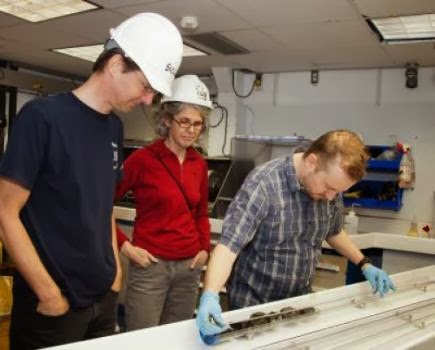
Dr. Beth Orcutt (front, second from left) of Bigelow Laboratory for Ocean Sciences examines oceanic crust samples with Dr. Wolfgang Bach of the University of Bremen, Germany, during IODP Expedition 336 to the Mid-Atlantic Ridge flank. (Credit: Photo courtesy of Jennifer T. Magnusson.)

Although long thought to be devoid of life, the bottom of the deep ocean is now known to harbor entire ecosystems teeming with microbes. Scientists have recently documented that oxygen is disappearing from seawater circulating through deep oceanic crust, a significant first step in understanding the way life in the “deep biosphere” beneath the sea floor is able to survive and thrive. The new research findings were published in the journal Nature Communications on September 27, 2013, and are helping to redefine our concepts of the limits of life on our planet.

A team of researchers led by Dr. Beth Orcutt of the Bigelow Laboratory for Ocean Sciences used the JOIDES Resolution, a sophisticated 470-foot scientific drilling vessel operated by the international Integrated Ocean Drilling Program (IODP), to sample the muddy and sandy sediments that blanket the rocks on the seafloor, as well as drill into the hard crustal rocks themselves — considered by many to be the largest reservoir of life on Earth — in order to understand how microbes can “breathe” and get the energy necessary to live in this remote environment.

The team measured oxygen concentrations in sediment cores collected above the rocky oceanic crust, almost three miles below the sea surface, on the western edge of the remote Mid-Atlantic Ridge. These measurements then allowed the researchers to determine oxygen concentration in seawater circulating in the rocks of the oceanic crust itself.

“Our computer models showed that the crustal oxygen concentrations in the region were most likely the result of microbial life forms scavenging oxygen in the crust as seawater moves through fractures and cracks deep in the rocks,” said Orcutt. “Under the cold conditions of the crust in this area, purely chemical oxygen consumption is minimal, which suggests that microbes in the oceanic crust are responsible for using the oxygen that’s down there.”

“We know there’s a vast reservoir of life in the ocean crust, but unless we take steps to quantify its metabolism, we’ll never know how vast it is,” said co-author Dr. Sam Hulme, from Moss Landing Marine Laboratories.

Another co-author of the paper, Dr. Geoff Wheat of the University of Alaska Fairbanks, pointed out that chemical composition of seawater within pore spaces between sediment grains provides important information about what reactions occur there and how fast they happen. “This result sets the stage for more directed experiments to understand how microbes use the oxygen for growth in a place with little food,” Wheat said.

“One of the biggest goals of the international scientific ocean drilling research community is to understand how life functions in the vast ‘deep biosphere’ buried alive below the seafloor, but it’s very challenging to access and explore the hard rocks that make up the base of the seafloor,” Orcutt added. “Our results are the first to document the removal of oxygen in the rocky crustal environment — something that had been expected but not shown until now. With this information, we can start to unravel the complex mystery of life below the seafloor.”

“Detecting life by measuring oxygen in subseafloor environments with vigorous seawater flow is not an easy task,” agreed Dr. Wolfgang Bach, a scientist at the University of Bremen in Germany, and another coauthor of the paper. “Imagine an extraterrestrial life-detection task force landing on Earth with oxygen probes as the only life-detection tool. If they ended up in a well-ventilated meeting room stuffed with delegates, they’d conclude from the measurements they’d be making that respiration was minimal, hence life is slow, if not absent. Doing these measurements in an environment where we think we know the direction of flow of seawater and detecting a gradient in oxygen makes all the difference in making inferences about subseafloor life.”

“Tiny microbial life on Earth is responsible for big tasks like global chemical cycling. In order to understand how important elements like oxygen — which we all need to breathe — move around Earth, we need to understand how quickly it is consumed in the largest aquifer on Earth, oceanic crust,” said Orcutt.

Note : The above story is based on materials provided by Bigelow Laboratory for Ocean Sciences. 

Late Cretaceous Period Was Likely Ice-Free

In the study, MacLeod examined fossils of organisms that lived 90 million years ago. This photo is an image from a Scanning electron microscope of a planktic (left) and benthic (right) foraminifera from Tanzania. Both shells are less than 0.5 millimeters across. (Credit: University of Missouri)

For years, scientists have thought that a continental ice sheet formed during the Late Cretaceous Period more than 90 million years ago when the climate was much warmer than it is today. Now, a University of Missouri researcher has found evidence suggesting that no ice sheet formed at this time. This finding could help environmentalists and scientists predict what Earth’s climate will be as carbon dioxide levels continue to rise.

“Currently, carbon dioxide levels are just above 400 parts per million (ppm), up approximately 120 ppm in the last 150 years and rising about 2 ppm each year,” said Ken MacLeod, a professor of geological sciences at MU. “In our study, we found that during the Late Cretaceous Period, when carbon dioxide levels were around 1,000 ppm, there were no continental ice sheets on earth. So, if carbon dioxide levels continue to rise, the Earth will be ice-free once the climate comes into balance with the higher levels.”

In his study, MacLeod analyzed the fossilized shells of 90 million-year-old planktic and benthic foraminifera, single-celled organisms about the size of a grain of salt. Measuring the ratios of different isotopes of oxygen and carbon in the fossils gives scientists information about past temperatures and other environmental conditions. The fossils, which were found in Tanzania, showed no evidence of cooling or changes in local water chemistry that would have been expected if a glacial event had occurred during that time period.

“We know that the carbon dioxide (CO2) levels are rising currently and are at the highest they have been in millions of years. We have records of how conditions have changed as CO2 levels have risen from 280 to 400 ppm, but I believe it also is important to know what could happen when those levels reach 600 to 1000 ppm,” MacLeod said. “At the rate that carbon dioxide levels are rising, we will reach 600 ppm around the end of this century. At that level of CO2, will ice sheets on Greenland and Antarctica be stable? If not, how will their melting affect the planet?”

Previously, many scientists have thought that doubling CO2 levels would cause earth’s temperature to increase as much as 3 degrees Celsius, or approximately 6 degrees Fahrenheit. However, the temperatures MacLeod believes existed in Tanzania 90 million years ago are more consistent with predictions that a doubling of CO2 levels would cause Earth’s temperature could rise an average of 6 degrees Celsius, or approximately 11 degrees Fahrenheit.

“While studying the past can help us predict the future, other challenges with modern warming still exist,” MacLeod said. “The Late Cretaceous climate was very warm, but the Earth adjusted as changes occurred over millions of years. We’re seeing the same size changes, but they are happening over a couple of hundred years, maybe 10,000 times faster. How that affects the equation is a big and difficult question.”

MacLeod’s study was published in the October issue of the journal Geology.

Note : The above story is based on materials provided by University of Missouri-Columbia.

Ancient Soils Reveal Clues to Early Life On Earth

Some of the rocks that Crowe and his colleagues studied. (Credit: Nic Beukes)

Oxygen appeared in the atmosphere up to 700 million years earlier than we previously thought, according to research published today in the journal Nature, raising new questions about the evolution of early life.

Researchers from the University of Copenhagen and University of British Columbia examined the chemical composition of three-billion-year-old soils from South Africa — the oldest soils on Earth — and found evidence for low concentrations of atmospheric oxygen. Previous research indicated that oxygen began accumulating in the atmosphere only about 2.3 billion years ago during a dynamic period in Earth’s history referred to as the Great Oxygenation Event.

“We’ve always known that oxygen production by photosynthesis led to the eventual oxygenation of the atmosphere and the evolution of aerobic life,” says Sean Crowe, co-lead author of the study and an assistant professor in the Departments of Microbiology and Immunology, and Earth, Ocean and Atmospheric Sciences at UBC.

“This study now suggests that the process began very early in Earth’s history, supporting a much greater antiquity for oxygen producing photosynthesis and aerobic life,” says Crowe, who conducted the research while a post-doctoral fellow at Nordic Center for Earth Evolution at the University of Southern Denmark in partnership with the centre’s director Donald Canfield.

There was no oxygen in the atmosphere for at least hundreds of millions of years after Earth formed. Today, Earth’s atmosphere is 20 per cent oxygen thanks to photosynthetic bacteria that, like trees and other plants, consume carbon dioxide and release oxygen. The bacteria laid the foundation for oxygen breathing organisms to evolve and inhabit the planet.

“These findings imply that it took a very long time for geological and biological processes to conspire and produce the oxygen rich atmosphere we now enjoy,” says Lasse Døssing, the other lead scientist on the study, from the University of Copenhagen.

Note : The above story is based on materials provided by University of British Columbia. 

Formation of Unusual Ring of Radiation Around Earth Explained

Ring-formation between belts: Model showing third radiation ring (red). Recent observations by NASA’s Van Allen Probes mission showed an event in which three radiation zones were observed at extremely high energies, including an unusual medium narrow ring (red) that existed for approximately four weeks. The modeling results, displayed in this illustration, revealed that for particles at these high energies, different physical processes are responsible for the acceleration and loss of electrons in the radiation belts, which explains the formation of the unusual long-lived ring between the belts. The discovery will help protect satellites form the harmful radiation in space, UCLA scientists report. (Credit: Yuri Shprits, Adam Kellerman, Dmitri Subbotin/UCLA)

Since the discovery of the Van Allen radiation belts in 1958, space scientists have believed these belts encircling Earth consist of two doughnut-shaped rings of highly charged particles — an inner ring of high-energy electrons and energetic positive ions and an outer ring of high-energy electrons.

 In February of this year, a team of scientists reported the surprising discovery of a previously unknown third radiation ring — a narrow one that briefly appeared between the inner and outer rings in September 2012 and persisted for a month.

In new research, UCLA space scientists have successfully modeled and explained the unprecedented behavior of this third ring, showing that the extremely energetic particles that made up this ring, known as ultra-relativistic electrons, are driven by very different physics than typically observed Van Allen radiation belt particles. The region the belts occupy — ranging from about 1,000 to 50,000 kilometers above Earth’s surface — is filled with electrons so energetic they move close to the speed of light.

“In the past, scientists thought that all the electrons in the radiation belts around the Earth obeyed the same physics,” said Yuri Shprits, a research geophysicist with the UCLA Department of Earth and Space Sciences. “We are finding now that radiation belts consist of different populations that are driven by very different physical processes.”

Shprits, who is also an associate professor at Russia’s Skolkovo Institute of Science and Technology, a new university co-organized by MIT, led the study, which is published Sept. 22 in the journal Nature Physics.

The Van Allen belts can pose a severe danger to satellites and spacecraft, with hazards ranging from minor anomalies to the complete failure of critical satellites. A better understanding of the radiation in space is instrumental to protecting people and equipment, Shprits said.

Ultra-relativistic electrons — which made up the third ring and are present in both the outer and inner belts — are especially hazardous and can penetrate through the shielding of the most protected and most valuable satellites in space, noted Shprits and Adam Kellerman, a staff research associate in Shprits’ group.

“Their velocity is very close to the speed of light, and the energy of their motion is several times larger than the energy contained in their mass when they are at rest,” Kellerman said. “The distinction between the behavior of the ultra-relativistic electrons and those at lower energies was key to this study.” Shprits and his team found that on Sept. 1, 2012, plasma waves produced by ions that do not typically affect energetic electrons “whipped out ultra-relativistic electrons in the outer belt almost down to the inner edge of the outer belt.” Only a narrow ring of ultra-relativistic electrons survived this storm. This remnant formed the third ring.

After the storm, a cold bubble of plasma around Earth expanded to protect the particles in the narrow ring from ion waves, allowing the ring to persist. Shprits’ group also found that very low-frequency electromagnetic pulsations that were thought to be dominant in accelerating and losing radiation belt electrons did not influence the ultra-relativistic electrons.

The Van Allen radiation belts “can no longer be considered as one consistent mass of electrons. They behave according to their energies and react in various ways to the disturbances in space,” said Shprits, who was honored by President Obama last July with a Presidential Early Career Award for Scientists and Engineers.

“Ultra-relativistic particles move very fast and cannot be at the right frequency with waves when they are close to the equatorial plane,” said Ksenia Orlova, a UCLA postdoctoral scholar in Shprits’ group who is funded by NASA’s Jack Eddy Fellowship. “This is the main reason the acceleration and scattering into the atmosphere of ultra-relativistic electrons by these waves is less efficient.”

“This study shows that completely different populations of particles exist in space that change on different timescales, are driven by different physics and show very different spatial structures,” Shprits said.

The team performed simulations with a model of Earth’s radiation belts for the period from late August 2012 to early October 2012. The simulation, conducted using the physics of ultra-relativistic electrons and space weather conditions monitored by ground stations, matched the observations from NASA’s Van Allen Probes mission extraordinarily well, confirming the team’s theory about the new ring.

“We have a remarkable agreement between our model and observations, both encompassing a wide range of energies,” said Dmitriy Subbotin, a former graduate student of Shprits and current UCLA staff research associate.

“I believe that, with this study, we have uncovered the tip of the iceberg,” Shprits said. “We still need to fully understand how these electrons are accelerated, where they originate and how the dynamics of the belts is different for different storms.”

Earth’s radiation belts were discovered in 1958 by Explorer I, the first U.S. satellite that traveled to space.

Note : The above story is based on materials provided by University of California – Los Angeles.

Related Articles