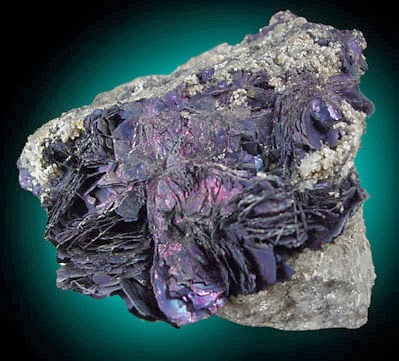
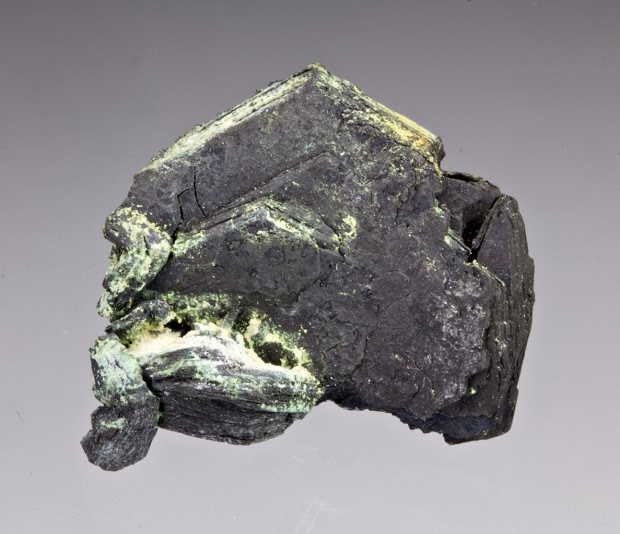
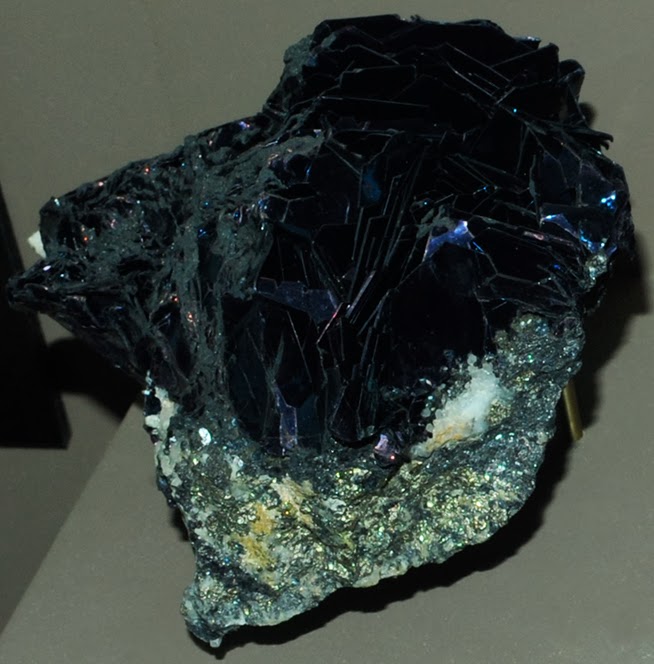
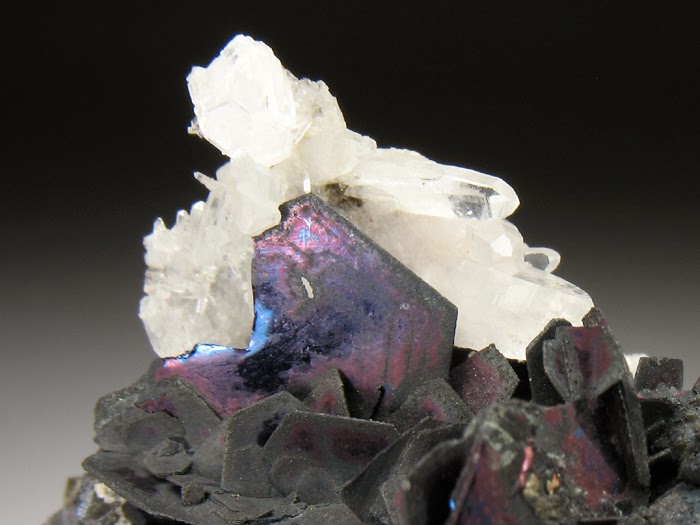
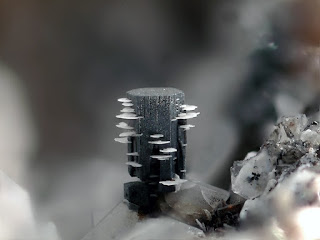
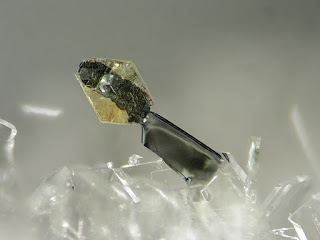
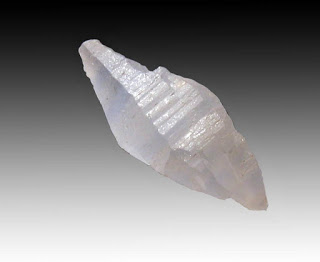
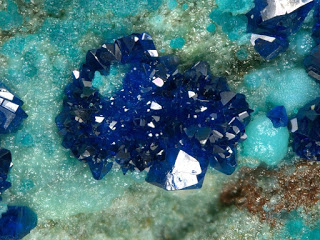
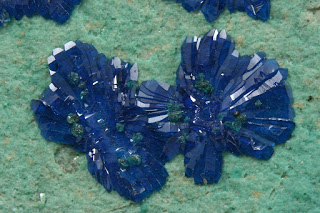
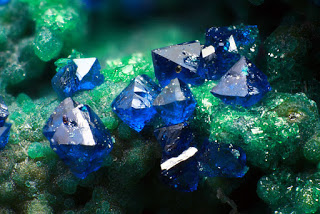
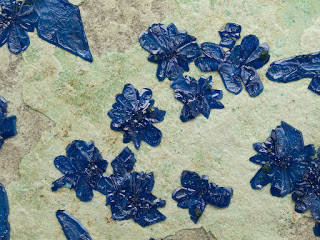
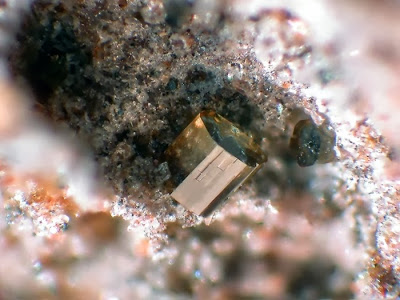
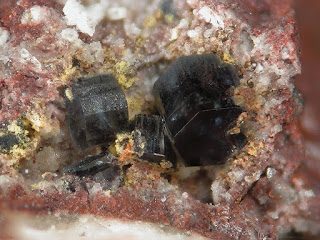
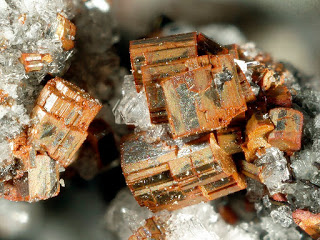
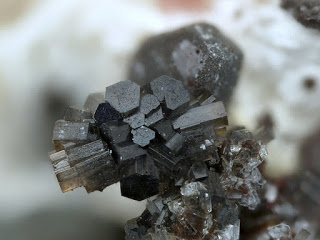
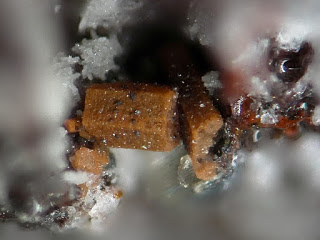
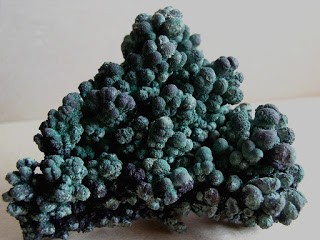
Chemical Formula: CuS Locality: Monte Somma, Vesuvius, Naples, Naples province, Campania, Italy. Name Origin: Named after the Italian mineralogist, N. Covelli (1790-1829).
Covellite (also known as covelline) is a rare copper sulfide mineral with the formula CuS. This indigo blue mineral is ubiquitous in copper ores, it is found in limited abundance and is not an important ore of copper itself, although it is well known to mineral collectors.
The mineral is associated with chalcocite in zones of secondary enrichment (supergene) of copper sulfide deposits. Commonly found with and as coatings on chalcocite, chalcopyrite, bornite, enargite, pyrite, and other sulfides, it often occurs as pseudomorphic replacements after other minerals. Despite the very rare occurrence as a volcanic sublimate, the initial description was at Mount Vesuvius by Nicola Covelli (1790–1829).
Physical Properties
Cleavage: {0001} Perfect Color: Indigo blue, Light blue, Dark blue, Black. Density: 4.6 – 4.76, Average = 4.68 Diaphaneity: Opaque Fracture: Brittle – Generally displayed by glasses and most non-metallic minerals. Hardness: 1.5-2 – Talc-Gypsum Luminescence: Non-fluorescent. Luster: Metallic Magnetism: Nonmagnetic Streak: black gray
Photos :
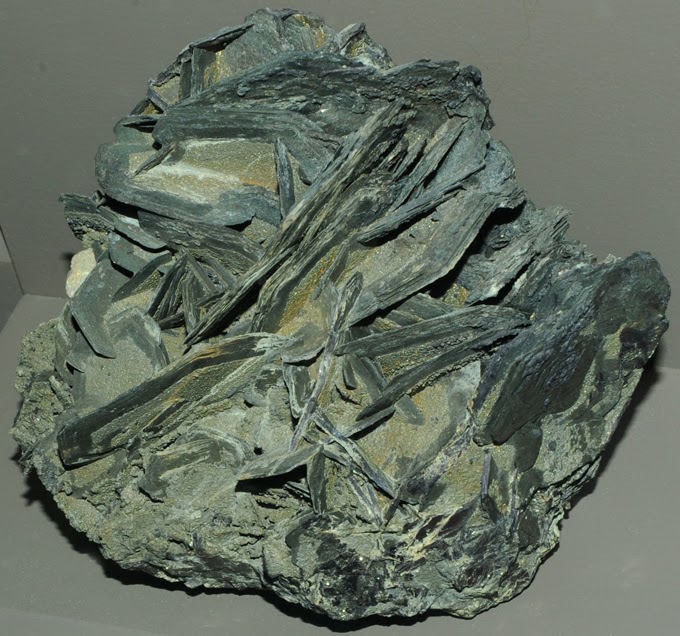
Chalcocite after Covellite – Butte District, Silver Bow Co., Montana, USA Size: 3.0 x 2.5 x 1.0 cmThese samples of covellite are displayed in the Smithsonian Museum of Natural History. The sample is about 18 cm across and is from Leonard mine, Butte, Montana.COVELLITEEast Colusa Mine, Butte, Silver Bow Co., Montana, USA, North America Size: 4 x 3 x 2.3 cm (Miniature)These samples of covellite are displayed in the Smithsonian Museum of Natural History. This covellite sample is from Sardegna, Italy. It is about 18 cm across.
This undated handout photo taken in Lhonga Leupung, Aceh province, shows a cave that scientists found layers of sandy sediment, which had been washed in by tsunamis over thousands of years
Scientists said Friday they have discovered a cave on the Indonesian island of Sumatra that provides a “stunning” record of Indian Ocean tsunamis over thousands of years.They say layers of tsunami-borne sediments found in the cave in northwest Sumatra suggest the biggest destructive waves do not occur at set intervals—meaning communities in the area should be prepared at all times for a tsunami.
“It’s something that communities need to know,” research team leader Charles Rubin told AFP, adding that the team wanted to “promote safety of coastal communities”.
Professor Rubin and other researchers from a Singapore institute were working with scientists from an Indonesian university when they discovered the cave, south of Banda Aceh, the capital of Aceh province.
A quake-triggered tsunami devastated Aceh and areas across the Indian Ocean in 2004, leaving some 170,000 people dead in the province alone.
Inside the cave the researchers found layers of sandy sediment, which had been washed in by tsunamis thousands of years previously, Rubin said.
The layers, which contained small fossils from the seabed, were well-preserved and separated by droppings deposited by bats in the cave, he added.
“This is a beautiful, stunning record of tsunamis that you just don’t have very often,” Rubin said.
Only huge tsunamis and storm surges can get into the cave, which has a raised entrance—and afterwards the sediment is protected inside from erosion by wind or water.
Rubin said the scientists dated the layers and believe they show that between 2,800 and 3,300 years ago, some four to five tsunamis battered the area.
Before the 2004 tsunami, it had been hundreds of years since such a huge destructive wave had hit Aceh, the scientist said.
But he said the new discovery suggests that tsunamis are not evenly spaced through time, which should provide food for thought for those involved in policy and planning in the region.
“These don’t happen like clockwork, they have variations in time and variations in size,” he said.
Rubin works at the Earth Observatory of Singapore, an institute that forms part of Nanyang Technological University.
Scientists from the institute were working with researchers from Syiah Kuala University in Banda Aceh.
Note : The above story is based on materials provided by AFP
Chemical Formula: Al2O3 Locality: Tchainit and Yakutia, Russia. Name Origin: Probably derived from the Sanskrit, kuruvinda, meaning “ruby.”
Corundum is a crystalline form of aluminium oxide (Al2O3) typically containing traces of iron, titanium, vanadium and chromium. It is a rock-forming mineral. It is one of the naturally transparent materials, but can have different colors when impurities are present. Transparent specimens are used as gems, called ruby if red and padparadscha if pink-orange. All other colors are called sapphire, e.g., “green sapphire” for a green specimen.
The name “corundum” is derived from the Tamil word Kuruvindam or Sanskrit word Kuruvinda meaning ruby.Because of corundum’s hardness (pure corundum is defined to have 9.0 Mohs), it can scratch almost every other mineral. It is commonly used as an abrasive on everything from sandpaper to large machines used in machining metals, plastics, and wood. Some emery is a mix of corundum and other substances, and the mix is less abrasive, with an average Mohs hardness of 8.0.In addition to its hardness, corundum is unusual for its density of 4.02 g/cm3, which is very high for a transparent mineral composed of the low-atomic mass elements aluminium and oxygen.
Physical Properties
Cleavage: None Color: Blue, Red, Yellow, Brown, Gray. Density: 4 – 4.1, Average = 4.05 Diaphaneity: Transparent to translucent Fracture: Tough – Difficult to break apart as shown by fibrous minerals and most metals. Hardness: 9 – Corundum Luminescence: Sometimes Fluorescent, Long UV=red. Luster: Vitreous (Glassy) Magnetism: Nonmagnetic Streak: none
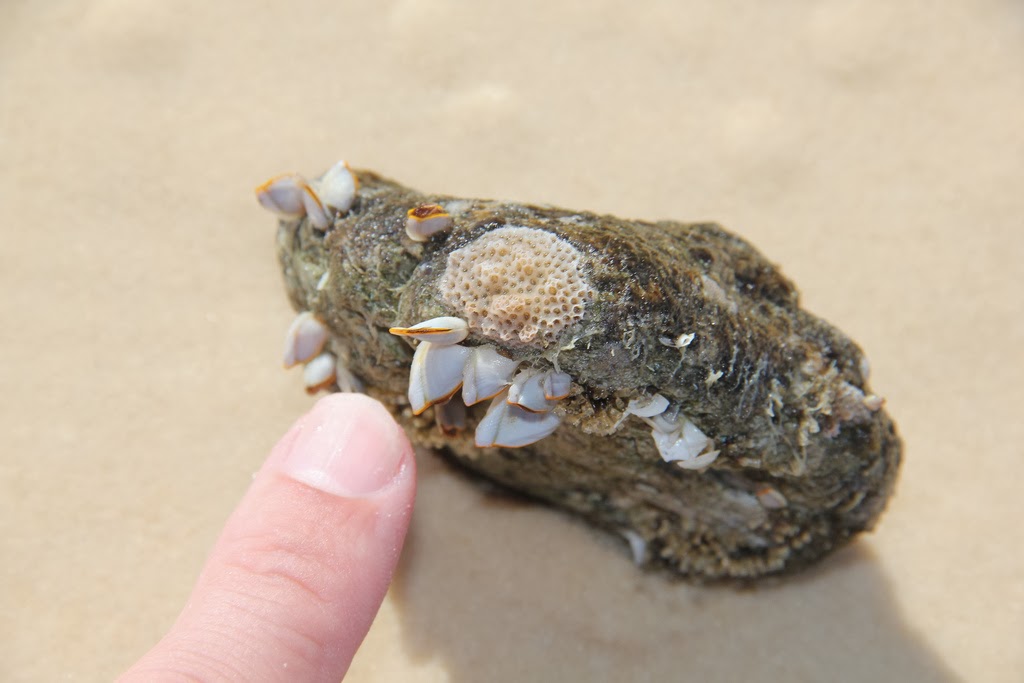
Pieces of pumice from the same volcanic eruption that caused the largest pumice raft seen in 50 years have continued to wash up on Queensland shores this week.The pumice was a result of the eruption of an underwater volcano known as Havre Seamount, 1000 km north of Auckland in July 2012. Dr Scott Bryan from QUT’s Science and Engineering Faculty has been collecting and studying the pumice since a raft of the porous volcanic rock was first spotted by a passenger while flying from Samoa to New Zealand two weeks after the eruption.
Pieces of pumice from the same volcanic eruption that caused the largest pumice raft seen in 50 years have continued to wash up on Queensland shores this week.The pumice was a result of the eruption of an underwater volcano known as Havre Seamount, 1000 km north of Auckland in July 2012.
Dr Scott Bryan from QUT’s Science and Engineering Faculty has been collecting and studying the pumice since a raft of the porous volcanic rock was first spotted by a passenger while flying from Samoa to New Zealand two weeks after the eruption.
“This volcano was discovered only a few years ago and so little is known about it,” he said.
“The summit sits about 700 m below sea level so it would have taken quite a lot of power to force the pumice up to the surface of the ocean. We are also looking at how big these pieces of pumice are and the amount that we are seeing washing up gives us an idea of the magnitude of the eruption.”
Since the discovery of the pumice raft, which was also seen early on via satellite imagery, pieces of the rock have washed up in New Zealand, Tonga, Fiji and along the eastern seaboard of Australia from as far north as the Torres Strait to Victoria. The most recent finds have been in South East Queensland, Townsville and the Whitsundays.
“It’s not unusual for pumice rafts to wash onto shore for up to a year after the first strandings which were in March this year,” Dr Bryan said.
“The pumice is essentially the only record we have of the eruption. It can help us to understand more about the nature of the volcano as well as how these volcanoes erupt explosively under so much water.”
While finding a piece of volcanic history on the beach is fun, Dr Bryan said the pumice does pose a safety issue for boats.
“The pumice can be a navigational hazard,” he said.
“We have had reports of it blocking and damaging water intakes for engine cooling systems on boats, which have had to be replaced, and so it can have a significant financial impact as well.”
Note : The above story is based on materials provided by Queensland University of Technology
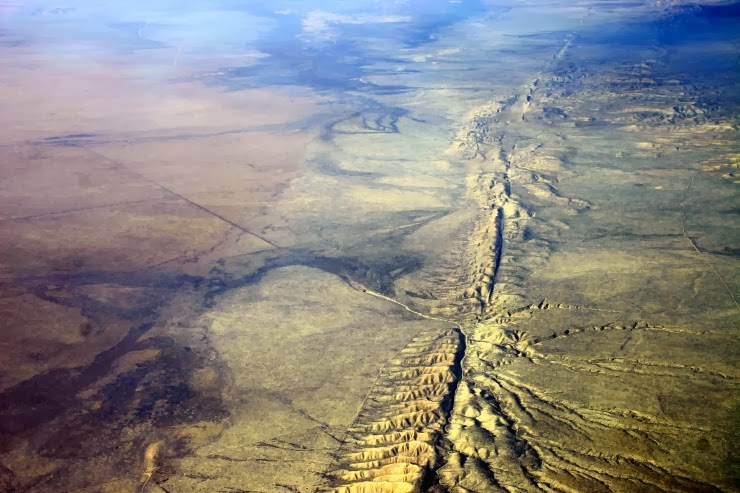
Aerial photo of the San Andreas Fault in the Carrizo Plain, northwest of Los Angeles. Credit: Wikipedia.
Several geologists from around the world are presenting a case for missing or underreported earthquakes at this year’s American Geophysical Union Fall meeting being held in San Francisco. They suggest that faulty or missing data from before 1900 might be leading to underestimations of the numbers of big quakes to expect in the future.
One such speaker is Susan Hough—she’s with the US Geological Survey. She reported to those in attendance that prior to the invention and implementation of seismometers, evidence of earthquakes could be found only through earlier anecdotal writings. But such records, she notes, tended to underestimate the size of the quakes being described. Suddenly, she says, after 1900, earthquakes started getting bigger.
They didn’t get bigger of course, what she meant was that the size perception of earlier earthquakes had been underestimated—many might not be in the historical record at all. Part of the problem, she explained, was that until fairly recently, it was believed that all earthquakes of a certain large size, produced tsunami’s, which of course tend to show up in written records.
The problem with relying on underestimated data, she also explained, is that it causes modern day planners to underestimate what is likely to happen in the future. She notes that one example was that of the Kamchatka quake that occurred in 1841 in Russia. The record shows it to have been an 8.3 magnitude quake, but closer scrutiny suggests that estimate was wrong—reports of a tsunami in Hawaii at the time, indicate it was almost certainly much stronger, perhaps as high as magnitude 9.2.
Roger Musson of the British Geological Survey concurred, noting that people were taken almost completely by surprise when the Fukushima quake struck in 2011. But, looking back, it’s clear that one almost exactly like it struck in the same place back in the 9th century. He noted virtually the same thing can be said for the Haiti quake that struck in 2010.
The overall point the geologists are trying to make is that it’s likely that the reported numbers and sizes of quakes described in the past are in error, and thus, using them as guides for the future is both risky and ill-advised as the lives of people in many at-risk areas may be depending on more accurate assessments.
Note : The above story is based on materials provided by Phys org
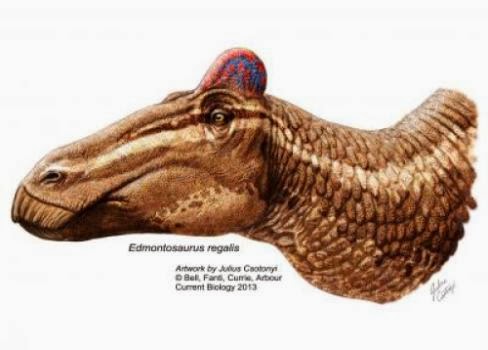
This is an Edmontosaurus regalis reconstruction. Credit: Bell, Fanti, Currie, Arbour, Current Biology
A rare, mummified specimen of the duck-billed dinosaur Edmontosauraus regalis described in the Cell Press journal Current Biology on December 12 shows for the first time that those dinosaurs’ heads were adorned with a fleshy comb, most similar to the roosters’ red crest.
The most common dinosaurs in North America between 75 and 65 million years ago, duck-billed dinosaurs were gentle giants, about 12 meters long, and filled the same ecological role that kangaroos or deer play today. But no one had suspected that they — or other dinosaurs, for that matter — had fleshy structures on the tops of their heads.
“Until now, there has been no evidence for bizarre soft-tissue display structures among dinosaurs; these findings dramatically alter our perception of the appearance and behavior of this well-known dinosaur and allow us to comment on the evolution of head crests in this group,” says Phil Bell from Australia’s University of New England. “It also raises the thought-provoking possibility of similar crests among other dinosaurs.”
The dinosaur specimen in question was found in deposits west of the city of Grande Prairie in west-central Alberta, Canada. Bell, along with Federico Fanti from the University of Bologna, Italy, knew they had something special when they found skin impressions on parts of the mummified body. But it wasn’t until Bell put a chisel through the top of the crest that he realized they really had something incredible.
“An elephant’s trunk or a rooster’s crest might never fossilize because there’s no bone in them,” Bell explains. “This is equivalent to discovering for the first time that elephants had trunks. We have lots of skulls of Edmontosaurus, but there are no clues on them that suggest they might have had a big fleshy crest. There’s no reason that other strange fleshy structures couldn’t have been present on a whole range of other dinosaurs, including T. rex or Triceratops.”
Of course, it’s hard to tell what that cocks comb might have done for the duck-billed dinosaurs. In roosters and some other birds, bright red crests are a way to get the girls. “We might imagine a pair of male Edmontosaurus sizing each other up, bellowing, and showing off their head gear to see who was the dominant male and who is in charge of the herd,” Bell says.
We may never know exactly, but the new study is a useful reminder of just how bizarre and amazing dinosaurs really were, the researchers say. There is much left to discover.
Note : The above story is based on materials provided by Cell Press, via EurekAlert!, a service of AAAS.
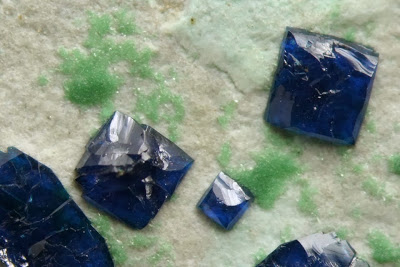
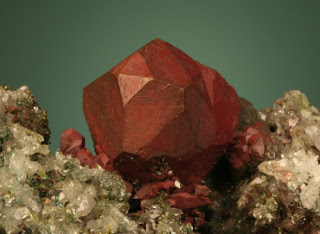
Chemical Formula: Cu3(PO4)(OH)3 Locality: Star of the Congo mine, near Lubumbashi, and at the Kalabi and Lukini mines, Katanga Province, Congo (Shaba Province, Zaire). Name Origin: Named for Jules Cornet (1865-1929), Belgian geologist.
Cornetite is a rare secondary copper mineral that is noted for its deep blue, green-blue to green color. It is found in highly weathered, oxidation zones of copper sulfide ore bodies. It has a good deep color, nice crystal forms and an attractive sparkle, all the ingredients for a popular collection mineral.
Physical Properties of Cornetite
Color: dark blue, green-blue to green. Luster: vitreous. Transparency: Specimens are translucent. Crystal System: orthorhombic; 2/m2/m2/m Crystal Habits: include crystals that are short, rounded, nearly diamond-shaped prisms that are terminated by a dome with trapezohedral faces, also as tiny crystalline druzes, fibrous masses and crusts. Cleavage: absent. Fracture: uneven. Hardness: 4.5 Specific Gravity : approximately 4.1 (above average for translucent minerals) Streak: blue.
Researchers from the University of Southampton and the Australian National University report that sea-level rise since the industrial revolution has been fast by natural standards and — at current rates — may reach 80cm above the modern level by 2100 and 2.5 metres by 2200.
The team used geological evidence of the past few million years to derive a background pattern of natural sea-level rise. This was compared with historical tide-gauge and satellite observations of sea-level change for the ‘global warming’ period, since the industrial revolution. The study, which was funded by the Natural Environment Research Council (iGlass consortium) and Australian Research Council (Laureate Fellowship), is published in the journal Scientific Reports.
Lead author Professor Eelco Rohling, from the Australian National University and formerly of the University of Southampton, says: “Our natural background pattern from geological evidence should not be confused with a model-based prediction. It instead uses data to illustrate how fast sea level might change if only normal, natural processes were at work. There is no speculation about any new mechanisms that might develop due to human-made global warming. Put simply, we consider purely what nature has done before, and therefore could do again.”
Co-author Dr Gavin Foster, a Reader in Ocean and Earth Science at the University of Southampton, who is based at the National Oceanography Centre, Southampton (NOCS), explains: “Geological data showed that sea level would likely rise by nine metres or more as the climate system adjusts to today’s greenhouse effect. But the timescale for this was unclear. So we studied past rates and timescales of sea-level rise, and used these to determine the natural background pattern.”
Co-author Dr Ivan Haigh, lecturer in coastal oceanography at the University of Southampton and also based at NOCS, adds: “Historical observations show a rising sea level from about 1800 as sea water warmed up and melt water from glaciers and ice fields flowed into the oceans. Around 2000, sea level was rising by about three mm per year. That may sound slow, but it produces a significant change over time.”
The natural background pattern allowed the team to see whether recent sea-level changes are exceptional or within the normal range, and whether they are faster, equal, or slower than natural changes.
Professor Rohling concludes: “For the first time, we can see that the modern sea-level rise is quite fast by natural standards. Based on our natural background pattern, only about half the observed sea-level rise would be expected.
“Although fast, the observed rise still is (just) within the ‘natural range’. While we are within this range, our current understanding of ice-mass loss is adequate. Continued monitoring of future sea-level rise will show if and when it goes outside the natural range. If that happens, then this means that our current understanding falls short, potentially with severe consequences.”
Note : The above story is based on materials provided by University of Southampton.
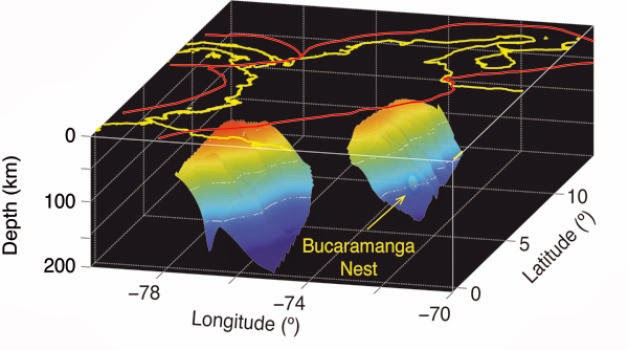
A 3D rendering of the tectonic plates (multicolored regions) in northern South America (coastline shown in yellow) shows the underlying Bucaramanga Nest, which experiences more intermediate-depth earthquakes than any place in the world. (Credit: Image courtesy of German Prieto)
Stanford researchers have uncovered a vital clue about the mechanism behind a type of earthquake that originates deep within Earth and accounts for a quarter of all temblors worldwide, some of which are strong enough to pose a safety hazard.
Stanford scientists may have solved the mystery of what drives a type of earthquake that occurs deep within Earth and accounts for one in four quakes worldwide.
Known as intermediate-depth earthquakes, these temblors originate farther down inside Earth than shallow earthquakes, which take place in the uppermost layer of Earth’s surface, called the crust. The kinds of quakes that afflict California and most other places in the world are shallow earthquakes.
“Intermediate-depth earthquakes occur at depths of about 30 miles down to about 190 miles,” said Greg Beroza, a professor of geophysics at Stanford and a coauthor of a new study that will be published in an upcoming issue of the journal Geophysical Research Letters.
Unlike shallow earthquakes, the cause of intermediate quakes is not well-understood. Part of the problem is that the mechanism for shallow earthquakes should not physically work for quakes at greater depths.
“Shallow earthquakes occur when stress building up at faults overcomes friction, resulting in sudden slip and energy release,” Beroza said. “That mechanism shouldn’t work at the higher pressures and temperatures at which intermediate depth earthquakes occur.”
A better understanding of intermediate-depth quakes could help scientists forecast where they will occur and the risk they pose to buildings and people.
“They represent 25 percent of the catalog of earthquakes, and some of them are large enough to produce damage and deaths,” said study first author Germán Prieto, an assistant professor of geophysics at the Massachusetts Institute of Technology.
A tale of two theories
There are two main hypotheses for what may be driving intermediate depth earthquakes. According to one idea, water is squeezed out of rock pores at extreme depths and the liquid acts like a lubricant to facilitate fault sliding. This fits with the finding that intermediate quakes generally occur at sites where one tectonic plate is sliding, or subducting, beneath another.
A competing idea is that as rocks at extreme depths deform, they generate heat due to friction. The heated rocks become more malleable, or plastic, and as a result slide more easily against each other. This can create a positive feedback loop that further weakens the rock and increases the likelihood of fault slippage.
“It’s a runaway process in which the increasing heat generates more slip, and more slip generates more heat and so on,” Prieto said.
To distinguish between the two possible mechanisms, the scientists studied a site near the city of Bucaramanga in Colombia that boasts the highest concentration of intermediate quakes in the world. About 18 intermediate depth temblors rattle Bucaramanga every day. Most are magnitude 2 to 3, weak quakes that are detectable only by sensitive instruments.
But about once a month one occurs that is magnitude 5 or greater — strong enough to be felt by the city’s residents. Moreover, past studies have revealed that most of the quakes appear to be concentrated at a site located about 90 miles beneath Earth’s surface that scientists call the Bucaramanga Nest.
A natural laboratory
This type of clustering is highly unusual and makes the Bucaramanga Nest a “natural laboratory” for studying intermediate depth earthquakes. Comparison studies of intermediate quakes from different parts of the world are difficult because the makeup of Earth’s crust and mantle can vary widely by location.
In the Bucaramanga Nest, however, the intermediate quakes are so closely packed together that for the purposes of scientific studies and computer models, it’s as if they all occurred at the same spot. This vastly simplifies calculations, Beroza said.
“When comparing a magnitude 2 and a magnitude 5 intermediate depth earthquake that are far apart, you have to model everything, including differences in the makeup of the Earth’s surface,” he said. “But if they’re close together, you can assume that the seismic waves of both quakes suffered the same distortions as they traveled toward the Earth’s surface.”
By studying seismic waves picked up by digital seismometers installed on Earth’s surface above the Bucaramanga Nest, the scientists were able to measure two key parameters of the intermediate quakes happening deep underground.
One, called the stress drop, allowed the team to estimate the total amount of energy released during the fault slips that caused the earthquakes. The other was radiated energy, which is a measure of how much of the energy generated by the fault slip is actually converted to seismic waves that propagate through Earth to shake the surface.
Two things immediately stood out to the researchers. One was that the stress drop for intermediate quakes increased along with their magnitudes. That is, larger intermediate quakes released proportionally more total energy than smaller ones. Second, the amount of radiated energy released by intermediate earthquakes accounted for only a tiny portion of the total energy as calculated by the stress drop.
“For these intermediate-depth earthquakes in Colombia, the amount of energy converted to seismic waves is only a small fraction of the total energy,” Beroza said.
The implication is that intermediate earthquakes are expending most of their energy locally, likely in the form of heat.
“This is compelling evidence for a thermal runaway failure mechanism for intermediate earthquakes, in which a slipping fault generates heat. That allows for more slip and even more heat, and a positive feedback loop is created,” said study coauthor Sarah Barrett, a Stanford graduate student in Beroza’s research group.
Note : The above story is based on materials provided by Stanford University. The original article was written by Ker Than.
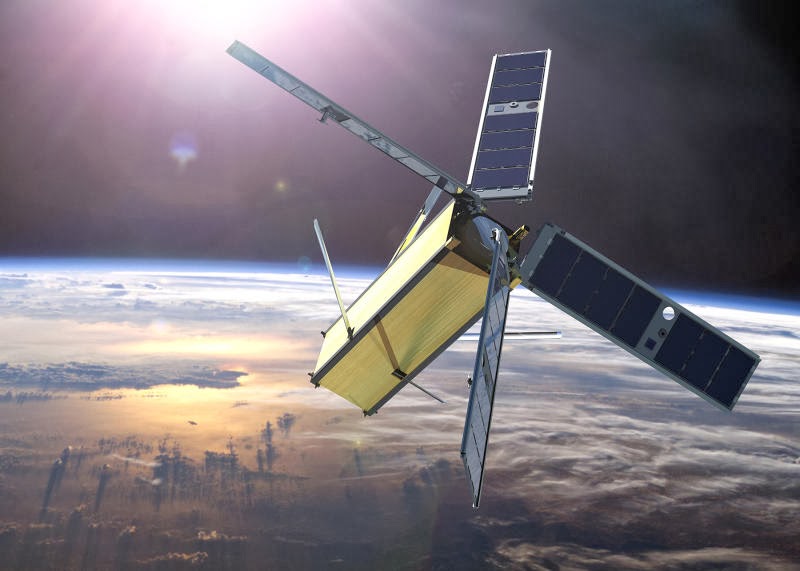
Artist rendering of the Radiometer Assessment using Vertically Aligned Nanotubes (RAVAN) satellite, a new, low-cost cubesat mission led by the Johns Hopkins Applied Physics Laboratory in Laurel, Md. RAVAN will demonstrate technology needed to measure the absolute imbalance in the Earth’s radiation budget for the first time; the cubesat is scheduled for launch in 2015. (Credit: JHU/APL)
A new, low-cost cubesat mission led by the Johns Hopkins Applied Physics Laboratory in Laurel, Md. will demonstrate technology needed to measure the absolute imbalance in Earth’s radiation budget for the first time, giving scientists valuable information to study our climate.
The Radiometer Assessment using Vertically Aligned Nanotubes (RAVAN) satellite, scheduled for launch in 2015, will demonstrate how accurate and wide-ranging measurements of Earth’s outgoing radiation can be made with a remarkably small instrument. The RAVAN team includes partners at Draper Laboratory in Cambridge, Ma.; L-1 Standards and Technology in New Windsor, Md.; and NASA’s Goddard Space Flight Center in Greenbelt, Md.
“Under stable climate conditions, the energy from the sun reaching the top of Earth’s atmosphere and that being reflected or radiated to space are equal,” explains Bill Swartz, an atmospheric scientist at APL and RAVAN principal investigator. “There is substantial evidence that they are not equal, and that difference is known as Earth’s radiation imbalance (ERI). It’s a really small number — a difference thought to be less than one percent — but that imbalance drives the future of climate change. RAVAN will demonstrate how ERI can be unambiguously and affordably quantified from space, enabling a huge leap in our ability to predict the future climate.”
RAVAN will use a small, accurate radiometer, developed at L-1 Standards and Technology and not much larger than a deck of cards, to measure the strength of Earth’s outgoing radiation across the entire spectrum of energy — from the ultraviolet to the far infrared. “ERI is too small to be measured by previous, current, or planned future space assets,” says co-investigator Warren Wiscombe, a climate scientist at Goddard.
The secret to RAVAN’s precise measurements is a “forest” of carbon nanotubes, grown at APL, that serve as the radiometer’s light absorber. “The carbon nanotubes are a very deep black across the energy spectrum, which will let the radiometer gather virtually all the light reflected and emitted from the planet,” says Swartz.
RAVAN represents the first step toward a constellation of cubesats, each no larger than a loaf of bread, that would provide global coverage of Earth’s total outgoing radiation throughout the day and night, and data to answer long-standing questions about Earth’s climate future.
“RAVAN is unique because it’s not only a technology demonstration, but a manufacturing and economic demonstration,” says Draper Laboratory’s Lars Dyrud, RAVAN project lead. “Resolving climate uncertainty and improved prediction of future climate change requires 30 to 40 RAVAN sensors. The cubesat revolution and advanced manufacturing offer the best hope for affordably achieving these urgent goals.” Draper Laboratory is responsible for process engineering for RAVAN, with the goal of ensuring that the instrument design can be manufactured in a cost-effective manner.
RAVAN is the first Earth science cubesat built by APL. It is part of the Lab’s ongoing development and refinement of these small, adaptable and cost-effective platforms for operational use. APL’s first two cubesats carried technology demonstration payloads, and launched Nov. 19, 2013, aboard a Minotaur rocket from Wallops Island. The RAVAN mission is sponsored by NASA’s Earth Science Technology Office, located at Goddard.
Note : The above story is based on materials provided by Johns Hopkins University Applied Physics Laboratory.
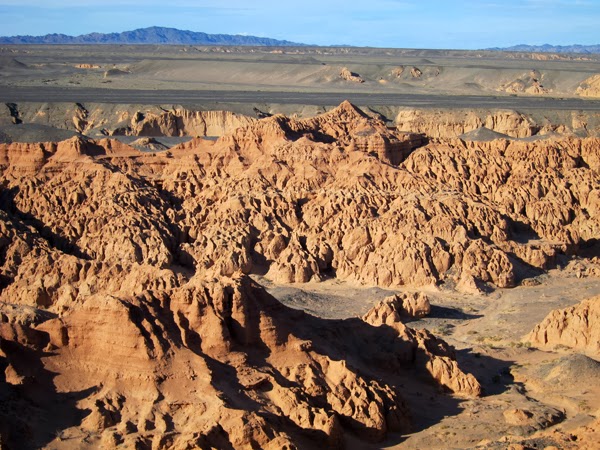
Stanford researchers visited the Nemegt Basin in Mongolia’s Gobi Desert in search of clues to Central Asia’s extreme aridity. Credit: Hari Mix
A record of ancient rainfall teased from long-buried sediments in Mongolia is challenging the popular idea that the arid conditions prevalent in Central Asia today were caused by the ancient uplift of the Himalayas and the Tibetan Plateau.
Instead, Stanford scientists say the formation of two lesser mountain ranges, the Hangay and the Altai, may have been the dominant drivers of climate in the region, leading to the expansion of Asia’s largest desert, the Gobi. The findings will be presented on Thursday, Dec. 12, at the annual meeting of the American Geophysical Union (AGU) in San Francisco.
“These results have major implications for understanding the dominant factors behind modern-day Central Asia’s extremely arid climate and the role of mountain ranges in altering regional climate,” said Page Chamberlain, a professor of environmental Earth system science at Stanford.
Scientists previously thought that the formation of the Himalayan mountain range and the Tibetan plateau around 45 million years ago shaped Asia’s driest environments.
“The traditional explanation has been that the uplift of the Himalayas blocked air from the Indian Ocean from reaching central Asia,” said Jeremy Caves, a doctoral student in Chamberlain’s terrestrial paleoclimate research group who was involved in the study.
This process was thought to have created a distinct rain shadow that led to wetter climates in India and Nepal and drier climates in Central Asia. Similarly, the elevation of the Tibetan Plateau was thought to have triggered an atmospheric process called subsidence, in which a mass of air heated by a high elevation slowly sinks into Central Asia.
“The falling air suppresses convective systems such as thunderstorms, and the result is you get really dry environments,” Caves said.
This long-accepted model of how Central Asia’s arid environments were created mostly ignores, however, the existence of the Altai and Hangay, two northern mountain ranges.
Searching for answers
To investigate the effects of the smaller ranges on the regional climate, Caves and his colleagues from Stanford and Rocky Mountain College in Montana traveled to Mongolia in 2011 and 2012 and collected samples of ancient soil, as well as stream and lake sediments from remote sites in the central, southwestern and western parts of the country.
The team carefully chose its sites by scouring the scientific literature for studies of the region conducted by pioneering researchers in past decades.
“A lot of the papers were by Polish and Russian scientists who went there to look for dinosaur fossils,” said Hari Mix, a doctoral student at Stanford who also participated in the research. “Indeed, at many of the sites we visited, there were dinosaur fossils just lying around.”
The earlier researchers recorded the ages and locations of the rocks they excavated as part of their own investigations; Caves and his team used those age estimates to select the most promising sites for their own study.
At each site, the team bagged sediment samples that were later analyzed to determine their carbon isotope content. The relative level of carbon isotopes present in a soil sample is related to the productivity of plants growing in the soil, which is itself dependent on the annual rainfall. Thus, by measuring carbon isotope amounts from different sediment samples of different ages, the team was able to reconstruct past precipitation levels.
An ancient wet period
The new data suggest that rainfall in central and southwestern Mongolia had decreased by 50 to 90 percent in the last several tens of million of years.
“Right now, precipitation in Mongolia is about 5 inches annually,” Caves said. “To explain our data, rainfall had to decrease from 10 inches a year or more to its current value over the last 10 to 30 million years.”
That means that much of Mongolia and Central Asia were still relatively wet even after the formation of the Himalayas and the Tibetan Plateau 45 million years ago. The data show that it wasn’t until about 30 million years ago, when the Hangay Mountains first formed, that rainfall started to decrease. The region began drying out even faster about 5 million to 10 million years ago, when the Altai Mountains began to rise.
The scientists hypothesize that once they formed, the Hangay and Altai ranges created rain shadows of their own that blocked moisture from entering Central Asia.
“As a result, the northern and western sides of these ranges are wet, while the southern and eastern sides are dry,” Caves said.
The team is not discounting the effect of the Himalayas and the Tibetan Plateau entirely, because portions of the Gobi Desert likely already existed before the Hangay or Altai began forming.
“What these smaller mountains did was expand the Gobi north and west into Mongolia,” Caves said.
The uplift of the Hangay and Altai may have had other, more far-reaching implications as well, Caves said. For example, westerly winds in Asia slam up against the Altai today, creating strong cyclonic winds in the process. Under the right conditions, the cyclones pick up large amounts of dust as they snake across the Gobi Desert. That dust can be lofted across the Pacific Ocean and even reach California, where it serves as microscopic seeds for developing raindrops.
The origins of these cyclonic winds, as well as substantial dust storms in China today, may correlate with uplift of the Altai, Caves said. His team plans to return to Mongolia and Kazakhstan next summer to collect more samples and to use climate models to test whether the Altai are responsible for the start of the large dust storms.
“If the Altai are a key part of regulating Central Asia’s climate, we can go and look for evidence of it in the past,” Caves said.
Note : The above story is based on materials provided by Stanford University
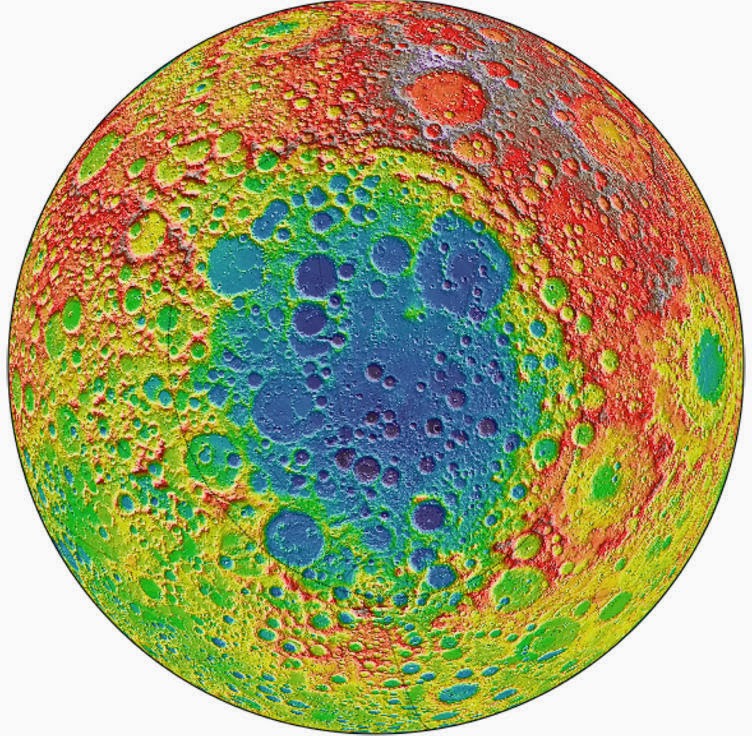
Among the largest known craters in the solar system. Red areas on the topographic image indicate high elevations, and blue or purple areas indicate low elevation. The South Pole Aitken basin could hold clues about the composition of the Moon’s mantle. (Credit: NASA/GSFC)
A massive impact on the Moon about 4 billion years ago left a 2,500-mile crater, among the largest known craters in the solar system. Smaller subsequent impacts left craters within that crater. Comparing the spectra of light reflected from the peaks of those craters may yield clues to the composition of the Moon’s lower crust and mantle — and would have implications for models of how the Moon formed.
Researchers from Brown University and the University of Hawaii have found some mineralogical surprises in the Moon’s largest impact crater.
Data from the Moon Mineralogy Mapper that flew aboard India’s Chandrayaan-1 lunar orbiter shows a diverse mineralogy in the subsurface of the giant South Pole Aitken basin. The differing mineral signatures could be reflective of the minerals dredged up at the time of the giant impact 4 billion years ago, the researchers say. If that’s true, then the South Pole Aitken (SPA) basin could hold important information about the Moon’s interior and the evolution of its crust and mantle.
The study, led by Brown graduate student Dan Moriarty, is published in online early view in the Journal of Geophysical Research: Planets.
At 2,500 kilometers across, the SPA is the largest impact basin on the Moon and perhaps the largest in the solar system. Impacts of this size turn tons of solid rock into molten slush. It has been assumed generally that the melting process would obliterate any distinct signatures of pre-existing mineralogical diversity through extensive mixing, but this latest research suggests that might not be the case.
The study looked at smaller craters within the larger SPA basin made by impacts that happened millions of years after the giant impact that formed the basin. Those impacts uncovered material from deep within the basin, offering important clues about what lies beneath the surface. Specifically, the researchers looked at the central peaks of four craters within the basin. Central peaks form when material under the impact zone rebounds, forming an upraised rock formation in the middle of the crater. The tops of those peaks represent pristine material from below the impact zone.
Using Moon Mineralogy Mapper data, the researchers looked at the light reflected from each of the four central peaks. The spectra of reflected light give scientists clues about the makeup of the rocks. The spectra showed substantial differences in composition from peak to peak. Some crater peaks were richer in magnesium than others. One of the four craters, located toward the outer edge of the basin, contained several distinct mineral deposits within its own peak, possibly due to sampling a mixture of both upper and lower crust or mantle materials.
The varying mineralogy in these central peaks suggests that the SPA subsurface is much more diverse than previously thought.
“Previous studies have suggested that all the central peaks look very similar, and that was taken as evidence that everything’s the same across the basin,” Moriarty said. “We looked in a little more detail and found significant compositional differences between these central peaks. The Moon Mineralogy Mapper has very high spatial and spectral resolution. We haven’t really been able to look at the Moon in this kind of detail before.”
The next step is figuring out where that diversity comes from.
It’s possible that the distinct minerals formed as the molten rock from the SPA impact cooled. Recent research from Brown and elsewhere suggests that such mineral formation in impact melt is possible. However, it’s also possible that the mineral differences reflect differences in rock types that were there before the giant SPA impact. Moriarty is currently undertaking a much larger survey of SPA craters in the hope of identifying the source of the diversity. If indeed the diversity reflects pre-existing material, the SPA could hold important clues about the composition of the Moon’s lower crust and mantle.
“If you do the impact scaling from models, [the SPA impact] should have excavated into the mantle,” Moriarty said. “We think the upper mantle is rich in a mineral called olivine, but we don’t see much olivine in the basin. That’s one of the big mysteries about the South Pole Aitken basin. So one of the things we’re trying to figure out is how deep did the impact really excavate. If it melted and excavated any material from the mantle, why aren’t we seeing it?”
If the impact did excavate mantle material, and it doesn’t contain olivine, that would have substantial implications for models of how the Moon was formed, Moriarty said.
Much more research is needed to begin to answer those larger questions. But this initial study helps raise the possibility that some of the original mantle mineralogy, if excavated, may be preserved in the Moon’s largest impact basin.
Carle Pieters, professor of geological sciences at Brown, and Peter Isaacson from the University of Hawaii were also authors on the paper. The work was supported by NASA’s Lunar Advanced Science and Exploration Research (LASER) program and the NASA Lunar Science Institute (NLSI).
Note : The above story is based on materials provided by Brown University.
Self portrait of “Curiosity,” a NASA Mars rover, taken on the outcrops that are being published in the Dec. 9, 2013 online edition of the journal Science. The rover landed on August 5, 2012 in Gale Crater on Mars on a two-year primary mission. (Credit: NASA/JPL-Caltech/MSSS)
Humankind is by nature inquisitive, especially about the prospect of life on other planets and whether or not we are alone. The aptly named Curiosity, a NASA Mars rover, has been scouring that planet’s surface as a potential habitat for life, either past or present.
Stony Brook Department of Geosciences professors Scott McLennan and Joel Hurowitz just revealed some exciting findings, as lead and co-authors of six papers that appeared in the December 9 online issue of Science.
“We have determined that the rocks preserved there represent an ancient geological environment that was habitable for microbial life,” says McLennan, who was selected as a Participating Scientist for the NASA Mars Science Laboratory rover mission. Adds Hurowitz, “Curiosity carried out the work in an area on Mars called Yellowknife Bay, within Gale crater. The rover fully characterized this environment in terms of its geological and geochemical relationships.”
This meticulous representation is crucial to understanding whether Mars was theoretically habitable. A major model of Martian history posits that the planet had fresh water to generate clay minerals — and possibly support life — more than 4 billion years ago, but experienced a drying phenomenon that changed the conditions to more acidic and briny. A key question about the clay minerals at Yellowknife Bay was whether they formed early in Martian history — up on the crater rim where the bits of rock originated — or later, down where the bits were carried by flowing water and deposited.
Professor McLennan and his co-authors determined that the chemical elements in the rocks indicate the particles were carried by rivers into Yellowknife Bay without experiencing much chemical weathering until sometime after they were deposited. If the weathering that turns some volcanic minerals into clay minerals had happened in the source regions where the sedimentary particles were generated, a loss of elements that readily dissolve in water — especially calcium and sodium — would be expected. The evidence indicates that did not occur, and that much of the geochemical “action” took place late in the history of the rocks found in Yellowknife Bay.
The clay-bearing Yellowknife Bay habitat, thought to be an ancient lakebed, consisted of water that was neither too acidic nor too salty, and had the right mix of elements to be an energy source for life. The energy source would have been similar to that used by many primitive rock-eating microbes on Earth — a mixture of sulfur- and iron-bearing minerals of the type that allow for the ready transfer of electrons, not unlike a simple battery.
Joel A. Hurowitz, Research Associate Professor in the Department of Geosciences at Stony Brook University.
“This demonstrates that the geological environments on early Mars were conducive for life,” McLennan says. “It justifies further investigations to determine if life actually existed on Mars. The age of these rocks is perhaps a little younger than thought was likely to contain such environments. This means that the current paradigm for the evolution of surface conditions on Mars may require some reinterpretation.”
The Mars Science Laboratory mission is part of NASA’s Mars Exploration Program for long-term robotic exploration of the red planet. The rover landed on August 5, 2012 in Gale Crater on Mars on a two-year primary mission. The four central objectives are to assess biological potential, characterize the geology of the landing region, investigate planetary processes that are relevant to past habitability — including the role of water, and describe the broad spectrum of surface radiation.
The record of the climate and geology of Mars is contained in the rock and soil formations, structure, and chemical composition. Curiosity scoops samples from the soil, drills them from rocks, and observes the geological and radiation environment around the rover. Its onboard laboratory ingests and analyzes the samples in an attempt to detect the chemical building blocks of life — especially different forms of carbon — and assess what the Martian surface environment was like in the past.
Hurowitz marvels at the remarkable state of preservation of these rocks, despite their great antiquity. “Finding ancient sedimentary rock that hasn’t been ‘chewed to pieces’ is exceedingly difficult to do on Earth,” he says. “But such rocks appear to be commonplace on Mars, making it an excellent target for understanding the early history of watery terrestrial planets in our Solar System and beyond.”
Curiosity is currently traversing over 5 miles from Yellowknife Bay to the base of Mount Sharp in the center of Gale crater, which has always been the prime target for the mission. “It is expected to arrive sometime in 2014, when it will begin the exploration of this 5 km high mountain that consists of layered rocks,” Hurowitz says.
During the first three months of the landed mission, Professors McLennan and Hurowitz worked out of the Jet Propulsion Laboratory in Pasadena, CA, where the science and engineering team operated the rover on “Mars time,” because a Martian day, or “sol,” is approximately 40 minutes longer than an Earth day. McLennan’s role is both as Participating Scientist and, operationally, as a Long Term Planning Lead.
Research Associate Professor Hurowitz is a Mars Science Laboratory Co-Investigator and also a Long Term Planning Lead. Hurowitz, co-author on all but one of the papers published in Science, was selected to be on the panel at the December 9 press conference — coordinated by the Jet Propulsion Laboratory and NASA, and held at the American Geophysical Union conference in San Francisco — where the findings were announced.
Both Hurowitz and McLennan are also science team members for the Mars Exploration Rovers Spirit and Opportunity that landed on Mars in 2004. Contact with the Spirit rover was lost in 2010, but Opportunity is still fit and currently exploring Endeavour Crater on the Meridiani Plains, over 5,000 miles to the west of where Curiosity is operating.
Note: A Special Collection of papers on the findings can be found on the Science web site at http://www.sciencemag.org/site/extra/curiosity/
Note : The above story is based on materials provided by Stony Brook University.
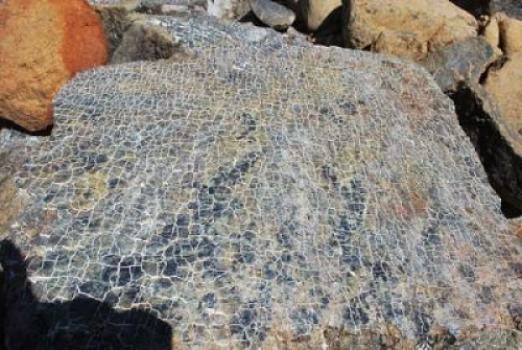
Chemical Formula: (Mg,Fe)2Al3(AlSi5O18) Locality: Bodenmais, Germany. Name Origin: From the French mining engineer and geologist P. L. A. Cordier (1777-1861).
Cordierite (mineralogy) or iolite (gemology) is a magnesium iron aluminium cyclosilicate. Iron is almost always present and a solid solution exists between Mg-rich cordierite and Fe-rich sekaninaite with a series formula: (Mg,Fe)2Al3(Si5AlO18) to (Fe,Mg)2Al3(Si5AlO18). A high temperature polymorph exists, indialite, which is isostructural with beryl and has a random distribution of Al in the (Si,Al)6O18 rings.
Occurrence
Cordierite typically occurs in contact or regional metamorphism of argillaceous rocks. It is especially common in hornfels produced by contact metamorphism of pelitic rocks. Two common metamorphic mineral assemblages include sillimanite-cordierite-spinel and cordierite-spinel-plagioclase-orthopyroxene. Other associated minerals include garnet (cordierite-garnet-sillimanite gneisses) and anthophyllite. Cordierite also occurs in some granites, pegmatites, and norites in gabbroic magmas. Alteration products include mica, chlorite, and talc. Cordierite occurs in the granite contact zone at Geevor Tin Mine in Cornwall.
Physical Properties of Cordierite
Cleavage: {010} Poor Color: Colorless, Pale blue, Violet, Yellow, Gray. Density: 2.55 – 2.75, Average = 2.65 Diaphaneity: Transparent to translucent Fracture: Conchoidal – Fractures developed in brittle materials characterized by smoothly curving surfaces, (e.g. quartz). Hardness: 7 – Quartz Luminescence: Non-fluorescent. Luster: Vitreous (Glassy) Streak: white
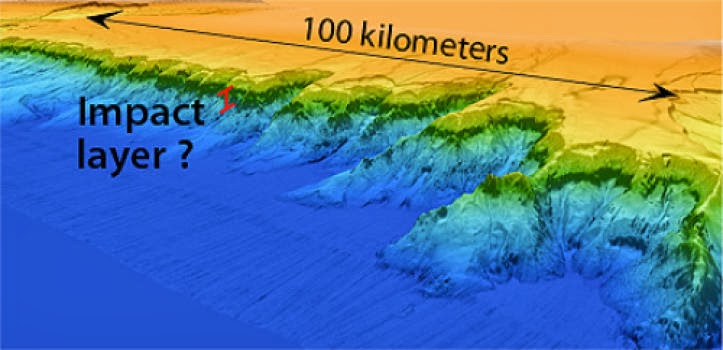
This close-up image of the Campeche Escarpment from the 2013 sonar survey shows a layer of resistent rock that researchers believe may contain rocks formed during an impact event 65 million years ago. (Credit: Copyright 2013 MBARI)
About 65 million years ago, an asteroid or comet crashed into a shallow sea near what is now the Yucatán Peninsula of Mexico. The resulting firestorm and global dust cloud caused the extinction of many land plants and large animals, including most of the dinosaurs. At this week’s meeting of the American Geophysical Union (AGU) in San Francisco, MBARI researchers will present evidence that remnants from this devastating impact are exposed along the Campeche Escarpment — an immense underwater cliff in the southern Gulf of Mexico.
The ancient meteorite impact created a huge crater, over 160 kilometers across. Unfortunately for geologists, this crater is almost invisible today, buried under hundreds of meters of debris and almost a kilometer of marine sediments. Although fallout from the impact has been found in rocks around the world, surprisingly little research has been done on the rocks close to the impact site, in part because they are so deeply buried. All existing samples of impact deposits close to the crater have come from deep boreholes drilled on the Yucatán Peninsula.
In March 2013, an international team of researchers led by Charlie Paull of the Monterey Bay Aquarium Research Institute (MBARI) created the first detailed map of the Campeche Escarpment. The team used multi-beam sonars on the research vessel Falkor, operated by the Schmidt Ocean Institute. The resulting maps have recently been incorporated in Google Maps and Google Earth for viewing by researchers and the general public.
Paull has long suspected that rocks associated with the impact might be exposed along the Campeche Escarpment, a 600-kilometer-long underwater cliff just northwest of the Yucatán Peninsula. Nearly 4,000 meters tall, the Campeche Escarpment is one of the steepest and tallest underwater features on Earth. It is comparable to one wall of the Grand Canyon — except that it lies thousands of meters beneath the sea.
As in the walls of the Grand Canyon, sedimentary rock layers exposed on the face of the Campeche Escarpment provide a sequential record of the events that have occurred over millions of years. Based on the new maps, Paull believes that rocks formed before, during, and after the impact are all exposed along different parts of this underwater cliff.
Just as a geologist can walk the Grand Canyon, mapping layers of rock and collecting rock samples, Paull hopes to one day perform geologic “fieldwork” and collect samples along the Campeche Escarpment. Only a couple of decades ago, the idea of performing large-scale geological surveys thousands of meters below the ocean surface would have seemed a distant fantasy. Over the last eight years, however, such mapping has become almost routine for MBARI geologists using underwater robots.
The newly created maps of the Campeche Escarpment could open a new chapter in research about one of the largest extinction events in Earth’s history. Already researchers from MBARI and other institutions are using these maps to plan additional studies in this little-known area. Detailed analysis of the bathymetric data and eventual fieldwork on the escarpment will reveal fascinating new clues about what happened during the massive impact event that ended the age of the dinosaurs — clues that have been hidden beneath the waves for 65 million years.
In addition to the Schmidt Ocean Institute, Paull’s collaborators in this research included Jaime Urrutia-Fucugauchi from the Universidad Nacional Autónoma de Mexico and Mario Rebolledo- Vieyra of the Centro de Investigación Científica de Yucatán. Paull also worked closely with MBARI researchers, including geophysicist and software engineer Dave Caress, an expert on processing of multibeam sonar data, and geologist Roberto Gwiazda, who served as project manager and will be describing this research at the AGU meeting.
Note : The above story is based on materials provided by Monterey Bay Aquarium Research Institute.
MSU scientist finds that, even miles deep and halfway across the globe, microbial communities are somehow quite similar. (Credit: Courtesy of MSU)
Scientists are digging deep into Earth’s surface collecting census data on the microbial denizens of the hardened rocks. What they’re finding is that, even miles deep and halfway across the globe, many of these communities are somehow quite similar.
The results, which were presented at the American Geophysical Union conference Dec. 8, suggest that these communities may be connected, said Matthew Schrenk, Michigan State University geomicrobiologist.
“Two years ago we had a scant idea about what microbes are present in subsurface rocks or what they eat,” he said. “We’re now getting this emerging picture not only of what sort of organisms are found in these systems but some consistency between sites globally — we’re seeing the same types of organisms everywhere we look.”
Schrenk leads a team funded by the Alfred P. Sloan Foundation’s Deep Carbon Observatory studying samples from deep underground in California, Finland and from mine shafts in South Africa. The scientists also collect microbes from the deepest hydrothermal vents in the Caribbean Ocean.
“It’s easy to understand how birds or fish might be similar oceans apart,” Schrenk said. “But it challenges the imagination to think of nearly identical microbes 16,000 kilometers apart from each other in the cracks of hard rock at extreme depths, pressures and temperatures.”
Cataloging and exploring this region, a relatively unknown biome, could lead to breakthroughs in offsetting climate change, the discovery of new enzymes and processes that may be useful for biofuel and biotechnology research, he added.
For example, Schrenk’s future efforts will focus on unlocking answers to what carbon sources the microbes use, how they cope in such extreme conditions as well as how their enzymes evolved to function so deep underground.
“Integrating this region into existing models of global biogeochemistry and gaining better understanding into how deep rock-hosted organisms contribute or mitigate greenhouse gases could help us unlock puzzles surrounding modern-day Earth, ancient Earth and even other planets,” Schrenk said.
Collecting and comparing microbiological and geochemical data across continents is made possible through the DCO. The DCO has allowed scientists from across disciplines to better understand and describe these phenomena, he added.
Note : The above story is based on materials provided by Michigan State University.
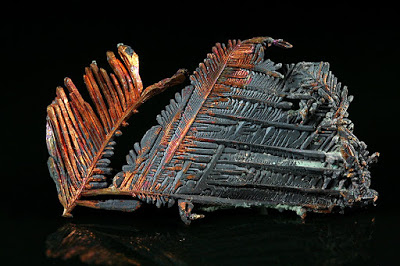
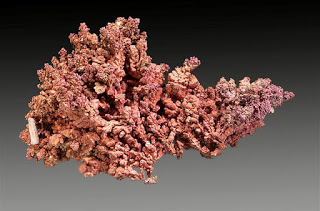
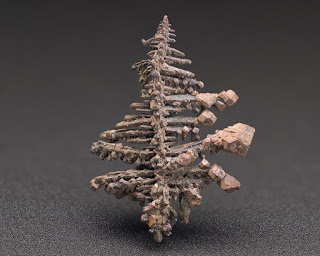
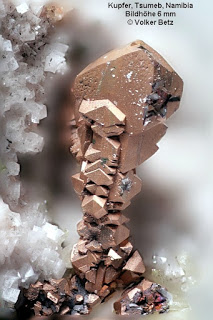
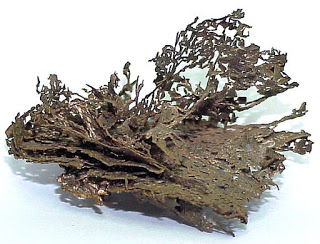
Chemical Formula: Cu Locality: Northern Michigan, USA, Cyprus island, Greece. Name Origin: From the Greek, Kyprios, the name of the island of Cyprus, once producing this metal.
Copper is a chemical element with symbol Cu (from Latin: cuprum) and atomic number 29. It is a soft, malleable and ductile metal with very high thermal and electrical conductivity. A freshly exposed surface of pure copper has a reddish-orange color. It is used as a conductor of heat and electricity, as a building material, and as a constituent of various metal alloys.
The metal and its alloys have been used for thousands of years. In the Roman era, copper was principally mined on Cyprus, the origin of the name of the metal from aes сyprium (metal of Cyprus), later corrupted to сuprum, from which the words copper (English), cuivre (French), Koper (Dutch) and Kupfer (German) are all derived. Its compounds are commonly encountered as copper(II) salts, which often impart blue or green colors to minerals such as azurite, malachite and turquoise and have been widely used historically as pigments. Architectural structures built with copper corrode to give green verdigris (or patina). Decorative art prominently features copper, both by itself and in the form of pigments.
Copper is essential to all living organisms as a trace dietary mineral because it is a key constituent of the respiratory enzyme complex cytochrome c oxidase. In molluscs and crustacea copper is a constituent of the blood pigment hemocyanin, which is replaced by the iron-complexed hemoglobin in fish and other vertebrates. The main areas where copper is found in humans are liver, muscle and bone. Copper compounds are used as bacteriostatic substances, fungicides, and wood preservatives.
Nature produces hydrogen through “serpentinization.” When water meets the ubiquitous mineral olivine under pressure, the rock absorbs mostly oxygen (O) atoms from H2O, transforming olivine into another mineral, serpentine — characterized by a scaly, green-brown surface appearance like snakeskin. The complex network of fracturing and created by serpentinization also creates habitat for subsurface microbial communities. Image from Gros Morne National Park, Newfoundland, Canada. (Credit: Matt Schrenk, Michigan State University)
Scientists in Lyon, a French city famed for its cuisine, have discovered a quick-cook recipe for copious volumes of hydrogen (H2).
The breakthrough suggests a better way of producing the hydrogen that propels rockets and energizes battery-like fuel cells. In a few decades, it could even help the world meet key energy needs — without carbon emissions contributing to the greenhouse effect and climate change.
It also has profound implications for the abundance and distribution of life, helping to explain the astonishingly widespread microbial communities that dine on hydrogen deep beneath the continents and seafloor.
Describing how to greatly speed up nature’s process for producing hydrogen will be a highlight among many presentations by Deep Carbon Observatory (DCO) experts at the American Geophysical Union’s annual Fall Meeting in San Francisco Dec. 9 to 13.
The DCO is a global, 10-year international science collaboration unraveling the mysteries of Earth’s inner workings — deep life, energy, chemistry, and fluid movements.
Muriel Andreani, Isabelle Daniel, and Marion Pollet-Villard of University Claude Bernard Lyon 1 discovered the quick recipe for producing hydrogen:
In a microscopic high-pressure cooker called a diamond anvil cell (within a tiny space about as wide as a pencil lead), combine ingredients: aluminum oxide, water, and the mineral olivine. Set at 200 to 300 degrees Celsius and 2 kilobars pressure — comparable to conditions found at twice the depth of the deepest ocean. Cook for 24 hours. And voilà.
Dr. Daniel, a DCO leader, explains that scientists have long known nature’s way of producing hydrogen. When water meets the ubiquitous mineral olivine under pressure, the rock reacts with oxygen (O) atoms from the H2O, transforming olivine into another mineral, serpentine — characterized by a scaly, green-brown surface appearance like snake skin. Olivine is a common yellow to yellow-green mineral made of magnesium, iron, silicon, and oxygen.
The process also leaves hydrogen (H2) molecules divorced from their marriage with oxygen atoms in water.
The novelty in the discovery, quietly published in a summer edition of the journal American Mineralogist, is how aluminum profoundly accelerates and impacts the process.
Finding the reaction completed in the diamond-enclosed micro space overnight, instead of over months as expected, left the scientists amazed. The experiments produced H2 some 7 to 50 times faster than the natural “serpentinization” of olivine.
Over decades, many teams looking to achieve this same quick hydrogen result focused mainly on the role of iron within the olivine, Dr. Andreani says. Introducing aluminum into the hot, high-pressure mix produced the eureka moment.
Dr. Daniel notes that aluminum is Earth’s 5th most abundant element and usually is present, therefore, in the natural serpentinization process. The experiment introduced a quantity of aluminum unrealistic in nature.
Jesse Ausubel, of The Rockefeller University and a founder of the DCO program, says current methods for commercial hydrogen production for fuel cells or to power rockets “usually involve the conversion of methane (CH4), a process that produces the greenhouse gas carbon dioxide (CO2) as a byproduct. Alternatively, we can split water molecules at temperatures of 850 degrees Celsius or more — and thus need lots of energy and extra careful engineering.”
“Aluminum’s ability to catalyze hydrogen production at a much lower temperature could make an enormous difference. The cost and risk of the process would drop a lot.”
“Scaling this up to meet global energy needs in a carbon-free way would probably require 50 years,” he adds. “But a growing market for hydrogen in fuel cells could help pull the process into the market.”
“We still need to solve problems for a hydrogen economy, such as storing the hydrogen efficiently as a gas in compact containers, or optimizing methods to turn it into a metal, as pioneered by Russell Hemley of the Carnegie Institution’s Geophysical Laboratory, another co-founder of the DCO.”
Deep energy, Dr. Hemley notes, is typically thought of in terms of geothermal energy available from heat deep within Earth, as well as subterranean fluids that can be burned for energy, such as methane and petroleum. What may strike some as new is that there is also chemical energy in the form of hydrogen produced by serpentinization.
At the time of the AGU Fall Meetings, Dr. Andreani will be taking a lead role with Javier Escartin of the Centre National de la Recherche Scientifique in a 40-member international scientific exploration of fault lines along the Mid-Atlantic Ridge. It is a place where the African and American continents continue to separate at an annual rate of about 20 mm (1.5 inches) and rock is forced up from the mantle only 4 to 6 km (2.5 to 3.7 miles) below the thin ocean floor crust. The study will advance several DCO goals, including the mapping of world regions where deep life-supporting H2 is released through serpentinization.
Aboard the French vessel Pourquoi Pas?, using a deep sea robot from the French Research Institute for Exploitation of the Sea (IFREMER), and a deep-sea vehicle from Germany’s Leibniz Institute of Marine Sciences (GEOMAR), the team includes researchers from France, Germany, USA, Wales, Spain, Norway and Greece.
Notes Dr. Daniel, until now it has been a scientific mystery how the rock + water + pressure formula produces enough hydrogen to support the chemical-loving microbial and other forms of life abounding in the hostile environments of the deep.
With the results of the experiment in France, “for the first time we understand why and how we have H2 produced at such a fast rate. When you take into account aluminum, you are able to explain the amount of life flourishing on hydrogen,” says Dr. Daniel.
Indeed, DCO scientists hypothesize that hydrogen was what fed the earliest life on primordial planet Earth — first life’s first food.
And, she adds: “We believe the serpentinization process may be underway on many planetary bodies — notably Mars. The reaction may take one day or one million years but it will occur whenever and wherever there is some water present to react with olivine — one of the most abundant minerals in the solar system.”
Enigmatic evidence of a deep subterranean microbe network
Meanwhile, the genetic makeup of Earth’s deep microbial life is being revealed through DCO research underway by Matt Schrenk of Michigan State University, head of DCO’s “Rock-Hosted Communities” initiative, Tom McCollom of the University of Colorado, Boulder, Steve D’Hondt of the University of Rhode Island, and many other associates.
At AGU, they will report the results of deep sampling from opposite sides of the world, revealing enigmatic evidence of a deep subterranean microbe network.
Using DNA, researchers are finding hydrogen-metabolizing microbes in rock fractures deep beneath the North American and European continents that are highly similar to samples a Princeton University group obtained from deep rock fractures 4 to 5 km (2.5 to 3 miles) down a Johannesburg-area mine shaft. These DNA sequences are also highly similar to those of microbes in the rocky seabeds off the North American northwest and northeastern Japanese coasts.
“Two years ago we had a scant idea about what microbes are present in subsurface rocks or what they eat,” says Dr. Schrenk. “Since then a number of studies have vastly expanded that database. We’re getting this emerging picture not only of what sort of organisms are found in these systems but some consistency between sites globally — we’re seeing the same types of organisms everywhere we look.”
“It is easy to understand how birds or fish might be similar oceans apart, but it challenges the imagination to think of nearly identical microbes 16,000 km apart from each other in the cracks of hard rock at extreme depths, pressures, and temperatures” he says.
“In some deep places, such as deep-sea hydrothermal vents, the environment is highly dynamic and promotes prolific biological communities,” says Dr. McCollom. “In others, such as the deep fractures, the systems are isolated with a low diversity of microbes capable of surviving such harsh conditions.”
“The collection and coupling of microbiological and geochemical data made possible through the Deep Carbon Observatory is helping us understand and describe these phenomena.”
How water behaves deep within Earth’s mantle
Among other major presentations, DCO investigators will introduce a new model that offers new insights into water / rock interactions at extreme pressures 150 km (93 miles) or more below the surface, well into Earth’s upper mantle. To now, most models have been limited to 15 km, one-tenth the depth.
“The DCO gives a happy twist to the phrase ‘We are in deep water’,” says researcher Dimitri Sverjensky of Johns Hopkins University, Baltimore MD.
Dr. Sverjensky’s work, accepted for publication by the Elsevier journal Geochimica et Cosmochimica Acta, is expected to revolutionize understanding of deep Earth water chemistry and its impacts on subsurface processes as diverse as diamond formation, hydrogen accumulation, the transport of diverse carbon-, nitrogen- and sulfur-fed species in the mantle, serpentinization, mantle degassing, and the origin of Earth’s atmosphere.
In deep Earth, despite extreme high temperatures and pressures, water is a fluid that circulates and reacts chemically with the rocks through which it passes, changing the minerals in them and undergoing alteration itself — a key agent for transporting carbon and other chemical elements. Understanding what water is like and how it behaves in Earth’s deep interior is fundamental to understanding the deep carbon cycle, deep life, and deep energy.
This water-rock interaction produces valuable ore deposits, creates the chemicals on which deep life and deep energy depend, influences the generation of magma that erupts from volcanoes — even the occurrence of earthquakes. Humanity gets glimpses of this water in hot springs.
Says Dr. Sverjensky: “The new model may enable us to predict water-rock interaction well into Earth upper mantle and help visualize where on Earth H2 production might be underway.”
The DCO is now in the 5th year of a decade-long adventure to probe Earth’s deepest geo-secrets: How much carbon is stored inside Earth? What are the reservoirs of that carbon? How does carbon move among reservoirs? How much carbon released from Earth’s deep interior is primordial and how much is recycled from the surface? Are there deep abiotic sources of hydrocarbons? What is the nature and extent of deep microbial life? And did deep Earth chemistry play a role in life’s origins?
The $500 million global collaboration is led by Dr. Robert Hazen, Senior Staff Scientist at the Geophysical Laboratory, Carnegie Institution of Washington.
Says Dr. Hazen: “Bringing together experts in microbes, volcanoes, the micro-structure of rocks and minerals, fluid movements, and more is novel. Typically these experts don’t connect with each other. Integrating such diversity in a single scientific endeavor is producing insights unavailable until the DCO.”
Ninety percent or more of Earth’s carbon is thought to be locked away or in motion deep underground, he notes, a hidden dimension of the planet as poorly understood as it is profoundly important to life on the surface.
Note : The above story is based on materials provided by Deep Carbon Observatory, via EurekAlert!, a service of AAAS
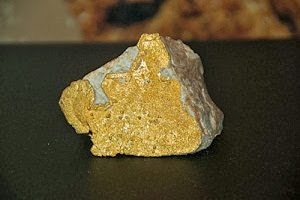
Geologists can infer the presence of gold in rock samples, by identifying certain characteristics. Credit: Graeme Churchard
A geologist is using conditional probability principles to improve the design of nuggetty gold mines.
CSIRO’s Dr June Hill says nuggetty deposits may be rich in chunks of gold that are spaced so far apart that a diamond drill misses them, and they do not show up in core samples.
“You underestimate the resource because you miss a lot of the gold,” she says.
To compensate for the lack of gold in the assay, geologists may then infer the presence of gold, using rock with certain characteristics as a proxy.
“They have to understand how the deposit formed to understand how the proxies are important,” she says.
“When the gold is introduced into the rock it comes in fluid.
“The fluids alter the rocks.
“Also you typically get deformation.
“You might get faulting, shearing, that sort of thing.
“You get alterations and veins around where you get gold deposited.”
The owners of Sunrise Dam mine near Kalgoorlie asked the CSIRO to produce a three dimensional model of the resource.
“We wanted to automate that process because there was a big drill hole database and they’d only started coding the proxies in the drill hole database quite recently,” Dr Hill says.
“The other problem was that for different parts of the mine they found that the things that indicated gold were different.
“And they only had one coding scheme so it wasn’t flexible enough for them to move around different parts of the mine where there were subtle differences.”
She developed a method using probability estimation to log various known characteristics associated with gold mineralisation in the mine.
“All that information was available in the database,” she says.
“It was just a matter of automatically looking at how often you get high gold values associated with different features and just assigning a probability value to that.”
Dr Hill says the principal is widely used in medicine, but had never been applied to gold mineralisation in geology.
She likens it to a positive test for cancer, which may not be 100 per cent definitive.
“They’ll say ‘what is the probability you’ll have cancer?’—which is usually a much lower probability,” she says.
“It’s called conditional probability because the idea is that you are conditioning the probability on the features.”
The result has been a series of three-dimensional images of the gold resource.
She is now working to further refine the model using geochemistry values.
Reference:
“Characterisation and 3D modelling of a nuggety, vein-hosted gold ore body, Sunrise Dam, Western Australia,” Evelyn June Hilla, Nicholas H.S. Oliverb, James S. Cleverleya, Michael J. Nugusc, John Carswell, Fraser Clarkc. Journal of Structural Geology, Available online 6 November 2013, ISSN 0191-8141, DOI: 10.1016/j.jsg.2013.10.013
Note : The above story is based on materials provided by Science Network WA
Australian researchers say they have identified vast reserves of fresh water trapped beneath the ocean floor off Australia, China, North American and South America
Australian researchers said Thursday they had established the existence of vast freshwater reserves trapped beneath the ocean floor which could sustain future generations as current sources dwindle.
Lead author Vincent Post, from Australia’s Flinders University, said that an estimated 500,000 cubic kilometres (120,000 cubic miles) of low-salinity water had been found buried beneath the seabed on continental shelves off Australia, China, North America and South Africa.
“The volume of this water resource is a hundred times greater than the amount we’ve extracted from the Earth’s sub-surface in the past century since 1900,” said Post of the study, published in the latest edition of Nature.
“Freshwater on our planet is increasingly under stress and strain so the discovery of significant new stores off the coast is very exciting.
“It means that more options can be considered to help reduce the impact of droughts and continental water shortages.”
UN Water, the United Nations’ water agency, estimates that water use has been growing at more than twice the rate of population in the last century due to demands such as irrigated agriculture and meat production.
More than 40 percent of the world’s population already live in conditions of water scarcity. By 2030, UN Water estimates that 47 percent of people will exist under high water stress.
Post said his team’s findings were drawn from a review of seafloor water studies done for scientific or oil and gas exploration purposes.
“By combining all this information we’ve demonstrated that the freshwater below the seafloor is a common finding, and not some anomaly that only occurs under very special circumstances,” he told AFP.
The deposits were formed over hundreds of thousands of years in the past, when the sea level was much lower and areas now under the ocean were exposed to rainfall which was absorbed into the underlying water table.
When the polar icecaps started melting about 20,000 years ago these coastlines disappeared under water, but their aquifers remain intact—protected by layers of clay and sediment.
Post said the deposits were comparable with the bore basins currently relied upon by much of the world for drinking water and would cost much less than seawater to desalinate.
Drilling for the water would be expensive, and Post said great care would have to be taken not to contaminate the aquifers.
He warned that they were a precious resource.
“We should use them carefully: once gone, they won’t be replenished until the sea level drops again, which is not likely to happen for a very long time,” Post said.
Note : The above story is based on materials provided by AFP