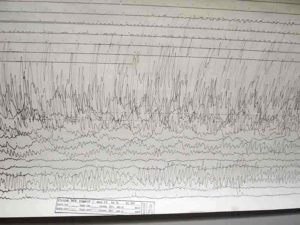
A seismogram of 2011 Tōhoku earthquake and tsunami recorded at Weston Observatory in Massachusetts, USA. Credit: Image from Wikimedia Commons.
The great 2011 earthquake that caused the tsunami in northeastern Japan is still remembered for its destructive power.
Also known as the Mw 9.0 Tohoku earthquake, the seismic nature of this calamity was not initially entirely clear. While earthquakes resulting from built-up tectonic stress in reverse faulting had only been partially released. In previous studies where complete releases have been posited, the hypothesis was based on seismicity observation and simulation, or on direct stress measurement data above the fault only by using log data.
Now, a team of researchers at Kyoto University has found evidence that a complete stress release may have contributed to the record-breaking event.
“The minor differences between maximum and minimum post-earthquake horizontal stresses near the fault suggest that the Tohoku earthquake occurred upon a complete stress release,” explains lead author Weiren Lin.
The team found that both sedimentary formations above and below the plate boundary fault lie in the stress state of normal faults in which vertical stress is greater than maximum horizontal stress.
“Knowledge about stress changes before and after this earthquake, both above and below a gently dipping fault, can provide us insights into how fault slipping caused the ensuing tsunami,” the author reflects.
Lin’s team was able to collect data for the stress state above the source fault of the Tohoku earthquake, at the boundary between the North American plate and the subducting Pacific plate. However, geophysical data for the stress state below this zone was unreliable.
To address this problem, the team studied one of four drill core samples collected by the Japan Trench Fast — or JFAST — Drilling Project from below the source fault and was the first to successfully reveal the stress state at that depth.
“Our new data show good consistency with previous results above the fault, suggesting that combining geophysical data and core samples to comprehensively investigate stress states is effective.”
Reference:
Weiren Lin, Yuhji Yamamoto, Takehiro Hirose. Three-dimensional stress state above and below the plate boundary fault after the 2011 Mw 9.0 Tohoku earthquake. Earth and Planetary Science Letters, 2023; 601: 117888 DOI: 10.1016/j.epsl.2022.117888
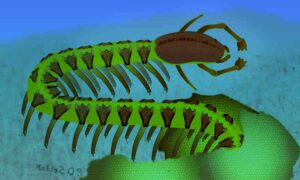
Artist’s impression of an individual 525-million-year-old Cardiodictyon catenulum on the shallow coastal sea floor, emerging from the shelter of a small stromatolite, rock-like structures built by microorganisms that were common at the time. Credit: Nicholas Strausfeld
Fossils of a tiny sea creature that died more than half a billion years ago may compel a science textbook rewrite of how brains evolved.
A study published in Science — led by Nicholas Strausfeld,a Regents Professor in the University of Arizona Department of Neuroscience, and Frank Hirth, a reader of evolutionary neuroscience at King’s College London — provides the first detailed description of Cardiodictyon catenulum, a wormlike animal preserved in rocks in China’s southern Yunnan province. Measuring barely half an inch (less than 1.5 centimeters) long and initially discovered in 1984, the fossil had hidden a crucial secret until now: a delicately preserved nervous system, including a brain.
“To our knowledge, this is the oldest fossilized brain we know of, so far,” Strausfeld said.
Cardiodictyon belonged to an extinct group of animals known as armored lobopodians, which were abundant early during a period known as the Cambrian, when virtually all major animal lineages appeared over an extremely short time between 540 million and 500 million years ago. Lobopodians likely moved about on the sea floor using multiple pairs of soft, stubby legs that lacked the joints of their descendants, the euarthropods — Greek for “real jointed foot.” Today’s closest living relatives of lobopodians are velvet worms that live mainly in Australia, New Zealand and South America.
A debate going back to the 1800s
Fossils of Cardiodictyon reveal an animal with a segmented trunk in which there are repeating arrangements of neural structures known as ganglia. This contrasts starkly with its head and brain, both of which lack any evidence of segmentation.
“This anatomy was completely unexpected because the heads and brains of modern arthropods, and some of their fossilized ancestors, have for over a hundred years been considered as segmented,” Strausfeld said.
According to the authors, the finding resolves a long and heated debate about the origin and composition of the head in arthropods, the world’s most species-rich group in the animal kingdom. Arthropods include insects, crustaceans, spiders and other arachnids, plus some other lineages such as millipedes and centipedes.
“From the 1880s, biologists noted the clearly segmented appearance of the trunk typical for arthropods, and basically extrapolated that to the head,” Hirth said. “That is how the field arrived at supposing the head is an anterior extension of a segmented trunk.”
“But Cardiodictyon shows that the early head wasn’t segmented, nor was its brain, which suggests the brain and the trunk nervous system likely evolved separately,” Strausfeld said.
Brains do fossilize
Cardiodictyon was part of the Chengjiang fauna, a famous deposit of fossils in the Yunnan Province discovered by paleontologist Xianguang Hou. The soft, delicate bodies of lobopodians have preserved well in the fossil record, but other than Cardiodictyon none have been scrutinized for their head and brain, possibly because lobopodians are generally small. The most prominent parts of Cardiodictyon were a series of triangular, saddle-shaped structures that defined each segment and served as attachment points for pairs of legs. Those had been found in even older rocks dating back to the advent of the Cambrian.
“That tells us that armored lobopodians might have been the earliest arthropods,” Strausfeld said, predating even trilobites, an iconic and diverse group of marine arthropods that went extinct around 250 million years ago.
“Until very recently, the common understanding was ‘brains don’t fossilize,'” Hirth said. “So you would not expect to find a fossil with a preserved brain in the first place. And, second, this animal is so small you would not even dare to look at it in hopes of finding a brain.”
However, work over the last 10 years, much of it done by Strausfeld, has identified several cases of preserved brains in a variety of fossilized arthropods.
A common genetic ground plan for making a brain
In their new study, the authors not only identified the brain of Cardiodictyon but also compared it with those of known fossils and of living arthropods, including spiders and centipedes. Combining detailed anatomical studies of the lobopodian fossils with analyses of gene expression patterns in their living descendants, they conclude that a shared blueprint of brain organization has been maintained from the Cambrian until today.
“By comparing known gene expression patterns in living species,” Hirth said, “we identified a common signature of all brains and how they are formed.”
In Cardiodictyon, three brain domains are each associated with a characteristic pair of head appendages and with one of the three parts of the anterior digestive system.
“We realized that each brain domain and its corresponding features are specified by the same combination genes, irrespective of the species we looked at,” added Hirth. “This suggested a common genetic ground plan for making a brain.”
Lessons for vertebrate brain evolution
Hirth and Strausfeld say the principles described in their study probably apply to other creatures outside of arthropods and their immediate relatives. This has important implications when comparing the nervous system of arthropods with those of vertebrates, which show a similar distinct architecture in which the forebrain and midbrain are genetically and developmentally distinct from the spinal cord, they said.
Strausfeld said their findings also offer a message of continuity at a time when the planet is changing dramatically under the influence of climatic shifts.
“At a time when major geological and climatic events were reshaping the planet, simple marine animals such as Cardiodictyon gave rise to the world’s most diverse group of organisms — the euarthropods — that eventually spread to every emergent habitat on Earth, but which are now being threatened by our own ephemeral species.”
Funding for this work was provided by the National Science Foundation, the University of Arizona Regents Fund, and the UK Biotechnology and Biological Sciences Research Council.
Reference:
Nicholas J. Strausfeld, Xianguang Hou, Marcel E. Sayre, Frank Hirth. The lower Cambrian lobopodian Cardiodictyon resolves the origin of euarthropod brains. Science, 2022; 378 (6622): 905 DOI: 10.1126/science.abn6264
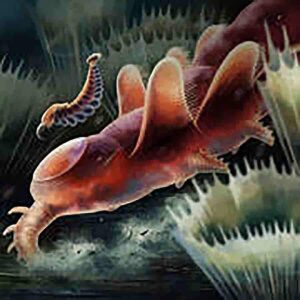
Artistic reconstruction of the Ordovician fossils Mieridduryn bonniae. Original artwork by Franz Anthony
The most famous fossils from the Cambrian explosion of animal life over half a billion years ago are very unlike their modern counterparts. These “weird wonders,” such as the five-eyed Opabinia with its distinctive frontal proboscis, and the fearsome apex predator Anomalocaris with its radial mouthparts and spiny feeding appendages, have become icons in popular culture. However, they were only quite recently recognised as extinct stages of evolution that are crucial for understanding the origins of one of the largest and most important animal phyla, the arthropods (a group that includes modern crabs, spiders, and millipedes).
In an article published today in Nature Communications, two new specimens with striking similarities to Opabinia are described from a new fossil deposit recording life in the Ordovician Period, 40 million years after the Cambrian explosion. This deposit, located in a sheep field near Llandrindod Wells in mid Wales (UK), was discovered during the COVID-19 lockdowns by independent researchers and Llandrindod residents Dr Joseph Botting and Dr Lucy Muir, Honorary Research Fellows at Amgueddfa Cymru — National Museum Wales.
The quarry is well known as one of several local sites yielding new species of fossil sponges. “When the lockdown started, I thought I’d make one more trip to collect some last sponges before finally writing them up,” said Botting, “of course, that was the day that I found something sticking its tentacles out of a tube instead.”
“This is the sort of thing that palaeontologists dream of, truly soft-body preservation,” said Muir, “we didn’t sleep well, that night.” That was the beginning of an extensive and ongoing investigation that grew into an international collaboration, with lead author Dr Stephen Pates (University of Cambridge) and senior author Dr Joanna Wolfe (The Department of Organismic and Evolutionary Biology at Harvard University).
Among the fossils unearthed so far are two very unexpected leftovers from the Cambrian “weird wonders.” Pates met with Botting and Muir to study the specimens using microscopes purchased through crowd-funding to examine the tiny specimens. The larger specimen measured 13 mm, while the smaller measured a miniscule 3 mm (for comparison Opabinia specimens can be 20 times as long).
Exhaustive studies during this visit revealed additional details in the new specimens. Some of these features are also found in Opabinia, such as triangular, squishy lobopod ‘legs’ for interacting with the sediment, and — in the smaller specimen — a tail fan with blades similar in shape to Opabinia’s recently described sister, Utaurora. However other features recognised in the material, such as sclerites covering the head as well as the presence of spines on the proboscis, were not known from any opabiniid and instead hinted at possible radiodont (including Anomalocaris) affinities. The differences between the two specimens led the researchers to wonder were these due to changes during the growth of one species, or did they instead suggest that two distinct species were present in this new deposit?
The authors describe the new taxon, Mieridduryn bonniae, with the larger specimen designated the holotype. The status of the smaller specimen was left open, reflecting these different possibilities. “The size of the smaller specimen is comparable to some modern arthropod larvae — we had to take into account this possibility in our analyses,” said Wolfe.
The genus name Mieridduryn is derived from the Welsh language, and translates as “bramble-snout,” reflecting the spiny proboscis in the new material. It is pronounced like “me-airy-theerin.” “Many scientific names are made using Latin or Greek words,” Muir said, “but we really wanted to honour Wales, where the specimens were discovered, and so chose to use the Welsh language.” The species name bonniae pays tribute to the niece of the landowners, Bonnie. “The landowners have been very supportive of our research, and Bonnie has been avidly following our progress, even attending some of our Zoom updates,” said Botting.
The researchers used phylogenetic analyses, comparing the new fossils with 57 other living and fossil arthropods, radiodonts, and panarthropods, to determine their place in the history of arthropod evolution. “The best-supported position for our Welsh specimens, whether considered as one or two species, were more closely related to modern arthropods than to opabiniids. These analyses suggested that Mieridduryn and the smaller specimen were not “true” opabiniids,” said Pates.
Crucially, these results suggested that a proboscis — thought to represent a fused pair of head appendages — was not unique to opabiniids, but instead was present in the common ancestor of radiodonts and deuteropods (more derived, modern arthropods), and through evolutionary time may have reduced to become the labrum that covers the mouth in modern arthropods. However, the second-best-supported position for these specimens was as true opabiniids, so the authors enquired a bit further to test the robustness of this first result.
“These Welsh animals are 40 million years younger than Opabinia and Utaurora” said Wolfe, “so it was important to assess the implications of some features, such as spines on the appendages or a carapace, evolving convergently with radiodonts in our analyses.” If some, or all, the features shared between the Welsh animals and radiodonts were instead considered to have evolved convergently, the analyses strongly favoured these specimens being considered true opabiniids, the first from outside North America and the youngest by 40 million years. Whatever the eventual conclusion, the fossils are an important new piece in the arthropod evolutionary jigsaw.
These small but scientifically mighty fossils are some of the first findings from this important new Ordovician fauna. Botting and Muir continue their work in the small quarry in the sheep field with more still to come. Muir added, “Even the sheep know we are on to something special here, they usually come to watch.”
Reference:
Stephen Pates, Joseph P. Botting, Lucy A. Muir, Joanna M. Wolfe. Ordovician opabiniid-like animals and the role of the proboscis in euarthropod head evolution. Nature Communications, 2022; 13 (1) DOI: 10.1038/s41467-022-34204-w
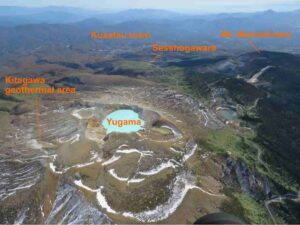
Thanks to its geothermally active location, the town of Kusatsu, Gunma Prefecture (in the background of this image), is one of Japan’s most popular onsen (hot springs) destinations. The acidic and vibrant turquoise Yugama crater lake, however, is definitely not suitable for swimming. Credit: Tomoya Obase
Volcanic eruptions are dangerous and difficult to predict. A team at the University of Tokyo has found that the ratio of atoms in specific gases released from volcanic fumaroles (gaps in the Earth’s surface) can provide an indicator of what is happening to the magma deep below — similar to taking a blood test to check your health. This can indicate when things might be “heating up.” Specifically, changes in the ratio of argon-40 and helium-3 can indicate how frothy the magma is, which signals the risk of different types of eruption. Understanding which ratios of which gases indicate a certain type of magma activity is a big step. Next, the team hopes to develop portable equipment which can provide on-site, real-time measurements for a 24/7 volcanic activity monitoring and early warning system.
Does the thought of standing on a volcano make you quiver with excitement, or fear? For many people, living in the shadow of a volcano is part of daily life. Japan has 111 active volcanoes and an average of 15 volcanic “events,” including eruptions, every year. But these events are notoriously difficult to predict and can be deadly. In 2014, Mount Ontake, Japan’s second-highest volcano and a famous tourist spot, unexpectedly erupted, sadly killing 58 people and leaving five missing. Earthquake activity is typically an early warning sign, but some eruptions (including the one at Ontake) can occur without clear earthquake signals and so disaster mitigators, like the Japan Meteorological Agency, would benefit from other reliable ways to forewarn residents of the next potential disaster.
Fumaroles are holes and cracks in the Earth’s surface (the crust), which release gas and steam and often occur around volcanoes. The ejected gas is made up of a mix of chemicals. Its composition can provide us with insight into what is happening below the Earth’s crust in the mantle, where magma (molten rock) forms and pushes upwards, eventually erupting as lava. Researchers already know that the ratio of isotopes (atoms from an element with the same chemical properties but different mass) of certain gases can indicate hidden magma activity. “We knew that the helium isotope ratio occasionally changes from a low value, similar to the helium found in the Earth’s crust, to a high value, like that in the Earth’s mantle, when the activity of magma increases. This was based on an observation of the helium isotope ratio of cold spring gas in El Hierro Island, in the Canary Islands (in the Atlantic Ocean off the northwestern coast of Africa), where an eruption occurred in 2011,” explained Professor Hirochika Sumino from the Research Center for Advanced Science and Technology. “But we didn’t know why we had more mantle-derived helium during magmatic unrest.”
To gain further insight, Sumino and team decided to monitor gases from six fumaroles around the active Kusatsu-Shirane volcano, which lies about 150 kilometers northwest of Tokyo in Gunma Prefecture. The team collected samples every few months for seven years between 2014 and 2021. After collection, they took the samples back to the lab and analyzed them using state-of-the-art equipment called a noble gas mass spectrometer. This enabled them to precisely measure isotopic compositions, including that of ultratrace (tiny but important) isotopes, such as helium-3, which is typically more abundant in the mantle compared to the crust or air.
“We succeeded in detecting changes in the magma-derived argon-40/helium-3 ratio, related to magmatic unrest. Using computer models, we revealed that the ratio reflects how much the magma underground is foaming, making bubbles of volcanic gases which separate from the liquid magma,” explained Sumino. “How much magma foams controls how much magmatic gas is provided to the hydrothermal system beneath a volcano and how buoyant the magma is. The former is related to a risk of phreatic eruption, in which an increase in water pressure in the hydrothermal system causes the eruption. The latter would increase the rate of magma ascent, resulting in a magmatic eruption.
“When you compare a volcano with a human body, the conventional geophysical methods represented by observations of earthquakes and crustal deformation are similar to listening to the chest and taking body size measurements. In these cases, it is difficult to know what health problem causes some noise in your chest or a sudden increase in your weight, without a detailed medical check. On the other hand, analyzing the chemical and isotope composition of elements in fumarolic gases is like a breath or blood test. This means we are looking at actual material directly derived from magma to know precisely what is going on with the magma.”
For now, gas samples have to be collected out in the field and brought back to the lab for analysis, which is a challenging and time-consuming process. However, Sumino has experience of improving noble gas mass spectrometers and hopes to develop a new tool which would enable them to perform the same analysis, but in real time and out in the field. “We want to be able to detect changes in magma activity as soon as possible,” said Sumino. “Now we are developing a portable mass spectrometer for on-site, real-time monitoring of noble gas isotope ratios from fumarolic gases. Our next step is to establish a noble gas analysis protocol with this new instrument, to make it a reality that all active volcanoes — at least those which have the potential to cause disaster to local residents — are monitored 24 hours a day, seven days a week.”
Reference:
Tomoya Obase, Hirochika Sumino, Kotaro Toyama, Kaori Kawana, Kohei Yamane, Muga Yaguchi, Akihiko Terada, Takeshi Ohba. Monitoring of magmatic–hydrothermal system by noble gas and carbon isotopic compositions of fumarolic gases. Scientific Reports, 2022; 12 (1) DOI: 10.1038/s41598-022-22280-3
Field area and glacier retreat due to calving. (A) Location of Börgen Bay at the West Antarctic Peninsula. Bathymetry from ETOPO 1 global relief model (74). (B) Bathymetry of Börgen Bay from multibeam echosounder data and coastline/topography from Landsat imagery (see Materials and Methods). Dots mark locations of conductivity-temperature-depth (CTD) profiles used here, with profiles taken before (red) and after (blue) the calving event. (C) Landsat images of the William Glacier front from (top) 17 January 2020 and (bottom) 24 January 2020. In both panels, the orange line marks the glacier front on 17 January 2020 to highlight the retreat of the glacier between those dates. Credit: Science Advances (2022). DOI: 10.1126/sciadv.add0720
Scientists on a research vessel in Antarctica watched the front of a glacier disintegrate and their measurements “went off the scale.” As well as witnessing disruptions on the ocean surface, they recorded “internal” underwater tsunamis as tall as a house, a phenomenon that has been previously missed in the understanding of ocean mixing and in computer models.
The team, led by British Antarctic Survey (BAS) researchers, report their observations today in the journal Science Advances.
Internal tsunamis are an important factor in ocean mixing, which affects life in the ocean, temperatures at different depths, and how much ice the ocean can melt. Ice in Antarctica flows to the coast along glacier-filled valleys. While some ice melts into the ocean, much breaks off into icebergs, which range in size from small chunks up to the size of a country.
A team on board the BAS research ship RRS James Clark Ross was taking ocean measurements close to the William Glacier, situated on the Antarctic Peninsula, as the front of it dramatically disintegrated into thousands of small pieces.
The William Glacier typically has one or two large calving events per year, and the team estimated this one broke off around 78,000 square meters of ice—around the area of 10 football pitches—with the front of the glacier towering 40 meters above sea level.
Before it broke away, the water temperature was cooler at around 50-100 meters in depth, and warmer below this. After the calving, this changed dramatically, with temperature much more even across different depths.
Lead author of the study Professor Michael Meredith, head of the Polar Oceans team at BAS, said, “This was remarkable to see, and we were lucky to be in the right place at the right time. Lots of glaciers end in the sea, and their ends regularly split off into icebergs. This can cause big waves at the surface but we know now it also creates waves inside the ocean. When they break, these internal waves cause the sea to mix and this affects life in the sea, how warm it is at different depths and how much ice it can melt. This is important for us to understand better.
“Ocean mixing influences where nutrients are in the water and that matters for ecosystems and biodiversity. We thought we knew what caused this mixing—in summer, we thought it was mainly wind and tides, but it never occurred to us that iceberg calving could cause internal tsunamis that would mix things up so substantially.”
Professor James Scourse, Head of the Department of Earth and Environmental Sciences at the University of Exeter, was Principal Scientific Officer on the RRS James Clark Ross at the time of the calving event, which was captured by a Sky News team on board at the time.
Two other scientists from Exeter have been central to the interpretation of the data captured, Dr. Katy Sheen and Ph.D. student Tobias Ehmen of the Centre for Geography and Environmental Science on the Penryn Campus.
“Often the most important and exciting discoveries in science are serendipitous—you happen to be at the right place at the right time with the right instruments and the right people—and because you know it’s important you just make sure you tweak the work plan to make the most of what nature has offered you,” Professor Scourse said. “We did that in Börgen Bay back in January 2020 and as a result we’ve produced the first data on a process that has implications for how fast the ocean is able to melt the ice sheets. This has implications for all of us.”
As opposed to the waves caused by wind and tides, tsunamis are caused by geophysical events where water is suddenly shifted, for example, by an earthquake or landslide.
Internal tsunamis have been noticed in a handful of places, caused by landslides. Until now, no one had noticed that they are happening around Antarctica, probably all the time because of the thousands of calving glaciers there. Other places with glaciers are likely affected also, including Greenland and elsewhere in the Arctic.
This chance observation and understanding is important, as glaciers are set to retreat and calve more as global warming continues. This could likely increase the number of internal tsunamis created and the mixing they cause.
This process is not factored into current computer models enabling us to predict what might happen around Antarctica. This discovery changes our understanding of how the ocean around Antarctica is mixed and will improve knowledge about what it means for climate, the ecosystem and sea level rise.
Professor Meredith remarked, “Our fortuitous timing shows how much more we need to learn about these remote environments and how they matter for our planet.”
Reference:
Michael P. Meredith et al, Internal tsunamigenesis and ocean mixing driven by glacier calving in Antarctica, Science Advances (2022). DOI: 10.1126/sciadv.add0720
Giant sea scorpions once roamed the ancient Devonian sea 400 million years ago. Now, researchers are learning more about that world. Credit: Aunt Spray | Shutterstock.com
Trapped for millennia, the tiniest liquid remnants of an ancient inland sea have now been revealed. The surprising discovery of seawater sealed in what is now North America for 390 million years opens up a new avenue for understanding how oceans change and adapt with the changing climate. The method may also be useful in understanding how hydrogen can be safely stored underground and transported for use as a carbon-free fuel source.
“We discovered we can actually dig out information from these mineral features that could help inform geologic studies, such as the seawater chemistry from ancient times,” said Sandra Taylor, first author of the study and a scientist at the Department of Energy’s Pacific Northwest National Laboratory.
Taylor worked with PNNL colleagues Daniel Perea, John Cliff, and Libor Kovarik to perform the analyses in collaboration with geochemists Daniel Gregory of the University of Toronto and Timothy Lyons of the University of California, Riverside. The research team reported their discovery in the December 2022 issue of Earth and Planetary Science Letters.
Ancient seas; modern tools
Many types of minerals and gems contain small pockets of trapped liquid. Indeed, some gemstones are prized for their light-catching bubbles of liquid trapped within. What’s different in this study is that scientists were able to reveal what was inside the tiniest water pockets, using advanced microscopy and chemical analyses.
The findings of the study confirmed that the water trapped inside the rock fit the chemistry profile of the ancient inland saltwater sea that once occupied upstate New York, where the rock originated. During the Middle Devonian period, this inland sea stretched from present day Michigan to Ontario, Canada. It harbored a coral reef to rival Australia’s Great Barrier Reef. Sea scorpions the size of a pickup truck patrolled waters that harbored now-extinct creatures like trilobites, and the earliest examples of horseshoe crabs.
But eventually the climate changed, and along with that change, most of the creatures and the sea itself disappeared, leaving behind only fossil remains embedded in sediments that eventually became the pyrite rock sample used in the current experiment.
Clues to an ancient climate and to climate change
Scientists use rock samples as evidence to piece together how the climate has changed over the long span of geologic time.
“We use mineral deposits to estimate the temperature of the ancient oceans,” said Gregory, a geologist at the University of Toronto, and one of the study leaders. But there are relatively few useful examples in the geological record.
“Salt deposits from trapped seawater [halite] are relatively rare in the rock record, so there are millions of years missing in the records and what we currently know is based on a few localities where there is halite found,” Gregory said. By contrast, pyrite is found everywhere. “Sampling with this technique could open up millions of years of the geologic record and lead to new understanding of changing climate.”
Seawater surprise
The research team was trying to understand another environmental issue — toxic arsenic leaching from rock — when they noticed the tiny defects. Scientists describe the appearance of these particular pyrite minerals as framboids — derived from the French word for raspberry — because they look like clusters of raspberry segments under the microscope.
“We looked at these samples through the electron microscope first, and we saw these kind of mini bubbles or mini features within the framboid and wondered what they were,” Taylor said.
Using the precise and sensitive detection techniques of atom probe tomography and mass spectrometry — which can detect minuscule amounts of elements or impurities in minerals — the team worked out that the bubbles indeed contained water and their salt chemistry matched that of ancient seas.
From ancient sea to modern energy storage
These types of studies also have the potential to provide interesting insights into how to safely store hydrogen or other gases underground.
“Hydrogen is being explored as a low-carbon fuel source for various energy applications. This requires being able to safely retrieve and store large-amounts of hydrogen in underground geologic reservoirs. So it’s important to understand how hydrogen interacts with rocks,” said Taylor. “Atom probe tomography is one of the few techniques where you can not only measure atoms of hydrogen, but you can actually see where it goes in the mineral. This study suggests that tiny defects in minerals might be potential traps for hydrogen. So by using this technique we could figure out what’s going on at the atomic level, which would then help in evaluating and optimizing strategies for hydrogen storage in the subsurface.”
This research was conducted at EMSL, the Environmental Molecular Sciences Laboratory, a DOE Office of Science user facility at PNNL. Lyons and Gregory applied to use the facility through a competitive application process. The research was also supported by a grant from the Natural Sciences and Engineering Research Council of Canada.
Reference:
S.D. Taylor, D.D. Gregory, D.E. Perea, L. Kovarik, J.B. Cliff, T.W. Lyons. Pushing the limits: Resolving paleoseawater signatures in nanoscale fluid inclusions by atom probe tomography. Earth and Planetary Science Letters, 2022; 599: 117859 DOI: 10.1016/j.epsl.2022.117859
A dazzling play of colors highlights Southern California’s long lost clam. Photo Credit: Jeff Goddard
Discovering a new species is always exciting, but so is finding one alive that everyone assumed had been lost to the passage of time. A small clam, previously known only from fossils, has recently been found living at Naples Point, just up the coast from UC Santa Barbara. The discovery appears in the journal Zookeys.
“It’s not all that common to find alive a species first known from the fossil record, especially in a region as well-studied as Southern California,” said co-author Jeff Goddard, a research associate at UC Santa Barbara’s Marine Science Institute. “Ours doesn’t go back anywhere near as far as the famous Coelacanth or the deep-water mollusk Neopilina galatheae — representing an entire class of animals thought to have disappeared 400 million years ago — but it does go back to the time of all those wondrous animals captured by the La Brea Tar Pits.”
On an afternoon low tide in November 2018, Goddard was turning over rocks searching for nudibranch sea slugs at Naples Point, when a pair of small, translucent bivalves caught his eye. “Their shells were only 10 millimeters long,” he said. “But when they extended and started waving about a bright white-striped foot longer than their shell, I realized I had never seen this species before.” This surprised Goddard, who has spent decades in California’s intertidal habitats, including many years specifically at Naples Point. He immediately stopped what he was doing to take close-up photos of the intriguing animals.
With quality images in hand, Goddard decided not to collect the animals, which appeared to be rare. After pinning down their taxonomic family, he sent the images to Paul Valentich-Scott, curator emeritus of malacology at the Santa Barbara Museum of Natural History. “I was surprised and intrigued,” Valentich-Scott recalled. “I know this family of bivalves (Galeommatidae) very well along the coast of the Americas. This was something I’d never seen before.”
He mentioned a few possibilities to Goddard, but said he’d need to see the animal in-person to make a proper assessment. So, Goddard returned to Naples Point to claim his clam. But after two hours combing just a few square meters, he still hadn’t caught sight of his prize. The species would continue to elude him many more times.
Nine trips later, in March 2019, and nearly ready to give up for good, Goddard turned over yet another rock and saw the needle in the haystack: A single specimen, next to a couple of small white nudibranchs and a large chiton. Valentich-Scott would get his specimen at last, and the pair could finally set to work on identification.
Valentich-Scott was even more surprised once he got his hands on the shell. He knew it belonged to a genus with one member in the Santa Barbara region, but this shell didn’t match any of them. It raised the exciting possibility that they had found a new species.
“This really started ‘the hunt’ for me,” Valentich-Scott said. “When I suspect something is a new species, I need to track back through all of the scientific literature from 1758 to the present. It can be a daunting task, but with experience it can go pretty quickly.”
The two researchers decided to check out an intriguing reference to a fossil species. They tracked down illustrations of the bivalve Bornia cooki from the paper describing the species in 1937. It appeared to match the modern specimen. If confirmed, this would mean that Goddard had found not a new species, but a sort of living fossil.
It is worth noting that the scientist who described the species, George Willett, estimated he had excavated and examined perhaps 1 million fossil specimens from the same location, the Baldwin Hills in Los Angeles. That said, he never found B. cooki himself. Rather, he named it after Edna Cook, a Baldwin Hills collector who had found the only two specimens known.
Valentich-Scott requested Willett’s original specimen (now classified as Cymatioa cooki) from the Natural History Museum of Los Angeles County. This object, called the “type specimen,” serves to define the species, so it’s the ultimate arbiter of the clam’s identification.
Meanwhile, Goddard found another specimen at Naples Point — a single empty shell in the sand underneath a boulder. After carefully comparing the specimens from Naples Point with Willett’s fossil, Valentich-Scott concluded they were the same species. “It was pretty remarkable,” he recalled.
Small size and cryptic habitat notwithstanding, all of this begs the question of how the clam eluded detection for so long. “There is such a long history of shell-collecting and malacology in Southern California — including folks interested in the harder to find micro-mollusks — that it’s hard to believe no one found even the shells of our little cutie,” Goddard said.
He suspects the clams may have arrived here on currents as planktonic larvae, carried up from the south during marine heatwaves from 2014 through 2016. These enabled many marine species to extend their distributions northward, including several documented specifically at Naples Point. Depending on the animal’s growth rate and longevity, this could explain why no one had noticed C. cooki at the site prior to 2018, including Goddard, who has worked on nudibranchs at Naples Point since 2002.
“The Pacific coast of Baja California has broad intertidal boulder fields that stretch literally for miles,” Goddard said, “and I suspect that down there Cymatioa cooki is probably living in close association with animals burrowing beneath those boulders.
Reference:
Paul Valentich-Scott, Jeffrey H. R. Goddard. A fossil species found living off southern California, with notes on the genus Cymatioa (Mollusca, Bivalvia, Galeommatoidea). ZooKeys, 2022; 1128: 53 DOI: 10.3897/zookeys.1128.95139
Impressions of the Ediacaran fossils Dickinsonia (at center) with the smaller anchor shaped Parvancorina (left) in sandstone of the Ediacara Member from the Nilpena Ediacara National Park in South Australia. Photo courtesy of Scott Evans.
A new study by Virginia Tech geobiologists traces the cause of the first known mass extinction of animals to decreased global oxygen availability, leading to the loss of a majority of animals present near the end of the Ediacaran Period some 550 million years ago.
The research spearheaded by Scott Evans, a postdoctoral researcher in the Department of Geosciences, part of the Virginia Tech College of Science, shows this earliest mass extinction of about 80 percent of animals across this interval. “This included the loss of many different types of animals, however those whose body plans and behaviors indicate that they relied on significant amounts of oxygen seem to have been hit particularly hard,” Evans said. “This suggests that the extinction event was environmentally controlled, as are all other mass extinctions in the geologic record.”
Evans’ work was published Nov. 7 in the Proceedings of the National Academy of Sciences, a peer-reviewed journal of the National Academy of Sciences. The study was co-authored by Shuhai Xiao, also a professor in the Department of Geosciences, and several researchers led by Mary Droser from the University of California Riverside’s Department of Earth and Planetary Sciences, where Evans earned his master’s degree and Ph.D.
“Environmental changes, such as global warming and deoxygenation events, can lead to massive extinction of animals and profound disruption and reorganization of the ecosystem,” said Xiao, who is an affiliated member of the Global Change Center, part of the Virginia Tech Fralin Life Sciences Institute. “This has been demonstrated repeatedly in the study of Earth history, including this work on the first extinction documented in the fossil record. This study thus informs us about the long-term impact of current environmental changes on the biosphere.”
What exactly caused the drop in global oxygen? That’s still up for debate. “The short answer to how this happened is we don’t really know,” Evans said. “It could be any number and combination of volcanic eruptions, tectonic plate motion, an asteroid impact, etc., but what we see is that the animals that go extinct seem to be responding to decreased global oxygen availability.”
The study by Evans and Xiao is timelier than one would think. In an unconnected study, Virginia Tech scientists recently found that anoxia, the loss of oxygen availability, is affecting the world’s fresh waters. The cause? The warming of waters brought on by climate change and excess pollutant runoff from land use. Warming waters diminish fresh water’s capacity to hold oxygen, while the breakdown of nutrients in runoff by freshwater microbes gobbles up oxygen.
“Our study shows that, as with all other mass extinctions in Earth’s past, this new, first mass extinction of animals was caused by major climate change — another in a long list of cautionary tales demonstrating the dangers of our current climate crisis for animal life,” said Evans, who is an Agouron Institute Geobiology fellow.
Some perspective: The Ediacaran Period spanned roughly 96 million years, bookended on either side by the end of Cryogenian Period — 635 million years ago — and the beginning of the Cambrian Period — 539 million years ago. The extinction event comes just before a significant break in the geologic record, from the Proterozoic Eon to the Phanerozoic Eon.
There are five known mass extinctions that stand out in the history of animals, the “Big Five,” according to Xiao, including the Ordovician-Silurian Extinction (440 million years ago), the late Devonian Extinction (370 million years ago), the Permian-Triassic Extinction (250 million years ago), the Triassic-Jurassic Extinction (200 million years ago), and the Cretaceous-Paleogene Extinction (65 million years ago).
“Mass extinctions are well recognized as significant steps in the evolutionary trajectory of life on this planet,” Evans and team wrote in the study. Whatever the instigating cause of the mass extinction, the result was multiple major shifts in environmental conditions. “Particularly, we find support for decreased global oxygen availability as the mechanism responsible for this extinction. This suggests that abiotic controls have had significant impacts on diversity patterns throughout the more than 570 million-year history of animals on this planet,” the authors wrote.
Fossil imprints in rock tell researchers how the creatures that perished in this extinction event would have looked. And they looked, in Evans’ words, “weird.”
“These organisms occur so early in the evolutionary history of animals that in many cases they appear to be experimenting with different ways to build large, sometimes mobile, multicellular bodies,” Evans said. “There are lots of ways to recreate how they look, but the take-home is that before this extinction the fossils we find don’t often fit nicely into the ways we classify animals today. Essentially, this extinction may have helped pave the way for the evolution of animals as we know them.”
The study, like scores of other recent publications, came out of the COVID-19 pandemic. Because Evans, Xiao, and their team couldn’t get access to the field, they decided to put together a global database based mostly on published records to test ideas about changing diversity. “Others had suggested that there might be an extinction at this time, but there was a lot of speculation. So we decided to put together everything we could to try and test those ideas.” Evans said. Much of the data used in the study was collected by Droser and several graduate students from the University of California Riverside.
Reference:
Scott D. Evans, Chenyi Tu, Adriana Rizzo, Rachel L. Surprenant, Phillip C. Boan, Heather McCandless, Nathan Marshall, Shuhai Xiao, Mary L. Droser. Environmental drivers of the first major animal extinction across the Ediacaran White Sea-Nama transition. Proceedings of the National Academy of Sciences, 2022; 119 (46) DOI: 10.1073/pnas.2207475119
SMU paleontologists helped find a new species of pterosaurs in Angola, where fossils of other large marine animals have been found. E. otyikokolo can be seen flying above the ocean in the ancient picture. Artwork by Karen Carr Studio.
With wings spanning nearly 16 feet, a new species of pterosaurs has been identified from the Atlantic coast of Angola.
An international team, including two vertebrate paleontologists from SMU, named the new genus and species Epapatelo otyikokolo. This flying reptile of the dinosaur age was found in the same region of Angola as fossils from large marine animals currently on display at the Smithsonian’s National Museum of Natural History.
Pterosaur fossils that date back to the Late Cretaceous are extremely rare in sub-Saharan Africa, said team member Michael J. Polcyn, research associate in the Huffington Department of Earth Sciences and senior research fellow, ISEM at SMU (Southern Methodist University).
“This new discovery gives us a much better understanding of the ecological role of the creatures that were flying above the waves of Bentiaba, on the west coast of Africa, approximately 71.5 million years ago,” Polcyn said.
Renowned paleontologist Louis L. Jacobs, SMU professor emeritus of earth sciences and president of ISEM, an interdisciplinary institute at the university, also collaborated on the research. The team’s findings were published in the journal Diversity.
Epapatelo otyikokolo is believed to have been a fish-eating pterosaur that behaved similarly to large modern-day seabirds.
“They likely spent time flying above open-water environments and diving to feed, like gannets and brown pelicans do today,” Jacobs said. “Epapatelo otyikokolo was not a small animal, and its wingspan was approximately 4.8 m, or nearly 16 feet.”
But fossils discovered since the study suggest that some of the newly identified pterosaur species could have been even larger creatures, Polcyn said. Pterosaurs were impressive creatures, with some of the largest species having wingspans of nearly 35 feet.
The genus name ‘Epapatelo’ is the translation of the word from the Angolan Nhaneca dialect meaning “wing,” and the species name “otyikokolo” is the translation of ‘lizard.’ The Nhaneca or Nyaneka people are an Indigenous group from Angola’s Namibe Province, the region where the fossils were found.
The lead author of the study was Alexandra E. Fernandes, of Museu da Lourinhã, Universidade NOVA de Lisboa and The Bavarian State Collection for Paleontology and Geology. Other co-authors include Octávio Mateus of Universidade NOVA de Lisboa and Museu da Lourinhã; Brian Andres of the University of Sheffield; Anne S. Schulp of the Naturalis Biodiversity Center and Utrecht University in the Netherlands; and Antonio Olímpio Gonçalves of the Universidade Agostinho Neto in Angola.
Jacobs and Polcyn forged the Projecto PaleoAngola partnership with collaborators in Angola, Portugal, and the Netherlands to explore and excavate Angola’s rich fossil history, and began laying the groundwork for returning the fossils to the West African nation. Back in Dallas, Jacobs, Polcyn, and research associate Diana Vineyard went to work over a period of 13 years with a small army of SMU students to prepare the fossils excavated by Projecto PaleoAngola.
This international team discovered and collected the fourteen bones from Epapatelo otyikokolo in Bentiaba, Angola, starting in 2005. Bentiaba is located on a section of Angola coastline that Jacobs has called a “museum in the ground” because so many fossils have been found in the rocks there.
Many of those fossils are currently on display at the Smithsonian’s National Museum of Natural History “Sea Monsters Unearthed” exhibit, which was co-produced with SMU. It features large marine reptiles from the Cretaceous Period — mosasaurs, turtles, and plesiosaurs.
Reference:
Alexandra E. Fernandes, Octávio Mateus, Brian Andres, Michael J. Polcyn, Anne S. Schulp, António Olímpio Gonçalves, Louis L. Jacobs. Pterosaurs from the Late Cretaceous of Angola. Diversity, 2022; 14 (9): 741 DOI: 10.3390/d14090741
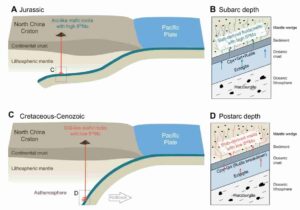
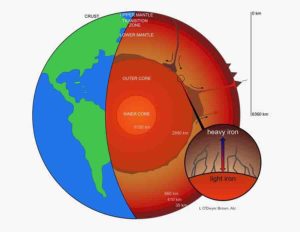
Interactions of mantles at different depths. Credit: Prof. Dai Liqun’s team.
Recently, a research team led by Prof. Dai Liqun from the University of Science and Technology of China (USTC) of the Chinese Academy of Science (CAS), has revealed that the mantle sources of Cenozoic and Mesozoic mafic igneous rocks from the eastern North China craton had gone through different types of metasomatism at different depths by comparing the composition of molybdenum isotopes. Their work was published in Geology.
Subducting slabs precipitate fluids with different compositions and properties at different depths, and when interacting with mantle wedge rocks, metasomatism occurs near the interface due to significant difference in physical condition and composition. Such metasomatism changes the chemical composition of mantle wedge rocks and produces different types of magmatism. By determining the composition of magmatic rock, researchers can study the interaction of mantles at different depths, therefore revealing the structure of the subduction zone.
DAI’s team compared the composition of molybdenum isotopes in the Mesozoic-Cenozoic mafic igneous rock in the eastern North China craton and discovered a systematic difference, indicating a difference in molybdenum isotopes composition in the fluids derived in the subducting oceanic slabs at subarc and postarc depths.
The team also discovered that Mesozoic mafic igneous rocks have island-arc basalt-like features and a heavier molybdenum isotopes composition than regular mantles, indicating that they came from subducting oceanic slab-derived fluids at subarc depths in a small mantle wedge. In contrast, Cenozoic mafic igneous rocks show oncean-island basalt-like features and have lighter molybdenum isotopes than regular mantles, coming from dehydrated slab-derived melts at postarc depths in a large mantle wedge.
The difference in molybdenum isotopes composition with rutile stability at different depths was explained. Molybdenum in subducting slabs was mainly hosted in mineral rutile, which was stable at subarc depths but broke down at postarc depth. Moreover, by combining the research on Sr-Nd isotopes with that on Mo isotopes, the team further verified that the mantle source of Mesozoic and Cenozoic mafic igneous rock had gone through different types of metasomatism at different depths.
This work provided an effective method to study the interaction of mantles at different depths, which can help the understanding of subduction zone structure in the future.
Reference:
Wei Fang et al, Molybdenum isotopes in mafic igneous rocks record slab-mantle interactions from subarc to postarc depths, Geology (2022). DOI: 10.1130/G50456.1
Artist’s reconstruction of Gangtoucunia aspera as it would have appeared in life on the Cambrian seafloor, circa 514 million years ago. The individual in the foreground has part of the skeleton removed to show the soft polyp inside the skeleton. Reconstruction by Xiaodong Wang.
An exceptionally well-preserved collection of fossils discovered in eastern Yunnan Province, China, has enabled scientists to solve a centuries-old riddle in the evolution of life on earth, revealing what the first animals to make skeletons looked like. The results have been published today in Proceedings of the Royal Society B.
The first animals to build hard and robust skeletons appear suddenly in the fossil record in a geological blink of an eye around 550-520 million years ago during an event called the Cambrian Explosion. Many of these early fossils are simple hollow tubes ranging from a few millimetres to many centimetres in length. However, what sort of animals made these skeletons was almost completely unknown, because they lack preservation of the soft parts needed to identify them as belonging to major groups of animals that are still alive today.
The new collection of 514 million year old fossils includes four specimens of Gangtoucunia aspera with soft tissues still intact, including the gut and mouthparts. These reveal that this species had a mouth fringed with a ring of smooth, unbranched tentacles about 5 mm long. It’s likely that these were used to sting and capture prey, such as small arthropods. The fossils also show that Gangtoucunia had a blind-ended gut (open only at one end), partitioned into internal cavities, that filled the length of the tube.
These are features found today only in modern jellyfish, anemones and their close relatives (known as cnidarians), organisms whose soft parts are extremely rare in the fossil record. The study shows that these simple animals was among the first to build the hard skeletons that make up much of the known fossil record.
According to the researchers, Gangtoucunia would have looked similar to modern scyphozoan jellyfish polyps, with a hard tubular structure anchored to the underlying substrate. The tentacle mouth would have extended outside the tube, but could have been retracted inside the tube to avoid predators. Unlike living jellyfish polyps however, the tube of Gangtoucunia was made of calcium phosphate, a hard mineral that makes up our own teeth and bones. Use of this material to build skeletons has become more rare among animals over time.
Corresponding author Dr Luke Parry, Department of Earth Sciences, University of Oxford, said: ‘This really is a one-in-million discovery. These mysterious tubes are often found in groups of hundreds of individuals, but until now they have been regarded as ‘problematic’ fossils, because we had no way of classifying them. Thanks to these extraordinary new specimens, a key piece of the evolutionary puzzle has been put firmly in place.’
The new specimens clearly demonstrate that Gangtoucunia was not related to annelid worms (earthworms, polychaetes and their relatives) as had been previously suggested for similar fossils. It is now clear that Gangtoucunia’s body had a smooth exterior and a gut partitioned longitudinally, whereas annelids have segmented bodies with transverse partitioning of the body.
The fossil was found at a site in the Gaoloufang section in Kunming, eastern Yunnan Province, China. Here, anaerobic (oxygen-poor) conditions limit the presence of bacteria that normally degrade soft tissues in fossils.
PhD student Guangxu Zhang, who collected and discovered the specimens, said: ‘The first time I discovered the pink soft tissue on top of a Gangtoucunia tube, I was surprised and confused about what they were. In the following month, I found three more specimens with soft tissue preservation, which was very exciting and made me rethink the affinity of Gangtoucunia. The soft tissue of Gangtoucunia, particularly the tentacles, reveals that it is certainly not a priapulid-like worm as previous studies suggested, but more like a coral, and then I realised that it is a cnidarian.’
Although the fossil clearly shows that Gangtoucunia was a primitive jellyfish, this doesn’t rule out the possibility that other early tube-fossil species looked very different. From Cambrian rocks in Yunnan province, the research team have previously found well-preserved tube fossils that could be identified as priapulids (marine worms), lobopodians (worms with paired legs, closely related to arthropods today) and annelids.
Co-corresponding author Xiaoya Ma (Yunnan University and University of Exeter) said: ‘A tubicolous mode of life seems to have become increasingly common in the Cambrian, which might be an adaptive response to increasing predation pressure in the early Cambrian. This study demonstrates that exceptional soft-tissue preservation is crucial for us to understand these ancient animals.’
Reference:
Guangxu Zhang, Luke A. Parry, Jakob Vinther, Xiaoya Ma. Exceptional soft tissue preservation reveals a cnidarian affinity for a Cambrian phosphatic tubicolous enigma. Proceedings of the Royal Society B: Biological Sciences, 2022; 289 (1986) DOI: 10.1098/rspb.2022.1623
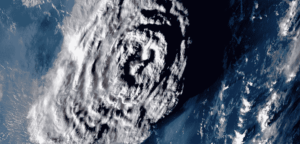
The Hunga Tonga–Hunga Haʻapai eruption as seen by Japan’s Himawari-8 satellite on 15 January 2022. Top image: Eruption at 4:20 UTC (about 15 minutes into the eruption); Middle image: Eruption at 4:50 UTC (45 minutes into the eruption); Bottom image: Eruption at 5:40 UTC (1 hour 35 minutes into the eruption). Image credit: Simon Proud / STFC RAL Space / NCEO / JMA.
Using images captured by satellites, researchers in the University of Oxford’s Department of Physics and RAL Space have confirmed that the January 2022 eruption of the Hunga Tonga-Hunga Ha’apai volcano produced the highest-ever recorded plume. The colossal eruption is also the first to have been directly observed to have broken through to the mesosphere layer of the atmosphere. The results have been published today in the journal Science.
On 15 January 2022, Hunga Tonga-Hunga Ha’apai a submarine volcano in the Tongan archipelago in the southern Pacific Ocean, violently erupted. The explosion was one of the most powerful ever observed, sending shock waves around the world and triggering devastating tsunamis that left thousands homeless. A towering column of ash and water was ejected into the atmosphere — but until now, scientists lacked an accurate way to measure just how tall this was.
Normally, the height of a volcanic plume can be estimated by measuring the temperature recorded at the top by infrared-based satellites and comparing this to a reference vertical temperature profile. This is because in the troposphere (the first and lowest layer of the Earth’s atmosphere), temperature decreases with height. But if the eruption is so large that the plume penetrates into the next layer of the atmosphere (the stratosphere), this method becomes ambiguous because the temperature begins to increase again with height (due to the ozone layer absorbing solar ultraviolet radiation).
To overcome this problem, the researchers used a novel method based on a phenomenon called ‘the parallax effect’. This is the apparent difference in an object’s position when viewed from multiple lines of sight. You can see this for yourself by closing your right eye, and holding out one hand with the thumb raised upwards. If you then switch eyes, so that your left is closed and your right is open, your thumb will appear to shift slightly against the background. By measuring this apparent change in position and combining this with the known distance between your eyes, you can calculate the distance to your thumb.
The location of the Tonga volcano is covered by three geostationary weather satellites, so the researchers were able to apply the parallax effect to the aerial images these captured. Crucially, during the eruption itself, the satellites recorded images every 10 minutes, enabling the rapid changes in the plume’s trajectory to be documented.
The results showed that the plume reached an altitude of 57 kilometres at its highest extent. This is significantly higher than the previous record-holders: the 1991 eruption of Mount Pinatubo in the Philippines (40 km at its highest point), and the 1982 eruption of El Chichón in Mexico (31 km). It also makes the plume the first observational evidence of a volcanic eruption injecting material through the stratosphere and directly into the mesosphere, which starts at about 50 km above the Earth’s surface.
Lead author Dr Simon Proud (University of Oxford, RAL Space and the National Centre for Earth Observation), said: ‘It’s an extraordinary result as we have never seen a cloud of any type this tall before. Furthermore, the ability to estimate the height in the way we did (using the parallax method) is only possible now that we have good satellite coverage. It wouldn’t have been possible a decade or so ago.’
The Oxford researchers now intend to construct an automated system to compute the heights of volcano plumes using the parallax method. Co-author Dr Andrew Prata from the Sub-department of Atmospheric, Oceanic & Planetary Physics added: ‘We’d also like to apply this technique to other eruptions and develop a dataset of plume heights that can be used by volcanologists and atmospheric scientists to model the dispersion of volcanic ash in the atmosphere. Further science questions that we would like to understand are: Why did the Tonga plume go so high? What will be the climate impacts of this eruption? And what exactly was the plume composed of?’
Besides the University of Oxford, the study also involved the Rutherford Appleton Laboratory and National Centre for Earth Observation in Harwell, and Munich University of Applied Sciences.
Reference:
Simon R. Proud, Andrew T. Prata, Simeon Schmauß. The January 2022 eruption of Hunga Tonga-Hunga Ha’apai volcano reached the mesosphere. Science, 2022; 378 (6619): 554 DOI: 10.1126/science.abo4076
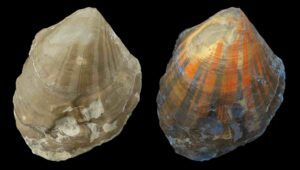
Scallop Pleuronectites from the Triassic period with fluorescent colour pattern; left under normal light, right under UV light. Photo: Klaus Wolkenstein
UV light makes it possible to see intricate structures of fossils that are barely visible in normal daylight. This method has often been used on the fossilised seashells from the Earth’s current geological era to reveal patterns of colour that had long since faded away. Now, research by a scientist from the University of Göttingen shows that fluorescent colour patterns can even be found in shells that are around 240 million years old, from the Earth’s Mesozoic Era. This makes them the oldest fluorescent colour patterns found so far. The results of this study have been published in the journal Palaeontology.
In fossils from the Mesozoic Era, traces of colour patterns are very rarely observed. However, the investigation with UV light of scallops from the Triassic period — right from the beginning of the Mesozoic Era — shows that colour patterns are preserved much more frequently than previously thought. UV light, which is invisible to the human eye, excites organic compounds in the fossils causing them to glow. This reveals a surprising variety of colour patterns: different variations of stripes, zigzags and flame patterns. The diversity of colour patterns is similar to those of today’s seashells found on a beach.
However, the colour patterns of today’s scallops do not show any fluorescence. “In the case of the Triassic shells, fluorescent compounds were only formed in the course of fossilisation through oxidation of the original pigments,” explains Dr Klaus Wolkenstein from the Geosciences Centre at the University of Göttingen, who is currently carrying out research at the University of Bonn. Surprisingly, the fossil shells show different fluorescent colours, depending on the region where they were found. “The colour spectrum ranges from yellow to red with all the transitions in between, which suggests that there were clear regional differences in the fossilisation of these scallops,” adds Wolkenstein.
Reference:
Klaus Wolkenstein. Fluorescent colour patterns in the basal pectinid Pleuronectites from the Middle Triassic of Central Europe: origin, fate and taxonomic implications of fluorescence. Palaeontology, 2022; 65 (5) DOI: 10.1111/pala.12625
There are several theories about how the Earth and the Moon were formed, most involving a giant impact. They vary from a model where the impacting object strikes the newly formed Earth a glancing blow and then escapes, through to one where the collision is so energetic that both the impactor and the Earth are vaporized.
Now scientists at the University of Leeds and the University of Chicago have analysed the dynamics of fluids and electrically conducting fluids and concluded that the Earth must have been magnetized either before the impact or as a result of it.
They claim this could help to narrow down the theories of the Earth-Moon formation and inform future research into what really happened.
Professor David Hughes, an applied mathematician in the School of Mathematics at the University of Leeds, said: “Our new idea is to point out that our theoretical understanding of the Earth’s magnetic field today can actually tell us something about the very formation of the Earth-Moon system.
“At first glance, this seems somewhat surprising, and previous theories had not recognized this potentially important connection.”
This new assessment is based on the resilience of Earth’s magnetic field, which is maintained by a rotating and electrically conducting fluid in the outer core, known as a geodynamo.
Professor Fausto Cattaneo, an astrophysicist at the University of Chicago, said: “A peculiar property of the Earth’s dynamo is that it can maintain a strong magnetic field but not amplify a weak one.
The scientists therefore concluded that if the Earth’s field were to get switched off, or even reduced to a very small level, it would not have the capability to kick in again.
“It is this remarkable feature that allows us to make deductions about the history of the early Earth; including, possibly, how the Moon was formed,” added Professor Cattaneo.
Professor Hughes added: “And if that is true, then you have to think, where did the Earth’s magnetic field come from in the first place?
“Our hypothesis is that it got to this peculiar state way back at the beginning, either pre-impact or as an immediate result of the impact.
“Either way, any realistic model of the formation of the Earth-Moon system must include magnetic field evolution. ”
Reference:
Fausto Cattaneo, David W. Hughes. How was the Earth–Moon system formed? New insights from the geodynamo. Proceedings of the National Academy of Sciences, 2022; 119 (44) DOI: 10.1073/pnas.2120682119
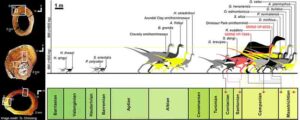
Paleohistological transverse sections of select elements of (A) large- and (B) medium-bodied individuals of the Eutaw ornithomimosaurs, and (C) relative body-size of the Eutaw ornithomimosaurs within known ornithomimosaur taxa through a geological time. Credit: Tsogtbaatar et al., CC-BY 4.0 (https://creativecommons.org/licenses/by/4.0/)
Ostrich-like dinosaurs called ornithomimosaurs grew to enormous sizes in ancient eastern North America, according to a study published October 19, 2022 in the open-access journal PLOS ONE by Chinzorig Tsogtbaatar of the North Carolina Museum of Natural Sciences and colleagues.
During the Late Cretaceous Period, North America was split by a seaway into two landmasses: Laramidia to the west and Appalachia to the east. But fossils from Appalachia are rare, and therefore ancient ecosystems from this region are poorly understood. In this study, Chinzorig and colleagues describe new fossils of ornithomimosaur dinosaurs from the Late Cretaceous Eutaw Formation of Mississippi.
Ornithomimosaurs, the so-called “bird-mimic” dinosaurs, were superficially ostrich-shaped with small heads, long arms, and strong legs. The new fossils, including foot bones, are around 85 million years old, making them a rare glimpse into a poorly known interval of North American dinosaur evolution
By comparing the proportions of these fossils and the patterns of growth within the bones, the authors determined that the fossils likely represent two different species of ornithomimosaurs, one relatively small and one very large. They estimate the larger species to have weighed over 800 kg, and the individual examined was likely still growing when it died. This makes it among the largest ornithomimosaurs known.
These fossils provide valuable insights into the otherwise poorly understood dinosaur ecosystems of Late Cretaceous eastern North America. They also shed light on ornithomimosaur evolution; giant body sizes and multiple species living side-by-side are recurring trends for these dinosaurs across North America and Asia. Further study will hopefully elucidate the reasons behind the success of these life strategies.
The authors add: “The co-existence of medium- and large-bodied ornithomimosaur taxa during the Late Cretaceous Santonian of North America does not only provide key information on the diversity and distribution of North American ornithomimosaurs from the Appalachian landmass, but it also suggests broader evidence of multiple cohabiting species of ornithomimosaurian dinosaurs in Late Cretaceous ecosystems of Laurasia.”
Reference:
Chinzorig Tsogtbaatar, Thomas Cullen, George Phillips, Richard Rolke, Lindsay E. Zanno. Large-bodied ornithomimosaurs inhabited Appalachia during the Late Cretaceous of North America. PLOS ONE, 2022; 17 (10): e0266648 DOI: 10.1371/journal.pone.0266648
Note: The above post is reprinted from materials provided by PLOS.
New research analyzing pieces of the most ancient rocks on the planet adds some of the sharpest evidence yet that Earth’s crust was pushing and pulling in a manner similar to modern plate tectonics at least 3.25 billion years ago. The study also provides the earliest proof of when the planet’s magnetic north and south poles swapped places.
The two results offer clues into how such geological changes may have resulted in an environment more conducive to the development of life on the planet.
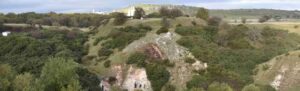
The work, described in PNAS and led by Harvard geologists Alec Brenner and Roger Fu, focused on a portion of the Pilbara Craton in western Australia, one of the oldest and most stable pieces of the Earth’s crust. Using novel techniques and equipment, the researchers show that some of the Earth’s earliest surface was moving at a rate of 6.1 centimeters per year and 0.55 degrees every million years.
That speed more than doubles the rate the ancient crust was shown to be moving in a previous study by the same researchers. Both the speed and direction of this latitudinal drift leaves plate tectonics as the most logical and strongest explanations for it.
“There’s a lot of work that seems to suggest that early in Earth’s history plate tectonics wasn’t actually the dominant way in which the planet’s internal heat gets released as it is today through the shifting of plates,” said Brenner, a Ph.D. candidate in the Graduate School of Arts and Sciences and member of Harvard’s Paleomagnetics Lab. “This evidence lets us much more confidently rule out explanations that don’t involve plate tectonics.”
For example, the researchers can now argue against phenomena called “true polar wander” and “stagnant lid tectonics,” which can both cause the Earth’s surface to shift but aren’t part of modern-style plate tectonics. The results lean more toward plate tectonic motion because the newly discovered higher rate of speed is inconsistent with aspects of the other two processes.
In the paper, the scientists also describe what’s believed to be the oldest evidence of when Earth reversed its geomagnetic fields, meaning the magnetic North and South Pole flipped locations. This type of flip-flop is a common occurrence in Earth’s geologic history with the pole’s reversing 183 times in the last 83 million years and perhaps several hundred times in the past 160 million years, according to NASA.
The reversal tells a great deal about the planet’s magnetic field 3.2 billion years ago. Key among these implications is that the magnetic field was likely stable and strong enough to keep solar winds from eroding the atmosphere. This insight, combined with the results on plate tectonics, offers clues to the conditions under which the earliest forms of life developed.
“It paints this picture of an early earth that was already really geodynamically mature,” Brenner said. “It had a lot of the same sorts of dynamic processes that result in an Earth that has essentially more stable environmental and surface conditions, making it more feasible for life to evolve and develop.”
Today, the Earth’s outer shell consists of about 15 shifting blocks of crust, or plates, which hold the planet’s continents and oceans. Over eons the plates drifted into each other and apart, forming new continents and mountains and exposing new rocks to the atmosphere, which led to chemical reactions that stabilized Earth’s surface temperature over billions of years.
Evidence of when plate tectonics started is hard to come by because the oldest pieces of crust are thrust into the interior mantle, never to resurface. Only 5 percent of all rocks on Earth are older than 2.5 billion years old, and no rock is older than about 4 billion years.
Overall, the study adds to growing research that tectonic movement occurred relatively early in Earth’s 4.5-billion-year history and that early forms of life came about in a more moderate environment. Members of the project revisited the Pilbara Craton in 2018, which stretches about 300 miles across. They drilled into the primordial and thick slab of crust there to collect samples that, back in Cambridge, were analyzed for their magnetic history.
Using magnetometers, demagnetizing equipment, and the Quantum Diamond Microscope — which images the magnetic fields of a sample and precisely identifies the nature of the magnetized particles — the researchers created a suite of new techniques for determining the age and way the samples became magnetized. This allows the researchers to determine how, when, and which direction the crust shifted as well as the magnetic influence coming from Earth’s geomagnetic poles.
The Quantum Diamond Microscope was developed in a collaboration between Harvard researchers in the Departments of Earth and Planetary Sciences (EPS) and of Physics.
For future studies, Fu and Brenner plan keep their focus on the Pilbara Craton while also looking beyond it to other ancient crusts around the world. They hope to find older evidence of modern-like plate motion and when the Earth’s magnetic poles flipped.
“Finally being able to reliably read these very ancient rocks opens up so many possibilities for observing a time period that often is known more through theory than solid data,” said Fu, professor of EPS in the Faculty of Arts and Sciences. “Ultimately, we have a good shot at reconstructing not just when tectonic plates started moving, but also how their motions — and therefore the deep-seated Earth interior processes that drive them — have changed through time.”
Reference:
Alec R. Brenner, Roger R. Fu, Andrew R. C. Kylander-Clark, George J. Hudak, Bradford J. Foley. Plate motion and a dipolar geomagnetic field at 3.25 Ga. Proceedings of the National Academy of Sciences, 2022; 119 (44) DOI: 10.1073/pnas.2210258119
Note: The above post is reprinted from materials provided by Harvard University. Original written by Juan Siliezar.
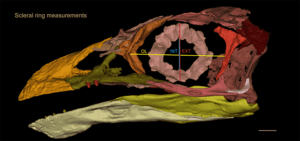
Jeholornis was a raven-sized bird that lived 120 million years ago, among the earliest examples of dinosaurs evolving into birds, in what’s now China. The fossils that have been found are finely preserved but smashed flat, the result of layers of sediment being deposited over the years. That means that no one’s been able to get a good look at Jeholornis’s head. But in a new study, researchers digitally reconstructed a Jeholornis skull, revealing details about its eyes and brain that shed light on its vision and sense of smell.
“Jeholornis is my favorite Cretaceous bird, it has a lot of unusual, primitive traits, and it helps shed light on the bigger story of how different birds evolved,” says Jingmai O’Connor, associate curator of fossil reptiles at the Field Museum and one of the authors of the paper describing the discovery in the Zoological Journal of the Linnean Society. “This study is the first time we’re really getting at what this bird’s skull looked like, what its brain must have been like, which is really exciting.”
The study’s first author, Han Hu, went through roughly 100 fossils at China’s Shandong Tianyu Museum of Nature and selected the one with the best-preserved skull — still a little flattened, but intact. “It is very difficult to find the right skull among around 100 fossils, since we won’t know if one skull will provide us the information we want before the scanning, and due to the costs of high quality scanning, we couldn’t scan all those specimens to choose the best one. However, I chose this one because at least from the exposed surface, it is relatively complete, and which is also important is that this skull is preserved to be isolated from other parts of its body,” says Hu, a researcher at the Department of Earth Sciences, University of Oxford, UK. “This is very helpful since we usually won’t chop the skull off from the skeleton if they are articulated — no one wants to hurt these previous fossils, but an isolated skull will reduce the size of the scanning area, which will increase the scanning quality a lot. Luckily, the specimen we chose here for this project is nearly a perfect one — it provided us so much unknown information after the digital reconstruction.”
“These bones were kind of like the bottom of a bag of potato chips — they weren’t completely crushed, but the pieces were compacted,” says O’Connor. “So we were able to CT scan them — essentially taking a bunch of X-rays and stacking them together to form a 3D image — and then digitally re-articulate them and reconstruct the skull from all these bones.”
“We were able to see different features of the skull that had never been seen before in Jeholornis, and we were even able to extrapolate what its brain looked like,” says co-author and Field Museum postdoctoral researcher Matteo Fabbri.
The brain itself isn’t preserved — soft tissues rarely are — but bird and dinosaur brains tend to nest neatly within their skulls. Knowing the shape and dimensions of a fossil bird’s skull, therefore, tells us a lot about its brain, kind of like how a glove gives a decent approximation of how a hand is shaped. What’s more, brain structures are conserved across species and over time — things like olfactory bulbs and the cerebellum in the same general spots whether you’re looking at the brain of a frog, a human, or a fossil bird.
Thanks to the long-standing placements of these structures, the researchers were able to determine how Jeholornis’s brain compares with modern birds and dinosaurs (or, strictly speaking, non-avian dinosaurs — all birds, including Jeholornis, are dinosaurs, but not all dinosaurs are birds).
“Jeholornis’s brain morphology is transitional, in-between what we see in non-avian dinosaurs and what we see in modern birds,” says Fabbri. “If you look at the skulls of dinosaurs, what you see is a spot for a very reptile-like brain, meaning that they have very large olfactory bulbs, and the optic lobes that are in the midbrain are reduced. They probably had a very good sense of smell and not great sight, which is very reptilian. And on the other hand, if you look at modern birds, they do the reverse. They have small olfactory bulbs, and very large optic lobes. Jeholornis falls in the middle.”
Jeholornis had bigger olfactory bulbs than most modern birds, meaning that it probably relied more on its sense of smell than birds today (with the exception of a few keen-smellers, like vultures). Jeholornis’s strong sense of smell makes sense in the context of another recent study by the team, showing that Jeholornis is the earliest-known fruit-eating animal. “As fruits ripen, they release lots of chemicals,” says O’Connor. “We can’t prove it yet, but having a better sense of smell might have helped Jeholornis find fruit.”
In addition to a brain adapted for smelling, the researchers found that Jeholornis was likely better at seeing in the daytime than at night. Birds have bones called scleral rings that help determine how much light goes into their eyes. Species that need to see at night, like owls, have wider scleral ring openings relative to their eye sockets, to let in more light; birds that are active during the day have narrower openings for light to go through, like the aperture on a camera. Jeholornis’s scleral rings seem to indicate that it was most active during the day.
All of these skull features ladder up to a better understanding of this early bird’s lifestyle and the role it played in its ecosystem. “Reconstructing a skull is painstaking work, and as people are starting to put in the time to do it, It’s becoming more and more clear that the evolution of birds was more complicated than what we expected,” says Fabbri. “It’s not just different from dinosaurs and modern birds, it’s different from other early birds too. It’s not a straightforward evolutionary story.”
“The same as Jingmai, Jeholornis is also one of my favorite birds. Its special position as one of the most primitive birds during the dinosaur-bird transition determines that completing its story will reveal the true scenery of that critical evolutionary period, and also, tell us why and how the modern birds — the only living dinosaurs — evolved to be what we see now.” says Hu.
Reference:
Han Hu, Yan Wang, Matteo Fabbri, Jingmai K O’Connor, Paul G Mcdonald, Stephen Wroe, Xuwei Yin, Xiaoting Zheng, Zhonghe Zhou, Roger B J Benson. Cranial osteology and palaeobiology of the Early Cretaceous bird Jeholornis prima (Aves: Jeholornithiformes). Zoological Journal of the Linnean Society, 2022; DOI: 10.1093/zoolinnean/zlac089
Derbyshire fossil study reveals insights into Peak District’s 12 million year-old climatic past
A decade-long study into unique rocks near a Derbyshire village has been uncovering the secrets of what the county and the Peak District might have looked like under a much warmer and wetter past.
Although first studied over 10 years ago, the most recent investigation into geological deposits near Brassington was initiated in 2019, with an international team of researchers from Northumbria University, the British Geological Survey, Morehead State University in the USA and CONICET in Argentina now assessing their latest findings.
The complex techniques used can analyse the fossil pollen of plants and spores of fungi captured within the rock layer, helping to form a picture of past habitats and reconstruct likely climatic conditions far beyond our most recent understanding of the Peak District.
With plants and fungi generally favouring particular conditions, researchers are able to determine what the environment may have looked like some 12 million years ago.
The results and insights are unique to the study location in Derbyshire, as there are no other rocks of a similar age anywhere else in the UK.
Gaining similar understanding to life and climate in Europe so far back would likely require analysis of rocks from Germany or the Netherlands and then assuming these were the same for Derbyshire and the Peak District.
The results from the Derbyshire site and similar studies have gone on to suggest that the UK may get wetter with climate change. Today Derbyshire has a mean annual temperature of around 8°C with up to 1000mm of rain a year, 12 million years ago it was 12-18°C with 1200-1400mm of rain. This doubling of temperature was with atmospheric carbon dioxide levels similar to those predicted for 2060. These differences in temperature and rainfall would fundamentally change the entire landscape. This highlights how important carbon capture is to avoid extreme changes in climate.
With some of the most extensive upland landscapes and peat bogs in the UK and globally, the Peak District is already at the forefront of carbon capture or ‘sequestration’ through conservation management and restoration programmes, but also has a role to play in mitigating the potential localised impacts of climate change through natural flood management.
Dr. Matthew Pound from Northumbria University, which was behind the study, said: “Fossil plants and fungi can tell us a lot about a place – even from 12 million years ago. That’s why when choosing a nice sunny holiday you’d always pick palm trees over Christmas trees, and why I always end up with green tomatoes in the north of England! The study suggests an anticipated warmer climate for the UK and therefore a wetter UK, which of course has implications for all of us; but also provides an opportunity to ensure landscapes like the Peak District and Derbyshire can be part of that resilience, not just for local communities but at scale as we manage the carbon in our environment.”
Anna Badcock, Team Leader for Cultural Heritage at the Peak District National Park added: “This work is incredibly powerful in helping us communicate ideas about landscape change. Researchers use fossil pollen for reconstructing past environments and understanding human impacts on landscape, but this is recent in geological terms. It’s wonderful that advances in this kind of analysis can also be used to help us understand climate and environments millions of years ago – we still have such an extraordinary amount to learn from fungi and plants, and about how our environments adapt.”
Chris Dean, Head of Moors for the Future Partnership based in the Peak District National Park added: “This study shows how our climate is changing, and with that comes an increased risk of flooding as we see more frequent extreme storm events. Moorland restoration and effective natural flood management strategies, such as planting sphagnum moss and blocking gullies to slow the flow of rainfall to the valleys, have never been more important.”
What is the structure of the Earth? For starters, it consists of several layers: the crust, the upper and lower mantle, and the core. The mantle makes up most of our planet’s volume—84%. The lower mantle represents 55% of the Earth’s volume—it is also hotter and denser than the upper mantle.
The lower mantle has played an important role in the Earth’s evolution, including how Earth has cooled over billions of years, how materials have been circulated, and how water is stored and transported from/to the deep interior over a geologic time scale.
For more than seven decades, the mineralogy of the lower mantle has been studied extensively. The decades of studies, including laboratory experiments, computational simulations, and the study of inclusions in deep diamonds, led to the conclusion that the lower mantle consists of three main minerals: bridgmanite, ferropericlase, and davemaoite.
In a study recently published in Nature, a team of scientists—including Byeongkwan Ko, former Ph.D. student at ASU, now a postdoctoral researcher at Michigan State University, and Sang-Heon Dan Shim, Professor at the School of Earth and Space Exploration and a Navrotsky Professor of Materials Research at ASU have completed a new high-pressure experiment employing some different styles of heating to reveal an additional mineral residing in the lower mantle.
Among these three main minerals, two minerals bridgmanite and davemaoite have both so-called perovskite-type crystal structures. This structure is also widely known in physics, chemistry, and materials engineering, as some materials with the perovskite-type structure have shown superconductivity.
At shallow depths, minerals with similar crystal structures often merge and become single minerals, typically under a high-temperature environment. For example, mineral diopside has both calcium and magnesium, and is stable in the crust. Despite the structural similarity, however, existing studies have shown that davemaoite, rich in calcium, and bridgmanite, rich in magnesium, remain separate throughout the lower mantle.
“Why davemaoite and bridgmanite do not merge to one despite the fact that they have very similar atomic-scale structures? This question has fascinated researchers over two decades,” said Shim. “Many attempts have been made to find conditions where these two minerals merge, yet the answer from experiments has been consistently two separate minerals. This where we felt we need some fresh new ideas in experiments.”
The new experiment was an opportunity for the research group to try various heating techniques to compare methods. Instead of increasing temperature slowly in conventional high-pressure experiments, they increased temperature very fast to the high temperature related to the lower mantle, reaching 3000–3500 F within a second. The reason for this was that once two perovskite-structured minerals form it becomes very difficult for them to merge even if they enter into temperature conditions where a single perovskite mineral should be stable.
By heating the samples fast to target temperatures, Ko and Shim were able to avoid formation of two perovskite-structured minerals at low temperatures. Once they reach the temperature of the lower mantle, they monitor what minerals form for 15–30 min using X-ray beams at the Advanced Photon Source. They found that only single perovskite mineral forms, unexpected from the previous experiments. They found that at sufficiently high temperatures greater than 3500 F, davemaoite and bridgmanite become a single mineral in the perovskite-type structure.
“It has been believed that a large size difference between calcium and magnesium, the major cations of davemaoite and bridgmanite, respectively, should hinder these two minerals from merging,” said Ko. “But our study shows that they can overcome such difference in hot environments.”
The experiments suggest that the deeper lower mantle with sufficiently high temperature should have a mineralogy different from the shallower lower mantle. Because the mantle was much warmer in early Earth, the group’s new results indicate that most of the lower mantle had a single perovskite-structured mineral then, which means the mineralogy differed from the present-day lower mantle.
This new observation has a range of substantial impacts on our understanding of the deep Earth. Many seismic observations have shown that the deeper lower mantle properties are different from the shallower lower mantle. The changes are reported to be gradual. The merge of bridgmanite and davemaoite is shown to be gradual in the research group’s experiments.
Also, the properties of a rock with three main minerals, bridgmanite, ferropericlase, and davemaoite, does not match well with the properties of the deeper lower mantle. Ko and collaborators predict that these unresolved problems can be explained by a merge of bridgmanite and davemaoite to a new single perovskite-structured mineral.
Reference:
Byeongkwan Ko et al, Calcium dissolution in bridgmanite in the Earth’s deep mantle, Nature (2022). DOI: 10.1038/s41586-022-05237-4
In 2010, two of the study’s authors—David Shuster of UC Berkeley (left) and Yosemite Park geologist Greg Stock (right)—collected rock samples from the rim of Yosemite Valley, where the granite has eroded only slowly over the last 50 million years. In the distance is the upper Merced River valley. Former UC Berkeley graduate student Johnny Webb is at center. Credit: Kurt Cuffey, UC Berkeley
First-time visitors to Yosemite Valley gape in awe at the sheer granite wall of El Capitan and the neatly sliced face of Half Dome, aware, perhaps vaguely, that rain and glaciers must have taken a long time to cut and sculpt that landscape. But how long?
Did it all start 50 million years ago, when the granite through which the valley cuts was first exposed to the elements? Was it 30 million years ago, when data suggest canyons in the southern Sierra Nevada began to form? Did the valley only begin to form after the Sierra tilted toward the west some 5 million years ago, or was it mostly due to glaciers that formed in a cooling climate 2 to 3 million years ago?
Geologists from the University of California, Berkeley, employed a novel technique of rock analysis to get a more precise answer, and concluded that much of Yosemite Valley’s impressive depth was carved since 10 million years ago, and most likely even more recently — over the past 5 million years. This shaves about 40 million years off the oldest estimates.
Rivers performed the initial carving in a preexisting shallow valley, they determined, and then both rivers and ice contributed recently.
While the scientists are unable to be more precise, the new estimate is the first to be based on an experimental study of the granite rocks in and near Yosemite, rather than on inferences based on what was going on elsewhere in the Sierra Nevada.
“Yosemite Valley is one of the most famous topographic features on the planet,” said glaciologist Kurt Cuffey, UC Berkeley professor of geography and of earth and planetary science. “And of course, if you go to Yosemite Park and read the signage, they will give you numbers for when it became a deep canyon. But up until this project, every single claim about how old this valley is, when it formed a deep canyon, was just based on assumptions and speculation.”
Yosemite National Park geologist Greg Stock admits that the story told about the origin of the park’s iconic granite topography has been a little vague, because geologists still do not agree about what has happened since the Sierra’s signature granite formed underground between about 80 and 100 million years ago, up to 10 kilometers (6 miles) under a mountain range that looked a lot different than it does today.
“We know that the Sierra was a high mountain range 100 million years ago, when the granite was forming at depth. It was a chain of volcanoes that might have looked a bit like the Andes Mountains in South America,” Stock said. “The question really is whether the elevation has just been coming down through erosion since that time or whether it came down some and then was uplifted again more recently. At this point, based on studies I’ve done for most of my career and supported by this study, I see a lot of evidence for recent uplift happening sometime in the last 5 million years.”
That uplift, which happened at the same time that earthquakefaulting in the eastern Sierra Nevada created an escarpment several kilometers high, steepened the western slopes and rivers, causing them to incise valleys more quickly.
Cuffey, UC Berkeley geochemist David Shuster and their colleagues, including Stock, published the findings this week in the journal Geological Society of America Bulletin.
Rock cooldown
Shuster, a professor of earth and planetary science, developed a technique 15 years ago that he thought at the time might shed light on the origins of the valley, something that has fascinated both him and Cuffey since they first saw Yosemite as kids. Shuster, a California native, has visited it since early childhood. Cuffey, from central Pennsylvania, made his first trip to the park at the age of 15.
Much of what they remember learning is that the valley was carved by glaciers, giving short shrift to what happened before Ice Age glaciers arrived in the Pleistocene some 2.5 million years ago.
“What I learned from the signage in the valley when I was a kid wasn’t quite right, given what the scientific literature said at the time. Nevertheless, the topography has been interpreted to be significantly modified by ice,” Shuster said. “How to quantify that with geochronological tools, rather than just make up a story about it based on geomorphology, is one thing we were trying to do here.”
Shuster’s technique, called helium-4/helium-3 thermochronometry, reconstructs the temperature history of a sample of rock based on the spatial distribution of natural helium-4 in minerals, which is measured by comparison to an artificially-produced uniform distribution of helium-3. Because temperature increases with depth underground, the temperature history can tell when a rock was uncovered as the landscape eroded.
“The temperature of the rock is a function of the surface lowering down into it,” Shuster said. “It’s very analogous to removing a down comforter — the rock beneath it progressively gets colder. This progression through time with the rock cooling is what we get from the geochemistry and thermochronometry.”
The expectation is that granite bedrock exposed on the broad uplands of the Sierra should show a long history of cool surface temperatures, since they’ve been exposed for tens of millions of years longer than bedrock more recently exposed on the floor of Tenaya Canyon, which feeds into Yosemite Valley from the northeast.
The experiments, conducted at the Berkeley Geochronology Center, indicated that, while rock from the uplands has been close to the surface for about 50 million years, bedrock at the bottom of Tenaya Canyon has been exposed much more recently. The temperature history of the rock obtained from the bottom of Tenaya Canyon — from an exposed area of bedrock at the base of Half Dome — indicates that it was more than a kilometer underground 10 million years ago, and most likely only 5 million years ago. This means that a kilometer of rock was eroded away since that time.
“This upland surface that people are familiar with from parts of the Tioga Road and Tuolumne Meadows — that’s a very old landscape,” said Cuffey, who is the Martin Distinguished Chair in Ocean, Earth and Climate Science. “The question is: What about the deep canyon? Is that also very old, or is it relatively young? And what we found in our study, our big contribution, is that it’s fairly young. The best guess for the timing is in the last 3 to 4 million years, but maybe as far back as 10 million years for the start of the rapid incision.”
Bedrock studies
The geologists collected samples of granite bedrock from nearby highlands and the bottom of Tenaya Canyon, but not from the bedrock bottom of Yosemite Valley itself, which lies buried under about 500 meters (1/3 mile) of sediment that today forms the valley floor. But since the two formed at the same time, one can infer the timing of the formation of Yosemite Valley from the time of the scouring of Tenaya Canyon.
“The brief history of Yosemite Valley would be that there was some kind of valley in place for tens of millions of years — a river-carved canyon associated with the ancient Sierra Nevada. And then, in the last 5 million years or so, renewed uplift of the range through westward tilting caused rivers to steepen and deepen the canyons that they were in,” Stock said. “So, that probably carved out more of Yosemite Valley and may have started forming Tenaya Canyon. And then in the last 2 to 3 million years, as the climate cooled and glaciers came down through Tenaya Canyon and into Yosemite Valley, they further sculpted the rock, deepening those valleys. And in the case of Yosemite Valley, widening it out considerably. So, there’s some component of an old Yosemite Valley. But I think this recent work shows that much more of that topography is younger, rather than older.”
Stock, who has held the position of park geologist for 17 years and is the park’s first geologist, said the new study will revise how the park tells the geological history of Yosemite Valley.
“The timing of this new study is perfect in the sense that, over the next several years, we’re hoping to completely redo the Geology Hut displays at Glacier Point. I’m very excited to include these new results in those displays,” he said. “It’s a perfect place to tell that story, because there’s a view straight up Tenaya Canyon.”
Reference:
Kurt M. Cuffey, Alka Tripathy-Lang, Matthew Fox, Greg M. Stock, David L. Shuster. Late Cenozoic deepening of Yosemite Valley, USA. GSA Bulletin, 2022; DOI: 10.1130/B36497.1