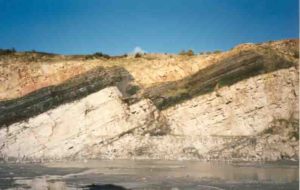
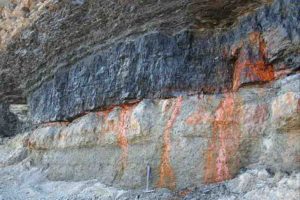
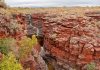
Quarry face showing 2 normal fault surfaces in the Upper Carboniferous sandstone and shale sequence of Round O Quarry, Lancashire, UK. Credit: University College Dublin
A fault is a planar fracture or discontinuity in a volume of rock, across which there has been significant displacement as a result of rock-mass movement.
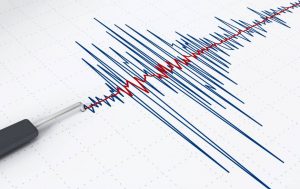
Not every crack in the ground is a fault. What defines a fault is the movement of the rock on either side. When that movement is sudden, the released energy causes an earthquake. Some faults are tiny, but others are part of great fault systems along which rocks have slid past each other for hundreds of miles.
Large faults within the Earth’s crust result from the action of plate tectonic forces, with the largest forming the boundaries between the plates, such as subduction zones or transform faults. Energy release associated with rapid movement on active faults is the cause of most earthquakes.
A fault plane is the plane that represents the fracture surface of a fault. A fault trace or fault line is the intersection of a fault plane with the ground surface. A fault trace is also the line commonly plotted on geologic maps to represent a fault.
Since faults do not usually consist of a single, clean fracture, geologists use the term fault zone when referring to the zone of complex deformation associated with the fault plane.
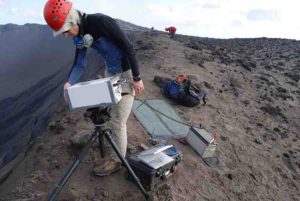
Simon Carn measures gas emissions from Mount Yasur in the island nation of Vanuatu in 2014. Credit: Simon Carn
Late last month, a stratovolcano in Bali named Mount Agung began to smoke. Little earthquakes trembled beneath the mountain. Officials have since evacuated thousands of people to prevent what happened when Agung erupted in 1963, killing more than 1,000 people.
Before volcanoes erupt, there are often warning signs. Tiny earthquakes rarely felt by humans but sensed by seismographs emanate from the volcano. Plumes of water vapor rise from the crater. When the volcano begins to emit gases like carbon dioxide and sulfur dioxide, eruption may be imminent.
But getting close to the top of a volcano is dangerous work. Using remote sensing to detect rising carbon dioxide and sulfur dioxide emissions without endangering people or equipment would greatly increase human understanding of volcanoes. Remote sensing emissions could prevent humanitarian disasters—and false alarms.
Mount Agung hasn’t erupted yet (at the time this article was written), but seismic activity remains intense. Balinese officials are beginning to wonder if an eruption truly is imminent; the people who were evacuated from the area want to return to their homes and tourism is down.
Researchers including Michigan Technological University volcanologist Simon Carn have published a collection of papers including “Spaceborne detection of localized carbon dioxide sources” in the journal Science; the article details the first-known measurement of localized anthropogenic and natural carbon dioxide sources from a satellite in low-Earth orbit.
The five papers in the OCO-2 Science Special Collection showcase the abilities of NASA’s Orbiting Carbon Observatory-2 (OCO-2) satellite; measurements from the satellite’s sensors provide insights into how carbon links everything on Earth. The research is supported by NASA’s Jet Propulsion Laboratory.
Monitoring CO2 Emissions From Space
The paper Carn co-authored discusses how the research team has taken high-resolution, sensitive spaceborne measurements of atmospheric carbon dioxide at the kilometer scale. This data reveals that the satellite’s sensors are able to pinpoint localized sources of carbon dioxide in the atmosphere—a difficult task considering the sheer amount of background carbon dioxide in the atmosphere to begin with.
The satellite uses spectrometry; the sensors onboard the satellite measure reflected sunlight—radiation—in high-spectral resolution using wavelengths undetectable to the human eye. When light passes through carbon dioxide, some is absorbed by the gas. The remaining light bounces off the ocean and the Earth. The OCO-2 sensors measure the light that bounces back to quantify what was absorbed by carbon dioxide, allowing scientists to isolate emission sources, whether human or natural.
“The main focus of the article is detecting localized, point-source emissions of carbon dioxide as opposed to measuring the broad-scale concentration in the atmosphere,” says Carn, an associate professor in the Department of Geological and Mining Engineering and Sciences. “Volcanoes can be strong, localized sources of carbon dioxide. But on a global basis, all available evidence indicates that human activities are emitting much more carbon dioxide than volcanoes.”
The OCO-2 satellite’s spatial resolution—2.25 kilometers—is high enough that chemical signals are not diluted. However, while OCO-2’s measurements are unprecedented, the satellite cannot be used as a routine volcano monitoring tool because it does not pass over the same place on the Earth frequently enough.
“This is a demonstration that the technique does work, but we need better sensors before it becomes a routine monitoring tool, especially for volcanoes where we expect rapid changes in gas emissions,” Carn says. “If we could measure volcanic carbon dioxide from space routinely, it would be a very powerful addition to the techniques we use. That kind of observation would be useful (for Agung) right now.”
Carn combed through satellite data to find detectable spaceborne carbon dioxide measurements from three volcanoes in the Pacific island nation of Vanuatu. One of these, Mount Yasur, has been erupting since at least the 1700s, and on the day of the OCO-2 measurement was emitting carbon dioxide about 3.4 parts per million above background atmospheric levels, equal to about 42 kilotons of emissions. In comparison, human emissions average 100,000 kilotons a day.
OCO-2’s sensors also measured carbon dioxide emissions over the Los Angeles basin, detecting a sort of carbon dioxide “dome”. Urban areas account for more than 70 percent of anthropogenic emissions.
“Natural processes on Earth are currently able to absorb about half of human fossil fuel emissions,” says Annmarie Eldering, OCO-2 deputy project scientist at NASA’s Jet Propulsion Laboratory in Pasadena, California, and lead author of an overview paper in Science on the state of OCO-2 science. “If those natural processes falter, slowing down the helpful removal of carbon dioxide, greenhouse-gas-induced warming would accelerate and intensify. These data begin to give us a better view of how climate affects the carbon cycle, reducing the huge uncertainty around how both might change in the future.”
The OCO-2 measurements across Los Angeles were detailed enough to capture differences in concentrations within the city resulting from localized sources. They also tracked diminishing carbon dioxide concentrations as the spacecraft passed from over the crowded city to the suburbs and out to the sparsely populated desert to the north.
Reference:
Florian M. Schwandner et al, Spaceborne detection of localized carbon dioxide sources, Science (2017). DOI: 10.1126/science.aam5782
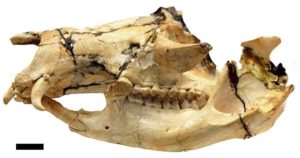
Fanged kangaroos – an extinct family of small fanged Australian kangaroos – might have survived at least five million years longer than previously thought.
A University of Queensland-led study has found the species might have competed for resources with ancestors of modern kangaroos.
Research into species diversity, body size and the timing of extinction found that fanged kangaroos, previously thought to have become extinct about 15 million years ago, persisted to at least 10 million years ago.
The fanged kangaroos, including the species Balbaroo fangaroo, were about the size of a small wallaby.
UQ School of Earth and Environmental Sciences PhD student Kaylene Butler said the research involved Queensland Museum holdings of ancient fossil deposits from the Riversleigh World Heritage Area, where kangaroo fossil evidence goes back as far as 25 million years.
“Fanged kangaroos and the potential ancestors of modern kangaroos are both browsers – meaning they ate leaves – and they scurried, but did not hop,” Ms Butler said.
“Northern Queensland was predominantly covered in rainforest when these fanged kangaroos first appear in the fossil record.
“There is a lot of research to be done before we can be sure what their canine teeth were used for but some have suggested they were used to attract potential mates. We do know that despite their large canines they were herbivorous (plant eaters).
“We found that fanged kangaroos increased in body size right up until their extinction.”
Ms Butler said the research aimed to fill significant gaps in the understanding of kangaroo evolution, and new fossil finds were helping to bring ancient lineages into focus.
“Currently 21 macropod species are listed as vulnerable or endangered on the International Union for the Conservation of Nature Red List of Threatened Species,” she said.
She said understanding when and why kangaroos went extinct in the past could help with understanding what drove extinction of such animals.
“Currently, we can only hypothesise as to why balbarids became extinct – the original hypothesis related to events during a change in climate 15 million years ago but the balbarids persisted past that,” she said.
“This new finding of their persistence until 10 million years ago means something else must have been at play, such as being outcompeted by other species.”
Ms Butler last year discovered two new ancient species of kangaroo, Cookeroo bulwidarri and Cookeroo hortusensis.
Reference:
Kaylene Butler et al. Species abundance, richness and body size evolution of kangaroos (Marsupialia: Macropodiformes) throughout the Oligo-Miocene of Australia, Palaeogeography, Palaeoclimatology, Palaeoecology (2017). DOI: 10.1016/j.palaeo.2017.08.016
A closer look at the bobcat-like fossil animal uncovered in Tanzania. Credit: Matthew Borths
Paleontologists working in Tanzania have identified a new species of hyaenodont, a type of extinct meat-eating mammal. The study is published today, National Fossil Day, in the journal PLOS ONE and funded by the National Science Foundation (NSF).
After the extinction of the non-avian dinosaurs 66 million years ago, hyaenodonts were the main predators on the African continent. The newly discovered animal is called Pakakali rukwaensis, the name derived from the Swahili term “pakakali,” meaning “fierce cat,” and “rukwaensis,” the word for the Rukwa Rift region of the Great Rift Valley in southwestern Tanzania.
Between 23 and 25 million years ago, newcomers arrived in Africa—the first relatives of modern dogs, cats and hyenas—where they coexisted with hyaenodonts for millions of years. But eventually, hyaenodonts went extinct.
“The shift from hyaenodonts to modern carnivores in Africa is like a controlled experiment,” says study co-author Matthew Borths of Ohio University.
“We start with only hyaenodonts. Then the relatives of cats and dogs arrive. They coexist for a few million years, then the hyaenodonts are driven to extinction and we’re left with ‘The Lion King.’ With Pakakali, we can start to unravel that extinction. Were the lineages competing? Were they adapting differently to a drier, more open landscape?”
The new fossil helps researchers unravel extinction dynamics for predatory mammals stalking African ecosystems of that long-ago time.
“This new carnivore, discovered in Tanzania sediment deposits dating from 25 million years ago, provides new information about the transition of carnivores in older ecosystem types to carnivores in today’s African ecosystems,” says Judy Skog, program director in NSF’s Division of Earth Sciences, which funded the research.
The new hyaenodont species was discovered in the same 25 million-year-old rocks as the oldest fossil evidence of the split between Old World monkeys and apes. At that time, the ecosystem was undergoing dramatic climate and tectonic upheavals as Africa collided with Eurasia and the modern East African Rift System formed.
The fossil gives paleontologists a glimpse of hyaenodont anatomy before modern carnivores invaded the continent, revealing that Pakakali was about the size of a bobcat.
Based on the findings of the study, hyaenodonts may have been pushed to become more specialized meat-eaters due to competition from other species. That dietary specialization may have made hyaenodonts more vulnerable to extinction in the changing African ecosystem by leaving them with fewer food choices.
Pakakali was discovered by an international team of scientists from the United States, Australia and Tanzania as part of the Rukwa Rift Basin Project (RRBP), an interdisciplinary collaboration examining the development of the modern African ecosystem. In more than a decade of exploration, RRBP researchers have described the habitat Pakakali called home along with many other animals that occupied the ecosystem.
“The environment containing Pakakali reveals a fascinating window into extinction,” says Nancy Stevens, co-author of the study and a paleontologist at Ohio University. “It highlights the vulnerability of carnivorous species to rapid environmental change, a topic we are grappling with on the African continent today.”
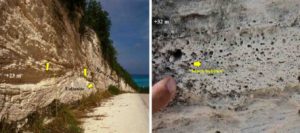
The image on the left shows eolian (lower) and runup bedding (upper) exposed in a roadcut on Old Land Road on Great Exuma Island (road elevation +23 meters). On the right are thick beds with fenestral porosity, or ‘beach bubbles,’ showing that massive waves ran up over older dunes exposed in a roadcut on Suzy Turn Road along the Atlantic Ocean east side of Providenciales, Turks and Caicos Islands, BWI. Credit: Marine Geology
While strong seasonal hurricanes have devastated many of the Caribbean and Bahamian islands this year, geologic studies on several of these islands illustrate that more extreme conditions existed in the past. A new analysis published in Marine Geology shows that the limestone islands of the Bahamas and Bermuda experienced climate changes that were even more extreme than historical events. In the interest of our future world, scientists must seek to understand the complexities of linked natural events and field observations that are revealed in the geologic record of past warmer climates.
In Bermuda and the Bahamas, the geology of the last interglacial (LIG; approximately 120,000 years ago) is exquisitely preserved in nearly pure carbonate sedimentary rocks. A record of superstorms and changing sea levels is exposed in subtidal, beach, storm, and dune deposits on multiple islands. Extensive studies by the authors over the past decades on these islands have documented stratigraphic, sedimentologic, and geomorphic evidence of major oceanic and climatic disruptions at the close of the last interglacial.
Dr. Paul J. Hearty, a retired Associate Professor at the University of North Carolina at Wilmington, and Dr. Blair. R. Tormey, a Coastal Research Scientist at Western Carolina University conducted an invited review of published findings. It demonstrates that during a global climate transition in the late last interglacial, also known as marine isotope substage 5e (MIS 5e), abrupt multi-meter sea-level changes occurred. Concurrently, coastlines of the Bahamas and Bermuda were impacted by massive storms generated in the North Atlantic Ocean, resulting in a unique trilogy of wave-transported deposits: megaboulders, chevron-shaped, storm-beach ridges, and runup deposits on high dune ridges.
While perhaps more mundane than the megaboulders (found only locally on Eleuthera), the sedimentological structures found within chevron ridge and runup deposits across islands throughout the Bahamas and Bermuda point to frequent and repeated inundation by powerful storm waves, in some locations leaving storm deposits tens of meters above sea level.
During the last interglacial, sea levels were about 3-9 meters higher than they are now. The geologic evidence indicates that the higher sea-levels were accompanied by intense “superstorms,” which deposited giant wave-transported boulders at the top of cliffed coastlines, formed chevron-shaped, storm beach ridges in lowland areas, and left wave runup deposits on older dunes more than 30 meters above sea level. These events occurred at a time of only slightly warmer global climate and CO2 (about 275 ppm) was much lower than today.
The authors emphasize “the LIG record reveals that strong climate forcing is not required to yield major impacts on the ocean and ice caps.” In our industrial world, rapidly increasing atmospheric CO2 has surpassed 400 ppm, levels not achieved since the Pliocene era about 3 million years ago, while global temperature has increased nearly 1 °C since the 1870s. Today, ice sheets are melting, sea level is rising, oceans are warming, and weather events are becoming more extreme.
Drs. Hearty and Tormey conclude that with the greatly increased anthropogenic CO2 forcing at rates unmatched in nature, except perhaps during global extinction events, dramatic change is certain. They caution that, “Our global society is producing a climate system that is racing forward out of humanity’s control into an uncertain future. If we seek to understand the non-anthropogenic events of the last interglaciation, some of the consequences of our unchecked forward speed may come more clearly into focus…a message from the past; a glimpse into the future.”
Reference:
P.J. Hearty, B.R. Tormey. Sea-level change and superstorms; geologic evidence from the last interglacial (MIS 5e) in the Bahamas and Bermuda offers ominous prospects for a warming Earth. Marine Geology, 2017; 390: 347 DOI: 10.1016/j.margeo.2017.05.009
Note: The above post is reprinted from materials provided by Elsevier.
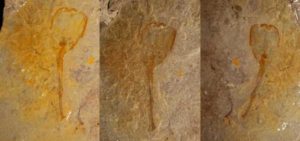
This is the only example of a species that lived in Utah during the mid Cambrian. Researchers believe the specimen probably drifted away from a community of similar stalked filter feeders. Credit: Julien Kimmig | KU News Service
To the untrained eye, it looks like a flower crudely etched into rock — as if a child had scratched a picture of a bloom. But to the late fossil hunter Lloyd Gunther, the tulip shape he unearthed at Antimony Canyon in northern Utah looked like the remnant of an ancient marine animal.
Years ago, Gunther collected the rock and later gave it to researchers at the University of Kansas’ Biodiversity Institute — just one among thousands of such fossils he donated to the institute over the years.
But this find was the only fossilized specimen of a species previously unknown to science — an “obscure” stalked filter feeder. It has just been detailed for the first time in a paper appearing in the Journal of Paleontology.
“This was the earliest specimen of a stalked filter feeder that has been found in North America,” said lead author Julien Kimmig, collections manager for Invertebrate Paleontology at the Biodiversity Institute. “This animal lived in soft sediment and anchored into the sediment. The upper part of the tulip was the organism itself. It had a stem attached to the ground and an upper part, called the calyx, that had everything from the digestive tract to the feeding mechanism. It was fairly primitive and weird.”
Kimmig researches the taxonomy, stratigraphy and paleoecology of the Cambrian Spence Shale found in Utah and Idaho, where Gunther found the obscure filter feeder.
“The Spence Shale gives us soft-tissue preservation, so we get a much more complete biota in these environments,” he said. “This gives us a better idea of what the early world was like in the Cambrian. It’s amazing to see what groups of animals had already appeared over 500 million years ago, like arthropods, worms, the first vertebrate animals — nearly every animal that we have around today has a relative that already lived during those times in the Cambrian.”
In honor of fossil hunter Gunther, a preeminent collector who performed fieldwork from the 1930s to the 2000s, Kimmig and Biodiversity Institute colleagues Luke Strotz and Bruce Lieberman named the newly described species Siphusauctum lloydguntheri.
The stalked filter feeder is just the second animal placed within its genus, and the first Siphusauctum to be discovered outside the Burgess Shale, a fossil-rich deposit in the Canadian Rockies.
“What these animals were doing was filtering water to get food, like micro-plankton,” Kimmig said. “The thing is, where this one was located we only found a single specimen over a period of 60 years of collecting in the area.”
Kimmig said it isn’t yet known if the newly discovered stalked filter feeder lived a highly solitary life or if it drifted off from a community of similar animals.
“It’s hard to tell from a single specimen,” he said. “There were algae found right next to it, so it likely was transported there. The algae found with it were planktonic algae that were floating themselves. It could have fallen just next to it — but that would be a big coincidence — so that’s why we’re thinking it came loose from somewhere else and got mixed in with the algae.”
Kimmig and his KU colleagues say the newly described specimen varies in key areas from similar known species of stalked filter feeders from the Cambrian.
“There are several differences in how the animal looked,” Kimmig said. “If you look at the digestive tract preserved in this specimen, the lower digestive tract is closer to the base of the animal compared to other animals. The calyx is very slim — it looks like a white wine glass, whereas in other species it looks like a big goblet. What we don’t have in this specimen that the others have are big branches for filter feeding. We don’t know if those weren’t preserved or if this one didn’t have them.”
According to the researchers, there are no species alive today that claim lineage to Siphusauctum lloydguntheri. But Kimmig said there were a few contemporary examples that share similarities.
“The closest thing to the lifestyle — but not a relative — would be crinoids, commonly called sea lilies,” he said. “Unfortunately, there’s likely not a relative of Siphusauctum in the world anymore. We have thousands of similar fossil specimens in the Burgess Shale, but it’s hard to identify what these animals actually were. It might be possibly related to contemporary entoprocts, which are a lot smaller than this one — but it’s hard to tell if they’re related at all.”
Ultimately, the mysterious stalked filter feeder is a reminder of the strange and vast arc of evolution where species continuously come and go, according to Kimmig.
“It is enigmatic because we don’t have anything living that is exactly like it,” he said. “What is fascinating about this animal is we can clearly relate it to animals existing in the Cambrian and then we just don’t find it anymore. It’s just fascinating to see how evolution works. Sometimes it creates something — and it just doesn’t work out. We have some lineages like worms that lived long before the Cambrian and haven’t changed in appearance or behavior, then we have things that were around for a couple of million years and just disappeared because they were chance victims of mass extinctions.”
Reference:
Julien Kimmig, Luke C. Strotz, Bruce S. Lieberman. The stalked filter feeder Siphusauctum lloydguntheri n. sp. from the middle Cambrian (Series 3, Stage 5) Spence Shale of Utah: its biological affinities and taphonomy. Journal of Paleontology, 2017; 91 (05): 902 DOI: 10.1017/jpa.2017.57
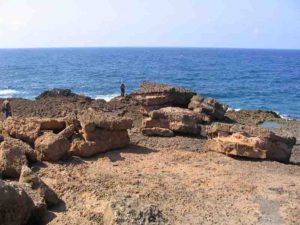
The boulders on the Tipaza coast of Algeria that would have been deposited in a high-energy event. Credit: C. Morhange
A review of geological evidence for tsunamis during the past 4500 years in the Mediterranean Sea has revealed that as many as 90 per cent of these inundation events may have been misinterpreted by scientists and were due to storm activity instead.
“Understanding the true incidence of devastating tsunamis is vital for assessing the current risk and introducing appropriate protective strategies for densely populated coastal cities,” says study senior author and UNSW Sydney scientist Honorary Professor James Goff.
“Yet discriminating between tsunamis and storm deposits is one of the most challenging and hotly debated areas of coastal geoscience.
“Following intense media coverage of events like the devastating 2004 Indian Ocean tsunami, there has been a marked increase in geological research reporting evidence for past tsunamis in the Mediterranean.
“Our provocative and timely study suggests that up to 90 per cent of the claims for tsunamis having occurred in the Mediterranean in the past 4500 years need to be reconsidered. The risk from this hazard could have been significantly overstated in this region,” Professor Goff says.
The study, by an international team of scientists from UNSW, the French National Centre for Scientific Research, and the universities of Toulouse, Aix-Marseille and Exeter, is published in the journal Science Advances.
About 130 million people live around the Mediterranean Sea and it is one of the world’s leading tourist destinations, with more than 230 million visitors a year.
Geological evidence for past tsunamis includes the presence of large boulders on rocky coastlines, coarse sedimentary deposits in coastal lagoons, and high-energy marine deposits a long way inland.
The team studied 135 past events in eight Mediterranean countries that had been identified in the scientific literature as tsunamis on the basis of geological evidence, and which had been dated using a variety of scientific techniques.
“We compared these events with storm records for the same period,” says study first author Dr Nick Marriner of the French National Centre for Scientific Research.
“We found the dates for the tsunamis peaked every 1500 years – at about 200, 1600 and 3100 years ago. This matched well with 1500-year climate cycles of cooling in the Mediterranean and North Atlantic and heightened storm activity.
“This suggests most of the geological evidence is related to periods of severe storms, rather than tsunamis.”
The Mediterranean is famous for one of the most catastrophic tsunamis of all time – the tsunami caused by the Santorini eruption almost 3500 years ago that devastated the civilisation of Crete, leading to the legend of the lost city of Atlantis.
Reference:
N. Marriner el al., “Tsunamis in the geological record: Making waves with a cautionary tale from the Mediterranean,” Science Advances (2017). DOI: 10.1126/sciadv.1700485
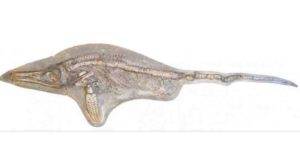
This is a skeleton of new species Protoichthyosaurus applebyi at University of Nottingham. Credit: Copyright University of Nottingham & Dean R. Lomax
An ichthyosaur first discovered in the 1970s but then dismissed and consigned to museum storerooms across the country has been re-examined and found to be a new species.
In 1979, after inspecting several ichthyosaurs from the UK, palaeontologist Dr Robert Appleby announced a new type of ichthyosaur called Protoichthyosaurus. He also named two species, P. prostaxalis and P. prosostealis. Other scientists, however, dismissed the discovery of Protoichthyosaurus and suggested that it was identical with Ichthyosaurus, a very common UK ichthyosaur.
Now a detailed study led by palaeontologists Dean Lomax (The University of Manchester) and Professor Judy Massare (State University of New York), has re-examined and compared Protoichthyosaurus and Ichthyosaurus. It found major differences in the number of bones in the front fin, or forefin, of both species. This fundamental difference probably reflects the way both species used them to manoeuvre whilst swimming. Differences were also found in the skulls. But it was another discovery about the fins that also got the team’s attention.
Lomax explains: “This unusual forefin structure was originally identified by Robert Appleby in 1979, but some of the historic specimens he examined had been ‘faked’, and this fakery had been missed until now. In some instances, an isolated fin of an Ichthyosaurus had been added to a Protoichthyosaurus skeleton to make it appear more complete, which led to the genuine differences being missed. This has been a major problem because it stopped science from progressing. We also found some pathological fins, including Ichthyosaurus fins with pathologies that mimic the Protoichthyosaurus forefin structure.”
Lomax and Massare also teamed up with former undergraduate student Rashmi Mistry (University of Reading), who had been studying an unusual ichthyosaur in the collections of the Cole Museum of Zoology, University of Reading, for her undergraduate dissertation.
“Whilst doing my dissertation in 2016, I studied several ichthyosaurs in the collections, including a very small skeleton. It had an unusual forefin that matched Protoichthyosaurus, which I understood to be a widely unrecognised genus. However, when I contacted Dean, he was very excited. He told me that this little skeleton is the only known small juvenile Protoichthyosaurus,” added Rashmi.
Over 20 specimens of Protoichthyosaurus were identified as part of this study. This is significant as each specimen (with a forefin) has the same structure. The specimens are from the Jurassic Period, between 200 — 190 million years old, and come from Somerset, Dorset, Leicestershire, Warwickshire, Nottinghamshire, England, and Glamorgan, Wales.
Whilst searching through collections, Dean also came across a skeleton at The University of Nottingham. This specimen is different to all other known examples of Protoichthyosaurus in the skull and humerus and it has been identified as a new species, which the team have called Protoichthyosaurus applebyi, in honour of Robert Appleby. It is currently on display as part of the ‘Dinosaurs of China’ exhibition at Lakeside Arts, University of Nottingham.
Reference:
Dean R. Lomax, Judy A. Massare, Rashmiben T. Mistry. The taxonomic utility of forefin morphology in Lower Jurassic ichthyosaurs: Protoichthyosaurus and Ichthyosaurus. Journal of Vertebrate Paleontology, 2017; e1361433 DOI: 10.1080/02724634.2017.1361433
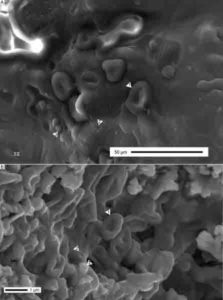
Electron microscopy of abiotically-formed structures as an explanation for ‘dinosaur blood’. A) Moderately matured turkey skin. B) Proposed blood-like structures in a dinosaur bone (modified from Bertazzo et al. (2015, online Supplementary Fig. 3c) and used under Creative Commons CC-BY license). Presented here with a defined scale bar. Arrowheads indicate several shared structures: (1) concave bulge/fold continuous with the underlying organic material; (2) pit/simple fold; (3) spherical bulge. Credit: University of Bristol
Their findings demonstrate that previous claims showing the preservation of keratin protein in dinosaur fossils are likely to be false.
Similarly, widely publicised claims of dinosaur blood in fossil bones were shown to likely represent an artefact of degraded organic matter rather than actual blood cells.
The researchers undertook experimental treatments that either used microbes to decay tissues or subjected tissues to intense heat and pressure — a process known as maturation — in order to mimic the conditions a fossil experiences deep underground.
Evan Saitta from the University of Bristol’s School of Earth Science, led the research which has been published in the journal Palaios.
He said: “Decay and mild maturation resulted in some intriguing textural differences in degradation patterns based on the type of keratin such as curling versus crimping of filaments when matured.
“These results may show promise for identifying relatively recent archaeological keratin remains but when maturation conditions are increased to simulate conditions present during burial and fossilisation, the keratin degrades into a foul-smelling, water-soluble fluid that can dissolve or leach away from the fossil.”
In another experiment the vacuum conditions of an electron microscope appear to have produced folds, pits and blebs in a sample of degraded turkey skin, similar to those features previously suggested to represent dinosaur blood cells.
The range of sizes and shapes of these experimental and fossil structures is evidence that they form through a non-biological process, as opposed to a biological process like the formation of cells.
Thus, the purported blood cells in these dinosaur bones are likely to be degraded organics, most likely from microbes that invaded the cavities in the bone rather than exceptionally preserved, easily-degradable blood cells.
Saitta added: “We’ve shown that different keratin types show intriguing differences in degradation patterns that might help identify keratinous remains in archaeological material.
“However, when the processes of fossilisation and burial over deep time are simulated, keratin protein fully degrades into a fluid that can be lost from fossils, meaning little utility for studying paleontological remains despite contrary claims.”
Reference:
Jakob Vinther et al. Experimental taphonomy of keratin: A structural analysis of early taphonomic changes. Palaios, October 2017 DOI: 10.2110/palo.2017.051
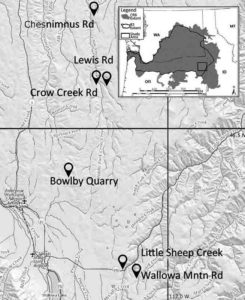
WSU researchers sampled sulfur dioxide trapped in rock near lava vents to gauge how much gas was put in the air by massive basalt flows 16.5 million years ago. The inset map shows the extent of the flows, with the region in the black line showing the Wapshilla Ridge flow that emitted more than 200 billion tons of sulfur dioxide. Credit: WSU
Washington State University researchers have determined that the Pacific Northwest was home to one of the Earth’s largest known volcanic eruptions, a millennia-long spewing of sulfuric gas that blocked out the sun and cooled the planet.
Only two other eruptions—the basalt floods of the Siberian Traps and the Deccan Traps—were larger, and they led to two of the Earth’s great extinctions.
“This would have been devastating regionally because of the acid-rain effect from the eruptions,” said John Wolff, a professor in the WSU School of the Environment. “It did have a global effect on temperatures, but not drastic enough to start killing things, or it did not kill enough of them to affect the fossil record.”
The research, which was funded by the National Science Foundation, appears in Geology, the top journal in the field. Starting 16.5 million years ago, they say, vents in southeast Washington and northeast Oregon put out a series of flows that reached nearly to Canada and all the way to the Pacific Ocean. The flows created the Wapshilla Ridge Member of the Grande Ronde Basalt, a kilometer-thick block familiar to travelers in the Columbia Gorge and most of Eastern Washington. The researchers say it is “the largest mapped flood basalt unit on Earth.”
The researchers estimate that, over tens of thousands of years, the floods put out between 242 and 305 billion tons of sulfur dioxide. That’s more than 4,000 times the output of the 1815 Mount Tambora eruption in present-day Indonesia. That eruption blanketed the Earth in an aerosol veil, creating the “Year Without A Summer” and food shortages across the northern hemisphere.
The volume of gas emitted from the Wapshilla Ridge lavas, said the researchers, “is equivalent to a Tambora eruption every day for 11 to 16 years.”
Most of the lava’s gases were released during the eruptions, but some of the gas remained trapped in crystals near the volcanic vents. Klarissa Davis, lead author of the paper, analyzed the gases as part of her doctoral studies. The other authors are Michael Rowe, now at the University of Auckland, and Owen Neill, now at the University of Michigan.
Wolff puts the eruption into one of three classes of cataclysms, the other two being a caldera eruption like the Yellowstone volcano and the impact of an asteroid. A similar eruption today “would devastate modern society globally,” said Wolff.
The eruption also provides an insight into the workings of climate change. It took place in what is known as the Miocene Climactic Optimum, or MCO, when some 50 million years of cooling was interrupted by 5 to 6 degrees Fahrenheit of warming. But at its peak, the MCO had a brief cooling period that coincides with the Wapshilla eruption and its profusion of sulfur dioxide.
Sulfur dioxide is now bandied about as a possible tool for engineering a break in the Earth’s current warming trend, though Wolff is not particularly keen on the idea.
“I personally think that it’s probably a dangerous thing to do without understanding all of the possible consequences,” he said. “But maybe we’re getting an idea of some possible consequences here.”
Reference:
Klarissa N. Davis et al, Sulfur release from main-phase Columbia River Basalt eruptions, Geology (2017). DOI: 10.1130/G39371.1
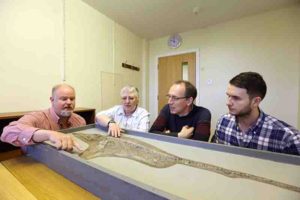
(L-R) Bill Wahl, Prof Judy Massare, Dr David Large and Dean Lomax Credit: The University of Nottingham
A new species of ichthyosaur has been identified from a fossil that has been in the University of Nottingham’s engineering collection for over half a century.
The University’s specimen, announced today as Protoichthyosaurus applebyi, is a holotype – the valuable original specimen that describes a new species. It is the first known fossil of its kind anywhere in the world, which makes it even more scientifically significant.
Dr David Large, a geologist and Head of the Department of Chemical and Environmental Engineering, who joined the University in 1995, had used the specimen for teaching and outreach work while visiting primary schools to encourage children to explore science and engineering. The fossil, which was a hit with children, had faded into obscurity and was forgotten about for years. However, it was rediscovered not long ago, sitting on a shelf in a storeroom. Recognising its rarity and uniqueness, Dr Large retrieved the fossil and his effort enabled palaeontologists and scientists to study the specimen in greater detail.
Dean Lomax, a palaeontologist and Visiting Scientist at The University of Manchester, contacted Dr Large in 2014 while searching for another ichthyosaur fossil and was unaware that the newly-found specimen even existed as it had not been scientifically examined before. Eventually it was determined that this specimen is of a species new to science. It has been hailed as a major step in uncovering Britain’s early fossil past and understanding ichthyosaur evolution.
Dean recently published his findings on the fossil in the Journal of Vertebrate Palaeontology in collaboration with Professor Judy Massare of State University of New York, USA, and Rashmi Mistry, a former student at the University of Reading.
He said, “This ichthyosaur is an essential part of Nottingham’s scientific collection and I’d like to thank David for bringing it to my attention. As part of our study we have identified over 20 specimens of Protoichthyosaurus, but only one example of P. applebyi, making this the only known specimen recorded so far. I’m confident that there will be more out there. This particular ichthyosaur dates back to the Early Jurassic period and lived around 200 million years ago. As part of the wider study, Protoichthyosaurus has improved our understanding of the evolutionary changes in the forefins of ichthyosaurs, which set it apart from other species. This small- to medium-sized species would have probably been less than 2m in length, swimming in large numbers in the seas around Britain when the dinosaurs roamed the land.”
Professor Andy Long, Pro-Vice-Chancellor, Faculty of Engineering said, “I am delighted with today’s announcement that a new species of ichthyosaur has been discovered in the University’s collections. This is not the kind of thing that engineering faculties report every day and it’s the first time that our Faculty can claim to have discovered a new species. David’s passion for geology helped him to recognise the fossil’s importance. The Faculty has carefully restored the fossil and categorised it with information on what it is, where it came from and how it lived.
“We get visiting researchers from all over the world to share their expertise with our staff and students, including Dean and Judy who came to examine, photograph and document the specimen in greater detail. All these studies form the basis of a constantly growing research effort here at Nottingham.”
Dr Large added, “When I first saw the fossil, I knew it was special and I am delighted that Dean has confirmed just how special it is. A new species of ichthyosaur is exciting and this particular one is a unique example of its kind. The fossil was a great way to introduce a young audience to science and it got many children asking the right questions about palaeontology. I’m delighted that we saved the fossil and it’s been great to have the faculty’s support in bringing this specimen to a wider audience. We’re now using the latest technology to find out more about this unique animal.”
The University’s fossil is named after Dr Robert Appleby, the palaeontologist who first announced the discovery of the genus Protoichthyosaurus in 1979.
This ichthyosaur is now on display as part of the one-time only world exclusive Dinosaurs of China exhibition at Lakeside Arts. The exhibition emerged from the research carried out by Dr Wang Qi, an Assistant Professor in Architecture who specialises in exhibition and museum design.
There are plans for the fossil to undergo CT scanning to create detailed images which can be studied further in addition to casting and 3D printing to fill in the missing parts.
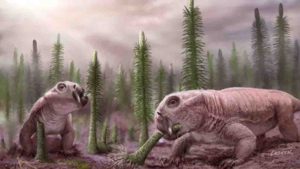
Lystrosaurus, an early relative of mammals whose fossils are known from Russia, China, India, Africa and Antarctica. Image courtesy of Victor O. Leshyk.
Two of Earth’s five mass extinction events — times when more than half of the world’s species died — resulted in the survival of a low number of so-called “weedy” species that spread their sameness across the world as Earth recovered from these dramatic upheavals. The findings could shed light on modern high extinction rates and how biological communities may change in the future.
David J. Button, an NC State and North Carolina Museum of Natural Sciences postdoctoral research scholar, and colleagues examined fossil records of almost 900 vertebrate species dating back between 260 and 175 million years ago — from the late Permian through the Triassic and early Jurassic periods. Two mass extinction events occurred during this time. Button says that similar patterns arising after two mass extinctions implies that other extinction events may have the same results — including current biodiversity loss.
“Mass extinctions not only reduced animal diversity, but also affected the distribution of animals and ecosystems, or biogeography,” Button said. “As species are removed by extinction, their ecological niches are left vacant. Following the extinction event, these niches are occupied by surviving and newly evolving ‘weedy’ species. These few generalists spread out and dominated for a time, leading to a low-diversity global ‘disaster fauna.'”
One of these generalists was the Lystrosaurus, a plant-eating early mammal relative that ranged from dog- to pig-sized. It had tusks to help it dig up plant matter.
The late-Permian event — occurring around 252 million years ago — allowed new groups to evolve, including the earliest dinosaurs, crocodiles and relatives of mammals and lizards, Button said. The late-Triassic event, which occurred around 201 million years ago, wiped out many major groups, setting the stage for dinosaurs to take over.
“The late-Permian event caused about 90 percent of sea life and 70 percent of land-living vertebrates to become extinct, probably as a result of climate change from hyperactive volcanism — when volcanoes spewed basalt lava and released gases into the atmosphere causing large increases in carbon dioxide and severe warming resulting in desertification,” Button said. “The late-Triassic event is also associated with volcanism.”
“Mass extinctions were global disasters that fundamentally reshaped ecosystems,” said Richard Butler, professor of palaeobiology at the University of Birmingham and a co-author of the study. “Our new analyses provide crucial data that show just how profoundly these cataclysmic events changed and influenced animal distribution.”
“The fossil record has the potential to test evolutionary hypotheses in long time spans, which is not possible if evolutionary research is limited to living plant and animals,” said Martín Ezcurra, a researcher at the Museo Argentino de Ciencias Naturales who co-authored the paper.
Identifying patterns across mass extinction events in the fossil record can help researchers make predictions about the consequences of current biodiversity loss, Button said.
“Further understanding of these ancient crises will help to inform conservation efforts to prevent modern animals from suffering a similar fate,” he added.
Graeme T. Lloyd of the University of Leeds also co-authored the paper, which is published in Nature Communications. The study was funded by a Marie Curie Actions grant (630123), a European Research Council Starting Grant (637483) and a Discovery Early Career Researcher (DE140101879) award.
Reference:
David J. Button, Graeme T. Lloyd, Martín D. Ezcurra, Richard J. Butler. Mass extinctions drove increased global faunal cosmopolitanism on the supercontinent Pangaea. Nature Communications, 2017; 8 (1) DOI: 10.1038/s41467-017-00827-7
Representative Image:Coastal exposure of the Point Aconi Seam (bituminous coal; Pennsylvanian) exposed at Point Aconi, Nova Scotia. Credit: Michael C. Rygel via Wikimedia Commons
While burning coal today causes Earth to overheat, about 300 million years ago the formation of that same coal brought our planet close to global glaciation. For the first time, scientists show the massive effect in a study to be published in the Proceedings of the US Academy of Sciences. When trees in vast forests died during a time called the Carboniferous and the Permian, the carbon dioxide (CO2) they took up from the atmosphere while growing got buried; the plants’ debris over time formed most of the coal that today is used as fossil fuel. Consequently, the CO2 concentration in the atmosphere sank drastically and Earth cooled down to a degree it narrowly escaped what scientists call a ‘snowball state’.
“It is quite an irony that forming the coal that today is a major factor for dangerous global warming once almost lead to global glaciation,” says author Georg Feulner from the Potsdam Institute for Climate Impact Research. “However, this illustrates the enormous dimension of the coal issue. The amount of CO2 stored in Earth’s coal reserves was once big enough to push our climate out of balance. When released by burning the coal, the CO2 is again destabilizing the Earth system.”
The study examines the sensitivity of the climate in a specific period of Earth’s deep past by using a large ensemble of computer simulations. While some of the changes in temperature at that time can clearly be attributed to how our planet’s axis was tilted and the way it circled the sun, the study reveals the substantial influence of CO2 concentrations. Estimates based on ancient soils and fossil leaves show that they fluctuated widely and at some point sank to about 100 parts CO2 per million parts of all gases in the atmosphere, and possibly even lower. The model simulations now reveal that global glaciation occurs below 40 parts per million.
Burning that same coal dangerously raises greenhouse gas concentration in our atmosphere
Today, CO2 levels in the atmosphere have reached more than 400 parts per million. Carbon dioxide acts as a greenhouse gas: the Sun warms Earth’s surface, but most of the heat radiated by the surface escapes into space; CO2 and other greenhouse gases hinder part of this heat from escaping, hence warming the planet.
“We should definitely keep CO2 levels in the atmosphere below 450 parts per million to keep our climate stable, and ideally much lower than that. Raising the amount of greenhouse gases beyond that limit means pushing ourselves out of the safe operating space of Earth,” says Feulner. “Earth’s past teaches us that periods of rapid warming were often associated with mass extinction events. This shows that a stable climate is something to appreciate and protect.”
Reference:
Georg Feulner. Formation of most of our coal brought Earth close to global glaciation. Proceedings of the National Academy of Sciences, 2017; 201712062 DOI: 10.1073/pnas.1712062114
The open lava stream continous at the kamokuna ocean entry.
Today, the stream was remarkably steady, but produced pulsating littoral explosions where the lava impacted the water
Researchers have long had good reason to believe that earthquakes are inherently unpredictable. But a new finding from Northwestern University might be a seismic shift for that old way of thinking.
An interdisciplinary team recently discovered that “slow earthquakes,” which release energy over a period of hours to months, could potentially lead to nearby “regular earthquakes.” The finding could help seismologists better forecast some strong earthquakes set to occur within a certain window of time, enabling warnings and other preparations that may save lives.
“While the build-up of stress in Earth’s crust is largely predictable, stress release via regular earthquakes is more chaotic in nature, which makes it challenging to predict when they might occur,” said Kevin Chao, a data science scholar in the Northwestern Institute on Complex Systems. “But in recent years, more and more research has found that large earthquakes in subduction zones are often preceded by foreshocks and slow earthquakes.”
Supported by the National Science Foundation, the research was published in the Journal of Geophysical Research: Solid Earth. Chao, who is also a member of Northwestern’s Center for Optimization and Statistical Learning, served as the paper’s first author. Suzan van der Lee, a professor of earth and planetary sciences in Northwestern’s Weinberg College of Arts and Sciences, also contributed to the work.
Chao and his colleagues began their work several years ago by turning to a region within Taiwan, home to approximately 100 seismic stations that have continuously recorded ground motion for years. It was there the team noticed deep tremors, a type of slow earthquake that typically recurs in days- or weeks-long cycles.
“Deep tremor is very sensitive to small stress changes,” Chao said. “So, we decided to use them as stress meters to monitor local variations in stress build-up and release before and after large earthquakes.”
To detect and monitor this deep tremor activity, Chao’s team developed a sophisticated set of algorithms and applied it to data from 10 seismic stations in Taiwan. They discovered that deep tremor started to change its behavior about two months before the occurrence of a 6.4-magnitude earthquake in March 2010 in southern Taiwan. The tremor’s duration, for example, increased by two-fold before this event and continued to increase afterwards.
Although deep tremor was first reported in 2002, scientists have not found many cases in which behavior changed before large earthquakes. “After the 6.4-magnitude earthquake occurred, we noticed a potential to study deep tremor near the event,” Chao said. “We identified the increase in tremor duration three weeks before the earthquake, but we initially could not draw conclusions because tremor rates increase all the time and for different reasons.
But three years after the 6.4-magnitude, Chao and his colleagues noticed that their observations of tremor activity coincided with nearby a GPS recording, which indicated a flip in the direction of ground motion near tremor sources.
By combining data from earth observatories, such as GPS and seismic stations, with statistics and a series of algorithms, the team showed that changes in deep tremor patterns could signal an impending earthquake nearby. To further test the finding, Chao examined four additional earthquakes and discovered that similar precursory patterns did exist. He and Van der Lee hope that this work will inspire more data-driven research in the seismology field.
“Much more data analysis of these tiny but fascinating tremor signals is necessary,” he said, “before mid- to short-term earthquake forecasting become reliable.”
Reference:
Kevin Chao, Zhigang Peng, Ya-Ju Hsu, Kazushige Obara, Chunquan Wu, Kuo-En Ching, Suzan van der Lee, Hsin-Chieh Pu, Peih-Lin Leu, Aaron Wech. Temporal variation of tectonic tremor activity in southern Taiwan around the 2010 M L 6.4 Jiashian earthquake. Journal of Geophysical Research: Solid Earth, 2017; 122 (7): 5417 DOI: 10.1002/2016JB013925
This diagram illustrates an interpretation for the origin of some deposits in the Eridania basin of southern Mars as resulting from seafloor hydrothermal activity more than 3 billion years ago. Credit: NASA
The discovery of evidence for ancient sea-floor hydrothermal deposits on Mars identifies an area on the planet that may offer clues about the origin of life on Earth.
A recent international report examines observations by NASA’s Mars Reconnaissance Orbiter (MRO) of massive deposits in a basin on southern Mars. The authors interpret the data as evidence that these deposits were formed by heated water from a volcanically active part of the planet’s crust entering the bottom of a large sea long ago.
“Even if we never find evidence that there’s been life on Mars, this site can tell us about the type of environment where life may have begun on Earth,” said Paul Niles of NASA’s Johnson Space Center, Houston. “Volcanic activity combined with standing water provided conditions that were likely similar to conditions that existed on Earth at about the same time — when early life was evolving here.”
Mars today has neither standing water nor volcanic activity. Researchers estimate an age of about 3.7 billion years for the Martian deposits attributed to seafloor hydrothermal activity. Undersea hydrothermal conditions on Earth at about that same time are a strong candidate for where and when life on Earth began. Earth still has such conditions, where many forms of life thrive on chemical energy extracted from rocks, without sunlight. But due to Earth’s active crust, our planet holds little direct geological evidence preserved from the time when life began. The possibility of undersea hydrothermal activity inside icy moons such as Europa at Jupiter and Enceladus at Saturn feeds interest in them as destinations in the quest to find extraterrestrial life.
Observations by MRO’s Compact Reconnaissance Spectrometer for Mars (CRISM) provided the data for identifying minerals in massive deposits within Mars’ Eridania basin, which lies in a region with some of the Red Planet’s most ancient exposed crust.
“This site gives us a compelling story for a deep, long-lived sea and a deep-sea hydrothermal environment,” Niles said. “It is evocative of the deep-sea hydrothermal environments on Earth, similar to environments where life might be found on other worlds — life that doesn’t need a nice atmosphere or temperate surface, but just rocks, heat and water.”
Niles co-authored the recent report in the journal Nature Communications with lead author Joseph Michalski, who began the analysis while at the Natural History Museum, London, and co-authors at the Planetary Science Institute in Tucson, Arizona, and the Natural History Museum.
The researchers estimate the ancient Eridania sea held about 50,000 cubic miles (210,000 cubic kilometers) of water. That is as much as all other lakes and seas on ancient Mars combined and about nine times more than the combined volume of all of North America’s Great Lakes. The mix of minerals identified from the spectrometer data, including serpentine, talc and carbonate, and the shape and texture of the thick bedrock layers, led to identifying possible seafloor hydrothermal deposits. The area has lava flows that post-date the disappearance of the sea. The researchers cite these as evidence that this is an area of Mars’ crust with a volcanic susceptibility that also could have produced effects earlier, when the sea was present.
The new work adds to the diversity of types of wet environments for which evidence exists on Mars, including rivers, lakes, deltas, seas, hot springs, groundwater, and volcanic eruptions beneath ice.
“Ancient, deep-water hydrothermal deposits in Eridania basin represent a new category of astrobiological target on Mars,” the report states. It also says, “Eridania seafloor deposits are not only of interest for Mars exploration, they represent a window into early Earth.” That is because the earliest evidence of life on Earth comes from seafloor deposits of similar origin and age, but the geological record of those early-Earth environments is poorly preserved.
The Johns Hopkins University Applied Physics Laboratory, Laurel, Maryland, built and operates CRISM, one of six instruments with which MRO has been examining Mars since 2006. NASA’s Jet Propulsion Laboratory, a division of Caltech in Pasadena, California, manages the project for the NASA Science Mission Directorate in Washington. Lockheed Martin Space Systems of Denver built the orbiter and supports its operations. For more about MRO, visit: https://mars.nasa.gov/mro
Reference:
Joseph R. Michalski, Eldar Z. Noe Dobrea, Paul B. Niles, Javier Cuadros. Ancient hydrothermal seafloor deposits in Eridania basin on Mars. Nature Communications, 2017; 8: 15978 DOI: 10.1038/ncomms15978
This is the model of Old Faithful’s hydrogeological system suggested by the study’s results. Credit: Sin-Mei Wu
Old Faithful is Yellowstone National Park’s most famous landmark. Millions of visitors come to the park every year to see the geyser erupt every 44-125 minutes. But despite Old Faithful’s fame, relatively little was known about the geologic anatomy of the structure and the fluid pathways that fuel the geyser below the surface. Until now.
University of Utah scientists have mapped the near-surface geology around Old Faithful, revealing the reservoir of heated water that feeds the geyser’s surface vent and how the ground shaking behaves in between eruptions. The map was made possible by a dense network of portable seismographs and by new seismic analysis techniques. The results are published in Geophysical Research Letters. Doctoral student Sin-Mei Wu is the first author.
For Robert Smith, a long-time Yellowstone researcher and distinguished research professor of geology and geophysics, the study is the culmination of more than a decade of planning and comes as he celebrates his 60th year working in America’s first national park.
“Here’s the iconic geyser of Yellowstone,” Smith says. “It’s known around the world, but the complete geologic plumbing of Yellowstone’s Upper Geyser Basin has not been mapped nor have we studied how the timing of eruptions is related to precursor ground tremors before eruptions.”
Small seismometers
Old Faithful is an iconic example of a hydrothermal feature, and particularly of the features in Yellowstone National Park, which is underlain by two active magma reservoirs at depths of 5 to 40 km depth that provide heat to the overlying near-surface groundwater. In some places within Yellowstone, the hot water manifests itself in pools and springs. In others, it takes the form of explosive geysers.
Dozens of structures surround Old Faithful, including hotels, a gift shop and a visitor’s center. Some of these buildings, the Park Service has found, are built over thermal features that result in excessive heat beneath the built environment. As part of their plan to manage the Old Faithful area, the Park Service asked University of Utah scientists to conduct a geologic survey of the area around the geyser.
For years, study co-authors Jamie Farrell and Fan-Chi Lin, along with Smith, have worked to characterize the magma reservoirs deep beneath Yellowstone. Although geologists can use seismic data from large earthquakes to see features deep in the earth, the shallow subsurface geology of the park has remained a mystery, because mapping it out would require capturing everyday miniature ground movement and seismic energy on a much smaller scale. “We try to use continuous ground shaking produced by humans, cars, wind, water and Yellowstone’s hydrothermal boilings and convert it into our signal,” Lin says. “We can extract a useful signal from the ambient background ground vibration.”
To date, the University of Utah has placed 30 permanent seismometers around the park to record ground shaking and monitor for earthquakes and volcanic events. The cost of these seismometers, however, can easily exceed $10,000. Small seismometers, developed by Fairfield Nodal for the oil and gas industry, reduce the cost to less than $2,000 per unit. They’re small white canisters about six inches high and are totally autonomous and self-contained. “You just take it out and stick it in the ground,” Smith says.
In 2015, with the new instruments, the Utah team deployed 133 seismometers in the Old Faithful and Geyser Hill areas for a two-week campaign.
The sensors picked up bursts of intense seismic tremors around Old Faithful, about 60 minutes long, separated by about 30 minutes of quiet. When Farrell presents these patterns, he often asks audiences at what point they think the eruption of Old Faithful takes place. Surprisingly, it’s not at the peak of shaking. It’s at the end, just before everything goes quiet again.
After an eruption, the geyser’s reservoir fills again with hot water, Farrell explains. “As that cavity fills up, you have a lot of hot pressurized bubbles,” he says. “When they come up, they cool off really rapidly and they collapse and implode.” The energy released by those implosions causes the tremors leading up to an eruption.
One scientist’s noise is another scientist’s signal
Typically, researchers create a seismic signal by swinging a hammer onto a metal plate on the ground. Lin and Wu developed the computational tools that would help find useful signals among the seismic noise without disturbing the sensitive environment in the Upper Geyser Basin. Wu says she was able to use the hydrothermal features themselves as a seismic source, to study how seismic energy propagates by correlating signals recorded at the sensor close to a persistent source to other sensors. “It’s amazing that you can use the hydrothermal source to observe the structure here,” she says.
When analyzing data from the seismic sensors, the researchers noticed that tremor signals from Old Faithful were not reaching the western boardwalk. Seismic waves extracted from another hydrothermal feature in the north slowed down and scattered significantly in nearly the same area suggesting somewhere west of Old Faithful was an underground feature that affects the seismic waves in an anomalous way. With a dense network of seismometers, the team could determine the shape, size, and location of the feature, which they believe is Old Faithful’s hydrothermal reservoir.
Wu estimates that the reservoir, a network of cracks and fractures through which water flows, has a diameter of around 200 meters, a little larger than the University of Utah’s Rice-Eccles Stadium, and can hold approximately 300,000 cubic meters of water, or more than 79 million gallons. By comparison, each eruption of Old Faithful releases around 30 m3 of water, or nearly 8,000 gallons. “Although it’s a rough estimation, we were surprised that it was so large,” Wu says.
Further work
The team is far from done answering questions about Yellowstone. They returned for another seismic survey in November 2016 and are planning their 2017 deployment, to begin after the park roads close for the winter. Wu is looking at how air temperature might change the subsurface structure and affect the propagation of seismic waves. Farrell is using the team’s seismic data to predict how earthquake waves might reverberate through the region. Smith is looking forward to conducting similar analysis in Norris Geyser Basin, the hottest geothermal area of the park. Lin says that the University of Utah’s research program in Yellowstone owes much to Smith’s decades-long relationship with the park, enabling new discoveries. “You need new techniques,” Lin says, “but also those long-term relationships.”
Reference:
Sin-Mei Wu, Kevin M. Ward, Jamie Farrell, Fan-Chi Lin, Marianne Karplus, Robert B. Smith. Anatomy of Old Faithful from subsurface seismic imaging of the Yellowstone Upper Geyser Basin. Geophysical Research Letters, 2017; DOI: 10.1002/2017GL075255
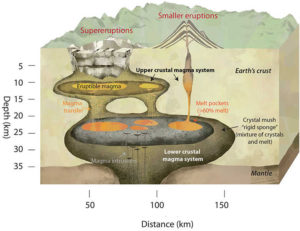
This is how volcanic researchers imagine the magma chamber under a supervolcano. Gredit: Graphic: from Bachmann & Huber, American Mineralogist, 2016
Supervolcanoes are superlative in every respect. The eruption of the Toba caldera in modern-day Indonesia approximately 74,000 years ago was so powerful that it led to a period of global cooling and, possibly, a drastic fall in the population of humankind. Around 2.1 million years ago, the first of three eruptions of the Yellowstone supervolcano in the USA formed a crater with an area of 50 x 80 kilometres. Approximately 2,800 cubic kilometres of material were ejected in the process — around 10 to 20 times as much as in the 1815 eruption of Mount Tambora in Indonesia. Even this relatively small eruption, considered the largest in recent times, produced effects that could be felt around the world.
However, supervolcanoes are difficult to study and therefore continue to baffle researchers to this day. For example, scientists agree that there must be a chamber of magma at a depth of a few kilometres in the Earth’s crust, containing material that escapes during an eruption. However, the experts do not agree on the form and consistency of such a reservoir.
Swimming pool vs solidified block
Some geologists assume that calderas, as supervolcano craters are known, sit on top of a gigantic reservoir of liquid magma embedded in the Earth’s crust. The mantle supplies this reservoir with material and heat, and a supervolcano of this kind can erupt explosively at any time.
Others deem it more plausible that the magma chamber has cooled down completely and solidified, and that it is only made liquid by a massive influx of heat from the mantle. Only then can an eruption take place.
“Probably neither theory is correct,” says Olivier Bachmann, Professor of Volcanology at ETH Zurich. Bachmann and his group have published two articles in the journal Nature Geoscience, in which they demonstrate that the truth may lie somewhere between these two extremes.
The truth somewhere in the middle?
“The magma chamber of a supervolcano does not resemble a pot of soup that can boil over at any time and at the slightest provocation,” Bachmann explains. Similarly, he says it is wrong to assume that the magma has cooled down to form a completely solidified body, as reactivating a body of this kind would require an enormous influx of heat within a very short time. In addition, volatile substances such as water and CO2 would escape from the body during cooling and solidification. However, these substances are essential for an eruption as they serve to build up the corresponding pressure in the magma chamber.
Taking the supervolcano eruption of the “Kneeling Nun Tuff” in New Mexico as an example, studies by Bachmann’s doctoral student Dawid Szymanowski demonstrated that a supervolcano’s magma chamber contains a mixture of liquid and crystalline — that is, solidified — magma. More than 40 to 50 percent of the reservoir is present in crystalline form. In the ETH researcher’s view, the chambers may exhibit a sponge-like texture, with a mesh structure of crystallised rock and pores containing molten material — crystal mush, as Szymanowski calls it.
Rare minerals as data-loggers
This mush is likely to remain in the magma chamber for a very long time before being hurled to the surface. Szymanowski derives this conclusion from the analysis of zircon and titanite, two trace minerals that are present in the magma. Zircon is the crystalline material of the oldest known rock samples on Earth — some crystals found in Australia are approximately 4.4 billion years old.
Zircon and titanite crystals record not only the time at which they were formed but also the temperature during their formation, as this temperature influences the incorporation of chemical elements into the crystal lattice. After crystal formation, the chemical composition of these minerals in a magma chamber remains essentially unchanged even if the conditions in the magma chamber change significantly.
By analysing the age and chemical composition of zircon and titanite crystals from different rocks in the laboratory, the researchers obtain information about how a magma chamber’s temperature has changed over time. The eruption brings these two minerals up to the surface, where they can be found in corresponding rock strata.
From these analyses, the volcanologists from ETH concluded that the temperature in the magma chamber that fed the Kneeling Nun Tuff eruption must have remained between 680 and 730 degrees Clesius for over half a million years. From the minerals, the researchers could determine that it took the supervolcano a very long time to become fully “charged” and to reach the point of eruption.
Numerical model supports mineral analyses
The mineral analyses are also supported by a computer model created by Ozge Karakas, a postdoc in Bachmann’s group. This model was published in June — also in the journal Nature Geoscience — and describes a system made up of a magma chamber in the upper crust that is connected with further chambers in the lower crust.
Hot “source” magma forms in the mantle at a temperature of approximately 1,200 degrees before rising through cracks and chimneys into the upper crust. Once there, it forms a reservoir, which cools down and partially crystallises but can survive as a crystal mush for hundreds of thousands of years.
Using the model, the scientists were able to show that the formation of a permanent reservoir in the upper crust does not require gigantic quantities of material from the mantle in short periods of time. “The conditions in the upper crust are not suitable for collecting and storing that much material very quickly,” says Karakas. Nevertheless, the geologist says that the reservoir does need a connection with magma in the lower mantle in order to ensure the transport of heat, and she emphasises that, until now, researchers had not included the lower crust in their considerations. “Without it, however, there would be no supervolcanoes.”
Very rare events
Both the model and the mineral analyses therefore point to the idea that supervolcanoes form and mature over very long periods of time, and that they can only erupt at intervals of tens of thousands of years. “The magma is primarily preserved as a type of crystalline, sponge-like structure. And it must always be reactivated by an influx of heat before it can erupt,” says Olivier Bachmann, summing up the findings.
It is not possible to predict when the next supervolcano eruption is about to occur based on the new findings, as the system is not yet understood in sufficient detail. However, mechanisms of growth and reactivation of giant magma reservoirs become clearer, and that may help to better assess the reawakening signs of those systems in the future. “In any case — and fortunately for us — a supervolcano eruption is a very rare event,” says Bachmann.
References:
Dawid Szymanowski, Jörn-Frederik Wotzlaw, Ben S. Ellis, Olivier Bachmann, Marcel Guillong, Albrecht von Quadt. Protracted near-solidus storage and pre-eruptive rejuvenation of large magma reservoirs. Nature Geoscience, 2017; 10 (10): 777 DOI: 10.1038/ngeo3020
Ozge Karakas, Wim Degruyter, Olivier Bachmann, Josef Dufek. Lifetime and size of shallow magma bodies controlled by crustal-scale magmatism. Nature Geoscience, 2017; 10 (6): 446 DOI: 10.1038/ngeo2959
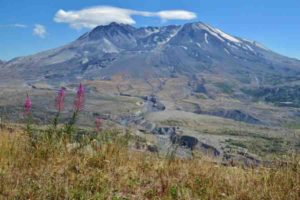
This is an image of Mt St. Helens in Washington State, USA, which erupted in 1980, killing 57 people. Credit: S Brown
It is hoped the findings, published recently in the Journal of Applied Volcanology, will help increase our understanding of volcanic hazards and the subsequent threat to life.
A tenth of the world’s population lives within the potential footprint of volcanic hazards with more than 800 million people living within 100 km of active volcanoes.
Between 1500 and 2017 more than 278,000 people met their fate as a result of volcanic hazards — on average that’s about 540 people a year.
Volcanoes produce numerous hazards which affect different distances, in both times of eruption and when the volcano is quiet.
During this research Dr Sarah Brown from the University of Bristol’s School of Earth Sciences and colleagues, updated previous databases of volcanic fatalities by correcting data, adding events and, crucially, now including information on the location of the fatalities in terms of distance from the volcano.
The location of fatal incidents was identified from official reports, volcano activity bulletins, scientific reports and media stories.
Nearly half of all fatal incidents were recorded within 10 km of volcanoes but fatalities are recorded as far away as 170 km.
Close to volcanoes (within 5 km) ballistics or volcanic bombs dominate the fatality record.
Pyroclastic density currents, fast-moving avalanches of hot rock, ash and gas are the dominant cause of death at more medial distances (5-15 km).
Lahars — volcanic mudflows, tsunami and tephra (ashfall) — are the main cause of death at greater distances.
As well as the distances, Dr Brown and her team were also able to classify the victims in more detail than any previous studies.
Whilst most victims were people who live on or near the volcano, several groups were identified as common victims. These were namely tourists, media, emergency response personnel and scientists (mostly volcanologists).
561 tourist fatalities were recorded, mostly during small eruptions or in times of quiescence when the volcano was not actively erupting. Most of these fatalities occurred close to the volcano (within 5 km), with ballistics being the most common cause of death in eruptions.
A recent example of tourist fatalities was the 2014 Ontake eruption in Japan when hikers on the volcano were caught out by a sudden eruption which tragically killed 57 people.
And, just a few weeks ago, a child and his parents died in Campi Flegri in Italy, likely overcome by deadly gases when the ground collapsed beneath them in a restricted area.
The fatalities of 67 scientists (mostly volcanologists and those supporting their work) were recorded with more than 70 per cent of these within 1 km of the volcano summit, highlighting the danger to field scientists visiting the summit of active volcanoes.
Disaster prevention and response personnel, military and emergency services working to evacuate, rescue or recover victims of volcanic eruptions have unfortunately also lost their lives, with 57 fatalities of emergency response personnel.
The deaths of 30 media employees are also recorded — these were reporting on eruptions and were often within the declared danger zones.
Dr Brown, who is also a member of the University of Bristol’s Cabot Institute, said: “The identification of these groups of victims is key for improving safety and reducing deaths and injuries in these groups.
“While volcanologists and emergency response personnel might have valid reasons for their approach into hazardous zones, the benefits and risks must be carefully weighed.
“The media and tourists should observe exclusion zones and follow direction from the authorities and volcano observatories.
“Tourist fatalities could be reduced with appropriate access restrictions, warnings and education.”
The location data allows the characterisation of volcanic threat with distance, as a function of eruption size and the hazard type. It contributes to risk reduction by providing an empirical dataset on which to forecast impacts and support evidence-based eruption planning and preparedness.
The data and analysis support assessment of volcanic threat, population exposure and vulnerabilities, and is a good step towards systematic fatality data collection which supports the priority target of the Sendai Framework for Disaster Risk Reduction in reducing mortality from disasters.
Reference:
Sarah K. Brown, Susanna F. Jenkins, R. Stephen J. Sparks, Henry Odbert, Melanie R. Auker. Volcanic fatalities database: analysis of volcanic threat with distance and victim classification. Journal of Applied Volcanology, 2017; 6 (1) DOI: 10.1186/s13617-017-0067-4
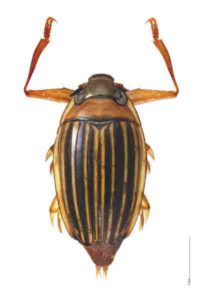
This is an image of H. milloti dorsal habitus. Credit: KU News Service
There are precious few species today in the biodiversity hotspot of Madagascar that scientists can trace directly back to when all of Earth’s continents were joined together as part of the primeval supercontinent Pangea.
But a new study in the journal Scientific Reports suggests the Malagasy striped whirligig beetle Heterogyrus milloti is an ultra-rare survivor among contemporary species on Madagascar, boasting a genetic pedigree stretching back at least 206 million years to the late Triassic period.
“This is unheard of for anything in Madagascar,” said lead author Grey Gustafson, a postdoctoral research fellow in ecology & evolutionary biology and affiliate of the Biodiversity Institute at the University of Kansas. “It’s the oldest lineage of any animal or plant known from Madagascar.”
Gustafson and his co-authors’ research compared the living striped whirligig found in Madagascar with extinct whirligig beetles from the fossil record. They then used a method called “tip dating” to reconstruct and date the family tree of whirligig beetles.
“You examine and code the morphology of extinct species the same as you would living species, and where that fossil occurs in time is where that tip of the tree ends,” he said. “That’s how you time their evolutionary relationships. We really wanted the fossils’ placement in the tree to be backed by analysis, so we could say these are the relatives of the striped whirligig as supported by analysis, not just that they looked similar.”
Gustafson noted one major hurdle for the team was the “painful” incompleteness of the fossil record for establishing all the places where relatives of the striped whirligig beetle once lived.
“All of the fossils come from what is today Europe and Asia — we don’t have any deposits from Madagascar or Africa for this group of insects,” he said. “But they likely were very widespread.”
Today, whirligig beetles are a family of carnivorous aquatic beetles with about 1,000 known species dominated by members of a subfamily called the Gyrininae. But the Gyrininae are young upstarts compared with the striped whirligig beetle, the last remaining species of a group dominant during the time of the dinosaurs. This group according to Gustafson was decimated by the same asteroid impact that cut down the dinosaurs and caused the Cretaceous-Paleogene extinction event.
“The remoteness of Madagascar is what may have saved this beetle,” Gustafson said. “It’s the only place that still has the striped whirligig beetle because it was already isolated at the time of the Cretaceous-Paleogene extinction event — so the lineage was able to persist, and now it’s surviving in a marginal environment.”
Even today, the ageless striped whirligig beetle keeps its own company, preferring to skitter atop the surface of out-of-the-way forest streams in southeastern Madagascar — not mixing with latecomers of the subfamily Gyrininae who have become the dominant whirligig beetles on Madagascar and abroad.
Indeed, Gustafson is one of the few researchers to locate them during a 2014 fieldwork excursion in Madagascar’s Ranomafana National Park.
“This one is pretty hard to find,” he said. “They like these really strange habitats that other whirligigs aren’t found in. We have video of them in a gulch in a mountain range clogged with branches and debris — there are striped whirligigs all over it.”
Unfortunately, the KU researcher said the remote habitats of the striped whirligig beetle in Malagasy national parks were threatened today by human activity on Madagascar.
“It’s a socioeconomic issue,” Gustafson said. “In the national park where first specimens of the striped whirligig beetle were discovered, there are local people who use the forest as a refuge for zebu cattle because they’re concerned about zebu being robbed. Their defecation can disturb the nutrient lode in aquatic ecosystems. Part of the problem is finding a way for local people to be able to make their livelihood while preserving natural ecosystems. But it’s a hard balance to strike. A lot of original forest cover also has been slashed and burned for rice-field patties to feed people.”
Gustafson hopes the primal origins of the striped whirligig beetle can draw attention to the need for protecting aquatic habitats while conceding that conservation efforts usually are aimed at bigger and more cuddly species, like Madagascar’s famous lemurs, tenrecs and other unique carnivorans.
“One of the things that invertebrate species suffer from is a lack of specific conservation efforts,” he said. “It’s usually trickle-down conservation where you find a charismatic vertebrate species to get protected areas started. But certain invertebrates will have different requirements, and right now invertebrate-specific conservation efforts are lacking. We propose the striped whirligig beetle would make for an excellent flagship species for conservation.”
Reference:
Grey T. Gustafson, Alexander A. Prokin, Rasa Bukontaite, Johannes Bergsten, Kelly B. Miller. Tip-dated phylogeny of whirligig beetles reveals ancient lineage surviving on Madagascar. Scientific Reports, 2017; 7 (1) DOI: 10.1038/s41598-017-08403-1