back to top
Facebook Instagram Linkedin TikTok X Youtube
  • Contribute
  • Advertising
  • FAQs
Search

Logo

27.8 C
New York
Wednesday, November 11, 2026
Facebook
Instagram
Linkedin
TikTok
X
Youtube

Logo

  • Home
  • List of Minerals
  • Geologic Time Scale
  • Geology Tools
  • Geology Adventure Tours
  • Plate Tectonics Map
    • Plate Boundary Map
  • Top Posts
  • Geology Jobs
  • GEO Courses
  • Geology Field Camps
  • Geology Field Camps in United States
  • Worldwide Geological Surveys
More
    Our planet has a layered structure of silicate mantle and metallic core. The liquid outer core is located 2900 km below the surface where the pressure and temperature are extremely high, >136 gigapascal (1.36 million atmospheres) and >4000 C. The sound speed and density profiles of the deep-interior of our planet is given by seismological observations.

    Precise measurement of liquid iron density under extreme conditions

    July 3, 2020
    Moon

    Higher concentration of metal in Moon’s craters provides new insights to...

    July 3, 2020
    Earth

    Uncovering the two ‘faces’ of the Earth

    July 3, 2020
    Amethyst-Geode in the parent rock

    How do the Geodes get Colorful?

    June 30, 2020
    zultanite gemstones, rough and crystal form lighting

    Zultanite : What is Zultanite Mineral? Where to find Zultanite?

    June 27, 2020
    An egg of Himeoolithus murakamii (left), outlined egg with intact eggshell remains (black area) (middle), and reconstruction of Himeoolithus murakamii and their probable parent dinosaur (right).

    Tiny Japanese dinosaur eggs help unscramble Cretaceous ecosystem

    June 27, 2020
    In a new report, paleontologists Lauren Sallan and Jack Stack re-examine the “enigmatic and strange” prehistoric fish Tanyrhinichthys mcallisteri.

    300-million-year-old fish resembles a sturgeon but took a different evolutionary path

    June 27, 2020
    Pictured left is an exceptionally preserved male pollen cone of Araucaria huncoensis showing characteristic cylindrical shape and many long, pointed bracts at the base. Pictured right is a leafy branch fossil of Araucaria huncoensis, showing rare preservation of a branching point connecting two leafy branch segments and a connected growth point on the right segment. The branches are usually shed from the tree as individual segments.

    New Argentine fossils uncover history of celebrated conifer group

    June 27, 2020

    How water in the deep Earth triggers earthquakes and tsunamis

    June 27, 2020
    Illustration of the natural fluid injection process that triggered the Cahuilla swarm.

    Natural fluid injections triggered Cahuilla earthquake swarm

    June 27, 2020
    1...929394...688Page 93 of 688

    MOST POPULAR

    Formation of coal almost turned our planet into a snowball

    October 11, 2017

    Darwin’s ‘strangest animal ever’ finds a family

    June 29, 2017
    An aerial view of Mount Tambora's caldera

    Future volcanic eruptions could cause more climate disruption

    November 1, 2017
    Numerous specimens of Kateretidae in a piece of amber from the Institute of Geology and Palaeontology in Nanjing (China). Included are also pollen grains from primitive water lilies. Credit: Georg Oleschinski/Uni Bonn

    Beetles changed their diet during the Cretaceous period

    March 21, 2020
    Load more

    MORE ARTICLES

    Reconstructed paleo-elevation in southwestern North America at the Late Eocene (36 million years ago). Credit: Bahadori and Holt

    New geologic modeling method explains collapse of ancient mountains in American...

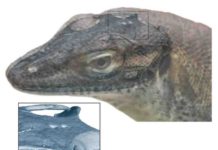
    This image depicts a reconstruction of what the extinct monitor lizard might have looked like.

    Extinct monitor lizard had four eyes, fossil evidence shows

    Rusting fool’s gold in glaciers a sign of increased carbon

    Underwater landslide may have doubled 2011 Japanese tsunami

    Facebook Instagram Linkedin TikTok X Youtube
    • Privacy Policy
    • Advertising
    • Contribute
    • FAQs
    © 2011-2026. All Rights Reserved.