back to top
Facebook Instagram Linkedin TikTok X Youtube
  • Contribute
  • Advertising
  • FAQs
Search

Logo

27.8 C
New York
Wednesday, September 16, 2026
Facebook
Instagram
Linkedin
TikTok
X
Youtube

Logo

  • Home
  • List of Minerals
  • Geologic Time Scale
  • Geology Tools
  • Geology Adventure Tours
  • Plate Tectonics Map
    • Plate Boundary Map
  • Top Posts
  • Geology Jobs
  • GEO Courses
  • Geology Field Camps
  • Geology Field Camps in United States
  • Worldwide Geological Surveys
More
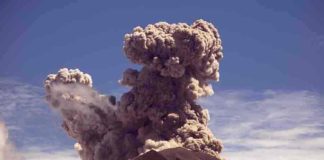
    Agung, a volcano in Bali, had an explosive eruption in 2018. Credit: O.L. Andersen

    New knowledge of Earth’s mantle helps to explain Indonesia’s explosive volcanoes

    June 26, 2021
    Zircons studied by the research team, photographed using cathodoluminescence, a technique that allowed the team to visualize the interiors of the crystals using a specialized scanning electron microscope. Dark circles on the zircons are the cavities left by the laser that was used to analyze the age and chemistry of the zircons.Scientists led by Michael Ackerson, a research geologist at the Smithsonian's National Museum of Natural History, provide new evidence that modern plate tectonics, a defining feature of Earth and its unique ability to support life, emerged roughly 3.6 billion years ago. The study, published May 14 in the journal Geochemical Perspective Letters, uses zircons, the oldest minerals ever found on Earth, to peer back into the planet's ancient past.The team tested more than 3,500 zircons, each just a couple of human hairs wide, by blasting them with a laser and then measuring their chemical composition with a mass spectrometer. These tests revealed the age and underlying chemistry of each zircon. Of the thousands tested, about 200 were fit for study due to the ravages of the billions of years these minerals endured since their creation. Credit: Michael Ackerson, Smithsonian.

    Earth’s oldest minerals date onset of plate tectonics to 3.6 billion...

    May 22, 2021
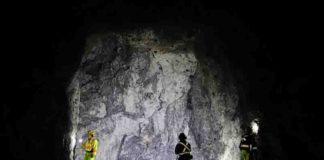
    McGill Colloidal Au research team study a mineralized (gold-bearing) vein underground at the Brucejack mine. Credit: Duncan McLeish

    Clues from soured milk reveal how gold veins form

    May 22, 2021
    The quantitative model used in the study explains the enigmatic melt degrees and layered structures observed in most cratons on Earth.

    Where on Earth is all the water?

    May 22, 2021
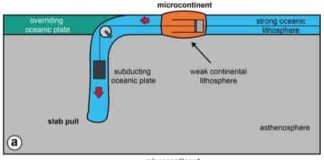
    Elements of a newly discovered process in plate tectonics include a mass (rock slab weight), a pulley (trench), a dashpot (microcontinent), and a string (oceanic plate) that connects these elements to each other. In the initial state, the microcontinent drifts towards the subduction zone (Figure a). The microcontinent then extends during its journey to the subduction trench owing to the tensional force applied by the pull of the rock slab pull across the subduction zone (Figure b). Finally, the microcontinent accretes to the overriding plate and resists subduction due to its low density, causing the down-going slab to break off (Figure c). Credit: Erkan Gün/University of Toronto

    Discovery of new geologic process calls for changes to plate tectonic...

    May 22, 2021
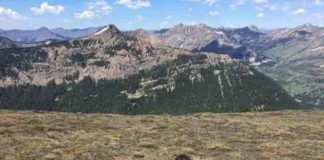
    Karen Heeter overlooks Yellowstone from Republic Pass on a tree coring excursion in July 2018. Credit: Grant L. Harley

    Yellowstone National Park is hotter than ever

    May 22, 2021
    This study site was used by researchers to examine a portion of the Oman–United Arab Emirates ophiolite’s metamorphic sole. Credit: Tyler Ambrose

    A closer look at the creation of a metamorphic sole

    May 22, 2021
    Early lineages of mammal like this large Gobiconodon from Mongolia, outcompeted the ancestors of modern mammals in the time of dinosaurs. Credit: Corbin Rainbolt

    Mammals in the time of dinosaurs held each other back

    May 22, 2021
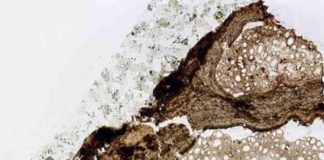
    A cross-section of an 18.5 million-year-old fossil of Ampelorhiza heteroxylon. Credit: Nathan Jud/Provided

    18.5 million year old vine fossil identified as new species

    May 8, 2021
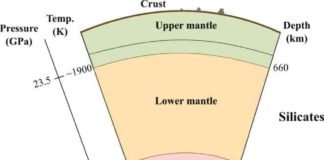
    The Earth has a layered internal structure with the crust, upper mantle, mantle transition zone, lower mantle, outer core, and inner core from the surface to the center. In the Earth’s formation stage at approximately 4.6 billion years ago, the heavy metal components were separated from silicates and sank in the magma ocean, and a core formed at the center of the Earth. In this core-mantle separation process, partitioning of noble gases between the core and mantle occurred. Credit: Taku Tsuchiya, Ehime University

    A deep reservoir of primordial helium in the Earth

    May 8, 2021
    1...656667...686Page 66 of 686

    Related Articles

    All
    • All
    • Featured
    • All time popular

    Sediments control methane release to the ocean

    September 6, 2016

    Earthquake fracture energy relates to how a quake stops

    March 13, 2022

    Heavy dinosaurs found a way to brood their eggs

    December 1, 2014

    Opalized “Petrified” Wood

    December 15, 2019

    Clues from past volcanic explosion helps research team to model future activity

    December 20, 2016

    Jurassic Records Warn of Risk to Marine Life from Global Warming

    March 13, 2013

    Facebook Instagram Linkedin TikTok X Youtube
    • Privacy Policy
    • Advertising
    • Contribute
    • FAQs
    © 2011-2026. All Rights Reserved.