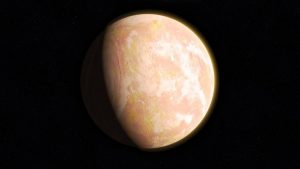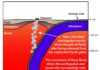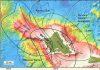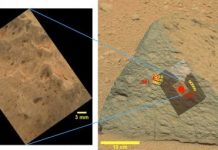

Something slammed into the surface of Mars 1 million years ago, hitting a volcano or lava plain. This impact ejected rocks into space. Fragments of these rocks crossed Earth’s orbit and fell as meteorites. Credit: Image courtesy of University of Houston
Analysis of a Martian meteorite found in Africa in 2012 has uncovered evidence of at least 2 billion years of volcanic activity on Mars. This confirms that some of the longest-lived volcanoes in the solar system may be found on the Red Planet.
Shield volcanoes and lava plains formed from lava flowing over long distances, similar to the formation of the Hawaiian Islands. The largest Martian volcano, Olympus Mons, is nearly 17 miles high. That’s almost triple the height of Earth’s tallest volcano, Mauna Kea, at 6.25 miles.
Tom Lapen, a geology professor at the University of Houston and lead author of a paper published Feb. 1 in the journal Science Advances, said the findings offer new clues to how the planet evolved and insight into the history of volcanic activity on Mars.
Much of what we know about the composition of rocks from volcanoes on Mars comes from meteorites found on Earth. Analysis of different substances provides information about the age of the meteorite, its magma source, length of time in space and how long the meteorite was on Earth’s surface.
Something slammed into the surface of Mars 1 million years ago, hitting a volcano or lava plain. This impact ejected rocks into space. Fragments of these rocks crossed Earth’s orbit and fell as meteorites.
The meteorite, known as Northwest Africa 7635 and discovered in 2012, was found to be a type of volcanic rock called a shergottite. Eleven of these Martian meteorites, with similar chemical composition and ejection time, have been found.
“We see that they came from a similar volcanic source,” Lapen said. “Given that they also have the same ejection time, we can conclude that these come from the same location on Mars.”
Together, these meteorites provide information about a single location on Mars. Previously analyzed meteorites range in age from 327 million to 600 million years old. In contrast, the meteorite analyzed by Lapen’s research team was formed 2.4 billion years ago and suggests that it was ejected from one of the longest-lived volcanic centers in the solar system.
Reference:
Thomas J. Lapen, Minako Righter, Rasmus Andreasen, Anthony J. Irving, Aaron M. Satkoski, Brian L. Beard, Kunihiko Nishiizumi, A. J. Timothy Jull, Marc W. Caffee. Two billion years of magmatism recorded from a single Mars meteorite ejection site. Science Advances, 2017; 3 (2): e1600922 DOI: 10.1126/sciadv.1600922
New research explains how atmospheric oxygen was trapped at low levels following the Great Oxidation. Credit: Image courtesy of NASA
A low level of atmospheric oxygen in Earth’s middle ages held back evolution for 2 billion years, raising fresh questions about the origins of life on this planet.
New research by the University of Exeter explains how oxygen was trapped at such low levels.
Professor Tim Lenton and Dr Stuart Daines of the University of Exeter Geography department, created a computer model to explain how oxygen stabilised at low levels and failed to rise any further, despite oxygen already being produced by early photosynthesis. Their research helps explain why the ‘great oxidation event’, which introduced oxygen into the atmosphere around 2.4 billion years ago, did not generate modern levels of oxygen.
In their paper, published in Nature Communications, Atmospheric oxygen regulation at low Proterozoic levels by incomplete oxidative weathering of sedimentary organic carbon, the University of Exeter scientists explain how organic material — the dead bodies of simple lifeforms — accumulated in the earth’s sedimentary rocks. After the Great Oxidation, and once plate tectonics pushed these sediments to the surface, they reacted with oxygen in the atmosphere for the first time.
The more oxygen in the atmosphere, the faster it reacted with this organic material, creating a regulatory mechanism whereby the oxygen was consumed by the sediments at the same rate at which it was produced.
This mechanism broke down with the rise of land plants and a resultant doubling of global photosynthesis. The increasing concentration of oxygen in the atmosphere eventually overwhelmed the control on oxygen and meant it could finally rise to the levels we are used to today.
This helped animals colonise the land, leading eventually to the evolution of humankind.
The model suggests atmospheric oxygen was likely at around 10% of present day levels during the two billion years following the Great Oxidation Event, and no lower than 1% of the oxygen levels we know today.
Professor Lenton said: “This time in Earth’s history was a bit of a catch-22 situation. It wasn’t possible to evolve complex life forms because there was not enough oxygen in the atmosphere, and there wasn’t enough oxygen because complex plants hadn’t evolved — It was only when land plants came about did we see a more significant rise in atmospheric oxygen.
“The history of life on Earth is closely intertwined with the physical and chemical mechanisms of our planet. It is clear that life has had a profound role in creating the world we are used to, and the planet has similarly affected the trajectory of life. I think it’s important people acknowledge the miracle of their own existence and recognise what an amazing planet this is.”
Life on earth is believed to have begun with the first bacteria evolving 3.8 billion years ago. Around 2.7 billion years ago the first oxygen-producing photosynthesis evolved in the oceans. But it was not until 600 million years ago that the first multi-celled animals such as sponges and jellyfish emerged in the ocean. By 470 million years ago the first plants grew on land with the first land animals such as millipedes appearing around 428 million years ago. Mammals did not rise to ecological prominence until after the dinosaurs went extinct 65 million years ago. Humans first appeared on earth 200,000 years ago.
Reference:
Stuart J. Daines, Benjamin J. W. Mills, Timothy M. Lenton. Atmospheric oxygen regulation at low Proterozoic levels by incomplete oxidative weathering of sedimentary organic carbon. Nature Communications, 2017; 8: 14379 DOI: 10.1038/NCOMMS14379
This is Ahuna Mons seen in a simulated perspective view. The elevation has been exaggerated by a factor of two. The view was made using enhanced-color images from NASA’s Dawn mission. Credit: NASA
A recently discovered solitary ice volcano on the dwarf planet Ceres may have some hidden older siblings, say scientists who have tested a likely way such mountains of icy rock — called cryovolcanoes — might disappear over millions of years.
NASA’s Dawn spacecraft discovered Ceres’s 4-kilometer (2.5-mile) tall Ahuna Mons cryovolcano in 2015. Other icy worlds in our solar system, like Pluto, Europa, Triton, Charon and Titan, may also have cryovolcanoes, but Ahuna Mons is conspicuously alone on Ceres. The dwarf planet, with an orbit between Mars and Jupiter, also lies far closer to the sun than other planetary bodies where cryovolcanoes have been found.
Now, scientists show there may have been cryovolcanoes other than Ahuna Mons on Ceres millions or billions of years ago, but these cryovolcanoes may have flattened out over time and become indistinguishable from the planet’s surface. They report their findings in a new paper accepted for publication in Geophysical Research Letters, a journal of the American Geophysical Union.
“We think we have a very good case that there have been lots of cryovolcanoes on Ceres but they have deformed,” said Michael Sori of the Lunar and Planetary Laboratory at the University of Arizona in Tucson, and lead author of the new paper.
Ahuna Mons is a prominent feature on Ceres, rising to about half the height of Mount Everest. Its solitary existence has puzzled scientists since they spied it.
“Imagine if there was just one volcano on all of Earth,” Sori said. “That would be puzzling.”
Adding to the puzzle are the steep sides and well-defined features of Ahuna Mons — usually signs of geologic youth, Sori said. That leads to two possibilities: Ahuna Mons is just as it appears, inexplicably alone after forming relatively recently on an otherwise inactive world. Or, the cryovolcano is not alone or unusual, and there is some process on Ceres that has destroyed its predecessors and left the young Ahuna Mons as the solitary cryovolcano on the dwarf planet, according to Sori.
Ceres has no atmosphere, so the processes that wear down volcanoes on Earth — wind, rain and ice — aren’t possible on the dwarf planet. Sori and his colleagues hypothesized that another process, called viscous relaxation, could be at work.
Viscous relaxation is the idea that just about any solid will flow, given enough time. For example, a cold block of honey appears to be solid. But if given enough time, the block will flatten out until there is no sign left of the original block structure.
On Earth, viscous relaxation is what makes glaciers flow, Sori explained. The process doesn’t affect volcanoes on Earth because they are made of rock, but Ceres’s volcanoes contain ice — making viscous relaxation possible. On Ceres, viscous relaxation could be causing older cryovolcanoes to flatten out over millions of years so they are hard to discern. Ceres’s location close to the sun could make the process more pronounced, Sori said.
To test the idea that viscous relaxation had caused cryovolcanoes to flatten out on Ceres, Sori and his colleagues created a model using the actual dimensions of Ahuna Mons to predict how fast the mountain might be flowing. They ran the model assuming different water contents of the material that makes up the mountain — ranging from 100 percent water ice to 40 percent water ice, Sori explained.
Ahuna Mons would need to be composed of more than 40 percent water ice to be affected by viscous relaxation, they found. At this composition, Sori estimates that Ahuna Mons should be flattening out at a rate of 10 to 50 meters (30 to 160 feet) per million years. That is enough to render cryovolcanoes unrecognizable in hundreds of millions to billions of years, suggesting there could have been other cryovolcanoes on Ceres, according to the new study.
“Ahuna Mons is at most 200 million years old. It just hasn’t had time to deform,” Sori said.
The next step for Sori and his team will be to try and identify the flattened remnants of older cryovolcanoes on Ceres. The findings could help scientists better decipher the history of how the dwarf planet formed, he added.
The new study helps scientists expand their knowledge of what might be possible on planetary bodies in our solar system, said Kelsi Singer, a postdoctoral researcher who studies icy worlds at Southwest Research Institute in Boulder, Colorado, and was not involved with the new research.
“It would be fun to check some of the other features that are potentially older domes on Ceres to see if they fit in with the theory of how the shapes should viscously evolve over time,” she said. “Because all of the putative cryovolcanic features on other worlds are different, I think this helps to expand our inventory of what is possible.”
Reference:
Michael M. Sori, Shane Byrne, Michael T. Bland, Ali M. Bramson, Anton I. Ermakov, Christopher W. Hamilton, Katharina A. Otto, Ottaviano Ruesch, Christopher T. Russell. The vanishing cryovolcanoes of Ceres. Geophysical Research Letters, 2017; DOI: 10.1002/2016GL072319
A new study led by a team of scientists at UCD shows that a reaction betwen silicon dioxide that is found in quartz crystals and fluid hydrogen at high temperatures and pressure, found in the earth’s upper mantle, can create water. Credit: flickr-jgsgeology
Earth’s water may have originally been formed by chemical reactions deep within the planet’s mantle, according to research led by University College Dublin.
The new theory offers an alternative explanation as to how the life-giving liquid may have originated on Earth. Previously, scientists have suggested that comets that collided with the planet could have deposited large amounts of ice on the Earth which later melted, forming water.
The investigators carried out computer simulations which found that reactions between high-pressure and high-temperature fluid hydrogen and silicon dioxide in quartz, found in Earth’s upper mantle, can form liquid water under the right conditions.
The simulations were carried out by Dr Zdenek Futera, UCD School of Chemical and Bioprocess Engineering, under the direction of Profesor Niall English, UCD School of Chemical and Bioprocess Engineering, and the Materials, Energy and Water Simulations research group. The team at UCD also worked closely with co-author of the paper, Professor John Tse, University of Saskatchewan in Canada.
The exercise tested the reaction at different temperatures and pressures typically found in the upper mantle 40 to 400km below the surface of the Earth.
The simulations revealed that the silica and fluid hydrogen could form water when exposed to temperatures of just over 1400°C and at pressure 20,000 times higher than Earth’s atmospheric pressure.
Silica is found in abundance above and below the surface of the earth in the form of the mineral quartz – the Earth’s crust is 59 per cent silica.
The scientists had expected that the water would form on the surface of the silica, but instead, they were surprised to find that the water remained trapped inside the silica, leading to a massive build up of pressure.
They also believe the release of this pressure could be responsible for triggering earthquakes hundreds of kilometres below the Earth’s surface.
The new findings support the experiments on the same reaction between silicon dioxide and liquid hydrogen carried out by Japanese scientists in 2014.
“We were initially surprised to see in-rock reactions, but we then realised that we had explained the puzzling mechanism at the base of earlier Japanese experimental work finding water formation,” said Prof English.
“We concluded that these findings help to rationalise, in vivid detail, the in-mantle genesis of water. This is very exciting and in accord with very recent findings of an ‘ocean’s worth’ of water in the Earth’s mantle.
“We thank Science Foundation Ireland and our collaborators at the University of Saskatchewan, and the Ireland-Canada Foundation for ‘seeding’ this 20-paper collaboration with Professor John Tse ten years ago.”
The findings were published in Earth and Planetary Science Letters.
Various studies in recent years have also suggested that vast quantities of water are stored in rocks as far as 1000km below the surface of the Earth.
Reference:
Zdenek Futera et al. Formation and properties of water from quartz and hydrogen at high pressure and temperature, Earth and Planetary Science Letters (2017). DOI: 10.1016/j.epsl.2016.12.031
Reconstruction of what Bulbasaurus may have looked like while alive. Credit: Matt Celeskey
Let’s go back to the Permian period, around 260 million years. Life was quite blissful, with no dinosaurs tearing up the turf as of yet.
Animals from this period were bizarre experimentations, with early ancestors evolving for some of the well-known groups still around today, like crocodiles, turtles and mammals.
Some of these include the dicynodonts, who despite looking more ‘reptilian’, are actually the precursors of early mammals. They were pretty weird looking, like a cross between a turtle and a wild boar. Dicynodonts, mammals and all other animals more closely related to mammals than any other egg-laying animals are called ‘synapsids’, and a pretty important group. Even humans are synapsids, so dicynodonts are like our great, great, great (etc.) grand-cousins.
A new species of dicynodont has been described from the Karoo Basin of South Africa, which researchers have dubbed Bulbasaurus phylloxyron. Pokémon fans around the world rejoice!
The name actually refers to the ‘bulbous’-shaped nose that Bulbasaurus has, rather than being a fan-based dedication to the chubby but lovable lizard-like original starter Pokémon.
“There is nothing alive today quite like them, but they were the most successful herbivores of their time,” said lead author Dr. Christian Kammerer of the Museum für Naturkunde Berlin.
The specimens were originally collected by Dr. Roger Smith of the Iziko Museums of South Africa and the University of Witwatersand. But while visiting the museum collections for research, Kammerer and his keen eye and love for synapsid taxonomy (his Twitter handle is even @synapsida), noticed something unusual about the specimens.
It was all in the tusks. Bulbasaurus has much larger tusks than any other species around at the time. “I knew that these skulls couldn’t be from one of the usual species of that age, because their tusks were huge compared to other, co-existing dicynodonts,” says Kammerer.
Bulbasaurus wasn’t exactly a heavyweight, with a skull only 16 centimetres long, so about the same as a medium-sized dog. But its tusks were as large as the largest of the dicynodonts, showing that even the smaller dicynodont species were equipped with pretty awesome face gear.
Bulbasaurus is the oldest known member of a group of dicynodonts called geikiids. This is important, as it helps to fill a gap in the early fossil record of this group. Scientists have long recognised that geikiids should have been around in rocks older than those they are typically found in. This is because we find their closest relatives in those older rocks too.
This problem is known as a “ghost lineage”, where we know that a group of organisms must have been present at a certain time as they share an equal origination time with their closest ancestors, but no fossils of that age have been found. Yet.
Bulbasaurus then is a delightful discovery to early synapsid researchers. “That specimens of a rare species like this were collected at all is a testament to the exhaustive, multi-decade field program of Roger Smith” said Kammerer. “Dicynodont skulls tend to look a lot alike, so if you are not a specialist in the group it is easy to overlook species-specific differences between specimens. I am sure that the solutions for a lot of gaps in the fossil record are already sitting in museums waiting to be studied, it just takes time and researcher expertise.”
Kammerer’s research highlights just how important preserving museum collections can be, as well as how crucial taxonomical skills are to our basic understanding of the evolution of life.
Their research is published in the Open Access journal PeerJ.
Reference:
Christian F. Kammerer et al. An early geikiid dicynodont from theAssemblage Zone (late Permian) of South Africa, PeerJ (2017). DOI: 10.7717/peerj.2913
Skeleton of the 195-million-year-old dinosaur “Lufengosaurus” preserved as found in the ground in Yunnan Province, China. Credit: Photo courtesy of Robert Reisz
Is fossilized rock all that remains when a dinosaur decomposes?
New research from scientists at the University of Toronto and researchers in China and Taiwan provides the first evidence that proteins have been preserved within the 195-million-year-old rib of the sauropodomorph dinosaur Lufengosaurus. The study appears in the Jan. 31 issue of the journal Nature Communications.
“These dinosaur proteins are more than 100 million years older than anything previously discovered,” says Professor Robert Reisz, a specialist in vertebrate paleontology in the department of biology at U of T Mississauga. “These proteins are the building blocks of animal soft tissues, and it’s exciting to understand how they have been preserved.”
The Canada-Taiwan research team, led by Reisz, used the synchrotron at the Taiwanese National Synchrotron Radiation Research Centre to find the substance in place, known as collagen type I, preserved within the tiny vascular canals of the rib where blood vessels and blood would be in the living dinosaur.
The collagen was found together with lots of small, spherical hematite particles. Hematite is a mineral that can be formed from the iron in hemoglobin, the oxygen-transport protein in red blood cells. The chemical bond between iron and oxygen is what gives blood cells their red colour.
Reisz and his colleagues believe that these hematite particles were derived from the original blood of the dinosaur, and that they acted as the catalyst for preserving the protein in the vascular canals of the bone. These collagen pieces are probably remnants of the blood vessels that supplied blood to the bone cells in the living dinosaur.
“Interestingly, there was no evidence of preservation of organic remains in the main mass of the bone, only in the small vascular canals that ran along the length of the rib, where hematite was also present” says Reisz.
“Our localized search, in areas of the bone that are likely to preserve remnants of the original soft tissues, is more likely to succeed than previously used methods. This approach has great future potential, because localized searches will yield important results even when the amount of organic remains is miniscule.”
Previous evidence of preserved collagen date back to the Late Cretaceous Period — more than 100 million years younger than this discovery — but those studies extracted the organic remains by dissolving away all other parts of the fossil, without a clear understanding of the precise origins of the collagen.
This research allowed the scientists to find the collagen in place without dissolving the rest of the fossil, and it has helped them understand how the organic remains were preserved. Reisz believes that future explorations for even older proteins will be possible if this technique is used.
Reference:
Yao-Chang Lee, Cheng-Cheng Chiang, Pei-Yu Huang, Chao-Yu Chung, Timothy D. Huang, Chun-Chieh Wang, Ching-Iue Chen, Rong-Seng Chang, Cheng-Hao Liao, Robert R. Reisz. Evidence of preserved collagen in an Early Jurassic sauropodomorph dinosaur revealed by synchrotron FTIR microspectroscopy. Nature Communications, 2017; 8: 14220 DOI: 10.1038/ncomms14220
The inner core, outer core, mantle and Earth’s crust.
Researchers in Japan say they may be one step closer to solving the mystery at the core of Earth.
It has long been established that approximately 85 percent of Earth’s core is made of iron, while nickel makes up an additional 10 percent. Details of the final 5 percent — believed to be some amount of light elements — has, until now, eluded scientists.
According to the Japanese research team, which includes Dr. Tatsuya Sakamaki and Prof. Eiji Ohtani from Tohoku University’s Graduate School of Science, new experiments show that possible candidates for the light elements are hydrogen, silicon and sulfur.
Experiments have consisted of building model cores containing different materials, and subjecting them to heat of up to 6,000C° and pressure 3.6 million times that at the surface of the planet. The researchers then measured the density and sound velocity, and concluded that the physical properties of the iron-alloy with those three elements are consistent with seismological observations in the real core.
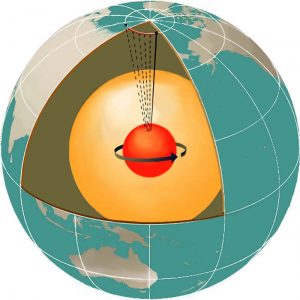
The core, which is the deepest region of Earth, is composed of a liquid outer core (2900~5100 km in depth) and solid inner core (5100~6400 km in depth). The core is one of the most important “final frontiers” for scientists looking to understand the history of Earth, and the conditions during its formation 4.5 billion years ago.
This study was initially published in Science Advances by the American Association for the Advancement of Science (AAAS) on Feb. 26, 2016. More recently, the team gave a presentation at a meeting of the American Geophysical Union in San Francisco in Dec. 2016.
Reference:
T. Sakamaki, E. Ohtani, H. Fukui, S. Kamada, S. Takahashi, T. Sakairi, A. Takahata, T. Sakai, S. Tsutsui, D. Ishikawa, R. Shiraishi, Y. Seto, T. Tsuchiya, A. Q. R. Baron. Constraints on Earths inner core composition inferred from measurements of the sound velocity of hcp-iron in extreme conditions. Science Advances, 2016; 2 (2): e1500802 DOI: 10.1126/sciadv.1500802
Green rust (l) forming in Dr. Halevy’s lab in conditions similar to those in the Precambrian ocean. (r) Electron microscope images reveal the thin, hexagonal plates typical of green rust. Credit: Weizmann Institute of Science
Though they may seem rock solid, the ancient sedimentary rocks called iron formations — the world’s chief economic source of iron ore — were once dissolved in seawater. How did that iron go from a dissolved state to banded iron formations? Dr. Itay Halevy and his group in the Weizmann Institute of Science’s Department of Earth and Planetary Sciences suggest that, billions of years ago, the “rust” that formed in the seawater and sank to the ocean bed was green — an iron-based mineral that is rare on Earth today but might once have been relatively common. Their findings were published in Nature Geoscience.
We know there was dissolved iron in the early oceans — a strong indication that Earth’s free oxygen concentrations were exceedingly low. Otherwise, the iron would have reacted with oxygen to form iron oxides, which are the rusty red deposits familiar to anyone who’s left a bike out in the rain. Today, says Dr. Halevy, iron is delivered from the land to the oceans as small insoluble oxide particles in rivers. But this mode of sedimentation only came about as free oxygen accumulated in Earth’s atmosphere, about 2.5 billion years ago. With almost no oxygen, the oceans were iron-rich, but that did not mean that iron remained dissolved in seawater indefinitely: it ultimately formed insoluble compounds with other elements and settled to the seabed to give rise to banded iron formations.
The idea that one of those insoluble compounds could be a rusty green mineral occurred to him during his doctoral research, says Dr. Halevy, when he was trying to recreate the conditions on early Mars, including its rusty-red iron sediments. “I got some green stuff I didn’t recognize at first, which quickly turned orange when I exposed it to air. With a little more careful experimentation, I found that this was a mineral called green rust, which is extremely rare on Earth today, owing to its affinity for oxygen.” Today, green rust quickly transforms into the familiar red rust, but with not much free oxygen around, Dr. Halevy reasoned, it could have been an important way for dissolved iron to form solid compounds and settle to the sea floor.
Support for these ideas comes from Sulawesi, Indonesia, where green rust forms today in iron-rich, oxygen-poor Lake Matano, thought to be similar to the seawater that existed during extended periods of Earth’s early history. To test his ideas in detail and explore their significance, Dr. Halevy set up experiments in which he and his team recreated, as closely as possible, the conditions of the ancient, oxygen-free, Precambrian ocean. They found that green rust not only forms under these conditions, but that when left to age, it transforms into the minerals found in Precambrian iron formations — a combination of iron-bearing oxides, carbonates, and silicates.
Could green rust have been a main vehicle for settling iron out of seawater? Dr. Halevy and his team developed models to depict the iron cycle in Earth’s early oceans, including the possibility of green rust formation and competition with other mineral shuttles of iron to the seafloor. Their findings suggest that green rust was probably a major player in the iron cycle. The iron in the green rust later transformed into the minerals we can now observe in the geologic record. “Of course, it would have been one of several means of iron deposition, just as a number of different processes are involved in chemical sedimentation in the oceans today,” says Dr. Halevy. “But as far as we can tell, green rust should have delivered a substantial proportion of iron to the very early ocean sediments.”
Reference:
I. Halevy, M. Alesker, E. M. Schuster, R. Popovitz-Biro, Y. Feldman. A key role for green rust in the Precambrian oceans and the genesis of iron formations. Nature Geoscience, 2017; DOI: 10.1038/ngeo2878
Track of the vessel Nathaniel B. Palmer in the Weddell Sea, with the remnants of the Larsen-B Ice Shelf and Antarctic Peninsula in the background. Credit: Galen Halverson
One of the big mysteries in the scientific world is how the ice sheets of Antarctica formed so rapidly about 34 million years ago, at the boundary between the Eocene and Oligocene epochs.
There are 2 competing theories:
The first explanation is based on global climate change: Scientists have shown that atmospheric carbon dioxide levels declined steadily since the beginning of the Cenozoic Era, 66 million years ago. Once CO2 dropped below a critical threshold, cooler global temperatures allowed the ice sheets of Antarctica to form.
The second theory focuses on dramatic changes in the patterns of ocean circulation. The theory is that when the Drake Passage (which lies between the southern tip of South America and Antarctica) deepened dramatically about 35 million years ago, it triggered a complete reorganization in ocean circulation. The argument is that the increased separation of the Antarctic land mass from South America led to the creation of the powerful Antarctic Circumpolar Current which acted as a kind of water barrier and effectively blocked the warmer, less salty waters from the North Atlantic and Central Pacific from moving southwards towards the Antarctic land mass leading to the isolation of the Antarctic land mass and lowered temperatures which allowed the ice sheets to form.
No one has thought to link these two competing explanations before
A group of researchers, led by scientists in McGill University’s Dept. of Earth and Planetary Sciences now suggest that the best way to understand the creation of this phenomenon is, in fact, by linking the two explanations.
In a paper published on the subject in Nature Geoscience earlier this week they argue that:
The deepening of the Drake Passage resulted in a change in ocean circulation that resulted in warm waters being directed northwards in circulation patterns like those found in the Gulf Stream that currently warms northwestern Europe.
That this shift in ocean currents, as the warmer waters were forced northward, lead to an increase in rainfall, which resulted, beginning about 35 million years ago to reduced carbon dioxide levels in the atmosphere. Eventually, as the levels of carbon dioxide in the atmosphere dropped, as a result of a process known as silicate weathering (whereby silica-bearing rocks are slowly worn away by rainfall leading the carbon dioxide from the atmosphere to eventually becomes trapped in limestone) there was such a significant drop in CO2 in the atmosphere that it reached a threshold where ice sheets could form rapidly in Antarctica.
Ocean circulation and climate change
Galen Halverson teaches in the Dept. of Earth and Atmospheric Science at McGill and is one of the authors of the paper. He believes that no one has thought of combining the two theories before because it’s not an intuitive idea to look at how the effects of changing patterns of ocean circulation, which occur on time scales of thousands of years, would effect global silicate weathering, which in turn controls global climate on time scales of 100s of thousands of years.
“It’s an interesting lesson for us when it comes to climate change,” says Halverson, “because what we get is a thumbnail shift between two stable climatic states in Antarctica — from no glaciers to glaciers. And what we see is both how complex climate changes can be and how profound an effect changing patterns of ocean circulation can have on global climate states, if looked at on a geological time scale.”
The research was funded by: the Canadian Foundation for Innovation (CFI), the Canadian Institute for Advanced Research (CIFAR), and the Natural Sciences and Engineering Research Council of Canada (NSERC).
Reference:
Geneviève Elsworth, Eric Galbraith, Galen Halverson, Simon Yang. Enhanced weathering and CO2 drawdown caused by latest Eocene strengthening of the Atlantic meridional overturning circulation. Nature Geoscience, 2017; DOI: 10.1038/ngeo2888
Indian Ocean topography showing the location of Mauritius as part of a chain of progressively older volcanoes extending from the presently active hot-spot of Réunion toward the 65-million-year-old Deccan traps of northwest India. Credit: Wits University
Scientists have confirmed the existence of a “lost continent” under the Indian Ocean island of Mauritius that was left-over by the break-up of the supercontinent, Gondwana, which started about 200 million years ago.The piece of crust, which was subsequently covered by young lava during volcanic eruptions on the island, seems to be a tiny piece of ancient continent, which broke off from the island of Madagascar, when Africa, India, Australia and Antarctica split up and formed the Indian Ocean.”We are studying the break-up process of the continents, in order to understand the geological history of the planet,” says Wits geologist, Professor Lewis Ashwal, lead author on the paper “Archaean zircons in Miocene oceanic hotspot rocks establish ancient continental crust beneath Mauritius”, published in the prestigious journal Nature Communications.
By studying the mineral, zircon, found in rocks spewed up by lava during volcanic eruptions, Ashwal and his colleagues Michael Wiedenbeck from the German Research Centre for Geosciences (GFZ) and Trond Torsvik from the University of Oslo, guest scientist at GFZ, have found that remnants of this mineral were far too old to belong on the island of Mauritius.
“Earth is made up of two parts – continents, which are old, and oceans, which are “young”. On the continents you find rocks that are over four billion years old, but you find nothing like that in the oceans, as this is where new rocks are formed,” explains Ashwal. “Mauritius is an island, and there is no rock older than 9 million years old on the island. However, by studying the rocks on the island, we have found zircons that are as old as 3 billion years.”
Zircons are minerals that occur mainly in granites from the continents. They contain trace amounts of uranium, thorium and lead, and due to the fact that they survive geological process very well, they contain a rich record of geological processes and can be dated extremely accurately.
“The fact that we have found zircons of this age proves that there are much older crustal materials under Mauritius that could only have originated from a continent,” says Ashwal.
This is not the first time that zircons that are billions of years old have been found on the island. A study done in 2013 has found traces of the mineral in beach sand. However, this study received some criticism, including that the mineral could have been either blown in by the wind, or carried in on vehicle tyres or scientists’ shoes.
“The fact that we found the ancient zircons in rock (6-million-year-old trachyte), corroborates the previous study and refutes any suggestion of wind-blown, wave-transported or pumice-rafted zircons for explaining the earlier results,” says Ashwal.
Ashwal suggests that there are many pieces of various sizes of “undiscovered continent”, collectively called “Mauritia”, spread over the Indian Ocean, left over by the breakup of Gondwanaland.
“According to the new results, this break-up did not involve a simple splitting of the ancient super-continent of Gondwana, but rather, a complex splintering took place with fragments of continental crust of variable sizes left adrift within the evolving Indian Ocean basin.”
Gondwanaland
Gondwanaland is a super-continent that existed more than 200 million years ago and contained rocks as old as 3.6 billion years old, before it split up into what are now the continents of Africa, South America, Antarctica, India and Australia. The split-up occurred because of the geological process of plate tectonics. This is the process where the ocean basin is in continuous motion, and moves between 2 cm and 11 cm per year. Continents ride on the plates that make up the ocean floor, which causes the movement of the continents.
Mauritius
Known as a tropical holiday destination, Mauritius is a volcanic island, formed by the eruption of volcanoes starting at about nine million years ago. The island forms part of a string of islands, formed by a stationary hotspot (volcano), presently located at Réunion Island. Originating from deep within the earth, the hotspot stays stationary while the ocean’s tectonic plates move across it, creating a string of volcanic islands. Reference:
Lewis D. Ashwal, Michael Wiedenbeck & Trond H. Torsvik. Archaean zircons in Miocene oceanic hotspot rocks establish ancient continental crust beneath Mauritius. DOI:10.1038/ncomms14086
A new species of lobopodian, a worm-like animal with soft legs from the Cambrian period (541 to 485 million years ago), has been described for the first time from fossils found in the Burgess Shale in the Canadian Rocky Mountains. Details of the new species, called Ovatiovermis cribratus, are being published in the open access journal BMC Evolutionary Biology this week.
Dr Jean-Bernard Caron, senior curator of invertebrate paleontology at Royal Ontario Museum (ROM), associate professor at the University of Toronto in the Departments of Earth Sciences and Ecology & Evolutionary Biology, and lead author of the study, said: “Ovatiovermis is no longer than my thumb with all limbs stretched out and is only known from two specimens. However this new species provides fantastic new insights into the ecology and relationship of lobopodians, a group of mainly Cambrian marine invertebrates which are key to our understanding of modern tardigrades, onychophorans and the largest group of animals on Earth — the arthropods.”
The researchers believe that strong recurved claws on the back limbs may have allowed Ovatiovermis and other related lobopodian species to anchor themselves on hard surfaces and stand more or less upright. Two long pairs of spinulose (hairy or spiky) limbs towards the front of the body would then have been used to filter or collect food from water and bring it closer to the animals’ mouth.
Cédric Aria, a doctoral candidate from the Department of Ecology & Evolutionary Biology at the University of Toronto and co-author of the study, explained: “The various adaptations of this new animal to anchored particle feeding are reflected in its name. The species, cribratus, is the Latin for ‘to sieve’, while the genus name, Ovatiovermis, refers to that posture it must have ordinarily adopted: a worm-like creature that stood in perpetual ovation.”
Even though lobopodians have long been known and studied, and occupy an intriguing position in the tree of life of invertebrate animals, their ecology had remained poorly understood. The authors of the study believe that their findings provide new views on the evolution of lobopodians and their relatives.
Aria added: “We think that suspension feeding was common among lobopodians and turned out to be important in the initial evolutionary ‘burst’ of that colossal group of organisms that gave rise to water bears, velvet worms and arthropods. Interestingly, today, skeleton shrimps (Caprellidae), which are arthropods and thus much more complex living relatives of the lobopodians, have adopted a very similar lifestyle, and you can see them waving in the drifting water possibly much like Ovatiovermis used to. ”
Dr. Caron further stated: “These results contribute further evidence that suspension feeding was already a widespread mode of life during the Cambrian period. Its emergence has been important for the origin of modern marine ecosystems, and must have played a role in the rapid diversification of the first animals. ”
The researchers were surprised to find that unlike other suspension feeding organisms, O. cribratus, did not have any hard structures to protect its body. Dr Caron said: “Contrary to its relatives, this species does not have any spines or plates on its body for protection. Its ‘naked’ state begs the question of how it was able to guard against predators.”
The lack of body protection in O. cribratus demonstrates that organisms that lived in the Cambrian period did not exclusively develop hard defensive structures. The researchers speculate that O. cribratus may have lived in sponge colonies to avoid predators, or that by analogy with modern animals it used camouflage or was toxic or distasteful to predators. “However, this is a question that is difficult to solve with fossils, and it may remain forever one of Ovatiovermis’ secrets,” Dr Caron added.
The new species is only the third lobopodian that has been formally described from the famous Burgess Shale site in Yoho National Park (British Columbia). It is one of the rarest species found there, and the only two known specimens of this species are now in the collections of the Royal Ontario Museum in Toronto.
Reference:
Jean-Bernard Caron, Cédric Aria. Cambrian suspension-feeding lobopodians and the early radiation of panarthropods. BMC Evolutionary Biology, 2017; 17 (1) DOI: 10.1186/s12862-016-0858-y
Note: The above post is reprinted from materials provided by BioMed Central.
Lake Kivu, in Africa, has a similar chemistry to the oceans of the Proterozoic eon. Credit: Flickr, Steve Evans.
New research shows there may have been more nitrogen in the ocean between one and two billion years ago than previously thought, allowing marine organisms to proliferate at a time when multi-cellularity and eukaryotic life first emerged.
UBC researchers travelled to Lake Kivu in the Democratic Republic of Congo, because of its similar chemistry to the oceans of the Proterozoic eon, some 2.3 to 0.5 billion years ago. The deep waters of part of the lake have no oxygen and are one of the few places on Earth where dissolved iron is present at high concentrations.
“This is the first time that we have observed microbes recycling nitrogen by reacting it with iron in such a body of water,” said Céline Michiels, lead author of the study and PhD student at UBC. “While these reactions have been observed in the lab, their activity in Lake Kivu gives us confidence that they can play an important role in natural ecosystems and allows us to build math models that can describe these reactions in oceans of the past.”
Michiels and her colleagues found that when microorganisms from Lake Kivu react iron with nitrogen in the form of nitrate, some of this nitrogen is converted to gas, which is lost to the atmosphere, but the rest of the nitrogen is recycled from nitrate to ammonium, which remains dissolved and available for diverse microorganisms to use as a nutrient.
The research team used math models, informed by data collected from lake Kivu, to learn more about how this recycling could have affected life in the oceans during the Proterozoic eon. They learned that biological activity was not limited by the availability of nitrogen, as previously thought, but rather was likely limited by another key nutrient, phosphorous. Nutrient availability would have played an important role in shaping the nature and activity of life in the oceans at this time, thus setting the stage for the evolution of multicellular life and Eukaryotes.
“It’s really exciting that we can use information recovered from modern environments like Lake Kivu to create and calibrate math models that reconstruct chemistry and biology from almost two billion years ago,” said Sean Crowe, senior author of the study and Assistant Professor and Canada Research Chair in Geomicrobiology at UBC. “With these models and clues from rocks, we’re learning more and more about how evolving life in the ancient oceans shaped Earth’s surface chemistry over long stretches of early history.”
Reference:
Céline C. Michiels et al, Iron-dependent nitrogen cycling in a ferruginous lake and the nutrient status of Proterozoic oceans, Nature Geoscience (2017). DOI: 10.1038/ngeo2886
Close up of oblique cut of rib of 195 Million year old Lufengosaurus, showing how the bone was organized around vascular canals that contained blood vessels in the living dinosaur, and ran along the length of the rib. Some of the vascular canals are partially filled by dark hematite particles, likely derived from the blood of the dinosaur, and would have helped preserve the proteins within these canals. Small dark areas within the bone, around the vascular canals are lacunae, or spaces where the adult bone cells would have lived in the dinosaur. Credit: Robert Reisz
The rib of a long-necked, plant-eating dinosaur that lived 195 million years ago has yielded what may be the oldest remains of soft tissue ever recovered, scientists said Tuesday.
The find promises a chance to extract rare clues about the biology and evolution of long-extinct animals, a team wrote in the journal Nature Communications.
Such information is mostly missing from preserved hard skeletons, which form the bulk of the fossil record.
“We have shown the presence of protein preserved in a 195 million-year-old dinosaur, at least 120 million years older than any other similar discovery,” study co-author Robert Reisz of the University of Toronto Mississauga, told AFP.
“These proteins are the building blocks of animal soft tissues, and it’s exciting to understand how they have been preserved,” he added.
Reisz and a team scanned a rib bone of Lufengosaurus, a common dinosaur in the Early Jurassic period. Fully grown, these lizards measured about eight metres (26 feet).
The researchers used a photon beam at the National Synchrotron Radiation Research Center in Taiwan to examine the insides of the bone, specifically its chemical contents.
They found evidence of collagen proteins within tiny canals in the rib and concluded they were “probably remnants of the blood vessels that supplied blood to the bone cells in the living dinosaur.”
Most previous studies had extracted organic remains by dissolving away other parts of the fossil, the team said.
With the synchrotron method, this is not necessary, and even older remains may be uncovered without damaging dinosaur bones in future.
Does it bring us any closer to recovering DNA from which dinosaurs may one day be cloned?
“No, that is still fantasy,” said Reisz.
The previous oldest find of suspected red blood cells and collagen fibres was reported in 2013, in dinosaurs that lived about 75 million years ago.
Proteins and other organic remains usually decay soon after an animal dies. During fossilisation, the space they occupied within bone is filled by mineral deposits carried by groundwater.
Finding fossilised soft tissue is very rare indeed.
Reference:
Yao-Chang Lee et al. Evidence of preserved collagen in an Early Jurassic sauropodomorph dinosaur revealed by synchrotron FTIR microspectroscopy, Nature Communications (2017). DOI: 10.1038/ncomms14220
Note: The above post is reprinted from materials provided by AFP.
Artist’s reconstruction of Saccorhytus coronarius, based on the original fossil finds. The actual creature was probably no more than a millimeter in size. Credit: S Conway Morris / Jian Han
Researchers have identified traces of what they believe is the earliest known prehistoric ancestor of humans — a microscopic, bag-like sea creature, which lived about 540 million years ago.
Named Saccorhytus, after the sack-like features created by its elliptical body and large mouth, the species is new to science and was identified from microfossils found in China. It is thought to be the most primitive example of a so-called “deuterostome” — a broad biological category that encompasses a number of sub-groups, including the vertebrates.
If the conclusions of the study, published in the journal Nature, are correct, then Saccorhytus was the common ancestor of a huge range of species, and the earliest step yet discovered on the evolutionary path that eventually led to humans, hundreds of millions of years later.
Modern humans are, however, unlikely to perceive much by way of a family resemblance. Saccorhytus was about a millimetre in size, and probably lived between grains of sand on the seabed. Its features were spectacularly preserved in the fossil record — and intriguingly, the researchers were unable to find any evidence that the animal had an anus.
The study was carried out by an international team of academics, including researchers from the University of Cambridge in the UK and Northwest University in Xi’an China, with support from other colleagues at institutions in China and Germany.
Simon Conway Morris, Professor of Evolutionary Palaeobiology and a Fellow of St John’s College, University of Cambridge, said: “We think that as an early deuterostome this may represent the primitive beginnings of a very diverse range of species, including ourselves. To the naked eye, the fossils we studied look like tiny black grains, but under the microscope the level of detail is jaw-dropping. All deuterostomes had a common ancestor, and we think that is what we are looking at here.”
Degan Shu, from Northwest University, added: “Our team has notched up some important discoveries in the past, including the earliest fish and a remarkable variety of other early deuterostomes. Saccorhytus now gives us remarkable insights into the very first stages of the evolution of a group that led to the fish, and ultimately, to us.”
Most other early deuterostome groups are from about 510 to 520 million years ago, when they had already begun to diversify into not just the vertebrates, but the sea squirts, echinoderms (animals such as starfish and sea urchins) and hemichordates (a group including things like acorn worms). This level of diversity has made it extremely difficult to work out what an earlier, common ancestor might have looked like.
The Saccorhytus microfossils were found in Shaanxi Province, in central China, and pre-date all other known deuterostomes. By isolating the fossils from the surrounding rock, and then studying them both under an electron microscope and using a CT scan, the team were able to build up a picture of how Saccorhytus might have looked and lived. This revealed features and characteristics consistent with current assumptions about primitive deuterostomes.
Dr Jian Han, of Northwest University, said: “We had to process enormous volumes of limestone — about three tonnes — to get to the fossils, but a steady stream of new finds allowed us to tackle some key questions: was this a very early echinoderm, or something even more primitive? The latter now seems to be the correct answer.”
In the early Cambrian period, the region would have been a shallow sea. Saccorhytus was so small that it probably lived in between individual grains of sediment on the sea bed.
The study suggests that its body was bilaterally symmetrical — a characteristic inherited by many of its descendants, including humans — and was covered with a thin, relatively flexible skin. This in turn suggests that it had some sort of musculature, leading the researchers to conclude that it could have made contractile movements, and got around by wriggling.
Perhaps its most striking feature, however, was its rather primitive means of eating food and then dispensing with the resulting waste. Saccorhytus had a large mouth, relative to the rest of its body, and probably ate by engulfing food particles, or even other creatures.
A crucial observation are small conical structures on its body. These may have allowed the water that it swallowed to escape and so were perhaps the evolutionary precursor of the gills we now see in fish. But the researchers were unable to find any evidence that the creature had an anus. “If that was the case, then any waste material would simply have been taken out back through the mouth, which from our perspective sounds rather unappealing,” Conway Morris said.
The findings also provide evidence in support of a theory explaining the long-standing mismatch between fossil evidence of prehistoric life, and the record provided by biomolecular data, known as the “molecular clock.”
Technically, it is possible to estimate roughly when species diverged by looking at differences in their genetic information. In principle, the longer two groups have evolved separately, the greater the biomolecular difference between them should be, and there are reasons to think this process is more or less clock-like.
Unfortunately, before a point corresponding roughly to the time at which Saccorhytus was wriggling in the mud, there are scarcely any fossils available to match the molecular clock’s predictions. Some researchers have theorised that this is because before a certain point, many of the creatures they are searching for were simply too small to leave much of a fossil record. The microscopic scale of Saccorhytus, combined with the fact that it is probably the most primitive deuterostome yet discovered, appears to back this up.
Reference:
Jian Han, Simon Conway Morris, Qiang Ou, Degan Shu, Hai Huang. Meiofaunal deuterostomes from the basal Cambrian of Shaanxi (China). Nature, 2017; DOI: 10.1038/nature21072
As part of the “Research in Collaborative Mathematics” project run by the Obra Social “la Caixa,” researchers of the Mathematics Research Centre (CRM) and the UAB have developed a mathematical law to explain the size distribution of earthquakes, even in the cases of large-scale earthquakes such as those which occurred in Sumatra (2004) and in Japan (2011).
The probability of an earthquake occurring exponentially decreases as its magnitude value increases. Fortunately, mild earthquakes are more probable than devastatingly large ones. This relation between probability and earthquake magnitude follows a mathematical curve called the Gutenberg-Richter law, and helps seismologists predict the probabilities of an earthquake of a specific magnitude occurring in some part of the planet.
The law however lacks the necessary tools to describe extreme situations. For example, although the probability of an earthquake being of the magnitude of 12 is zero, since technically this would imply the earth breaking in half, the mathematics of the Gutenberg-Richter law do not consider impossible a 14-magnitude earthquake.
“The limitations of the law are determined by the fact that the Earth is finite, and the law describes ideal systems, in a planet with an infinite surface,” explains Isabel Serra, first author of the article, researcher at CRM and affiliate lecturer of the UAB Department of Mathematics.
To overcome these shortages, researchers studied a small modification in the Gutenberg-Richter law, a term which modified the curve precisely in the area in which probabilities were the smallest. “This modification has important practical effects when estimating the risks or evaluating possible economic losses. Preparing for a catastrophe where the losses could be, in the worst of the cases, very high in value, is not the same as not being able to calculate an estimated maximum value,” clarifies co-author Álvaro Corral, researcher at the Mathematics Research Centre and the UAB Department of Mathematics.
Obtaining the mathematical curve which best fits the registered data on earthquakes is not an easy task when dealing with large tremors. From 1950 to 2003 there were only seven earthquakes measuring higher than 8.5 on the Richter scale and since 2004 there have only been six. Although we are now in a more active period following the Sumatra earthquake, there are very few cases and that makes it statistically a poorer period. Thus, the mathematical treatment of the problem becomes much more complex than when there is an abundance of data. For Corral, “this is where the role of mathematics is fundamental to complement the research of seismologists and guarantee the accuracy of the studies.” According to the researcher, the approach currently used to analyse seismic risk is not fully correct and, in fact, there are many risk maps which are downright incorrect, “which is what happened with the Tohoku earthquake of 2011, where the area contained an under-dimensioned risk.” “Our approach has corrected some things, but we are still far from being able to give correct results in specific regions,” Corral continues.
The mathematical expression of the law at the seismic moment, proposed by Serra and Corral, meets all the conditions needed to determine both the probability of smaller earthquakes and of large ones, by adjusting itself to the most recent and extreme cases of Tohoku, in Japan (2011) and Sumatra, in Indonesia (2004); as well as to determine negligible probabilities for earthquakes of disproportionate magnitudes.
The derived Gutenberg-Richter law has also been used to begin to explore its applications in the financial world. Isabel Serra worked in this field before beginning to study earthquakes mathematically. “The risk assessment of a firm’s economic losses is a subject insurance companies take very seriously, and the behaviour is similar: the probability of suffering losses decreases in accordance with the increase in volume of losses, according to a law that is similar to that of Gutenberg-Richter, but there are limit values which these laws do not take into consideration, since no matter how big the amount, the probability of losses of that amount never results in zero” Serra explains. “That makes the ‘expected value of losses’ enormous. To solve this, changes would have to be made to the law similar to those we introduced to the law on earthquakes.”
Reference:
Isabel Serra, Álvaro Corral. Deviation from power law of the global seismic moment distribution. Scientific Reports, 2017; 7: 40045 DOI: 10.1038/srep40045
Scientists from universities of Leicester and Cambridge find an ‘unfossilizable’ creature. Credit: Dr Tom Harvey / University of Leicester
Dr Tom Harvey from the Department of Geology, University of Leicester, together with Professor Nicholas Butterfield, University of Cambridge, discovered the new species while conducting a survey of microfossils in mudstones from western Canada.
To their surprise, the samples yielded miniscule loriciferans: a type of animal so small it has been considered “unfossilizable”.
Moreover, the fossils date to the late Cambrian Period, meaning they lived around half a billion years ago. This suggests that soon after the origin of animals, some groups were adopting specialized “meiobenthic” lifestyles, living among grains of sediment on the seabed.
Funded by the Natural Environment Research Council (NERC), the scientist have co-authored a paper in the journal Nature Ecology & Evolution.
Dr Harvey, a Lecturer in Geoscience at the University of Leicester, said: “I discovered the fossil loriciferans by accident while surveying other types of microfossil: this required many hours working at the microscope.
“I kept finding mysterious fragments which looked like the back ends of loriciferans, but I told myself it was impossible.
“Finally, however, I found an exceptionally well-preserved specimen with a fossilized head still in place, proving its identity as a loriciferan. Then began the delicate task of cleaning the fossil and securing it on a microscope slide.
“Luckily I did this without breaking the specimen, by holding my breath and trying to keep a steady hand…”
Loriciferans are a group of miniscule animals, always less than a millimetre long, which live among grains of sediment on the seabed. They are easy to overlook: the first examples were described from modern environments as recently as the 1980s.
Dr Harvey added: “As well as being very small, loriciferans lack hard parts (they have no shell), so no-one expected them ever to be found as fossils – but here they are! The fossils represent a new genus and species, which we name Eolorica deadwoodensis, loosely meaning the “ancient corset-animal from rocks of the Deadwood Formation.”
“It’s remarkable that so early in their evolution, animals were already exploiting such specialized meiobenthic ecologies: shrinking their bodies down to the size of single-celled organisms, and living among grains of sediment on the seabed.”
Dr Harvey’s area of research is the application of fossils to understand the origin and early evolution of animals. In particular, he looks at exceptionally well-preserved microscopic fossils to work out when the earliest animals lived, what they looked like, and how they fed, moved, and interacted with one another and their environment.
He said: “By studying the earliest fossil animals, we can trace the history of our own evolution and find out how life on Earth came to be so diverse. Unknown to many people, there is a hidden world of tiny animals inhabiting the spaces between sand grains on beaches and under the sea. Despite their small size, these animals are an important link in the food chain, and they help recycle nutrients in marine ecosystems. The discovery of specialised microscopic loriciferans shows that as long ago as the Cambrian Period (around half a billion years ago), some animals had already adapted to this specialized, cryptic way of life. Therefore, the ecological range of early animals has been underestimated, and we will have to think again about how these early ecosystems worked.”
“The dramatic diversification of animals known as the Cambrian “explosion” is a source of fascination to many people. Working out why animals evolved when they did, and how they came to dominate almost all ecosystems on Earth, is a longstanding scientific question that affects how we think about our place in the universe.”
The scientists added that the new fossils also support a close relationship between loriciferans and another obscure group of animals (the priapulid worms), helping to piece together the tree of animal life.
Dr Harvey used a specially designed laboratory technique to extract the delicate microfossils from mudstone, using strong acid combined with gentle sieving. This allowed the tiny fossils, which are less than half a millimetre long, to be extracted from the rock – revealing a previously hidden aspect to early animal life on Earth.
He said: “We have developed a new technique for extracting delicate microscopic fossils from ancient rocks, promising to shed new light on early animal evolution
“We also now have a search-image for very small fossil animals. Perhaps they are extremely rare – or perhaps they are widespread, but have been overlooked. Hopefully more will now come to light, giving further insights into when tiny animals first evolved, and how they diversified to eventually become such an important component of modern ecosystems.”
Reference:
Thomas H. P. Harvey et al, Exceptionally preserved Cambrian loriciferans and the early animal invasion of the meiobenthos, Nature Ecology & Evolution (2017). DOI: 10.1038/s41559-016-0022
This is a satellite image of the Gibraltar Arc (NASA). Credit: NASA
A team of Andalusian scientists, led by the University of Granada (UGR), has been able to reconstruct for the first time what the Gibraltar Arc was like 9 million years ago. It’s one of the most narrowest landforms on Earth.
The researchers have been able to prove that, since then, large blocks of land, with sizes of about 300 kilometers long and 150 kilometers wide, have rotated clockwise (in the case of the Baetic System mountain range) and counterclockwise (in the case of the Rif mountain range, in the north of Morocco).
Said movements have completely reshaped the Gibraltar Arc, since they have been carried out at a very high speed: 6 degrees per million years (in total, 53 degrees for the block of the Western Baetic System), and are compatible with both the opening of the Strait of Gibraltar about 5 million years ago as with the current movements measured with GPS.
As Ana Crespo-Blanc, professor from the Department of Geodynamics at the UGR and lead researcher of the project, explains, the Gibraltar Arc is a geological region corresponding to the arched mountain range that surrounds the sea of Alborán (located between the Iberian peninsula and Africa), and it is formed by the Baetic System (south of Spain), the Strait of Gibraltar and the Rif (north of Morocco).
The team of geologists, belonging to the universities of Granada, Pablo de Olavide (Seville) and the Andalusian Earth Sciences Institute (IACT from its abbreviation in Spanish), has analyzed the existing connection between the different episodes of deformation that the Baetic and Rif mountain ranges have suffered (which include folds and ridges), as well as the paleomagnetism data of previous publications.
“This work, published in the journal Tectonophysics, is the first in the world that shows both the homogeneity of block rotations and the speed of said rotations for the Gibraltar Arc. It allows to reconcile many apparently contradictory data, particularly in relation to the kinematic markers of the movements associated with large geological structures such as faults systems 9 million years ago”, professor Crespo-Blanc explains.
Their research culminates with a reconstruction of the Gibraltar Arc 9 million years ago, at a key moment in the tectonic history of the collision between Africa and Iberia, shortly before the closure of the connection between the Atlantic and the Mediterranean and when the Gibraltar Arc was situated more to the East than at present.
Reference:
Clues for a Tortonian reconstruction of the Gibraltar Arc: Structural pattern, deformation diachronism and block rotations. DOI: 10.1016/j.tecto.2016.05.045
Microscopic pictures of individual foraminifers. Left: A foraminifer with a shell containing four chambers of which one is empty. Also note the spines. Right: Picture of the interior of a foraminifer. The green colour is caused by seawater with an indicator showing that the acidity has changed. The actual size of the foraminifer is about 0.25 millimeter. Credit: Dr. Lennart de Nooijer (NIOZ)
Fact: More carbon dioxide (CO2) in the air also acidifies the oceans. It seemed to be the logical conclusion that shellfish and corals will suffer, because chalk formation becomes more difficult in more acidic seawater. But now a group of Dutch and Japanese scientists discovered to their own surprise that some tiny unicellular shellfish make better shells in an acidic environment. This is a completely new insight.
Researchers from the NIOZ (Royal Dutch Institute for Sea Research) and JAMSTEC (Japanese Agency for Marine-Earth Science and Technology) found in their experiments that so-called foraminifera might even make their shells better in more acidic water. These single-celled foraminifera shellfish occur in huge numbers in the oceans. The results of the study are published in the leading scientific journal Nature Communications.
Since 1750 the acidity of the ocean has increased by 30%. According to the prevailing theory and related experiments with calcareous algae and shellfish, limestone (calcium carbonate) dissolves more easily in acidic water. The formation of lime by shellfish and corals is more difficult because less carbonate is available under acidic conditions. The carbonate-ion relates directly to dissolved carbon dioxide via two chemical equilibrium reactions.
Self-regulating biochemical magic trick
The classical theory is based on purely chemical processes by which the rate at which lime is created is determined entirely by the acidity of the water. NIOZ researcher and shared first author Lennart de Nooijer: “In our experiments the foraminifera were regulating the acidity at the micro level. In the places where shell formation occurs, the acidity was substantially lower than in the surrounding seawater. Foraminifera expel large amounts of hydrogen ions through their cell wall. This leads to acidification of their immediate micro-environment causing the equilibrium between carbon dioxide and carbonate to change in favour of carbon dioxide. The organism take up the increased concentration of carbon dioxide quickly through its cell wall. On the inner side of the cell wall, a low acidity prevails due to the massive excretion of protons. Under these conditions the ingested carbon dioxide is again converted to carbonate, which reacts with calcium to form lime. Such an active biochemical regulation mechanism has never been found before.”
Can self-regulating single-celled organisms lead to a more rapid global warming?
The surface layer of the ocean is in equilibrium with the atmosphere. Therefore, more carbon dioxide in the air also leads to more dissolved carbon dioxide in the ocean’s surface . “This finding may have important implications for the relationship between carbon dioxide levels in the air and the formation of calcareous structures by organisms,” says co-author Professor Gert-Jan Reichart. “If the classic hypothesis holds and more carbon dioxide leads to less lime production, the oceans can continue to take up CO2 from the atmosphere. But what if the majority of the organisms can regulate the chemical form of their inorganic carbon by biochemical processes like our foraminifers did, and continue to form lime structures in a more acidic ocean? Over time, the concentration of dissolved carbon dioxide in the oceans may start to increase. Consequently, the ability of the oceans to take up a large part of the carbon dioxide in the air may start to decrease. This would mean that more carbon dioxide would remain in the air, leading to a more rapid warming of our planet.”
Reference:
Takashi Toyofuku, Miki Y. Matsuo, Lennart Jan de Nooijer, Yukiko Nagai, Sachiko Kawada, Kazuhiko Fujita, Gert-Jan Reichart, Hidetaka Nomaki, Masashi Tsuchiya, Hide Sakaguchi & Hiroshi Kitazato. Proton pumping accompanies calcification in foraminifera. DOI:10.1038/ncomms14145
Stair Hole is a small cove that is to the west of Lulworth Cove in Dorset, southern England.
The folded limestone strata known as the Lulworth crumple are particularly visible at Stair Hole. There are several caves visible from the seaward side of Stair Hole; Cathedral Cavern is supported by pillars of rock rising out of the water.
The rock structure was created during the Alpine orogeny and exposed by subsequent erosion.
This strange insect found preserved in amber represents a new species, genus, family and order of insects. Credit: Photo by George Poinar, courtesy of Oregon State University
Researchers at Oregon State University have discovered a 100-million-year-old insect preserved in amber with a triangular head, almost-alien and “E.T.-like” appearance and features so unusual that it has been placed in its own scientific “order” — an incredibly rare event.
There are about 1 million described species of insects, and millions more still to be discovered, but every species of insect on Earth has been placed in only 31 existing orders. Now there’s one more.
The findings have been published in the journal Cretaceous Research and describe this small, wingless female insect that probably lived in fissures in the bark of trees, looking for mites, worms or fungi to feed on while dinosaurs lumbered nearby. It was tiny, but scary looking.
“This insect has a number of features that just don’t match those of any other insect species that I know,” said George Poinar, Jr., an emeritus professor of entomology in the OSU College of Science and one of the world’s leading experts on plant and animal life forms found preserved in the semi-precious stone amber.
“I had never really seen anything like it. It appears to be unique in the insect world, and after considerable discussion we decided it had to take its place in a new order.”
Perhaps most unusual, Poinar said, was a triangular head with bulging eyes, with the vertex of the right triangle located at the base of the neck. This is different from any other known insect, and would have given this species the ability to see almost 180 degrees by turning its head sideways.
The insect, probably an omnivore, also had a long, narrow, flat body, and long slender legs. It could have moved quickly, and literally seen behind itself. It also had glands on the neck that secreted a deposit that scientists believe most likely was a chemical to repel predators.
The insect has been assigned to the newly created order Aethiocarenodea, and the species has been named Aethiocarenus burmanicus, in reference to the Hukawng Valley mines of Myanmar — previously known as Burma — where it was found. Only one other specimen of this insect has been located, also preserved in Burmese amber, Poinar said.
Those two specimens, which clearly belong to the same species, now comprise the totality of the order Aethiocarenodea. The largest order of insects, by comparison, is Coleoptera, the beetles, with hundreds of thousands of known species.
Needless to say, this species from such ancient amber is long extinct. It obviously had special features that allowed it to survive in the forests of what is now Burma, 100 million years ago, but for some unknown reason it disappeared. Loss of its preferred habitat is a likely possibility.
“The strangest thing about this insect is that the head looked so much like the way aliens are often portrayed,” Poinar said. “With its long neck, big eyes and strange oblong head, I thought it resembled E.T. I even made a Halloween mask that resembled the head of this insect. But when I wore the mask when trick-or-treaters came by, it scared the little kids so much I took it off.”
Video
Reference:
George Poinar, Alex E. Brown. An exotic insect Aethiocarenus burmanicus gen. et sp. nov. (Aethiocarenodea ord. nov., Aethiocarenidae fam. nov.) from mid-Cretaceous Myanmar amber. Cretaceous Research, 2017; 72: 100 DOI: 10.1016/j.cretres.2016.12.011