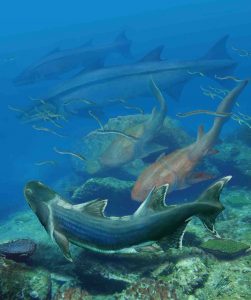
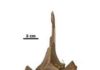
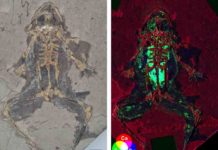
Life restoration of Sparalepis tingi (foreground) and other fauna from the Kuanti Formation. Credit: Brian Choo
An ancient fish species with unusual scales and teeth from the Kuanti Formation in southern China may have evolved prior to the “Age of Fish”, according to a study published March 8, 2017 in the open-access journal PLOS ONE by Brian Choo from Flinders University, Australia, and colleagues at the Institute of Vertebrate Paleontology and Paleoanthropology, China.
The Devonian Period (419.2 – 358.9 million years ago) is popularly called the “Age of Fishes” because of the apparent increase in the abundance and variety of jawed fishes when compared with the preceding Silurian Period (443.7 – 419.2 million years ago). Until recently, the Silurian fossil record of jawed vertebrates has been based on highly fragmentary remains, limiting our understanding of their early evolution. Recent discoveries from the Kuanti Formation of Yunnan, southwestern China, have dramatically enhanced our knowledge, with several superbly preserved fish species described in recent years. The fish-bearing sediments of the Kuanti Formation have been dated to the latter part of the Silurian, about 423 million years ago.
Now, Choo and colleagues have described a new genus and species of Kuanti fish, Sparalepis tingi, which represents only the second Silurian bony fish based on more than isolated fragments. This new form, along with its contemporary Guiyu and the slightly more recent Psarolepis, possesses spine-bearing pectoral and pelvic girdles, features once thought to be restricted to the armored placoderm fishes. Sparalepis and its kin may represent an early radiation of stem-sarcopterygians, ancient cousins of modern lungfish, coelacanths and tetrapods.
But Sparalepis also has an unusual scale morphology which distinguishes it from its cousins. The scales are particularly tall, thick and narrow, with the ones at the front having interlocking mechanisms on both the outer and inner surfaces. The closely packed squamation resembles a wall of shields, giving rise to the genus name of Sparalepis, a mixture of ancient Persian and Greek meaning “shield scale”.
Sparalepis adds to an ever-growing list of bizarre ancient fishes from the Silurian and earliest Devonian of Yunnan, suggesting that this region may have been an early center of diversification for the jawed vertebrates. The “Age of Fishes” appears to have arrived early during the Silurian of southern China.
Reference:
Choo B, Zhu M, Qu Q, Yu X, Jia L, Zhao W (2017) A new osteichthyan from the late Silurian of Yunnan, China. PLoS ONE 12(3): e0170929. DOI: 10.1371/journal.pone.0170929
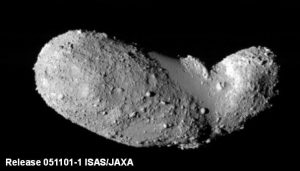
In 2005, the Hayabusa spacecraft developed by the Japan Aerospace Exploration Agency (JAXA) landed on Itokawa, a small near-Earth asteroid named after the famous Japanese rocket scientist Hideo Itokawa. The aim of the unmanned mission was to study the asteroid and collect a sample of material to be returned to Earth for analysis. Contrary to scientific predictions that small asteroids are barren nuggets of rock, photographs taken by the Hayabusa spacecraft revealed that the surface of Itokawa is strewn with different sized particles. Even more puzzling was the lateral separation of small and large particles – with large boulders occupying the highlands and small pebbles occupying the lowlands.
Researchers at the Okinawa Institute of Science and Technology Graduate University (OIST), Japan, in collaboration with researchers at Rutgers University, USA, have used a combination of experiments, simulations and analyses to propose a mechanism underlying the lateral size-sorting of particles on Itokawa: small pebbles hitting the surface of Itokawa rebound from boulders but sink into pebble-rich regions.
Size-sorting of particles on Itokawa was formerly attributed to the Brazil Nut Effect (BNE) in which particles of different sizes separate during sustained vertical shaking in the presence of gravity. Similar to the phenomenon in which shaking a box of granola causes large clusters to rise to the surface and smaller oats sink to the bottom, large boulders rise to the surface of asteroid rubble piles, while smaller pebbles sink. But even if the BNE can account for boulders rising to the surface, it fails to explain the observed lateral segregation of particles.
“Together with researchers at Rutgers University, we have come up with a simpler and more viable reason for the size-sorting of particles on Itokawa,” says Professor Pinaki Chakraborty, head of OIST’s Fluid Mechanics Unit.
The findings, to be published in Physical Review Letters give insight into the formation and evolution of small asteroids, providing a window into the early stages of the solar system.
From the photographs, it can be observed that volumes of boulders and pebbles on the surface of Itokawa are comparable, meaning that there must be many more pebbles by number. It follows that most collisions that formed the asteroid must have been from small particles. This is significant because when a pebble hits a boulder it rebounds, whereas when it hits a sea of other pebbles its momentum dies. The researchers predicted that this process – which they termed ‘ballistic sorting’ – could underlie Itokawa’s size-sorting phenomenon.
To test this experimentally, researchers at Rutgers University dropped sand particles on to a ceramic plate to model pebbles colliding with boulders and other pebbles. They observed that when sand particles hit the plate, they bounce off, but when they hit a mound of sand, they aggregate, leading to growing sand piles.
“These initial experiments show that falling sand bounces away from boulders, but stays near sandy regions,” explains Professor Troy Shinbrot from Rutgers University and lead author of the study.
Next, Prof. Shinbrot and colleagues dropped sand particles on stones that were randomly placed at the bottom of a box. Measuring the size of the sand islands over time, the team showed that the area of the islands grows according to the Hill equation, which is used to describe processes in which an initial accumulation promotes further accumulation.
In order to test if these experimental results apply to Itokawa – which has much lower gravity than Earth – Dr. Tapan Sabuwala from OIST’s Continuum Physics Unit, conducted computer simulations in which he varied the gravity and quantified the ballistic sorting effect by dropping pebbles on a substrate of boulders and pebbles and tracking each pebble’s trajectory. He found that pebbles that hit boulders travel further than pebbles that hit other pebbles, irrespective of gravitational pull.
“Our simulations confirm that pebble seas grow because incoming pebbles rebound from stones but collide inelastically with other pebbles,” says Dr. Sabuwala. “We also find that ballistic sorting leads to the formation of flat pebble seas in gravitational valleys.”
Based on both experiments and simulations, the team concluded that low speed deposition of pebbles results in a predictable growth of pebble seas.
“We believe that ballistic sorting may be the dominant mechanism underlying size-sorting of particles on small asteroids like Itokawa,” says Prof. Shinbrot. “Larger asteroids may also undergo ballistic sorting but because they are more susceptible to high energy impacts and other landscape-disrupting factors, the situation is more complicated.”
Preliminary imaging of asteroid Bennu, which is comparable in size to Itokawa, suggests that it also exhibits lateral size segregation of particles on its surface. A NASA-led exploration of Bennu commencing in 2018 is expected to give further insights into the extent of ballistic sorting.
“Our research may be useful for upcoming space missions, particularly in guiding successful spacecraft-landings on asteroids,” says Prof. Chakraborty. “In addition to the mission to asteroid Bennu, ongoing JAXA’s Hayabusa 2 mission to asteroid Ryugu and the upcoming NASA-led mission to Jupiter’s Trojan asteroids due to launch in 2021, could benefit from this new finding.”
A thankfully rare event: an asteroid hits the Earth. (Visualisations: iStock / Solarseven)
Asteroids don’t hit our planet at regular intervals, as was previously thought. Earth scientists have reached this conclusion after analyzing impact craters formed in the last 500 million years, concentrating on precisely dated events.
Do mass extinctions, like the fall of the dinosaurs, and the formation of large impact craters on Earth occur together at regular intervals? “This question has been under discussion for more than thirty years now,” says Matthias Meier from ETH Zurich’s Institute of Geochemistry and Petrology. As late as 2015, US researchers indicated that impact craters were formed on Earth around every 26 million years. “We have determined, however, that asteroids don’t hit the Earth at periodic intervals,” says Meier, refuting the popular hypothesis.
In the past, researchers have even postulated the existence of a companion star to the Sun. This supposed dim dwarf star, named Nemesis after the Greek goddess of revenge, was believed to draw near to the Sun every 26 million years and cause asteroids to bombard Earth. This would next occur in around 10 million years. Nemesis, however, has never been found.
False data corrected
Today, we know of around 190 impact craters on Earth, with diameters ranging from a few metres to more than 100 kilometres. They range from just a few years to billions of years old. Matthias Meier and his former doctoral student Sanna Holm-Alwmark at Lund University restricted their analysis to craters formed within the last 500 million years, since the emergence of the first complex life forms. Holm-Alwmark then discovered that some of the dates used in previous studies were false, and have now been corrected. She arrived at a list of 22 craters whose exact age is known to within one percent.
Meier then analysed these impacts using circular spectral analysis (CSA). The timeline of events was represented in a circle with a particular range — in this case, 26 million years. If events repeated themselves regularly within this timespan, the points would have arranged themselves in a particular area of the circle. In their work, which was published in the British journal Monthly Notices of the Royal Astronomical Society, Meier and Holm-Alwmark showed that there was no such accumulation.
Almost the same age, but far apart
The researchers also determined that some of the impact craters were almost exactly the same age. “Some of these craters could have been formed by the collision of an asteroid accompanied by a moon,” suggests Meier. “But in other cases, the impact sites are too far away from each other for this to be the explanation.” A clear example of this is the 66 million-year-old Chicxulub crater in Mexico, which has been linked to the extinction of the dinosaurs, and the Boltysh crater in the Ukraine, which was formed at almost exactly the same time. “We have no definitive explanation for that,” says Meier. One possible cause could be a collision between two fragments in the asteroid belt, forming debris which might then have quickly found its way to Earth.
One thing is certain, however: craters with similar ages could distort the results of the analysis. “Our work has shown that just a few of these so-called impact clusters are enough to suggest a semblance of periodicity,” says Meier, explaining that because the researchers of the 2015 study overlooked the formation of these clusters, their statistical method led them in the wrong direction.
Reference:
Matthias M. M. Meier, Sanna Holm-Alwmark. A tale of clusters: No resolvable periodicity in the terrestrial impact cratering record. Monthly Notices of the Royal Astronomical Society, 2017; stx211 DOI: 10.1093/mnras/stx211
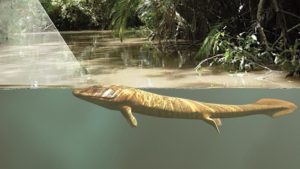
A side view of a 3-D model of Tiktaalik in a murky waterway in the Devonian, 385 million years ago, looking out above the water line through eyes set on top of the skull, and breathing through spiracles located just behind the eyes. Credit: Malcolm MacIver, Northwestern University
A provocative new Northwestern University and Claremont McKenna, Scripps and Pitzer colleges study suggests it was the power of the eyes and not the limbs that first led our ancient aquatic ancestors to make the momentous leap from water to land. Crocodile-like animals first saw easy meals on land and then evolved limbs that enabled them to get there, the researchers argue.
Neuroscientist and engineer Malcolm A. MacIver of Northwestern and evolutionary biologist and paleontologist Lars Schmitz of Claremont McKenna, Scripps and Pitzer colleges studied the fossil record and discovered that eyes nearly tripled in size before — not after — the water-to-land transition. The tripling coincided with a shift in location of the eyes from the side of the head to the top. The expanded visual range of seeing through air may have eventually led to larger brains in early terrestrial vertebrates and the ability to plan and not merely react, as fish do.
“Why did we come up onto land 385 million years ago? We are the first to think that vision might have something to do with it,” said MacIver, professor of biomedical engineering and of mechanical engineering in the McCormick School of Engineering.
“We found a huge increase in visual capability in vertebrates just before the transition from water to land. Our hypothesis is that maybe it was seeing an unexploited cornucopia of food on land — millipedes, centipedes, spiders and more — that drove evolution to come up with limbs from fins,” MacIver said. (Invertebrates came onto land 50 million years before our vertebrate ancestors made that transition.)
The enlargement of eyes is significant. By just popping those eyes above the water line, the fish could see 70 times farther in air than in water. With the tripling of eye size, the animal’s visually monitored space increased a millionfold. This happened millions of years before fully terrestrial animals existed.
“Bigger eyes are almost worthless in water because vision is largely limited to what’s directly in front of the animal,” said Schmitz, assistant professor of biology at the W.M. Keck Science Department, a joint program of Claremont McKenna, Scripps and Pitzer colleges.
“But larger eye size is very valuable when viewing through air. In evolution, it often comes down to a trade-off. Is it worth the metabolic toll to enlarge your eyes? What’s the point? Here we think the point was to be able to search out prey on land,” he said.
Larger eyes were consequently selected for, whereas the study shows that in water, larger eyes led to negligible increases in visual range. In fact, one animal group that arose after animals came onto land went back to full-time life underwater, and their eyes went back to the smaller eye size normally seen in fish, MacIver and Schmitz found.
The study, “Massive Increase in Visual Range Preceded the Origin of Terrestrial Vertebrates,” was published today (March 7) by the journal Proceedings of the National Academy of Sciences (PNAS).
The massive increase in visual capability enabled by vision in air likely allowed early-limbed animals to evolve more complex cognition. These animals were no longer forced to react with split-second speed as was required by life in the vision-limiting water. Eventually, the researchers said, evolution led to the human capability of prospective cognition: the power to weigh options for the future and to choose strategically.
MacIver and Schmitz studied 59 fossil specimens spanning the time before the water-to-land transition, during the transition and after the transition. Their computer simulations of the animals’ visual environments (such as clear or murky water in the daytime or above water in the daytime and the nighttime) show that the benefit of increased eye size would be realized when an animal is seeing through air, not water.
The researchers measured the size of each fossil’s orbits, or eye sockets, and head length. From that, they determined the size of the eyes and the size of the animal itself. They found that before the water-to-land transition the average orbit size was 13 millimeters and around the time of transition the average size was 36 millimeters.
“The tripling of orbit size took 12 million years,” MacIver said. “This is the timescale of evolution, which boggles our mind.”
Through an interdisciplinary approach, MacIver and Schmitz have been able to show that our aquatic ancestors followed an informational zipline provided by long-range vision to an abundance of food on land. Rather than limbs, it was eyes that brought our ancestors to land.
Reference:
Malcolm A. MacIver, Lars Schmitzd, Ugurcan Mugan, Todd D. Murphey, and Curtis D. Mobley. Massive increase in visual range preceded the origin of terrestrial vertebrates. PNAS, 2017 DOI: 10.1073/pnas.1615563114
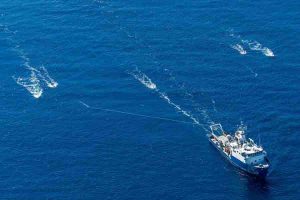
In 2013, Scripps research vessel New Horizon towed a hydrophone array to map the bathymetry of the Newport-Inglewood/Rose Canyon fault zone. Credit: Scripps Institution of Oceanography at UC San Diego
A fault system that runs from San Diego to Los Angeles is capable of producing up to magnitude 7.3 earthquakes if the offshore segments rupture and a 7.4 if the southern onshore segment also ruptures, according to an analysis led by Scripps Institution of Oceanography at the University of California San Diego.
The Newport-Inglewood and Rose Canyon faults had been considered separate systems but the study shows that they are actually one continuous fault system running from San Diego Bay to Seal Beach in Orange County, then on land through the Los Angeles basin.
“This system is mostly offshore but never more than four miles from the San Diego, Orange County, and Los Angeles County coast,” said study lead author Valerie Sahakian, who performed the work during her doctorate at Scripps and is now a postdoctoral fellow with the U.S. Geological Survey. “Even if you have a high 5- or low 6-magnitude earthquake, it can still have a major impact on those regions which are some of the most densely populated in California.”
The study, “Seismic constraints on the architecture of the Newport-Inglewood/Rose Canyon fault: Implications for the length and magnitude of future earthquake ruptures,” appears in the American Geophysical Union’s Journal of Geophysical Research.
The researchers processed data from previous seismic surveys and supplemented it with high-resolution bathymetric data gathered offshore by Scripps researchers between 2006 and 2009 and seismic surveys conducted aboard former Scripps research vessels New Horizon and Melville in 2013. The disparate data have different resolution scales and depth of penetration providing a “nested survey” of the region. This nested approach allowed the scientists to define the fault architecture at an unprecedented scale and thus to create magnitude estimates with more certainty.
They identified four segments of the strike-slip fault that are broken up by what geoscientists call stepovers, points where the fault is horizontally offset. Scientists generally consider stepovers wider than three kilometers more likely to inhibit ruptures along entire faults and instead contain them to individual segments — creating smaller earthquakes. Because the stepovers in the Newport-Inglewood/Rose Canyon (NIRC) fault are two kilometers wide or less, the Scripps-led team considers a rupture of all the offshore segments is possible, said study co-author Scripps geologist and geophysicist Neal Driscoll.
The team used two estimation methods to derive the maximum potential a rupture of the entire fault, including one onshore and offshore portions. Both methods yielded estimates between magnitude 6.7 and magnitude 7.3 to 7.4.
The fault system most famously hosted a 6.4-magnitude quake in Long Beach, Calif. that killed 115 people in 1933. Researchers have found evidence of earlier earthquakes of indeterminate size on onshore portions of the fault, finding that at the northern end of the fault system, there have been between three and five ruptures in the last 11,000 years. At the southern end, there is evidence of a quake that took place roughly 400 years ago and little significant activity for 5,000 years before that.
Driscoll has recently collected long sediment cores along the offshore portion of the fault to date previous ruptures along the offshore segments, but the work was not part of this study.
In addition to Sahakian and Driscoll, study authors include Jayne Bormann, Graham Kent, and Steve Wesnousky of the Nevada Seismological Laboratory at the University of Nevada, Reno, and Alistair Harding of Scripps. Southern California Edison funded the research at the direction of the California Energy Commission and the California Public Utilities Commission.
“Further study is warranted to improve the current understanding of hazard and potential ground shaking posed to urban coastal areas from Tijuana to Los Angeles from the NIRC fault,” the study concludes.
Reference:
Valerie Sahakian, Jayne Bormann, Neal Driscoll, Alistair Harding, Graham Kent, Steve Wesnousky. Seismic Constraints on the Architecture of the Newport-Inglewood/Rose Canyon Fault: Implications for the Length and Magnitude of Future Earthquake Ruptures. Journal of Geophysical Research: Solid Earth, 2017; DOI: 10.1002/2016JB013467
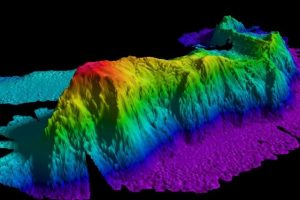
A map of a seamount in the Arctic Ocean created by gathering data with a multibeam echo sounder. Researchers have found that such topographic features can trap deep waters and produce turbulence. Credit: NOAA
At high latitudes, such as near Antarctica and the Arctic Circle, the ocean’s surface waters are cooled by frigid temperatures and become so dense that they sink a few thousand meters into the ocean’s abyss.
Ocean waters are thought to flow along a sort of conveyor belt that transports them between the surface and the deep in a never-ending loop. However, it remains unclear where the deep waters rise to the surface, as they ultimately must. This information would help researchers estimate how long the ocean may store carbon in its deepest regions before returning it to the surface.
Now scientists from MIT, Woods Hole Oceanographic Institution (WHOI), and the University of Southampton in the U.K. have identified a mechanism by which waters may rise from the ocean’s depths to its uppermost layers. Their results are published in the journal Nature Communications.
Through numerical modeling and observations in the Southern Ocean, the team found that topographic features such as seamounts, ridges, and continental margins can trap deep waters from migrating to flatter, calmer parts of the ocean. The underwater chasms and cliffs generate turbulent flows, similar to wind that whips between a city’s skyscrapers. The longer water is trapped among these topographic features, the more it mixes with upper layers of the ocean, swirling its way back toward the surface.
“In the abyssal ocean, you have 4,000-meter sea mountains and very deep troughs, up and down, and these topographic features help create turbulence,” says Raffaele Ferrari, the Cecil and Ida Green Professor of Oceanography in MIT’s Department of Earth, Atmospheric and Planetary Sciences. “What seems to be emerging is that water comes back up from the abyss by spending a lot of time in these places where turbulence is really strong.”
Knowing there are hotspots where deep waters return to the surface may help scientists identify regions where carbon, once absorbed from the atmosphere and stored deep in the ocean, rises and is released back to the atmosphere.
“The general understanding is that abyssal waters take few to several thousand years to resurface,” says lead author and MIT postdoc Ali Mashayek. “If a considerable amount of such upwelling occurs rapidly along sloped boundaries, continental margins, and mid-ocean ridges, then the timescale of recycling of abyssal waters can be shorter.”
Ferrari and Mashayek’s co-authors are Sophia Merrifield, an MIT graduate student; Jim Ledwell and Lou St. Laurent of WHOI; and Alberto Naveira Garabato of the University of Southampton.
The power of 10 light bulbs
In cold polar regions, the amount of water that continually sinks to the deep ocean is estimated to be “about 107 cubic meters per second — 50 times the transport of the Amazon River,” Ferrari says.
In 1966, acclaimed oceanographer Walter Munk addressed the puzzle of how all this deep water returns to the surface, proposing that small-scale ocean turbulence may drive heavy, deep water to mix and rise. This turbulence, he posited, takes the form of breaking internal gravity waves that travel between water layers of different densities, below the ocean’s surface.
Munk calculated the mixing power that would have to be generated by breaking internal gravity waves to bring all the ocean’s deep water back up to the surface. The number, Ferrari says, is equivalent to “about 10 light bulbs per cubic kilometer of the ocean.”
Since then, oceanographers have identified limited areas, such as seamounts and ridges, that create turbulence similar to what Munk theorized.
“But if you summed those few places up, you didn’t seem to come up to the number you needed to bring all that water back up,” Ferrari says.
Making passage
In February 2009, collaborators from WHOI deployed a tracer in the Southern Ocean, about 1,000 miles west of Drake Passage, as part of a project called DIMES (Diapycnal and Isopycnal Mixing Experiment in the Southern Ocean) to analyze the mixing of ocean waters.
“They released a blob of dye, like a drop of milk in a coffee cup, and let the ocean mix it around,” Ferrari says.
Over two years, they sampled the tracer at various stations downstream from where it was released, and found that it experienced very little turbulence, or mixing, in parts of the ocean with few topographic features. However, once the tracer crossed Drake Passage, it encountered seamounts and ridges, and “all of a sudden, it started to spread in the vertical quite fast, at three times the rate predicted by Munk,” Ferrari says.
What was driving this accelerated mixing? To find out, the team, led by Mashayek, developed a numerical model to simulate the Southern Ocean region — no small task, as it was unclear whether such a model could have high enough resolution to reproduce a tracer’s small-scale movements amid a vast volume of seawater.
“I did some preliminary calculations, back of the envelope estimates, and realized we would have just enough resolution to be able to do it,” Mashayek recalls.
A tracer, trapped
The researchers used MIT’s general circulation model — a numerical model designed to study Earth’s atmosphere, ocean, and climate — as their framework, and programmed into it all the external forces that are known to exist in the Southern Ocean, including wind patterns, solar heating, evaporation, and precipitation. They then worked measurements from the DIMES experiment into the model and extrapolated the turbulence across the entire ocean region, given the underlying topography.
The team then placed a tracer in its model at the same location where the real tracer was released into the Southern Ocean, and observed that, indeed, it spread vertically, at the same rate that the researchers observed in the field, proving that the model was representing the real ocean’s turbulence.
Looking more closely at their simulations, the researchers observed that regions with topography such as seamounts and ridges were essentially trapping the tracer for long periods of time, buffeting and mixing it vertically, before the tracer escaped and drifted through calmer waters.
The researchers believe the turbulence that occurs in these isolated regions over long periods of time may measure up to the total amount of mixing that Munk initially predicted. This mixing process may thus explain how waters in the deep ocean swell back up to the surface.
“Mixing-induced upwelling is globally relevant,” Mashayek says. “If our finding in the Southern Ocean extends to other mixing hotspots around the globe, then it will somewhat reshape our understanding of role of turbulent mixing in ocean overturning circulation. It also has important implications for parameterization of mixing processes in climate models.”
Reference:
A. Mashayek, R. Ferrari, S. Merrifield, J. R. Ledwell, L. St Laurent, A. Naveira Garabato. Topographic enhancement of vertical turbulent mixing in the Southern Ocean. Nature Communications, 2017; 8: 14197 DOI: 10.1038/ncomms14197
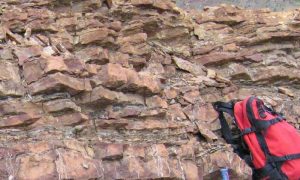
Permian-Triassic boundary in shallow marine sediments, characterised by a significant sedimentation gap between the black shales of Permian and dolomites of Triassic age. This gap documents a globally-recognised regression phase, probably linked to a period of a cold climate and glaciation. Credit: H. Bucher, Zürich
Earth has known several mass extinctions over the course of its history. One of the most important happened at the Permian-Triassic boundary 250 million years ago. Over 95% of marine species disappeared and, up until now, scientists have linked this extinction to a significant rise in Earth temperatures. But researchers from the University of Geneva (UNIGE), Switzerland, working alongside the University of Zurich, discovered that this extinction took place during a short ice age which preceded the global climate warming. It’s the first time that the various stages of a mass extinction have been accurately understood and that scientists have been able to assess the major role played by volcanic explosions in these climate processes. This research, which can be read in Scientific Reports, completely calls into question the scientific theories regarding these phenomena, founded on the increase of CO2 in the atmosphere, and paves the way for a new vision of Earth’s climate history.
Teams of researchers led by Professor Urs Schaltegger from the Department of Earth and Environmental Sciences at the Faculty of Science of the UNIGE and by Hugo Bucher, from the University of Zürich, have been working on absolute dating for many years. They work on determining the age of minerals in volcanic ash, which establishes a precise and detailed chronology of Earth’s climate evolution. They became interested in the Permian-Triassic boundary, 250 million years ago, during which one of the greatest mass extinctions ever took place, responsible for the loss of 95% of marine species. How did this happen? for how long marine biodiversity stayed at very low levels?
A technique founded on the radioactive decay of uranium.
Researchers worked on sediment layers in the Nanpanjiang basin in southern China. They have the particularity of being extremely well preserved, which allowed for an accurate study of the biodiversity and the climate history of the Permian and the Triassic. “We made several cross-sections of hundreds of metres of basin sediments and we determined the exact positions of ash beds contained in these marine sediments,” explained Björn Baresel, first author of the study. They then applied a precise dating technique based on natural radioactive decay of uranium, as Urs Schaltegger added: “In the sedimentary cross-sections, we found layers of volcanic ash containing the mineral zircon which incorporates uranium. It has the specificity of decaying into lead over time at a well-known speed. This is why, by measuring the concentrations of uranium and lead, it was possible for us to date a sediment layer to an accuracy of 35,000 years, which is already fairly precise for periods over 250 million years.” Ice is responsible for mass extinction
By dating the various sediment layers, researchers realised that the mass extinction of the Permian-Triassic boundary is represented by a gap in sedimentation, which corresponds to a period when the sea-water level decreased. The only explanation to this phenomenon is that there was ice, which stored water, and that this ice age which lasted 80,000 years was sufficient to eliminate much of marine life. Scientists from the UNIGE explain the global temperature drop by a stratospheric injection of large amounts of sulphur dioxide reducing the intensity of solar radiation reaching the surface of Earth. “We therefore have proof that the species disappeared during an ice age caused by the activity of the first volcanism in the Siberian Traps,” added Urs Schaltegger. This ice age was followed by the formation of limestone deposits through bacteria, marking the return of life on Earth at more moderate temperatures. The period of intense climate warming, related to the emplacement of large amounts of basalt of the Siberian Traps and which we previously thought was responsible for the extinction of marine species, in fact happened 500,000 years after the Permian-Triassic boundary.
This study therefore shows that climate warming is not the only explanation of global ecological disasters in the past on Earth: it is important to continue analysing ancient marine sediments to gain a deeper understanding of Earth’s climate system.
Reference:
Björn Baresel, Hugo Bucher, Borhan Bagherpour, Morgane Brosse, Kuang Guodun, Urs Schaltegger. Timing of global regression and microbial bloom linked with the Permian-Triassic boundary mass extinction: implications for driving mechanisms. Scientific Reports, 2017; 7: 43630 DOI: 10.1038/srep43630
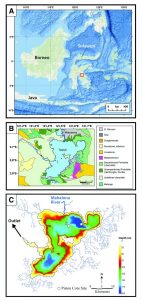
Lake Towuti, Indonesia. (A) Regional context for Lake Towuti on the island of Sulawesi in Indonesia. Red box indicates approximate location of part B. Background is the Ocean base map from ESRI et al. (2015). (B) Generalized geologic map of Lake Towuti and the surrounding area showing the dominance of ultramafic material. Map is modified from Costa et al. (2015). (C) Bathymetry of Lake Towuti showing the location of the two analyzed sediment cores at the distal margins of the Mahalona River delta (white dots labeled 4 for TOW4 and 5 for TOW5). River inputs are shown in thin blue lines, with the Mahalona River shown as a thick blue line. Credit: Goudge et al. and GSA Bulletin
In their GSA Bulletin article published online last week, Timothy A. Goudge and colleagues detail the clay mineralogy of sediment from Lake Towuti, Indonesia, using a technique called visible to near-infrared (VNIR) spectroscopy. VNIR measures the signature of reflected light from a sample across a larger wavelength range than just visible light. At Lake Towuti, the spectral record shows distinct variations in clay mineralogy over the past 40,000 years.
The record also captures the response of the lake system to changing climate, including changes in lake levels, forced delta progradation, and river incision. According to Goudge and colleagues, this demonstrates the utility of VNIR spectroscopy in developing paleoenvironmental records over tens of thousands of years.
Interestingly, Goudge and colleagues also suggest that paleolake deposits on Mars should preserve similar paleoenvironmental information that could be accessed through remote sensing studies of stratigraphy and VNIR reflectance spectroscopy.
Lead author Tim Goudge says, “The major link between this study of lake sediment in Indonesia and lake deposits on Mars is in terms of the methods we used. We can differentiate material properties with color (e.g., rust is red because of the iron in it), so VNIR spectroscopy allows us to determine what minerals are within a sample of lake sediment.”
While this technique is relatively new for applying to lake deposits on Earth, it can be run remotely simply using reflected sunlight. Thus it is commonly employed to study the mineralogy and composition of the surface of other planetary bodies, including Mars.
Goudge says, “Our study shows that one can use VNIR spectroscopy to understand the evolution of past climate that is recorded by lake sediment. Therefore, we propose that applying a similar approach to studying ancient lake deposits on Mars at high resolution will help to unravel the history of ancient martian climate.”
Lake Towuti is also contained within an ophiolite, which is composed of very iron- and magnesium-rich (mafic) rocks, and so is more comparable to the mafic surface of Mars than much of Earth’s land surface, which is commonly more felsic (richer in silicon, aluminum, sodium, etc.). The compositional link is not perfect, however, so Goudge and colleagues more heavily emphasize the applicability of the technique.
Reference:
Timothy A. Goudge, James M. Russell, John F. Mustard, James W. Head, Satria Bijaksana. A 40,000 yr record of clay mineralogy at Lake Towuti, Indonesia: Paleoclimate reconstruction from reflectance spectroscopy and perspectives on paleolakes on Mars. Geological Society of America Bulletin, 2017; B31569.1 DOI: 10.1130/B31569.1
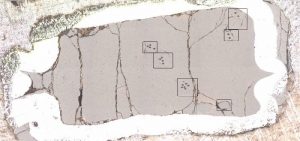
An image of one of the team’s lab mimicry experiments, which was conducted in a capsule made of gold-palladium alloy. The black boxes highlight the locations of olivine grains, and the dark pits in the olivines are actual measurements for the water content of the olivine. The peridotite is the super fine-grained matrix. Credit: Emily Sarafian.
A joint study between Carnegie and the Woods Hole Oceanographic Institution has determined that the average temperature of Earth’s mantle beneath ocean basins is about 110 degrees Fahrenheit (60 Celsius) higher than previously thought, due to water present in deep minerals. The results are published in Science.
Earth’s mantle, the layer just beneath the crust, is the source of most of the magma that erupts at volcanoes. Minerals that make up the mantle contain small amounts of water, not as a liquid, but as individual molecules in the mineral’s atomic structure. Mid-ocean ridges, volcanic undersea mountain ranges, are formed when these mantle minerals exceed their melting point, become partially molten, and produce magma that ascends to the surface. As the magmas cool, they form basalt, the most-common rock on Earth and the basis of oceanic crust. In these oceanic ridges, basalt can be three to four miles thick.
Studying these undersea ranges can teach scientists about what is happening in the mantle, and about the Earth’s subsurface geochemistry.
One longstanding question has been a measurement of what’s called the mantle’s potential temperature. Potential temperature is a quantification of the average temperature of a dynamic system if every part of it were theoretically brought to the same pressure. Determining the potential temperature of a mantle system allows scientists better to understand flow pathways and conductivity beneath the Earth’s crust. The potential temperature of an area of the mantle can be more closely estimated by knowing the melting point of the mantle rocks that eventually erupt as magma and then cool to form the oceanic crust.
In damp conditions, the melting point of peridotite, which melts to form the bulk of mid-ocean ridge basalts, is dramatically lower than in dry conditions, regardless of pressure. This means that the depth at which the mantle rocks start to melt and well up to the surface will be different if the peridotite contains water, and beneath the oceanic crust, the upper mantle is thought to contain small amounts of water–between 50 and 200 parts per million in the minerals of mantle rock.
So lead author Emily Sarafian of Woods Hole, Carnegie’s Erik Hauri, and their team set out to use lab experiments in order to determine the melting point of peridotite under mantle-like pressures in the presence of known amounts of water.
“Small amounts of water have a big effect on melting temperature, and this is the first time experiments have ever been conducted to determine precisely how the mantle’s melting temperature depends on such small amounts of water,” Hauri said.
They found that the potential temperature of the mantle beneath the oceanic crust is hotter than had previously been estimated.
“These results may change our understanding of the mantle’s viscosity and how it influences some tectonic plate movements,” Sarafian added.
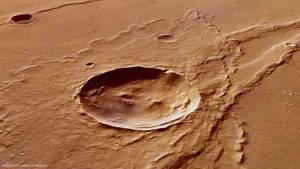
An impact crater on Mars, named Melas Dorsa, and its surroundings show a rich geologic history. The image was created by the European Space Agency’s Mars Express. Studies of the transformation of a synthetic version of a mineral known as whitlockite suggest that Mars had a more water-rich past than previously thought. Credit: G. Neukum/ESA,DLR, FU Berlin
Mars may have been a wetter place than previously thought, according to research on simulated Martian meteorites conducted, in part, at the Department of Energy’s Lawrence Berkeley National Laboratory (Berkeley Lab).
In a study published today in the journal Nature Communications, researchers found evidence that a mineral found in Martian meteorites — which had been considered as proof of an ancient dry environment on Mars — may have originally been a hydrogen-containing mineral that could indicate a more water-rich history for the Red Planet.
Scientists at the University of Nevada, Las Vegas (UNLV), who led an international research team in the study, created a synthetic version of a hydrogen-containing mineral known as whitlockite.
After shock-compression experiments on whitlockite samples that simulated the conditions of ejecting meteorites from Mars, the researchers studied their microscopic makeup with X-ray experiments at Berkeley Lab’s Advanced Light Source (ALS) and at Argonne National Laboratory’s Advanced Photon Source (APS).
The X-ray experiments showed that whitlockite can become dehydrated from such shocks, forming merrillite, a mineral that is commonly found in Martian meteorites but does not occur naturally on Earth.
“This is important for deducing how much water could have been on Mars, and whether the water was from Mars itself rather than comets or meteorites,” said Martin Kunz, a staff scientist at Berkeley Lab’s ALS who participated in X-ray studies of the shocked whitlockite samples.
“If even a part of merrillite had been whitlockite before, it changes the water budget of Mars dramatically,” said Oliver Tschauner, a professor of research in the Department of Geoscience at UNLV who co-led the study with Christopher Adcock, an assistant research professor at UNLV.
And because whitlockite can be dissolved in water and contains phosphorous, an essential element for life on Earth — and merrillite appears to be common to many Martian meteorites — the study could also have implications for the possibility of life on Mars.
“The overarching question here is about water on Mars and its early history on Mars: Had there ever been an environment that enabled a generation of life on Mars?” Tschauner said.
The pressures and temperatures generated in the shock experiments, while comparable to those of a meteorite impact, lasted for only about 100 billionths of a second, or about one-tenth to one-hundredth as long as an actual meteorite impact.
The fact that experiments showed even partial conversion to merrillite in these lab-created conditions, a longer duration impact would likely have produced “almost full conversion” to merrillite, Tschauner said.
He added that this latest study appears to be one of the first of its kind to detail the shock effects on synthetic whitlockite, which is rare on Earth.
Researchers blasted the synthetic whitlockite samples with metal plates fired from a gas-pressurized gun at speeds of up to about half a mile per second, or about 1,678 miles per hour, and at pressures of up to about 363,000 times greater than the air pressure in a basketball.
“You need a very severe impact to accelerate material fast enough to escape the gravitational pull of Mars,” Tschauner said.
At Berkeley Lab’s ALS, researchers used an X-ray beam to study the microscopic structure of shocked whitlockite samples in a technique known as X-ray diffraction. The technique allowed researchers to differentiate between merrillite and whitlockite in the shocked samples.
Separate X-ray experiments carried out at Argonne Lab’s APS showed that up to 36 percent of whitlockite was transformed to merrillite at the site of the metal plate’s impact with the mineral, and that shock-generated heating rather than compression may play the biggest role in whitlockite’s transformation into merrillite.
There is also evidence that liquid water flows on Mars today, though there has not yet been scientific proof that life has ever existed on Mars. In 2013, planetary scientists reported that darkish streaks that appear on Martian slopes are likely related to periodic flows of water resulting from changing temperatures. They based their analysis on data from NASA’s Mars Reconnaissance Orbiter.
And in November 2016, NASA scientists reported that a large underground body of water ice in one region of Mars contains the equivalent of all of the water in Lake Superior, the largest of the Great Lakes. Rover explorations have also found evidence of the former abundance of water based on analysis of surface rocks.
“The only missing link now is to prove that (merrillite) had, in fact, really been Martian whitlockite before,” Tschauner said. “We have to go back to the real meteorites and see if there had been traces of water.”
Adcock and Tschauner are pursuing another round of studies using infrared light at the ALS to study actual Martian meteorite samples, and are also planning X-ray studies of these actual samples this year.
Many Martian meteorites found on Earth seem to come from a period of about 150 million to 586 million years ago, and most are likely from the same region of Mars. These meteorites are essentially excavated from a depth of about a kilometer below the surface by the initial impact that sent them out into space, so they aren’t representative of the more recent geology at the surface of Mars, Tschauner explained.
“Most of them are very similar in the rock composition as well as the minerals that are occurring, and have a similar impact age,” he said. Mars is likely to have formed about 4.6 billion years ago, about the same time as Earth and the rest of our solar system.
Even with more detailed studies of Martian meteorites coupled with thermal imaging of Mars taken from orbiters, and rock samples analyzed by rovers traversing the planet’s surface, the best evidence of Mars’ water history would be an actual Martian rock taken from the planet and transported back to Earth, intact, for detailed studies, researchers noted.
“It’s really important to get a rock that hasn’t been ‘kicked'” like the Martian meteorites have, said Kunz, in order to learn more about the planet’s water history.
Reconstruction of the Early Cretaceous Darwinylus marcosi beetle on a gymnosperm host. Based on the pollen grains found in the amber with the beetle, scientists believe that the beetle was closely associated with cycads — an ancient gymnosperm group of plants that have living relatives today throughout the warmer parts of the world. Modern cycads are commonly confused with palms due to their roughly similar appearance, though relatively distant evolutionary relationship. Credit: Courtesy of Enrique Peñalver (Museo Geominero, Instituto Geológico y Minero de España, Madrid, Spain).
Named for Charles Darwin, the only known specimen of a newly discovered beetle, Darwinylus marcosi, died in a sticky gob of tree sap some 105 million years ago in what is now northern Spain. As it thrashed about before drowning, more than 100 clumped pollen grains were dislodged from its body and released into the resin. Five grains remained stuck to the beetle itself. Preserved with the beetle in the now-hard amber, the grains reveal that the beetle had been chewing a pollen meal with its jaw-like mouthparts just before it died.
Scientists familiar with this era in earth’s history, the mid-Mesozoic, didn’t need to ponder long about what flowers produced the pollen. The answer is none. The amber dates to a time when flowering plants — angiosperms — were just beginning to appear and the earth was overwhelmingly dominated by diverse, non-flowering plant species, such as cycads, ginkgoaleans, bennettitaleans and conifers — the gymnosperms.
Now, the discovery of D. marcosi in Spanish amber is proof of a new insect pollination mode that dates to the mid-Mesozoic: beetles with biting or “jaw-like mouthparts and a chewing feeding style,” says Conrad Labandeira, a paleobiologist at the Smithsonian’s National Museum of Natural History. This amber fossil is the .” .. first, direct evidence of a fourth major gymnosperm-insect pollination mode during this time.” A study on this discovery — and its significance in the context of a growing body of evidence of gymnosperm-insect pollinator relationships and modes leading up to the rise of flowering plants — was published today, March 2, 2017, in the journal Current Biology. A display featuring key findings from this study and gymnosperm-insect pollinator relationships will be included in the museum’s new fossil hall, scheduled to open in 2019.
The beetle is the latest in a series of recently discovered gymnosperm-pollinating insects that flourished during the mid-Mesozoic. Scorpionflies, lacewings, flies and moths with long, straw-like proboscises siphoned pollination drops. Pollination drops are a liquid similar to the nectar of flowering plants that originate from deep funnel-like holes in pine-cone-like structures and other, often bizarre, gymnosperm ovule-bearing organs. Flies with sponge-like mouthparts also lapped up this sweet plant nectar. Thrips with punch-and-suck mouthcone mouthparts drained the nutritious juices by cracking pollen grains, performing a different type of pollination. All three of these insect-pollinator feeding modes have been found in 165- to 105-year-old amber and stone fossils that show gymnosperm pollen clinging to various mouthpart structures, heads and bodies of these insects.
The newly reported discovery, taken with the growing body of gymnosperm-pollinator insect evidence, is important, Labandeira says, .” .. as it reveals the broad pattern of four distinctive pollinator modes that were present before the dominance of flowering plants between 125 and 90 million years ago.” These pollinator modes survive to the present day, although the particular plant and insect participants are mostly long gone.
Modern relatives of D. marcosi, a family known as false blister beetles, today pollinate flowering plants rather than gymnosperms. The amber fossil reveals that these beetles are one of a number of gymnosperm pollinators that .” .. successfully made the transition to feeding on and pollinating flowering plants,” Labandeira says.
In the Cretaceous, many gymnosperms and the insects that pollinated them went extinct in a world-wide shake-up during the Aptian-Albian Gap between 125 to 90 million years ago. This period is well-documented in the fossil record as gymnosperm diversity plunged and flowering plants soon came to dominate the earth during a 35-million-year long transition.
Those insect pollinators that depended upon gymnosperms and couldn’t make the transition became extinct. The very few that remained with the gymnosperms and survived saw a major drop in their diversity. Most gymnosperms today, such as conifers and the ginkgo, are wind pollinated; far fewer gymnosperms, such as the cycads and an unusual group known as gnetaleans, are insect-pollinated.
“During this transition in pollination strategies, some pollinators had finely tuned mouthparts and other bodily features that corresponded to delicately constructed components in their gymnosperm host plants,” says Labandeira. “And since these insect pollinators and plants were codependent, there was a risk for extinction of both partners, if one faltered — which largely happened. Modern insect pollinators and their host plants may be facing similar conditions today, and our understanding of this earlier transition may help us better grasp and comprehend the present situation.”
Many gymnosperm pollinators, such as D. marcosi, made a successful transition to angiosperms. Other pollinators, such as bees, originated during or after flowering plants came to dominate the earth.
Insects that made the transition from gymnosperms to angiosperms were able to do so while retaining basically the same mouthpart types, Labandeira says, in part because most insects pollinated a variety of generally unrelated plants with the similar rewards of pollen and pollination drops, even though the pollen producing and ovule-bearing organs were quite different between these two major types of plants. “The protoplasts of gymnosperm pollen are virtually the same as that of angiosperm pollen,” Labandeira says. “Gymnosperm pollen drops and angiosperm nectar originate in different tissues but also are very similar in composition and in almost all other properties, including nutritional content.”
The ability to pollinate a broad variety of unrelated gymnosperms was probably very useful for pollinating insects in making the transition to pollinating a broad variety of flowering plants.
Reference:
David Peris, Ricardo Pérez-de la Fuente, Enrique Peñalver, Xavier Delclòs, Eduardo Barrón, Conrad C. Labandeira. False Blister Beetles and the Expansion of Gymnosperm-Insect Pollination Modes before Angiosperm Dominance. Current Biology, 2017; DOI: 10.1016/j.cub.2017.02.009
Note: The above post is reprinted from materials provided by Smithsonian.
Scientists at EPFL and SLF describe with precision how snow and sand surfaces erode when exposed to wind. Their description can contribute to better predictions of dust emissions from deserts and snow transport in Antarctica, and can be adapted to other planets.
Wind and water transport a multitude of particles with them, leading to erosion or deposits, like dust emissions from the Saharan desert that can reach Europe and snow transport that can… block traffic.
Francesco Comola and Michael Lehning from EPFL and SLF accurately describe how wind flow affects a generic surface of non-homogeneous particles, like snow or sand, using a new theory that will one day help improve weather predictions. The results are now available in Vol. 44, No. 3 of Geophysical Research Letters.
Descriptions of wind or water transport already exist, but this is the first time that fundamental laws – Newton’s second law and energy conservation – are used to describe how particles are ejected from a bed of particles.
“It is a milestone since it is astonishing that the particle ejection process has never been described thus far by using the fundamental conservation laws,” says Lehning, “at least not for a wide range of sediments from heterogeneous sand to snow.”
The new theory is powerful enough so that they can statistically predict the number of particles ejected from the surface of the particle bed and lifted into the flow, even for varying particle sizes and varying material or flow properties.
The theory can be seen as a generalization of how billiard balls are scattered by the white ball during that first hit. But in many ways, the billiard table is a trivial case compared to beds of particles in nature. Instead of having a bed of only 15 billiard balls, the model can handle large numbers of particles and therefore be applied to vast areas on Earth or other planets. Instead of having only one white ball, there can be many incident particles. Instead of having billiard balls all of the same shape and size, the particles can be a mix of shapes and sizes like what we see in a handful of sand or snow. Instead of billiard balls that neither attract nor repulse each other, the particles can be sticky due to cohesive forces, like wet sand or humid snow.
The scientists believe that their new model will advance the study of dune and ripple development, both in arid and polar regions. It will also contribute to improve predictions of dust emissions from deserts and snow transport in Antarctica, whose effects extend from global health to weather and climate change. The model can also help find the cause of the intense sand transport activity observed on Mars, where the low density of the atmosphere would suggest that winds are not sufficiently strong to erode surface particles.
Reference:
Francesco Comola et al. Energy- and momentum-conserving model of splash entrainment in sand and snow saltation, Geophysical Research Letters (2017). DOI: 10.1002/2016GL071822
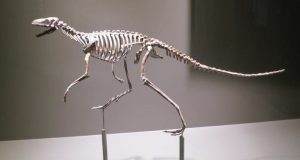
Skeleton of the proto-dinosaur Marasuchus — a squirrel-sized carnivore that likely walked on all fours but ran on two legs. Credit: Scott Persons
Paleontologists at the University of Alberta have developed a new theory to explain why the ancient ancestors of dinosaurs stopped moving about on all fours and rose up on just their two hind legs.
Bipedalism in dinosaurs was inherited from ancient and much smaller proto-dinosaurs. The trick to this evolution is in their tails explains Scott Persons, postdoctoral fellow and lead author on the paper.
“The tails of proto-dinosaurs had big, leg-powering muscles,” says Persons. “Having this muscle mass provided the strength and power required for early dinosaurs to stand on and move with their two back feet. We see a similar effect in many modern lizards that rise up and run bipedally.”
Over time, proto-dinosaurs evolved to run faster and for longer distances. Adaptations like hind limb elongation allowed ancient dinosaurs to run faster, while smaller forelimbs helped to reduce body weight and improve balance. Eventually, some proto-dinosaurs gave up quadrupedal walking altogether.
The research, conducted by Persons and Phil Currie, paleontologist and Canada Research Chair, also debunks theories that early proto-dinosaurs stood on two legs for the sole purpose of free their hands for use in catching prey.
“Those explanations don’t stand up,” says Persons. “Many ancient bipedal dinosaurs were herbivores, and even early carnivorous dinosaurs evolved small forearms. Rather than using their hands to grapple with prey, it is more likely they seized their meals with their powerful jaws.”
But, if it is true that bipedalism can evolve to help animals run fast, why aren’t mammals like horses and cheetahs bipedal?
“Largely because mammals don’t have those big tail-based leg muscles,” Persons explains. “Looking across the fossil record, we can trace when our proto-mammal ancestors actually lost those muscles. It seems to have happened back in the Permian period, over 252 million years ago.”
At that time the mammalian lineage was adapting to dig and to live in burrows. In order to dig, mammals had strong front limbs. Muscular back legs and tails likely made it more difficult to maneuver in the narrow confines of a burrow.
“It also makes the distance a predator has to reach in to grab you that much shorter,” says persons. “That’s why modern burrowers tend to have particularly short tails. Think rabbits, badgers, and moles.”
The researchers also theorize that living in burrows may have helped our ancestors to survive a mass extinction that occurred at the end of the Permian. But when proto-mammals emerged from their burrows, and some eventually evolved to be fast runners, they lacked the tail muscles that would have inclined them towards bipedalism.
Reference:
W. Scott Persons, Philip J. Currie. The functional origin of dinosaur bipedalism: Cumulative evidence from bipedally inclined reptiles and disinclined mammals. Journal of Theoretical Biology, 2017; 420: 1 DOI: 10.1016/j.jtbi.2017.02.032
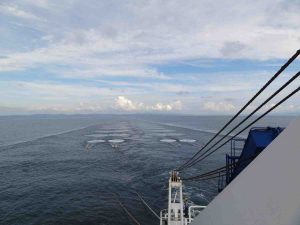
The wake behind this JAMSTEC research vessel is caused by the seismic sensors being towed behind the boat. The sensors allow researchers to create detailed images of the bedrock and structures under the ocean’s bottom. Credit: JAMSTEC
The 11 March 2011 Tohoku-Oki earthquake was the largest and most destructive in the history of Japan. Japanese researchers—and their Norwegian partners—are hard at work trying to understand just what made it so devastating.
The massive earthquake that rocked Japan on 11 March 2011 killed more than 20,000 people, making it one of the most deadly natural disasters in the country’s history. Virtually all of the victims drowned in a tsunami that in places was more than 30 metres high.
The tsunami also crippled the Fukushima Daiichi nuclear power plant, causing meltdowns in three of the plant’s six reactors and releasing record amounts of radiation to the ocean. The reactors were so unstable at one point that the former Prime Minister, Naoto Kan, later admitted he considered evacuating 50 million people from the greater Tokyo region. Eventually, 160,000 people had to leave their homes because of radiation.
This national disaster, Japan’s largest-ever earthquake, was a call to action for Japanese earth scientists. Their mission: to understand exactly what happened to make this quake so destructive. For this, they turned to JAMSTEC, the Japan Agency for Marine-Earth Science and Technology to probe the secrets in the 7000-metre deep Japan Trench, the epicentre of the temblor.
In the five years since the disaster, researchers have found intriguing clues as to what made the quake so dangerous. Norwegian petroleum expertise from working on the Norwegian Continental Shelf is now helping to uncover new details as scientists continue to try to understand what factors contribute to making an earthquake in this region really big. In doing so, they hope to be able to better predict the magnitude and location of future quakes and tsunamis.
A jumble of tectonic plates
Japan sits in what may be one of the most dangerous places possible when it comes to earthquakes. The northern part of the country lies on a piece of the North American plate, whereas the southern part of the country sits on the Eurasian plate. In the north, the Pacific plate is sliding underneath the North American plate, while to the south, the Eurasian plate is riding over the Philippine Sea plate. When one plate moves in relation to another, the movement can trigger an earthquake and tsunami.
The complex jumble of tectonic plates explains why roughly 1,500 earthquakes rattle the country every year, and why it is home to 40 active volcanoes—10 per cent of the world’s total.
Given that Japan experiences so many earthquakes, the quake that shook the country on the afternoon of 11 March wasn’t completely unexpected. In fact, researchers predicted that the region would see an earthquake of 7.5 magnitude or more over the next 30 years.
Earthquakes are routine enough in Japan that the country has strict building codes to prevent damage. Most large buildings wriggle and sway with the shaking of the earth—one man in Tokyo told the BBC that the movements in his workplace skyscraper during the 2011 quake were so strong he felt seasick—and even the Fukushima Daiichi nuclear plant was protected by 10-metre-high seawall.
Yet some combination of factors made the Tohoku-Oki earthquake bigger and with a more deadly tsunami than scientists expected. But what?
“This is what we want to understand—and to mitigate,” says Shin’ichi Kuramoto, Director General for the Center for Deep Earth Exploration at JAMSTEC. “Why do these big earthquakes occur?”
A really big slip
JAMSTEC researchers mobilized almost immediately after the disaster, and sent their 106-metre-long research vessel RV Kairei to the quake’s epicentre just a few days after it occurred.
For a little over two weeks, the ship cruised over the Japan Trench off the coast of Honshu. The purpose was to create a bathymetric picture of the sea bottom and to collect reflection seismic data, which allows researchers to peer into the sediments and rocks underneath the seafloor.
A subsequent cruise by JAMSTEC’s RV Kaiyo 7-8 months after the earthquake collected additional high-resolution reflection seismic images in the area. Fortunately, the researchers also had data from a similar study that had been done in 1999 in the same region.
The data showed them that the landward seafloor in the trench area slipped as much as 50 metres horizontally, said Yasuyuki Nakamura, Deputy Group leader in JAMSTEC’s Center for Earthquake and Tsunami Structural Seismology Group.
“This was a big slip in the trench axis area,” he said. “For comparison, the 1995 Kobe earthquake, which killed more than 6000 people and was a magnitude 7.3, had an average slip of 2 metres.”
Another magnitude 8 earthquake in 1946 in the Nankai area in southern Japan that destroyed 36,000 homes had a maximum slip of 10 metres, Nakamura said.
“So you can see that 50 metres is a very huge slip,” he said. That in itself partly explains why the tsunami wave was so big, he said.
Creating images using sound waves
When Martin Landrø, a geophysicist at the Norwegian University of Science and Technology (NTNU), read about the Japanese earthquake and learned that his Japanese counterparts had collected seismic data from both before and after the quake, he thought he might be able to offer some help.
For more than 20 years, Landrø has worked with interpreting and visualizing seismic data. Oil companies and geophysicists routinely use this approach to collect information about the geology under the seafloor. Landrø has studied everything from putting seismic data to work to discover new undersea oil reservoirs to visualizing what happens to CO2 injected into an undersea reservoir, as is being done now in the Sleipner Field in the North Sea.
It works like this: a ship sails along a straight line for 100 kilometres or more, and uses airguns to send an acoustic signal every 50 metres while the ship sails along. The ship also tows a long cable behind it to record the acoustic signals that are reflected back by the sediments and bedrock under the sea floor. Simply stated, harder materials reflect signals back more quickly than softer materials.
Geologists can create a two-dimensional image, a cross section of the geology under the sea floor, by towing one long cable behind a ship. A three-dimensional image can be created by towing a number of cables with sensors on them and essentially combining a series of two-dimensional images into a three-dimensional one.
A very special type of seismic data, however, is called 4-D, where the fourth dimension is time. Here, geophysicists can combine 2-D images from different time periods, or 3-D images from different time periods to see how an area has changed over time. It can be highly complex, especially if different systems have been used to collect the seismic data from the two different time periods. But 4-D seismic analysis is Landrø’s special expertise.
From North Sea oil reservoirs to the Japan Trench
Landrø contacted Shuichi Kodaira, director of JAMSTEC’s Center for Earthquake and Tsunami, and said that he wanted to see if some of the techniques that had been used for petroleum-related purposes could be used to understand stress changes related to earthquakes. Kodaira agreed.
Then it was just a matter of getting the data and “reprocessing it,” Landrø said, to make the two different time periods as comparable as possible.
“We could then estimate movements and changes caused by the earthquake at the seabed and below the seabed,” Landrø said.
After nearly a year of working remotely together on the data, Landrø and his Norwegian colleagues flew to Japan in November 2016 to meet their Japanese counterparts for the first time. They’re now in the process of jointly writing a scientific paper for publication, so he is reluctant to describe their new findings in detail before they are published.
“The ultimate goal here is to understand what happened during the earthquake in as detailed a way as possible. The big picture is more or less the same,” Landrø said. “It is more like we are looking at minor details that might be important using a technique that has been used in the oil industry for many years. Maybe we will see some details that haven’t been seen before.”
An early warning system
Landrø is also interested in a system that JAMSTEC has installed in the ocean off the southern part of the country, called the Dense Oceanfloor Network system for Earthquakes and Tsunamis, more commonly known as DONET.
The DONET system (of which there are now two) is a series of linked pressure sensors installed on the ocean floor in the Nankai Trough, an area that has been hit by repeated dangerous earthquakes, JAMSTEC’s Nakamura said.
The Nankai Trough is located where the Philippine Sea plate is sliding under the Eurasian plate at a rate of about 4 cm per year. In general, there have been large earthquakes along the trough every 100 to 150 years.
DONET 1 also includes a series of seismometers, tilt meters and strain indicators that were installed in a pit 980 metres below a known earthquake centre in the Nankai Trough. The sensors from the pit and from the seafloor above are all linked in a network of cables that sends real-time observations to monitoring stations and to local governments and businesses.
Essentially, if there is movement big enough to cause an earthquake and tsunami, the sensors will report it. JAMSTEC researchers have conducted studies that show that the DONET network could detect a coming tsunami as much as 10 to 15 minutes earlier than land-based detection stations along the coast. Those extra minutes could mean saving thousands of lives.
“One of the main purposes here is to provide a tsunami early warning system,” Nakamura said. “We’ve been collaborating with local governments to establish this.”
Other applications a possibility
Landrø says he thinks that using techniques from 4-D seismic imaging could also be used with the data collected by all the DONET sensors.
The DONET approach, or some variation of it, might also be useful in the future as Norway and other countries explore using oil reservoirs to store CO2. One of the biggest concerns about storing CO2 in subsea reservoirs is monitoring the storage area to make certain the CO2 stays in place. A DONET-style monitoring system might be of interest here, Landrø said.
Landrø also says he thinks that techniques from 4-D seismic imaging could be used with the data collected by all the DONET sensors to obtain a better understanding of how the area is changing over time.
DONET “is passive data, listening to the rock,” Landrø said. “But here you could also use some of the same techniques as for 4-D analysis to learn more.”
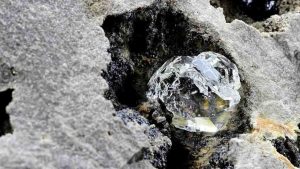
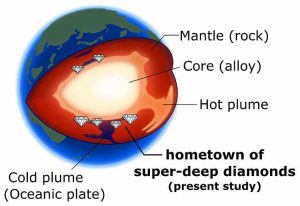
Researchers at Tohoku University believe that it is possible for natural diamonds to form at the base of the Earth’s mantle (Fig.1). The formation of such “super-deep” diamonds was simulated using high-pressure and high-temperature experiments by the Japanese research team, led by Fumiya Maeda.
Diamonds are evidence that carbon exists deep in the Earth. Most natural diamonds are formed around the depth of 200km. But it’s been suggested that some extremely rare diamonds come from as deep as 400km. Such diamonds are called “super-deep” diamonds, and researchers are hoping that they may offer new clues about the deep interior of the Earth.
(Fig.1) Earth’s interior and the hometown of super-deep diamonds.
This is because natural diamonds often contain mineral inclusions in their crystals, and these inclusions can reveal the conditions of the environment where the diamonds were formed. The hardness of the diamonds also make them good capsules as they can protect the inclusions from contamination or breakdown when they are brought to the Earth’s surface.
Although super-deep diamonds can provide good samples to help understand the Earth’s deep interior, researchers say they are still uncertain of the real depth and the formation process of these diamonds.
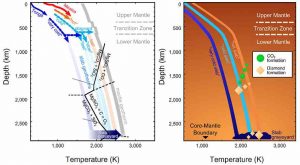
Results of their experiment show that super-deep diamonds can form through the reaction of Mg-carbonate and silica minerals. The reaction may occur in cold plates which descend all the way to the base of the mantle (Fig. 2).
(Fig.2) Diamond formation through the reaction of carbonate and silicate in the deep Earth.
Details of actual diamond formation in such a deep part of the Earth has so far, never been reported. But researchers plan to combine their recent experimental model with observation and analysis, in the hopes of getting information from natural diamonds that would provide further knowledge about our planet.
This study was published in Nature Publishing Group’s Scientific Reports on January 13, 2017.
Reference:
Fumiya Maeda et al, Diamond formation in the deep lower mantle: a high-pressure reaction of MgCO3 and SiO2, Scientific Reports (2017). DOI: 10.1038/srep40602
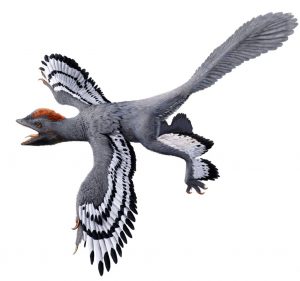
Revised life reconstruction using the new body outline laser-stimulated fluorescence data. Credit: Julius T. Csotonyi.
A chicken-sized, feathered dinosaur that scuttled around Earth 160 million years ago is helping flesh out the missing link between land-bound animals and flying ones, scientists said Tuesday.
A team from China and the United States used lasers to study traces of soft tissue once attached to the now-fossilised bones of a Jurassic dinosaur called Anchiornis.
The outlines revealed it had “drumstick-shaped legs, a slender tail and an arm that looks just like a modern bird wing,” said Michael Pittman of the University of Hong Kong, who co-authored the study in Nature Communications.
“We even have foot scales preserved in the Anchiornis specimens that are just like chickens today,” he said in a video explaining the findings.
It is still not clear if Anchiornis was a flier.
Most of what scientists know about dinosaur body shape is gleaned from looking at fossilised skeletons and comparing them to living dinosaur relatives—birds and crocodiles.
Pittman and a team used potent lasers to study the fossil-containing rock and isolate the imprint of the fleshy parts.
“We shone violet lasers at Anchiornis specimens in a dark room to cause them to glow in the dark, revealing amazing details,” said Pittman.
“This revealed the first quantitative high-detail outline of a feathered dinosaur.”
Scientists believe the study of Anchiornis is key to understanding the origin of birds, and of flight.
The creature is thought to have lived at about the same time that birds first appeared on Earth.
The lasers revealed a flap at the front of the creature’s elbow, the team said.
In modern birds, this is called the propatagium—the boneless leading edge of the wing, covered in feathers, and crucial for flight.
“The fact that we find this really neat wing in an older bird-like animal is really exciting,” said Pittman.
It is hoped the new data will help unravel how, and when, birds evolved from Earth-bound into sky-soaring creatures.
In 2010, a study of Anchiornis’ feathers revealed it had sported a grey body, a reddish-brown Mohawk crest and facial speckles.
Reference:
Basal paravian functional anatomy illuminated by high-detail body outline, Nature Communications, DOI:10.1038/ncomms14576
Note: The above post is reprinted from materials provided by AFP.
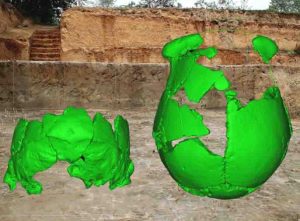
Virtual reconstructions of the Xuchang 1 and 2 human crania are superimposed on the archeological site where they were discovered. Credit: Xiujie Wu
Two partial archaic human skulls, from the Lingjing site, Xuchang, central China, provide a new window into the biology and populations patterns of the immediate predecessors of modern humans in eastern Eurasia.
Securely dated to about 100,000 years ago, the Xuchang fossils present a mosaic of features.
With late archaic (and early modern) humans across the Old World, they share a large brain size and lightly built cranial vaults with modest brow ridges.
With earlier (Middle Pleistocene) eastern Eurasian humans, they share a low and broad braincase, one that rounds onto the inferior skull.
With western Eurasian Neandertals, they share two distinct features — the configuration of their semicircular canals and the detailed arrangement of the rear of the skull.
“The biological nature of the immediate predecessors of modern humans in eastern Eurasia has been poorly known from the human fossil record,” said Erik Trinkaus, a corresponding author for the study and professor of anthropology at Washington University in St. Louis. “The discovery of these skulls of late archaic humans, from Xuchang, substantially increases our knowledge of these people.”
More importantly, he noted: “The features of these fossils reinforce a pattern of regional population continuity in eastern Eurasia, combined with shared long-terms trends in human biology and populational connections across Eurasia. They reinforce the unity and dynamic nature of human evolution leading up to modern human emergence.”
Reference:
Zhan-Yang Li, Xiu-Jie Wu, Li-Ping Zhou, Wu Liu, Xing Gao, Xiao-Mei Nian, Erik Trinkaus. Late Pleistocene archaic human crania from Xuchang, China. Science, 2017; 355 (6328): 969 DOI: 10.1126/science.aal2482
Dwindling populations created a “mutational meltdown” in the genomes of the last wooly mammoths, which had survived on an isolated island until a few thousand years ago. Rebekah Rogers and Montgomery Slatkin of the University of California, Berkeley, report these findings in a study published March 2nd, 2017 in PLOS Genetics.
Woolly mammoths were one of the most common large herbivores in North America, Siberia, and Beringia until a warming climate and human hunters led to their extinction on the mainland about 10,000 years ago. Small island populations persisted until about 3,700 years ago before the species finally disappeared. Researchers compared existing genomes from a mainland mammoth that dates back to 45,000 years ago, when the animal was plentiful, to one that lived about 4,300 years ago. The recent genome came from a mammoth that had lived in a group of about 300 animals on Wrangel Island in the Arctic Ocean. The analysis showed that the island mammoth had accumulated multiple harmful mutations in its genome, which interfered with gene functions. The animals had lost many olfactory receptors, which detect odors, as well as urinary proteins, which can impact social status and mate choice. The genome also revealed that the island mammoth had specific mutations that likely created an unusual translucent satin coat.
The comparison gives researchers the rare opportunity to see what happens to the genome as a population declines, and supports existing theories of genome deterioration stemming from small population sizes. The study also offers a warning to conservationists: preserving a small group of isolated animals is not sufficient to stop negative effects of inbreeding and genomic meltdown. For those interested in wooly mammoth “de-extinction,” the study demonstrates that some mammoth genomes carry an overabundance of negative mutations.
Rebekah Rogers adds: “When I first started this project, I was excited to be working with the new woolly mammoth sequences, published by Love Dalen’s lab. It was even more exciting when we found an excess of what looked like bad mutations in the mammoth from Wrangel Island. There is a long history of theoretical work about how genomes might change in small populations. Here we got a rare chance to look at snapshots of genomes ‘before’ and ‘after’ a population decline in a single species. The results we found were consistent with this theory that had been discussed for decades.
The mammoth genome analysis was also a great project to do with Monty Slatkin. He has spent his career developing mathematical models of how genomes will look different when population conditions change. With only two specimens to look at, these mathematical models were important to show that the differences between the two mammoths are too extreme to be explained by other factors.”
Reference:
Rebekah L. Rogers, Montgomery Slatkin. Excess of genomic defects in a woolly mammoth on Wrangel island. PLOS Genetics, 2017; 13 (3): e1006601 DOI: 10.1371/journal.pgen.1006601
Note: The above post is reprinted from materials provided by PLOS.
Each of the tiny rocks in this circular mount is about half of a synthetic mantle sample—after it has been heated and crushed in the piston-cylinder apparatus, then cut open and polished. Sarafian puts her samples in this mount in order to analyze them for their water content using secondary ion mass spectrometry (SIMS). Credit: Jayne Doucette, Woods Hole Oceanographic Institution
The temperature of Earth’s interior affects everything from the movement of tectonic plates to the formation of the planet.
A new study led by Woods Hole Oceanographic Institution (WHOI) suggests the mantle — the mostly solid, rocky part of Earth’s interior that lies between its super-heated core and its outer crustal layer — may be hotter than previously believed. The new finding, published March 3 in the journal Science, could change how scientists think about many issues in Earth science including how ocean basins form.
“At mid-ocean ridges, the tectonic plates that form the seafloor gradually spread apart,” said the study’s lead author Emily Sarafian, a graduate student in the MIT-WHOI Joint Program. “Rock from the upper mantle slowly rises to fill the void between the plates, melting as the pressure decreases, then cooling and re-solidifying to form new crust along the ocean bottom. We wanted to be able to model this process, so we needed to know the temperature at which rising mantle rock starts to melt.”
But determining that temperature isn’t easy. Since it’s not possible to measure the mantle’s temperature directly, geologists have to estimate it through laboratory experiments that simulate the high pressures and temperatures inside Earth.
Water is a critical component of the equation: the more water (or hydrogen) in rock, the lower the temperature at which it will melt. The peridotite rock that makes up the upper mantle is known to contain a small amount of water. “But we don’t know specifically how the addition of water changes this melting point,” said Sarafian’s advisor, WHOI geochemist Glenn Gaetani. “So there’s still a lot of uncertainty.”
To figure out how the water content of mantle rock affects its melting point, Sarafian conducted a series of lab experiments using a piston-cylinder apparatus , a machine that uses electrical current, heavy metal plates, and stacks of pistons in order to magnify force to recreate the high temperatures and pressures found deep inside Earth. Following standard experimental methodology, Sarafian created a synthetic mantle sample. She used a known, standardized mineral composition and dried it out in an oven to remove as much water as possible.
Until now, in experiments like these, scientists studying the composition of rocks have had to assume their starting material was completely dry, because the mineral grains they’re working with are too small to analyze for water. After running their experiments, they correct their experimentally determined melting point to account for the amount of water known to be in the mantle rock.
“The problem is, the starting materials are powders, and they adsorb atmospheric water,” Sarafian said. “So, whether you added water or not, there’s water in your experiment.”
Sarafian took a different approach. She modified her starting sample by adding spheres of a mineral called olivine, which occurs naturally in the mantle. The spheres were still tiny — about 300 micrometers in diameter, or the size of fine sand grains — but they were large enough for Sarafian to analyze their water content using secondary ion mass spectrometry (SIMS). From there, she was able to calculate the water content of her entire starting sample. To her surprise, she found it contained approximately the same amount of water known to be in the mantle.
Based on her results, Sarafian concluded that mantle melting had to be starting at a shallower depth under the seafloor than previously expected.
To verify her results, Sarafian turned magnetotellurics — a technique that analyzes the electrical conductivity of the crust and mantle under the seafloor. Molten rock conducts electricity much more than solid rock, and using magnetotelluric data, geophysicists can produce an image showing where melting is occurring in the mantle.
But a magnetotelluric analysis published in Nature in 2013 by researchers at the Scripps Institution of Oceanography in San Diego showed that mantle rock was melting at a deeper depth under the sea floor than Sarafian’s experimental data had suggested.
At first, Sarafian’s experimental results and the magnetotelluric observations seemed to conflict, but she knew both had to be correct. Reconciling the temperatures and pressures Sarafian measured in her experiments with the melting depth from the Scripps study led her to a startling conclusion: The oceanic upper mantle must be 60°C (~110°F) hotter than current estimates,” Sarafian said.
A 60-degree increase may not sound like a lot compared to a molten mantle temperature of more than 1,400°C. But Sarafian and Gaetani say the result is significant. For example, a hotter mantle would be more fluid, helping to explain the movement of rigid tectonic plates.
Reference:
Emily Sarafian, Glenn A. Gaetani, Erik H. Hauri, Adam R. Sarafian. Experimental constraints on the damp peridotite solidus and oceanic mantle potential temperature. Science, 2017; 355 (6328): 942 DOI: 10.1126/science.aaj2165
This is a schematic depiction of how an early metabolism could have expanded from an initial set of prebiotic molecules, with thioester (S) vs. phosphate (P) as the main driving force. Credit: Joshua Goldford and Daniel Segrè
One major mystery about life’s origin is how phosphate became an essential building block of genetic and metabolic machinery in cells, given its poor accessibility on early Earth. In a study published on March 9 in the journal Cell, researchers used systems biology approaches to tackle this long-standing conundrum, providing compelling, data-driven evidence that primitive life forms may not have relied on phosphate at all. Instead, a few simple, abundant molecules could have supported the emergence of a sulfur-based, phosphate-free metabolism, which expanded to form a rich network of biochemical reactions capable of supporting the synthesis of a broad category of key biomolecules.
“The significance of this work is that future efforts to understand life’s origin should take into account the concrete possibility that phosphate-based processes, which are essential today, may not have been around when the first life-like processes started emerging,” says senior study author Daniel Segrè (@dsegre) of Boston University. “An early phosphate-independent metabolism capable of producing several key building blocks of living systems is in principle viable.”
Phosphate is essential for all living systems and is present in a large proportion of known biomolecules. A sugar-phosphate backbone forms the structural framework of nucleic acids, including DNA and RNA. Moreover, phosphate is a critical component of adenosine triphosphate (ATP), which transports chemical energy within cells, and a compound called NADH, which has several essential roles in metabolism. But it is unclear how phosphate could have assumed these central roles on primordial Earth, given its scarcity and poor accessibility.
In light of this puzzle, some have proposed that early metabolic pathways did not rely on phosphate. In many of these scenarios, sulfur and iron found on mineral surfaces are thought to have fulfilled major catalytic and energetic functions prior to the appearance of phosphate. One notable origin-of-life scenario suggests that the role of ATP was originally assumed by sulfur-containing compounds called thioesters, which are widely involved in protein, carbohydrate, and lipid metabolism. Despite the availability of iron and sulfur on early Earth, concrete evidence supporting these scenarios has been lacking.
To test the feasibility of the “iron-sulfur world hypothesis” and the “thioester world scenario,” Segrè and his team used computational systems biology approaches originally developed for large-scale analyses of complex metabolic networks. The researchers used a large database to assemble the complete set of all known biochemical reactions. After exploring this so-called “biosphere-level metabolism,” the researchers identified a set of eight phosphate-free compounds thought to have been available in prebiotic environments. They then used an algorithm that simulated the emergence of primitive metabolic networks by compiling all possible reactions that could have taken place in the presence of these eight compounds, which included formate, acetate, hydrogen sulfide, ammonium, carbon dioxide, water, bicarbonate, and nitrogen gas.
This analysis revealed that a few simple prebiotic compounds could support the emergence of a rich, phosphate-independent metabolic network. This core network, consisting of 315 reactions and 260 metabolites, was capable of supporting the biosynthesis of a broad category of key biomolecules such as amino acids and carboxylic acids. Notably, the network was enriched for enzymes containing iron-sulfur clusters, bolstering the idea that modern biochemistry emerged from mineral geochemistry. Moreover, thioesters rather than phosphate could have enabled this core metabolism to overcome energetic bottlenecks and expand under physiologically realistic conditions.
“Before our study, other researchers had proposed a sulfur-based early biochemistry, with hints that phosphate may not have been necessary until later,” Segrè says. “What was missing until now was data-driven evidence that these early processes, rather than scattered reactions, could have constituted a highly connected and relatively rich primitive metabolic network.”
Although this non-experimental evidence does not definitively prove that life started without phosphate, it provides compelling support for the iron-sulfur world hypothesis and the thioester world scenario. At the same time, the study calls into question the “RNA world hypothesis,” which proposes that self-replicating RNA molecules were the precursors to all current life on Earth. Instead, the results support the “metabolism-first hypothesis,” which posits that a self-sustaining phosphate-free metabolic network predated the emergence of nucleic acids. In other words, nucleic acids could have been an outcome of early evolutionary processes rather than a prerequisite for them.
“Evidence that an early metabolism could have functioned without phosphate indicates that phosphate may have not been an essential ingredient for the onset of cellular life,” says first author Joshua Goldford of Boston University. “This proto-metabolic system would have required an energy source and may have emerged either on the Earth’s surface, with solar energy as the main driving force, or in the depth of the oceans near hydrothermal vents, where geochemical gradients could have driven the first life-like processes.”
In future studies, the researchers will continue to apply systems biology approaches to study the origin of life. “My hope is that these findings will motivate further studies of the landscape of possible historical paths of metabolism, as well as specific experiments for testing the feasibility of a phosphate-free sulfur-based core biochemistry,” Segrè says. “The idea of analyzing metabolism as an ecosystem-level or even planetary phenomenon, rather than an organism-specific one, may also have implications for our understanding of microbial communities. Furthermore, it will be interesting to revisit the question of how inheritance and evolution could have worked prior to the appearance of biopolymers.”