
Around 309 million years ago, long before the dinosaurs, the area around Chicago was a swampy river delta swarming with early land-dwelling animals, giant insects and strange swimming animals. What was once a hotbed for new forms of life to flourish and evolve has become one of today’s richest Carboniferous period fossil deposits. Two student scientists from the Field Museum have just described the latest animal discovered at this location—and they named it after their mothers, who both happen to be named Jean.
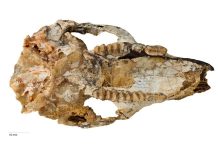
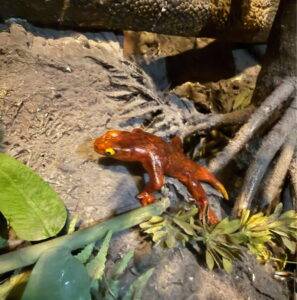
Meet Jeanerpeton mazonensis, meaning “Jean’s crawler from Mazon Creek.” Described in the Journal of Vertebrate Paleontology, J. mazonensis is an early ancestor of today’s amphibians. Think of a salamander, but make it squat and chubby like a frog.
Fine details preserved in stone
Because the Mazon Creek area was a river delta during the Carboniferous period, sediment was quickly deposited on dead animals and plants. That’s a perfect recipe for fossilization. Today, Mazon Creek is home to one of the world’s best fossil sites, with fossils that preserve soft tissues and fine details that are normally lost.
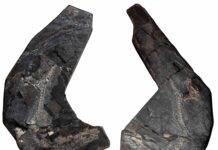
“What’s really cool about Mazon Creek is that it preserves all of these unusual details—things like toe pads and body outlines,” said Allison Sefcovic, co-lead author of the paper and 2025 Women in Science intern at the Field.
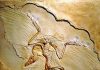
“In the fossil of Jeanerpeton, we can see some of the scales on its back and tiny ‘belly ribs’ called gastralia. You can even see the eye impressions! It’s so cool to see.” These findings point to a 309-million-year-old origin of classic traits we see in today’s frogs and salamanders.
A fossil leaves the waste bin
The fossil specimen was found many years ago by an amateur collector and donated to the Field Museum. At a glance, the fossil was classified as another species with a well-established presence in the region, Amphibamus grandiceps.
Sometimes, poorly understood specimens are lumped together into what scientists call a “waste bin taxon,” which serves as a metaphorical dumping ground for specimens that seem related but haven’t been well studied yet.
“What we’re finding from the Field Museum’s collection are a bunch of things that historically were grouped together into this waste bin taxon known as Amphibamus grandiceps,” said Cam So, co-author on the study and postdoctoral researcher at the Field Museum.
“Jeanerpeton is one of those species. And now, we’ve found enough evidence to support it being an anatomically distinct animal. With this publication, we officially pull Jeanerpeton out of this waste bin taxon.”
Interns take the lead
The study’s co-lead authors, Payton Kohlberg and Sefcovic, were part of last year’s cohort of Women in Science Interns at the Field Museum, a program that champions young women to pursue careers in science and museums. They, along with So, are all part of the lab group of Arjan Mann, the Field’s assistant curator of fossil fishes and early tetrapods in the Negaunee Integrative Research Center.
“Before working in the Mann Lab, I didn’t know much about paleontology,” said Kohlberg. “My experience at the Field and in the Women in Science program has made me more confident in my abilities to try something new. It is scary to take on a project when you feel like you don’t know as much as you should, but I learned through practical experience that it is possible to overcome that fear with hard work.”
The description of J. mazonensis opens a door for researchers as they continue to chronicle the biodiversity that once lived in Mazon Creek. Together, their discoveries make a detailed mosaic of what life looked like in Illinois more than 300 million years ago.
Reference:
Jeanerpeton mazonensis, gen. et sp. nov.: A new, exceptionally preserved, late Carboniferous amphibamiform from the Mazon Creek Lagerstätte, Illinois, Journal of Vertebrate Paleontology (2026). DOI: 10.1080/02724634.2026.2698799
Note: The above post is reprinted from materials provided by Field Museum.