

Credit: Andrew Z. Colvin/wikipedia
The Geodynamo Theory: How Liquid Iron Circulation Generates the Magnetic Field
The Geodynamo theory explains how Earth generates and sustains its magnetic field through the motion of electrically conductive liquid iron within the outer core. Unlike a permanent bar magnet, Earth’s magnetic field is a dynamic, self-sustaining electromagnetic phenomenon driven by fluid motion, rotation, heat transfer, and magnetohydrodynamics (MHD).
Understanding the geodynamo requires integrating core composition, thermodynamics, fluid mechanics, and electromagnetic theory. For students and geologists, the geodynamo is a cornerstone concept linking deep Earth physics to plate tectonics, mantle convection, and planetary habitability.
Structure of Earth’s Core — The Physical Setting of the Geodynamo
Inner Core vs Outer Core
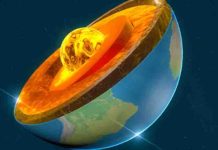
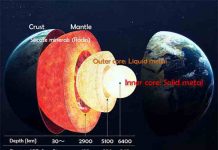
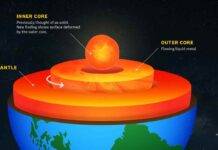
Earth’s core consists of:
- Solid inner core (~1,220 km radius)
- Liquid outer core (~2,260 km thick)
The outer core is composed primarily of molten iron (Fe) alloyed with light elements such as sulfur, oxygen, silicon, or hydrogen. Its liquid state is essential to the geodynamo process.
The magnetic field is generated specifically in the liquid outer core, where fluid motion enables electrical current circulation.
Fundamental Requirements of the Geodynamo Theory
For a planetary magnetic field to form via dynamo action, three conditions must be met:
1. Electrically Conductive Fluid
Liquid iron is an excellent electrical conductor. Under core conditions (~3,000–4,000 K and >130 GPa), electrical conductivity is sufficiently high to sustain induced currents.
2. Energy Source Driving Convection
Convection in the outer core is driven by:
- Thermal convection: heat escaping from the core into the mantle
- Compositional convection: light elements expelled during inner core solidification
These buoyancy forces cause fluid iron to rise and sink.
3. Planetary Rotation
Earth’s rotation introduces the Coriolis force, organizing convective flow into columnar structures aligned with the rotation axis. This rotational control stabilizes large-scale magnetic field generation.
How Liquid Iron Motion Generates a Magnetic Field
Electromagnetic Induction
According to Faraday’s law of induction, moving conductive fluid within an existing magnetic field generates electrical currents. These currents, in turn, produce new magnetic fields.
If the flow configuration is favorable, this feedback process sustains and amplifies the magnetic field — a process known as self-exciting dynamo action.
Magnetohydrodynamics (MHD)
The geodynamo operates under the principles of magnetohydrodynamics, which describe the interaction between magnetic fields and conductive fluids.
The governing equation combines:
- Maxwell’s equations (electromagnetism)
- Navier–Stokes equations (fluid dynamics)
In simplified form, the magnetic induction equation is:
∂B/∂t=∇×(v×B)+η∇2B
Where:
B = magnetic field
v = fluid velocity
η = magnetic diffusivity
If convective advection exceeds magnetic diffusion, the dynamo sustains itself.
The Role of Inner Core Solidification
Latent Heat Release
As Earth cools, the inner core grows by solidifying from the liquid outer core. This process releases:
- Latent heat
- Gravitational energy
Both contribute to maintaining convection.
Compositional Buoyancy
When iron crystallizes, lighter elements are excluded and released into the outer core. This chemical differentiation enhances buoyancy-driven convection — a key driver of the geodynamo.
Magnetic Field Structure and Dipole Behavior
Dipole Dominance
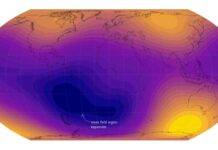
Earth’s magnetic field resembles a dipole aligned approximately with the rotation axis. However, this dipole fluctuates in intensity and orientation.
Secular Variation
The magnetic field changes continuously over decades to centuries due to dynamic outer core flow.
Geomagnetic Reversals
The geodynamo occasionally undergoes polarity reversals, where magnetic north and south switch positions. These reversals reflect changes in flow patterns within the outer core.
Heat Flow and Core–Mantle Boundary Interaction
Heat escaping from the core into the mantle regulates convection strength.
Regions of higher heat flux at the core–mantle boundary (CMB) can influence:
- Flow symmetry
- Magnetic field morphology
- Long-term stability of the dipole
Thus, mantle convection indirectly affects the geodynamo.
Energy Budget of the Geodynamo
Sustaining the geodynamo requires balancing:
- Thermal energy output
- Electrical dissipation
- Viscous dissipation
Recent studies indicate that both thermal and compositional convection are necessary to maintain the present magnetic field over billions of years.
Why the Geodynamo Is Essential for Life
Earth’s magnetic field:
- Shields the atmosphere from solar wind stripping
- Reduces radiation exposure
- Protects surface water
Without a sustained geodynamo, atmospheric erosion could resemble conditions on Mars.
Modern Methods for Studying the Geodynamo
Geoscientists investigate the geodynamo using:
- Numerical MHD simulations
- Paleomagnetic records
- High-pressure experiments on iron alloys
- Seismic imaging of core structure
These approaches constrain:
- Outer core flow speed
- Magnetic diffusion rates
- Inner core growth history
Open Questions in Geodynamo Research
Despite strong theoretical support, major questions remain:
- What was the exact onset time of inner core solidification?
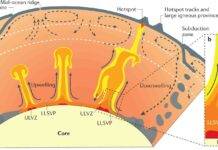
- How do LLSVPs influence core heat flux?
- What controls reversal frequency?
- How stable is the dipole over geological timescales?
These questions sit at the intersection of inner core physics, mantle dynamics, and planetary evolution.
References
- Roberts, P. H., & King, E. M. (2013). On the genesis of the geodynamo. Reports on Progress in Physics, 76, 096801.
- Glatzmaier, G. A., & Roberts, P. H. (1995). A three-dimensional self-consistent computer simulation of a geomagnetic field reversal. Nature, 377, 203–209.
- Olson, P., Christensen, U. R., & Glatzmaier, G. A. (1999). Numerical modeling of the geodynamo. Journal of Geophysical Research, 104, 10383–10404.
- Pozzo, M., Davies, C., Gubbins, D., & Alfè, D. (2012). Thermal and electrical conductivity of iron at Earth’s core conditions. Nature, 485, 355–358.
- Buffett, B. A. (2000). Earth’s core and the geodynamo. Science, 288, 2007–2012.
- Labrosse, S. (2015). Thermal and compositional stratification of the inner core. Comptes Rendus Geoscience, 347, 13–21.