

Introduction — Why “Mantle Blobs” Matter in Deep Earth Science
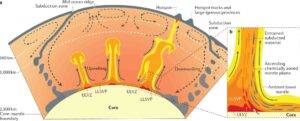
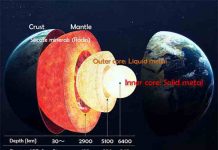
Large Low-Shear-Velocity Provinces (LLSVPs), often informally called mantle blobs, represent some of the most enigmatic and fundamental structures within Earth’s interior. Identified through global seismic tomography, LLSVPs are vast regions at the base of the mantle, near the core–mantle boundary (CMB), where seismic shear waves (S-waves) travel anomalously slowly.
Understanding LLSVPs is essential because they are increasingly linked to:
- Mantle plume initiation
- The location of hotspots and large igneous provinces (LIPs)
- Long-term mantle convection patterns
- The thermal and chemical evolution of Earth
In modern deep-Earth geodynamics, LLSVPs are no longer considered passive anomalies. Instead, they are thought to play an active, organizing role in how heat and material are transferred from the deep mantle to the surface.
What Are LLSVPs? A Seismological Definition
Seismic Characteristics of LLSVPs
LLSVPs are defined as regions of markedly reduced shear-wave velocity in the lowermost mantle, typically extending several hundred kilometers above the core–mantle boundary.
Key defining features include:
- Shear-wave velocity reductions of 1–3% relative to surrounding mantle
- Lateral dimensions on the order of thousands of kilometers
- Vertical thicknesses of 200–1000 km
- Sharp lateral boundaries detectable in high-resolution tomography
Two dominant LLSVPs have been consistently imaged:
- One beneath Africa
- One beneath the central Pacific
These structures have remained stable over hundreds of millions of years, suggesting a fundamental role in mantle dynamics.
Discovery Through Seismic Tomography
How Seismic Tomography Reveals Deep Mantle Structure
Seismic tomography works by analyzing variations in seismic wave travel times from earthquakes recorded worldwide. Slower-than-expected S-wave velocities indicate:
- Elevated temperatures
- Chemical heterogeneity
- Partial melt or compositional anomalies
The recognition of LLSVPs emerged in the late 20th century as global datasets improved, revealing coherent, continent-scale low-velocity provinces at the base of the mantle rather than random thermal anomalies.
Thermal vs Chemical Nature of LLSVPs
A central scientific debate concerns what LLSVPs are made of.
Thermal Anomaly Hypothesis
In a purely thermal interpretation, LLSVPs represent:
- Hot, buoyant regions
- Accumulations of heat above the core
- Long-lived thermal reservoirs
However, temperature alone cannot fully explain:
- Their sharp boundaries
- Their long-term stability against convective mixing
Thermochemical Pile Hypothesis
The prevailing model interprets LLSVPs as thermochemical piles, meaning they are:
- Hotter and compositionally distinct
- Enriched in dense materials such as recycled oceanic crust
- Stabilized by chemical density contrasts
This model explains both seismic observations and the persistence of LLSVPs over geological time.
Origin of LLSVPs in Earth History
Accumulation of Subducted Slabs
One leading hypothesis suggests that LLSVPs formed through:
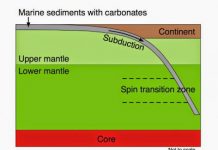
- Long-term subduction of oceanic lithosphere
- Sinking slabs reaching the lowermost mantle
- Chemical segregation and accumulation near the CMB
Over billions of years, this process may have produced compositionally distinct mantle reservoirs.
Primordial Mantle Reservoirs
An alternative view proposes that LLSVPs represent primordial mantle domains, preserved since Earth’s early differentiation. Isotopic signatures from plume-related basalts support the existence of deep, ancient mantle sources.
LLSVPs and Mantle Plume Initiation
Why Plumes Prefer LLSVP Margins
One of the strongest links between LLSVPs and surface geology is the observation that mantle plumes preferentially originate at the edges of LLSVPs rather than their centers.
This occurs because:
- Strong lateral thermal gradients exist at LLSVP margins
- Instabilities develop where hot, dense material meets cooler mantle
- These instabilities evolve into buoyant plume upwellings
This relationship explains why many hotspots and LIPs cluster geographically above inferred LLSVP boundaries.
Connection to Large Igneous Provinces and Hotspots
Large Igneous Provinces (LIPs)
Geochronological reconstructions show that many LIPs erupted above present-day or reconstructed LLSVP margins, including:
- Deccan Traps
- Karoo–Ferrar province
- Ontong Java Plateau
This spatial correlation strongly supports a deep-mantle control on surface magmatism.
Hotspot Stability
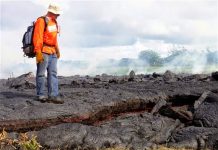
Long-lived hotspots such as Hawaii and Réunion are thought to be fed by plumes rooted near LLSVPs, explaining their persistence over tens of millions of years despite plate motion.
LLSVPs and Global Mantle Convection
Influence on Mantle Flow Patterns
LLSVPs act as large-scale boundary conditions for mantle convection by:
- Deflecting descending slabs
- Anchoring plume generation zones
- Organizing long-wavelength mantle circulation
Rather than a chaotic system, Earth’s mantle appears structured around these deep reservoirs.
Interaction with the Core–Mantle Boundary
LLSVPs sit directly above the outer core, influencing:
- Heat flux from the core
- Core cooling rates
- Potential links to the geodynamo
This coupling highlights the importance of LLSVPs in whole-Earth dynamics.
Implications for Plate Tectonics
Deep Control on Surface Plates
Although plate tectonics operates at the surface, LLSVPs may indirectly influence:
- Plate boundary reorganization
- Supercontinent cycles
- Long-term distribution of volcanism
This challenges the traditional view that mantle convection is driven only from the top down.
Competing Models and Open Questions
Despite major advances, key questions remain:
- Are LLSVPs primarily thermal, chemical, or both?
- How sharp are their boundaries at mineralogical scales?
- Do they evolve over time, or are they quasi-permanent?
Future progress depends on integrating seismology, mineral physics, geochemistry, and numerical modeling.
Why LLSVPs Matter Beyond Academia
Understanding LLSVPs has implications for:
- Interpreting mantle-derived geochemical signatures
- Predicting long-term volcanic patterns
- Modeling Earth’s thermal evolution
- Constraining deep carbon and volatile cycles
In short, LLSVPs are central to explaining how Earth works as a coupled deep-to-surface system.
References
- Garnero, E. J., McNamara, A. K., & Shim, S.-H. (2016). Continent-sized anomalous zones with low seismic velocity at the base of the mantle. Nature Geoscience, 9, 481–489.
- Burke, K., Steinberger, B., Torsvik, T. H., & Smethurst, M. A. (2008). Plume generation zones at the margins of large low shear velocity provinces. Earth and Planetary Science Letters, 265, 49–60.
- McNamara, A. K., & Zhong, S. (2005). Thermochemical structures within a spherical mantle. Journal of Geophysical Research, 110, B07402.
- Dziewonski, A. M., Lekic, V., & Romanowicz, B. A. (2010). Mantle anchor structure. Earth and Planetary Science Letters, 299, 69–79.
- Torsvik, T. H., et al. (2014). Deep mantle structure as a reference frame for plate motion. Nature, 514, 400–404.
- Li, M., McNamara, A. K., & Garnero, E. J. (2014). Chemical complexity of hotspots caused by cycling oceanic crust through mantle plumes. Nature Geoscience, 7, 366–370.










 in mantle plume initiation and their influence on global seismic tomography and plate tectonics.)