
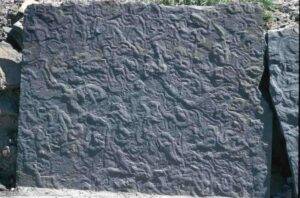
Ethological Interpretations of Ichnotaxa: Reconstructing Behavior from Trace Fossils
Trace Fossil Ichnology is the branch of paleontology that studies the physical evidence of biological activity preserved in the rock record. Unlike body fossils, which preserve the remains of organisms, trace fossils (ichnofossils) record behavior—burrowing, crawling, feeding, dwelling, grazing, or resting. The scientific classification of these traces into ichnotaxa allows geologists and paleontologists to reconstruct not the organism itself, but its behavior, environmental setting, and ecological strategy.
Understanding ichnotaxa is fundamental to paleoenvironmental reconstruction, basin analysis, and sequence stratigraphy. In many sedimentary successions where body fossils are rare or absent, trace fossils provide the only direct evidence of life and environmental conditions.
What Is Trace Fossil Ichnology?
Definition of Trace Fossils
Trace fossils are sedimentary structures produced by the life activities of organisms, preserved within or on sedimentary strata. They include:
- Burrows
- Tracks and trackways
- Trails
- Borings
- Feeding marks
- Resting impressions
Importantly, ichnology classifies these traces independently of the organism that produced them. This approach recognizes that similar behaviors may be produced by unrelated organisms, and that behavior—not anatomy—is the preserved feature.
Ichnotaxa — A Behavior-Based Classification System
Why Ichnotaxa Are Independent of Biological Taxonomy
Ichnotaxa are classified based on:
- Morphology
- Architectural pattern
- Wall lining
- Fill characteristics
- Relationship to bedding
This means a burrow is named according to its form and structure, not the identity of the tracemaker. For example, Skolithos refers to vertical cylindrical burrows, regardless of whether the organism was a worm, arthropod, or other invertebrate.
This separation between biological taxonomy and ichnotaxonomy prevents misinterpretation when the tracemaker is unknown.
Ethological Categories of Trace Fossils
Ethology—the study of behavior—forms the conceptual foundation of trace fossil interpretation.
Domichnia (Dwelling Structures)
These are permanent or semi-permanent burrows used as living structures. Examples include vertical shafts such as Skolithos, common in high-energy shallow marine environments.
Ethological implication:
- Organisms adapted to shifting substrates
- Suspension feeding strategies
- High-energy coastal settings
Fodinichnia (Feeding Burrows)
Fodinichnia are complex, branching burrow systems formed during deposit feeding. They record systematic exploitation of sediment for organic matter.
Example:
- Chondrites, associated with low-oxygen environments.
Ethological implication:
- Sediment mining behavior
- Low oxygen tolerance
- Deep-tier infaunal activity
Pascichnia (Grazing Trails)
These traces represent systematic grazing on microbial mats or organic films.
Example:
- Cruziana, often attributed to trilobite locomotion and feeding.
Ethological implication:
- Surface deposit feeding
- Shallow marine environments
- Controlled locomotion patterns
Repichnia (Locomotion Traces)
Repichnia record simple movement across a substrate without feeding.
Example:
- Arthropod trackways on tidal flats.
These traces reveal:
- Directional behavior
- Substrate consistency
- Episodic exposure
Cubichnia (Resting Traces)
Resting traces form when organisms temporarily settle on the substrate.
Example:
- Starfish impressions preserved in fine sediment.
Ethological implication:
- Low-energy conditions
- Soft substrate stability
Ichnofacies and Paleoenvironmental Reconstruction
While individual ichnotaxa reflect behavior, ichnofacies represent recurring assemblages of trace fossils linked to specific depositional environments.
The Skolithos Ichnofacies
- Dominated by vertical burrows
- High-energy shoreface environments
- Shifting sandy substrates
The Cruziana Ichnofacies
- Horizontal feeding traces
- Moderate-energy marine shelf
- Stable sediment conditions
The Zoophycos and Nereites Ichnofacies
- Deep-marine settings
- Complex feeding strategies
- Low sedimentation rates
Ichnofacies analysis is a powerful tool for reconstructing paleobathymetry, oxygenation, energy conditions, and sedimentation rates.
Bioturbation and Sedimentary Fabric
Bioturbation Intensity
Bioturbation refers to sediment reworking by organisms. Its intensity affects:
- Sedimentary structures
- Porosity and permeability
- Reservoir quality in hydrocarbon systems
The Bioturbation Index (BI) quantifies the degree of sediment disruption, linking ichnology directly to applied sedimentology.
Trace Fossils as Proxies for Oxygenation
Certain ichnotaxa correlate strongly with oxygen availability.
- Chondrites → dysoxic to anoxic conditions
- Thalassinoides → well-oxygenated substrates
Thus, trace fossils serve as proxies for:
- Redox conditions
- Nutrient flux
- Bottom-water circulation
Ichnology in Sequence Stratigraphy
Trace fossil assemblages vary systematically across sequence boundaries:
- Transgressive surfaces often show increased bioturbation.
- Maximum flooding surfaces may display specific deep-tier traces.
- Lowstand deposits may show stressed, low-diversity assemblages.
Thus, trace fossil ichnology supports stratigraphic correlation where body fossils are absent.
Challenges in Ethological Interpretation
Interpreting ichnotaxa requires caution because:
- Similar morphologies can arise from different organisms.
- Substrate conditions influence trace morphology.
- Post-depositional compaction may distort traces.
Modern ichnologists combine:
- Neoichnology (modern analogs)
- Sedimentology
- Geochemistry
- Experimental studies
to refine behavioral interpretations.
Why Trace Fossil Ichnology Matters Today
Trace fossils are invaluable in:
- Hydrocarbon reservoir characterization
- Paleoenvironmental modeling
- Sequence stratigraphy
- Marine ecology studies
- Understanding evolutionary behavior
In many deep-marine or Precambrian successions where body fossils are rare, trace fossils provide the only biological evidence.
References
- Seilacher, A. (1967). Bathymetry of trace fossils. Marine Geology, 5, 413–428.
- Bromley, R. G. (1996). Trace Fossils: Biology, Taphonomy and Applications. Chapman & Hall.
- Buatois, L. A., & Mángano, M. G. (2011). Ichnology: Organism–Substrate Interactions in Space and Time. Cambridge University Press.
- Pemberton, S. G., MacEachern, J. A., & Frey, R. W. (1992). Trace fossil facies models. SEPM Short Course Notes.
- Ekdale, A. A., Bromley, R. G., & Pemberton, S. G. (1984). Ichnology: The Use of Trace Fossils in Sedimentology and Stratigraphy. SEPM.