
Physical Properties of Iron Alloys in the Superionic State at Earth’s Core Conditions
The concept of a Superionic Earth Core challenges the classical view of Earth’s inner core as a purely solid iron–nickel alloy. Recent high-pressure experiments and first-principles simulations suggest that under extreme temperature and pressure conditions, iron alloys containing light elements (H, C, O, Si, S) may enter a superionic state—a phase where one atomic sublattice remains solid while lighter elements become partially mobile, behaving like a liquid within a crystalline framework.
This emerging model has profound implications for inner core physics, geodynamics, seismic anisotropy, and the long-term stability of Earth’s magnetic field.
To understand whether Earth’s inner core may host superionic behavior, we must examine the physical conditions, experimental constraints, mineral physics, and thermodynamic mechanisms operating at depths of ~5,100–6,371 km.
What Is a Superionic State? A Mineral Physics Perspective
Definition of Superionic Matter
A superionic state is a phase of matter in which:
- One component (typically heavier atoms) forms a rigid crystalline lattice.
- Another component (usually lighter ions such as hydrogen or oxygen) becomes highly mobile.
- The material exhibits both solid-like and liquid-like properties simultaneously.
Superionic phases were first observed in materials such as AgI and later predicted for planetary ices (e.g., water at Uranus–Neptune conditions). Under extreme pressures and temperatures, ionic mobility increases dramatically without complete melting.
In the context of the Superionic Earth Core, the key question is whether iron alloys under core conditions exhibit similar behavior.
Physical Conditions at Earth’s Inner Core
Pressure and Temperature Regime
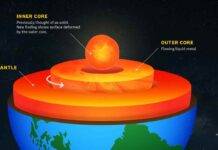
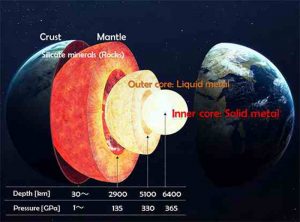
The inner core exists under:
- Pressures of ~330–360 GPa
- Temperatures estimated between 5,000–6,500 K
These extreme conditions are replicated experimentally using:
- Diamond anvil cells
- Laser-heated compression experiments
- Shock compression methods
Such conditions approach the melting boundary of iron alloys and may stabilize unusual high-temperature phases.
Composition of the Inner Core — Beyond Pure Iron
Seismic density measurements indicate that Earth’s core is not pure iron. It must contain 5–10 wt% light elements, inferred from density deficits relative to pure Fe at core pressures.
Candidate Light Elements
Commonly proposed light elements include:
- Hydrogen (H)
- Carbon (C)
- Oxygen (O)
- Silicon (Si)
- Sulfur (S)
The incorporation of light elements alters:
- Melting temperature
- Electrical conductivity
- Sound velocity
- Diffusion rates
These compositional effects are central to evaluating superionic behavior.
Experimental Evidence for Superionic Behavior in Iron Alloys
Hydrogen-Bearing Iron Alloys
First-principles molecular dynamics simulations suggest that Fe–H systems under core conditions may allow hydrogen to diffuse rapidly through an iron lattice. At sufficiently high temperatures, hydrogen mobility resembles liquid diffusion while the iron framework remains crystalline.
This diffusion resembles superionic phases predicted in high-pressure ices and oxides.
Oxygen and Other Light Elements
Experimental studies of Fe–O and Fe–Si alloys indicate possible decoupling between heavy and light atomic mobility at extreme conditions. While not definitively proven in the inner core, these findings support the plausibility of partial ionic mobility.
Implications for Inner Core Physics
Seismic Anisotropy
Earth’s inner core exhibits seismic anisotropy, where P-waves travel faster along polar directions than equatorial ones. A superionic state could influence:
- Elastic constants
- Crystal alignment
- Diffusion-assisted recrystallization
Superionic mobility may contribute to anisotropic behavior via enhanced lattice reorganization.
Thermal Conductivity
The mobility of light elements affects:
- Heat transport efficiency
- Core cooling rates
- Energy available for convection in the outer core
If the inner core hosts superionic properties, it may modify estimates of the heat flux driving the geodynamo.
Connection to the Geodynamo and Magnetic Field
Role of the Inner Core in Magnetic Field Generation
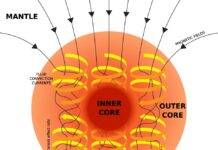
Earth’s magnetic field originates primarily in the liquid outer core, where convection of electrically conductive iron generates a self-sustaining dynamo.
However, the inner core influences this system by:
- Releasing latent heat during solidification
- Expelling light elements into the outer core
- Contributing compositional buoyancy
If the inner core exhibits partial superionic behavior, the exchange of light elements between solid and liquid regions may alter buoyancy flux and magnetic field stability.
Thermodynamics of the Superionic Transition
Melting vs Superionic Transition
A superionic transition differs from full melting:
- Lattice framework persists
- Partial ionic disorder occurs
- Electrical and thermal properties change nonlinearly
Phase diagrams of Fe–light element systems at 300+ GPa suggest complex transitions that are not fully constrained experimentally.
Challenges and Open Questions
Despite compelling theoretical work, several uncertainties remain:
- Is superionic behavior stable under inner core pressure–temperature conditions?
- What is the exact composition of the core?
- How does long-term diffusion affect core evolution?
- Can seismic observations distinguish superionic phases from conventional solid phases?
Resolving these questions requires advances in:
- High-pressure mineral physics
- Synchrotron experiments
- Ab initio simulations
- Seismic modeling
Broader Implications for Planetary Science
The concept of a Superionic Earth Core also informs the study of:
- Superionic water in ice giants
- Core states of terrestrial exoplanets
- Evolution of planetary magnetic fields
If superionic phases are common under extreme planetary conditions, they may represent a fundamental state of matter in planetary interiors.
References
- Hirose, K., Labrosse, S., & Hernlund, J. (2013). Composition and state of the core. Annual Review of Earth and Planetary Sciences, 41, 657–691.
- Pozzo, M., Davies, C., Gubbins, D., & Alfè, D. (2012). Thermal and electrical conductivity of iron at Earth’s core conditions. Nature, 485, 355–358.
- Umemoto, K., & Wentzcovitch, R. M. (2011). Ab initio study of Fe–H systems at high pressure. Earth and Planetary Science Letters, 311, 225–229.
- Ohta, K., et al. (2016). Experimental determination of electrical resistivity of iron at core conditions. Nature, 534, 95–98.
- McDonough, W. F. (2014). Compositional model for Earth’s core. Treatise on Geochemistry, 3, 559–577.
- French, M., Mattsson, T. R., Nettelmann, N., & Redmer, R. (2009). Equation of state and phase diagram of water at extreme conditions. Physical Review B, 79, 054107.