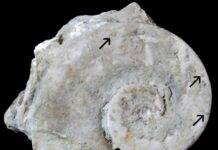

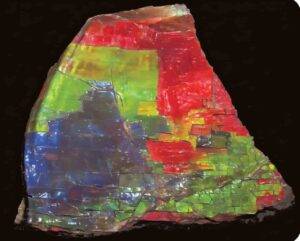
The origins of vivid colors within the gemstone ammolite—a rare type of brightly colored fossilized ammonite shell—are reported in research published in Scientific Reports.
The colors of ammolite occur within a preserved layer of nacre—also known as mother-of-pearl—which consists of layered plates of the mineral aragonite and a small amount of organic material such as proteins. Although it is thought that the colors of ammolite arise from the interaction of light with these layers, the origins of these colors have not been evaluated experimentally.
Hiroaki Imai and colleagues investigated the structural and optical properties of ammolite specimens from Alberta, Canada using electron microscopy and simulations. They then compared these to the properties of paler nacre from an ammonite fossil from Madagascar as well as abalone and nautilus shells.
The authors identified similar structures of stacked aragonite plates within all samples but found that the thickness of these plates and the size of the gaps between them varied.
They found that the brightness of ammolite colors is caused by light reflecting off four nanometer-wide gaps between aragonite plates and by the even distribution of layers of uniform thickness within the nacre.
They suggest that the paler color of nacre in the other samples is caused by larger gaps or a lack of gaps between aragonite plates, the presence of organic material within these gaps, or by variations in the distribution of layers within the nacre.
The authors suggest that their findings could inform the development of non-fading colored paints.
Reference:
Brilliant structural colors originating from reflection by nanogaps of nacreous layers in fossilized ammonite shells, Scientific Reports (2025). DOI: 10.1038/s41598-025-21872-z
Note: The above post is reprinted from materials provided by Nature Publishing Group.