back to top
Facebook Instagram Linkedin TikTok X Youtube
  • Contribute
  • Advertising
  • FAQs
Search

Logo

27.8 C
New York
Wednesday, September 2, 2026
Facebook
Instagram
Linkedin
TikTok
X
Youtube

Logo

  • Home
  • List of Minerals
  • Geologic Time Scale
  • Geology Tools
  • Geology Adventure Tours
  • Plate Tectonics Map
    • Plate Boundary Map
  • Top Posts
  • Geology Jobs
  • GEO Courses
  • Geology Field Camps
  • Geology Field Camps in United States
  • Worldwide Geological Surveys
More
    Artist's impression of the giant dormouse (left) and its nearest living relative the garden dormouse (right). Credit: James Sadler, University of York

    Researcher reconstructs skull of two million year-old giant dormouse

    July 11, 2020
    Diverse structural-colored insects in mid-Cretaceous amber from northern Myanmar. Credit: NIGPAS

    Amber fossils unlock true color of 99-million-year-old insects

    July 3, 2020
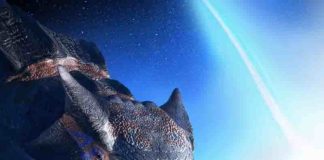
    An individual of Ankylosaurus magniventris, a large armoured dinosaur species, witnesses the impact of an asteroid, falling on the Yucatán peninsula 66 million years ago. Not even its large size and thick armour sheltered its kind from the violence of this cosmic disaster. Credit: Fabio Manucci

    Asteroid impact, not volcanoes, made the Earth uninhabitable for dinosaurs

    July 3, 2020
    Hauffiopteryx altera. Credit: McGill University

    New species of Ichthyosaur discovered in museum collection

    July 3, 2020
    An Underwater Volcanic Eruption. Credit: NSF and NOAA

    How volcanoes explode in the deep sea

    July 3, 2020
    Next to Prof. Oded Aharonson is the tri-axial Helmholtz Coil used to generate the magnetic field during the growing of the ice samples

    The magnetic history of ice

    July 3, 2020
    False color satellite image of the Taimali catchment area in southeastern Taiwan in August 2009 after typhoon Morakot. Red: vegetated surface, grey: barren surface (Image: LANDSAT-7 / NASA, JPL).

    Typhoon changed earthquake patterns

    July 3, 2020
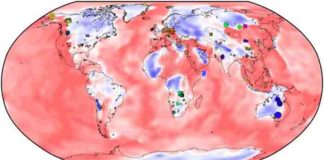
    A new study shows that giant ore deposits are tightly distributed above where rigid rocks that comprise the nuclei of ancient continents begin to thin, far below the surface (white areas). Redder areas indicate the thinnest rocks beyond the boundary; bluer ones, the thickest. Circles, triangles and squares show known large sediment-hosted deposits of different metals. (Adapted from Hoggard et al., Nature Geoscience, 2020)

    Geologists identify deep-earth structures that may signal hidden metal lodes

    July 3, 2020
    Our planet has a layered structure of silicate mantle and metallic core. The liquid outer core is located 2900 km below the surface where the pressure and temperature are extremely high, >136 gigapascal (1.36 million atmospheres) and >4000 C. The sound speed and density profiles of the deep-interior of our planet is given by seismological observations.

    Precise measurement of liquid iron density under extreme conditions

    July 3, 2020
    Moon

    Higher concentration of metal in Moon’s craters provides new insights to...

    July 3, 2020
    1...899091...686Page 90 of 686

    Related Articles

    All
    • All
    • Featured
    • All time popular

    From dig to digital: Australia’s iconic dinosaurs as you’ve never seen them before

    September 23, 2015

    Woolly mammoths experienced a genomic meltdown just before extinction

    March 2, 2017

    New process recycles magnets from factory floor

    July 6, 2015

    Researcher studies volcanic gases in remote areas of world

    February 12, 2016

    Hematite

    April 19, 2014

    Record-breaking volcanic kettle on Iceland explored

    July 15, 2016

    Facebook Instagram Linkedin TikTok X Youtube
    • Privacy Policy
    • Advertising
    • Contribute
    • FAQs
    © 2011-2026. All Rights Reserved.