back to top
Facebook Instagram Linkedin TikTok X Youtube
  • Contribute
  • Advertising
  • FAQs
Search

Logo

27.8 C
New York
Wednesday, November 11, 2026
Facebook
Instagram
Linkedin
TikTok
X
Youtube

Logo

  • Home
  • List of Minerals
  • Geologic Time Scale
  • Geology Tools
  • Geology Adventure Tours
  • Plate Tectonics Map
    • Plate Boundary Map
  • Top Posts
  • Geology Jobs
  • GEO Courses
  • Geology Field Camps
  • Geology Field Camps in United States
  • Worldwide Geological Surveys
More
    The Grand Prismatic Spring in Yellowstone National Park (Stock photo).

    Inside Yellowstone’s fiery heart: Researchers map volatile-rich cap, offering clues to...

    May 5, 2025
    A graphic showing the convective heat cycle (red arrows) that drives plate tectonic motion (black arrows) on Earth. Heat flows toward subduction zones through the uppermost mantle layer, the asthenosphere. A computer model from Rice University finds that the asthenosphere can locally drag plates along with it rather than acting exclusively as a brake on plate movements as had been widely believed. (Image courtesy of Surachit/Wikimedia Commons)

    Crustal brines at an oceanic transform fault

    May 5, 2025
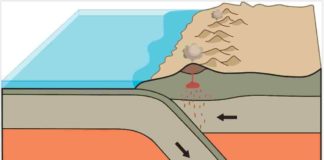
    Creative destruction: a thinner ocean plate sides under a continental plate, melting and recycling the ocean crust into the Earth’s interior and birthing volcanoes in this illustration of subduction, a consequence of modern plate tectonics. A new study reports evidence of a transition in multiple locations around the world, 3.8-3.6 billion years ago, from stable “protocrust” to pressures and processes that look a lot like modern subduction, suggesting a time when plates first got moving. Credit: Nikolas Midttun, CC-BY

    Sink or Swim: The fate of sinking tectonic plates depends on...

    May 5, 2025
    Early Earth was bombarded by meteors which played a crucial role in disrupting and recycling Earth’s first crust.

    Early Earth’s first crust composition discovery rewrites geological timeline

    April 9, 2025
    Biogeochemical cycles billions of years ago. A complex web of interactions between geological features including volcanoes, subsurface mantle, oceans and the atmosphere created the chemical mixture necessary for early life to oxygenate our atmosphere. ©2025 Watanabe et al. CC-BY-ND

    Are volcanoes behind the oxygen we breathe?

    April 9, 2025
    Large conical shatter cones within the Pilbara Craton, Western Australia, provide visible proof of a meteorite impact 3.5 billion years ago. Credit: Chris Kirkland, Curtin University

    World’s oldest impact crater found, rewriting Earth’s ancient history

    April 2, 2025
    Artistic view of Earth’s interior during mantle solidification in the first hundreds of millions of years of Earth’s history. Gravitational segregation of dense, iron-rich magma (in orange) likely formed a basal magma ocean atop the core, that can explain the present-day structure of the lower mantle.

    Earliest days of Earth’s formation

    April 2, 2025
    Evan Saitta, the paper’s lead author, with an emperor penguin in the Field Museum’s bird collections. Photographer(s): Kate Golembiewski (c) Field Museum

    When birds lose the ability to fly, their bodies change faster...

    April 2, 2025
    Detailed highlights of the rock sample at Biloela in Queensland.

    Dozens of 3-toed dinosaurs leave their mark in Queensland

    April 2, 2025
    At the 12th day of incubation, feather buds exhibit longitudinal domains of cell density that correspond to the barbs of the future down feather. © Rory Cooper & Michel Milinkovitch (CC BY)

    From dinosaurs to birds: the origins of feather formation

    April 2, 2025
    1...161718...688Page 17 of 688

    MOST POPULAR

    Ancient mass extinction led to dominance of tiny fish, paleontologist shows

    November 13, 2015

    1.56-billion-year-old Fossils Discovered in North China

    May 23, 2016

    Prediction of large earthquake probability improved

    January 30, 2017
    Image of fruit belonging to Palaeophytocrene chicoensis. The Sierra College Museum of Natural History is the permanent repository for this fossil. Credit: Brian Atkinson.

    A fossil fruit from California shows ancestors of coffee and potatoes...

    February 11, 2023
    Load more

    MORE ARTICLES

    Parts of the Earth’s original crust remain in place today

    Rapid rise of the Mesozoic sea dragons

    New tools increase Palestine’s capacity to face earthquakes

    Garnet

    Facebook Instagram Linkedin TikTok X Youtube
    • Privacy Policy
    • Advertising
    • Contribute
    • FAQs
    © 2011-2026. All Rights Reserved.