
Scientists have discovered several 518-million-year-old fossils that reshape understanding of the origins of the animal group containing starfish. The fossils show that these animals ate using tentacles rather than passively using their gills, as previously thought.
The fossilized animals, discovered in southwestern China and named Yujingia glutenotunica, are thought to be close to the last common ancestor of ambulacrarians, the modern group that includes starfish, sea stars, sea urchins and acorn worms.
The international research team, including researchers from the University of Cambridge, says the fossils could also help us understand why two closely related lineages—starfish and their relatives, and chordates, the phylum that includes humans—evolved wildly different body plans over millions of years. The results are reported in the journal Current Biology.
The fossilized animals date from a period of rapid evolutionary development known as the Cambrian explosion, when most major animal groups first appeared in the fossil record.
Most animal fossils from the Cambrian are of hard-shelled creatures, but in a handful of locations around the world—such as the Maotianshan Shales in China’s Yunnan Province, where Yujingia was found—conditions allow softer body parts to be preserved before they decay.
A soft-bodied ancestor emerges
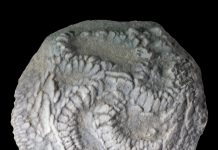
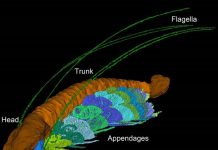
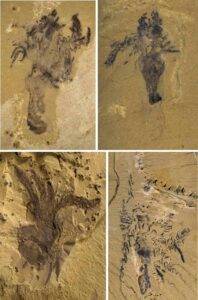
The Yujingia fossils measure between 8 and 22 millimeters (0.3 to 0.9 inches) in length and preserve the body, gut and appendages, providing rare examples of ambulacrarians without a mineralized skeleton. The animals had two distinct sets of appendages: one set of featherlike feeding tentacles that captured organic particles from the water, and a second set thought to have temporarily anchored Yujingia to the seabed, although it was likely capable of some degree of movement.
“There has been a tendency to think of the last common ancestor of ambulacrarians as more closely resembling a worm living in its seafloor burrow, filtering food from the water,” said co-author Dr. Giovanni Mussini, from Cambridge’s Department of Earth Sciences. “This new fossil suggests instead that the common ancestor of the ambulacrarians might have actually fed with tentacles, and may have been more like starfish and their relatives.”
Ambulacraria is one of the two major branches of deuterostome animals and was first classified in the 1880s. Ambulacrarians include echinoderms (such as starfish) and hemichordates (such as acorn worms), two groups with strikingly different body forms. However, fossil evidence of the origins of this group has remained scarce.
“The fivefold radial symmetry of starfish and their relatives, and the bilaterally symmetrical, wormlike bodies of acorn worms and their relatives have been a bit of a mystery until now,” said Mussini.
Challenging the wormlike model
Chordates, echinoderms and hemichordates make up the principal branches of deuterostome evolution, yet differ profoundly in body organization and feeding. Reconstructing the ambulacrarian ancestor is central to understanding how these lineages diverged. A longstanding hypothesis proposes that this ancestor was a tentacle-free worm that filtered food through its pharynx, resembling a modern acorn worm. Detailed anatomical study and phylogenetic analysis of Yujingia now challenge that view with direct fossil evidence.
“The animal has an elongated, bottlelike form, with tentacles spreading above a rounded lower body,” said lead author Kaiyue He from Northwest University in China. “Its outline closely resembles the ritual vase, or yujingping, in traditional Chinese culture, which inspired the genus name Yujingia. All the specimens clearly preserve a pale, original membrane enclosing the visceral mass. Its soft, gelatinous appearance is the species’ most immediately recognizable feature and inspired the species name.”
To establish the evolutionary position of Yujingia, Mussini and He assembled a large data set comprising 505 morphological characters across 100 living and extinct taxa and analyzed it using Bayesian phylogenetic reconstruction. The results place Yujingia closer to the last common ancestor of living ambulacrarians than previously described fossils, making it a key transitional form linking early Cambrian tentacled animals with hemichordates and echinoderms.
Although it lacked a hard skeleton, Yujingia possessed a complex tentacle-based feeding system, suggesting that sophisticated feeding structures evolved early, while echinoderm skeletons and other specialized features appeared later.
Ecology split the lineages
“It tells us how ecology can drive different lineages onto very different evolutionary paths, and very different morphological specializations,” said Mussini. “The chordates became reliant on movement for finding their food, so they streamlined their bodies and developed their brains, while members of the starfish lineage remained relatively anchored to the seafloor and specialized in this particle-feeding lifestyle.”
“How the major deuterostome groups diverged during the Cambrian explosion is one of the central questions in animal evolution,” said co-author Degan Shu, also from Northwest University. “Yujingia helps connect primitive, tentacle-bearing animals living on the seafloor with modern echinoderms and hemichordates. It offers a new way to understand the profound transition from bilateral symmetry to the fivefold radial body plan of echinoderms, and adds an important fossil to a crucial gap in the early animal tree of life.”
Reference:
Cambrian fossils illuminate the ambulacrarian common ancestor, Current Biology (2026). DOI: 10.1016/j.cub.2026.08.053.
Note: The above post is reprinted from materials provided by University of Cambridge.