
Ask any zoo-goer and they will tell you that capybaras are adorable. Ask a scientist specializing in the rodents, which resemble oversized guinea pigs, and they will tell you they are obligate semiaquatic herbivores that indicate persistent riparian ecosystems. In plain English: Capybaras like it wet.
Accordingly, scientists were stunned when they discovered a fossilized tooth from a capybara that lived in the Atacama Desert in northern Chile almost 9 million years ago. The discovery not only provides the first and oldest record of a capybara in coastal Chile—a country where no capybaras live today—but also calls into question the longstanding textbook version of the Atacama Desert as one of the oldest continuously dry regions on Earth, dating back an estimated 40 million years.
The work is published in the journal Scientific Reports.
The fossil was found in a layer of sediments deposited in a shallow marine environment between 10 million and 7 million years ago at a site called El Morro, part of the fossil-rich Bahía Inglesa Formation. The formation also hosts Cerro Ballena, or “Whale Hill,” famously recognized as the world’s largest concentration of whale fossils. But a capybara?
“Finding a capybara tooth in a marine deposit in what today is one of the driest regions on Earth is just freakish,” said Priscilla Martinez, the study’s lead author and a doctoral student at the University of Arizona Department of Geosciences.
A route around the Andes
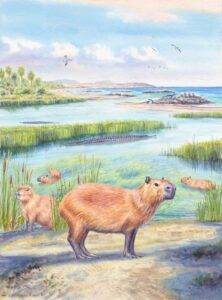
Capybaras, the largest living rodents, and their close cousins, guinea pigs, are native to South America. Today, capybaras thrive east of the Andes in low-elevation wetlands, with their core range roughly outlining the Amazon River basin. Their semiaquatic lifestyle tightly links them to persistent surface water, wetland vegetation and the ability to migrate along riparian corridors along creeks and rivers.
“We don’t have any other evidence of capybaras in that part of coastal Chile,” added co-author Barbara Carrapa, a professor of geosciences and Martinez’s doctoral adviser. “They’re not supposed to be there. So, we immediately asked ourselves, ‘Why were they there? Where did they come from?'”
Geologists estimate that long before capybaras appeared roughly 9 million years ago, the Andean mountain chain would have presented a formidable barrier, rising to 18,000 feet, effectively walling off the Atacama Desert from the eastern lowlands stretching across parts of Venezuela and Colombia to northeastern Argentina and Uruguay, the animal’s current range.
Geography is one factor in determining the range of a species, but by far not the only one. Climate plays a huge role, too, according to Martinez.
Evidence of ancient wetlands
“Not only are the plateau lands of the Central Andes very tall, they’re also extremely arid,” she said. “So, if capybaras originated east of the Andes in this foreland region, how in the world could these short-legged rodents make it across?”
The most likely answer, of course, is that they didn’t.
Instead, the authors propose a scenario in which the capybaras took advantage of low-elevation wetlands connecting their original range along coastal areas, going “counterclockwise” around the northern portion of South America—from today’s Venezuela into Colombia, Ecuador and Peru, then into northern Chile.
“We have multiple lines of evidence indicative of really wet conditions that are typically associated with capybaras today,” said Mark Clementz, a paleobiology expert and head of the Department of Geology and Geophysics at the University of Wyoming and one of the study’s co-authors. “The same deposits contain fossils of freshwater fishes and gavials (freshwater crocodiles).”
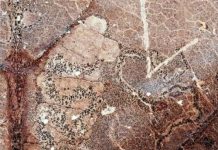
In addition, the team unearthed so-called phytoliths, microscopic accumulations of silica that form inside plant cells and tissues as they absorb dissolved silica from groundwater through their roots. Specialists like co-author Caroline Strömberg, a professor at the University of Washington, can analyze these structures to find out what types of plants likely made them.
In this case, the fossil evidence pointed to palms and other flowering plants, including dicots—not anything that would grow in today’s Atacama Desert.
A desert ecosystem reconsidered
“Think sunny Southern California full of palm trees,” Martinez said. “You don’t really expect the Atacama Desert to have palms, and we’re not sure if they were blooming extensively there, but they were definitely there.”
“All this supports the idea that there was enough of an ecological community to support capybara populations long term,” Clementz added.
No other remains of capybaras this old have been found in Chile to date, so finding a lone tooth within a 3-foot-thick (0.9-meter-thick) bed preserved in the desert was the linchpin of this discovery, according to Martinez. The assembly of strange creatures not typically found in a desert was not lost on the local population, and many sought to profit by digging for fossils and selling them to collectors.
“Many of the fossils originally discovered at that location are lost in time,” Martinez said, “but certain merchants were interested in understanding them a little bit better, and so they donated them to local scientists.”
One of them was the study’s first author, Carolina Gutstein, head of paleontology at Chilean mining company Fosfatos de Caldera and a professor at Universidad Santo Tomás in Santiago, Chile, who has a long relationship with local fossil experts in the area.
Clementz added that the findings show it is worth challenging assumptions, in this case about the Atacama being an ancient desert for millions and millions of years.
“No one really argued with that paradigm, even in the face of these other fossil finds suggesting that things were different in the past,” he said. “Finding this capybara—which I think everyone can agree is not a desert animal by any means—at that location is going to challenge many of the ideas about the Atacama’s history.”
The study has implications beyond capybaras and the Atacama, Martinez pointed out.
“The more we understand deserts, which are extremely sensitive to changes in climate, including shifts in monsoon intensity from year to year, the better we can predict how they fare long term,” she said. “And if we can understand past climate changes that had nothing to do with humans, it gives us a baseline to work from to understand how climate can evolve over time with humans in the mix.”
Reference:
Carolina S. Gutstein et al, Late Miocene capybara in the Atacama Desert reveals a wetter climate and a transcontinental dispersal pathway, Scientific Reports (2026). DOI: 10.1038/s41598-026-67368-2
Note: The above post is reprinted from materials provided by University of Arizona.