back to top
Facebook Instagram Linkedin TikTok X Youtube
  • Contribute
  • Advertising
  • FAQs
Search

Logo

27.8 C
New York
Tuesday, September 1, 2026
Facebook
Instagram
Linkedin
TikTok
X
Youtube

Logo

  • Home
  • List of Minerals
  • Geologic Time Scale
  • Geology Tools
  • Geology Adventure Tours
  • Plate Tectonics Map
    • Plate Boundary Map
  • Top Posts
  • Geology Jobs
  • GEO Courses
  • Geology Field Camps
  • Geology Field Camps in United States
  • Worldwide Geological Surveys
More
    Comet

    The comet that killed the dinosaurs

    February 15, 2021
    mosasaurs

    The songs of fin whales offer new avenue for seismic studies...

    February 15, 2021
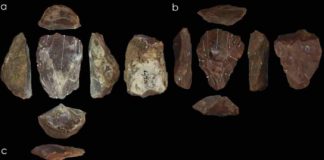
    Photos of Nubian Levallois cores associated with Neanderthal fossils. Credit © UCL, Institute of Archaeology & courtesy of the Penn Museum, University of Pennsylvania

    Neanderthals and Homo sapiens used identical Nubian technology

    February 15, 2021
    The colorful banded Tepees are part of the Blue Mesa Member, a geological feature about 220 million to 225 million years old in the Chinle Formation in Petrified Forest National Park in Arizona. Credit: NPS

    How rocks rusted on Earth and turned red

    February 8, 2021
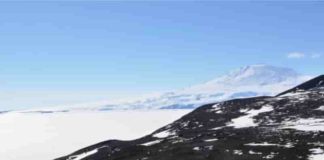
    Rock samples collected near the Antarctic volcano Mount Erebus, seen here in the distance, harbor fingerprints of Earth’s ancient magnetic field. A new analysis delves into discrepancies between these fingerprints and predictions from a long-standing approximation of the field. Credit: Hanna Asefaw

    Antarctic Lava Yields Clues to Earth’s Past Magnetic Field

    February 8, 2021
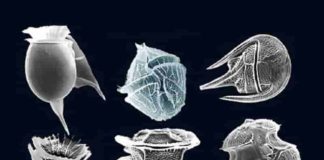
    Several types of dinoflagellates are shown in this microscope image. Some dinoflagellates are classified as nanoplankton, which new research shows have a more important role in Earth’s biological pump than previously thought. Credit: fickleandfreckled, CC BY 2.0

    The Role of Midsized Phytoplankton in Earth’s Biological Pump

    February 8, 2021
    Mylonite is a fine-grained, compact metamorphic rock produced by dynamic recrystallization of the constituent minerals resulting in a reduction of the grain size of the rock. Credit: Wikipedia

    Going with the grains to explain a fundamental tectonic force

    January 28, 2021
    Professor Cathryn Newton studies Middle Devonian marine faunas (such as these brachiopods from 380-390 million years ago), whose fossils are lodged in a unit of bedrock in Central New York. Credit: Syracuse University

    Diving into Devonian seas: Ancient marine faunas unlock secrets of warming...

    January 28, 2021
    The newly named trace fossil Glossifungites gingrasi is a collection of burrows that were home to water-dwelling insects, similar to mayflies, more than 90 million years ago. (Photo: Ryan King)

    Newly discovered fossil, likely subaqueous insect

    January 28, 2021
    Scientists identified flank instability at Pacaya, an active volcano in Guatemala. Credit: Kirsten Stephens/Penn State

    Scientists identify flank instability at a volcano with history of collapse

    January 28, 2021
    1...707172...686Page 71 of 686

    Related Articles

    All
    • All
    • Featured
    • All time popular

    Rare opportunity to study short-lived volcanic island reveals sulfur-metabolizing microbes

    January 27, 2023

    Earth’s Core Affects Length of Day

    July 11, 2013

    Terreneuvian Epoch

    February 23, 2014

    Research offers new evidence about the Gulf of Mexico’s past

    February 17, 2016

    Ancient fossils of bizarre figure-eight water creatures confirmed among our strangest distant cousins

    October 16, 2014

    Lazurite

    May 20, 2014

    Facebook Instagram Linkedin TikTok X Youtube
    • Privacy Policy
    • Advertising
    • Contribute
    • FAQs
    © 2011-2026. All Rights Reserved.