back to top
Facebook Instagram Linkedin TikTok X Youtube
  • Contribute
  • Advertising
  • FAQs
Search

Logo

27.8 C
New York
Friday, September 4, 2026
Facebook
Instagram
Linkedin
TikTok
X
Youtube

Logo

  • Home
  • List of Minerals
  • Geologic Time Scale
  • Geology Tools
  • Geology Adventure Tours
  • Plate Tectonics Map
    • Plate Boundary Map
  • Top Posts
  • Geology Jobs
  • GEO Courses
  • Geology Field Camps
  • Geology Field Camps in United States
  • Worldwide Geological Surveys
More
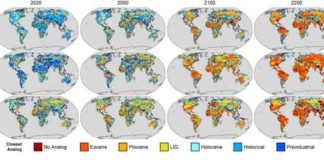
    Future climate analogs for the years 2020, 2050, 2100 and 2200 according to three well-established models. If greenhouse gas emissions are not curbed, the study says, the climate will continue to warm until it begins to resemble the Eocene in 2100. Credit: Courtesy of the authors

    Humans may be reversing the climate clock, by 50 million years

    December 11, 2018
    Transportable Array station P19K is one of the closest stations to the Iniskin earthquake origin. Solar panels power the station, and the seismometer is buried in a specially drilled borehole to insulate it from surface noise. Photo taken in 2017 during a service site visit by Incorporated Research Institutions for Seismology (IRIS). IRIS manages the Transportable Array station installation and maintenance. Credit: Doug Bloomquist, IRIS

    Alaska earthquakes offer new insight into improving hazard assessment

    December 11, 2018

    The complex history of Earth’s magnetic reversals

    December 11, 2018
    Volgatitan simbirskiensis anterior caudal vertebra

    Scientists find new giant dinosaur

    December 8, 2018
    Maohokite

    Scientists discover possible mantle mineral

    December 8, 2018
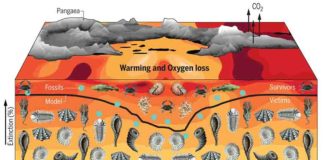
    This illustration shows the percentage of marine animals that went extinct at the end of the Permian era by latitude, from the model (black line) and from the fossil record (blue dots). A greater percentage of marine animals survived in the tropics than at the poles. The color of the water shows the temperature change, with red being most severe warming and yellow less warming. At the top is the supercontinent Pangaea, with massive volcanic eruptions emitting carbon dioxide. The images below the line represent some of the 96 percent of marine species that died during the event. Includes fossil drawings by Ernst Haeckel/Wikimedia; Blue crab photo by Wendy Kaveney/Flickr; Atlantic cod photo by Hans-Petter Fjeld/Wikimedia; Chambered nautilus photo by ©2010 John White/CalPhotos. Credit: Justin Penn and Curtis Deutsch/University of Washington

    Biggest mass extinction caused by global warming leaving ocean animals gasping...

    December 8, 2018
    A fossil trilobite with its complex eye

    Enhancing our vision of the past

    December 6, 2018
    Spectacular soft-tissue fossil

    Soft tissue shows Jurassic ichthyosaur was warm-blooded, had blubber and camouflage

    December 6, 2018
    Magma Chamber

    Volcanoes fed by ‘mush’ reservoirs rather than molten magma chambers

    December 6, 2018
    Yellowstone National Park

    A microbe’s membrane helps it survive extreme environments

    December 6, 2018
    1...161162163...686Page 162 of 686

    Related Articles

    All
    • All
    • Featured
    • All time popular

    Erythrite

    March 5, 2014

    Discovery of extinct bat doubles diversity of native Hawaiian land mammals

    March 23, 2016

    New data helps explain recent fluctuations in Earth’s magnetic field

    February 28, 2018

    Scientists Discover World’s Oldest Stone Tools

    May 21, 2015

    Scientists solve mystery of arsenic release into groundwater

    December 5, 2015

    Developing a picture of the Earth’s mantle

    December 14, 2015

    Facebook Instagram Linkedin TikTok X Youtube
    • Privacy Policy
    • Advertising
    • Contribute
    • FAQs
    © 2011-2026. All Rights Reserved.