back to top
Facebook Instagram Linkedin TikTok X Youtube
  • Contribute
  • Advertising
  • FAQs
Search

Logo

27.8 C
New York
Thursday, November 12, 2026
Facebook
Instagram
Linkedin
TikTok
X
Youtube

Logo

  • Home
  • List of Minerals
  • Geologic Time Scale
  • Geology Tools
  • Geology Adventure Tours
  • Plate Tectonics Map
    • Plate Boundary Map
  • Top Posts
  • Geology Jobs
  • GEO Courses
  • Geology Field Camps
  • Geology Field Camps in United States
  • Worldwide Geological Surveys
More
    Ampyx priscus in linear formation (Moroccan Lower Ordovician Fezouata Shale). Credit: Jean Vannier, Laboratoire de Geologie de Lyon: Terre, Planètes, Environnement (CNRS / ENS de Lyon / Université Claude Bernard Lyon 1)

    Fossils show lining up is primal urge

    October 23, 2019
    Gigantic dinosaurs like the sauropod Diplodocus, which weighed over 15 tons and was longer than an 18-wheeler truck, would have had problems with potentially lethal overheating. Hot blood from the body core would have been pumped to the head, damaging the delicate brain. New research shows that in sauropods, evaporation of moisture in the nose and mouth would have cooled extensive networks of venous blood destined for the brain. Other large dinosaurs evolved different brain-cooling mechanisms, but all involving evaporative cooling of blood in different regions of the head. Credit: Life restoration by Michael Skrepnick. Courtesy of WitmerLab at Ohio University.

    Huge dinosaurs evolved different cooling systems to combat heat stroke

    October 23, 2019
    A small, feathered theropod dinosaur, Saurornitholestes langstoni was long thought to be so closely related to Velociraptor mongoliensis that some researchers called it Velociraptor langstoni—until now. Credit: Jan Sovak.

    Paleontologists discover complete Saurornitholestes langstoni specimen

    October 23, 2019
    The Sosnogorsk lagoon just before a deadly storm. Credit: Mikhail Shekhanov for the Ukhta Local Museum

    The earliest well-preserved tetrapod may never have left the water

    October 23, 2019
    A new study led by Yale University confirms a long-held theory about the last great mass extinction event in history and how it affected Earth's oceans. The findings may also answer questions about how marine life eventually recovered. Credit: Michael Henehan & Pincelli Hull

    Mystery solved: Ocean acidity in the last mass extinction

    October 23, 2019
    In this handout image provided by NASA/JPL-Caltech/MSSS, a color image from NASA’s Curiosity rover’s Mast Camera shows part of the wall of Gale Crater, the location on Mars where the rover landed August 5, 2012 on Mars. Credit: NASA via Getty Images

    Mars once had salt lakes similar to those on Earth

    October 23, 2019
    Giant gold nugget found in California

    Prospecting for gold just got a lot easier

    October 14, 2019
    The Ice Drilling Design and Operations (IDDO) group at the University of Wisconsin-Madison designed and built the South Pole Ice Core (SPICE) drilling system, called the Intermediate Depth Drill. Based on a Danish drill called the Hans-Taunsen drill, the Intermediate Depth Drill was purpose-built for coring 1,500 meters of ice. The ice cores collected at this depth (from the South Pole) contain atmospheric gases from the past 40,000 years, the time of transition from the last ice age to the present warm climate. Credit: T.J. Fudge

    Ice core source discovery adds to study of volcanic activity, climate...

    October 14, 2019
    Siamraptor skull reconstruction. Credit: Chokchaloemwong et al., 2019

    Meet Siamraptor suwati, a new species of giant predatory dinosaur from...

    October 14, 2019
    Ancient fossils reveal fresh clues about early life on land

    Ancient fossils reveal fresh clues about early life on land

    October 14, 2019
    1...119120121...688Page 120 of 688

    MOST POPULAR

    The type specimen of Aenigmaspina pantyfynnonensis, photograph and 3D scan model, produced by Erin Patrick as part of her Masters thesis work in Bristol. This little block, the size of the palm of your hand, shows the backbone, curved round from top right to bottom left, and in the middle the ribs and shoulder blades. Scale bar is 1 cm. Credit: University of Bristol

    A new reptile species from Wales named by Bristol student

    September 4, 2019

    Oldest orchid fossil on record identified

    May 5, 2017

    Mars, too, has macroweather

    November 15, 2014
    American Mammoth

    Modern humans vs. giant animals

    January 31, 2018
    Load more

    MORE ARTICLES

    Scientists research deep-sea hydrothermal vents, find carbon-removing properties

    An artist's interpretation of the asteroid impact that wiped out all non-avian dinosaurs. Credit: NASA/Don Davis.

    Rocks at asteroid impact site record first day of dinosaur extinction

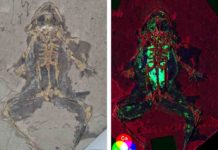
    Fig. 1. 10 million-year-old fossil frog from Libros, Spain and X-ray map showing elevated levels of copper and zinc in the internal organs. Fossil photograph copyright the Natural History Museum, London. X-ray fluorescence map. Credit: Valentina Rossi

    Scientists discover new way to reconstruct what extinct animals looked like

    Mukawaryu

    Japan’s largest complete dinosaur skeleton comes to life

    Facebook Instagram Linkedin TikTok X Youtube
    • Privacy Policy
    • Advertising
    • Contribute
    • FAQs
    © 2011-2026. All Rights Reserved.